
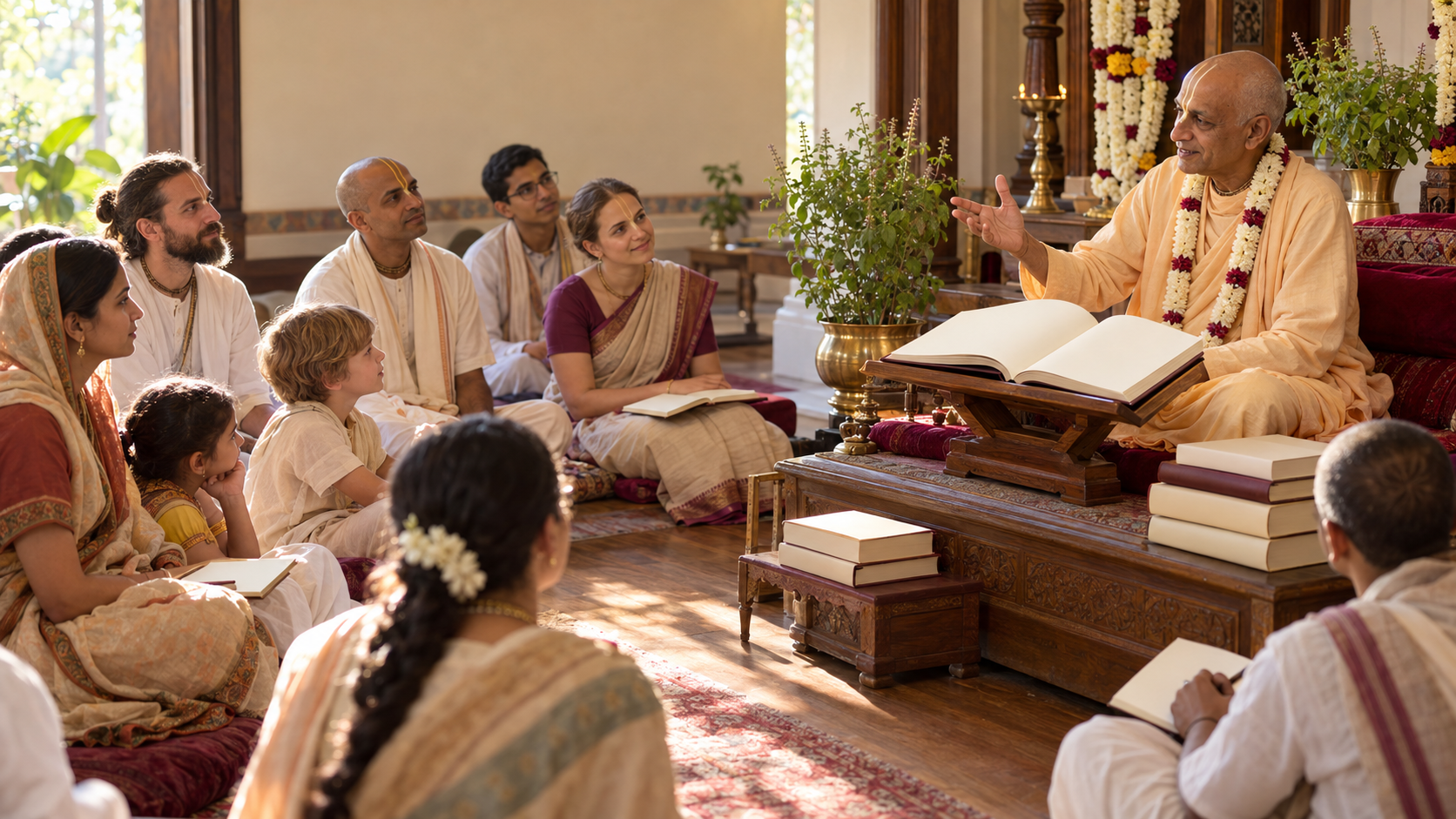
You may want to honour ISKCON’s sixtieth year but need more than an anniversary slogan. You need a way to hear Srimad-Bhagavatam so that a class changes what you notice, remember, and do.
Start smaller than a grand pledge: choose one passage, keep one reliable time for hearing, and write one application you can test. The anniversary becomes meaningful when it strengthens a practice capable of surviving the celebration.
An anniversary should renew transmission, not only memory
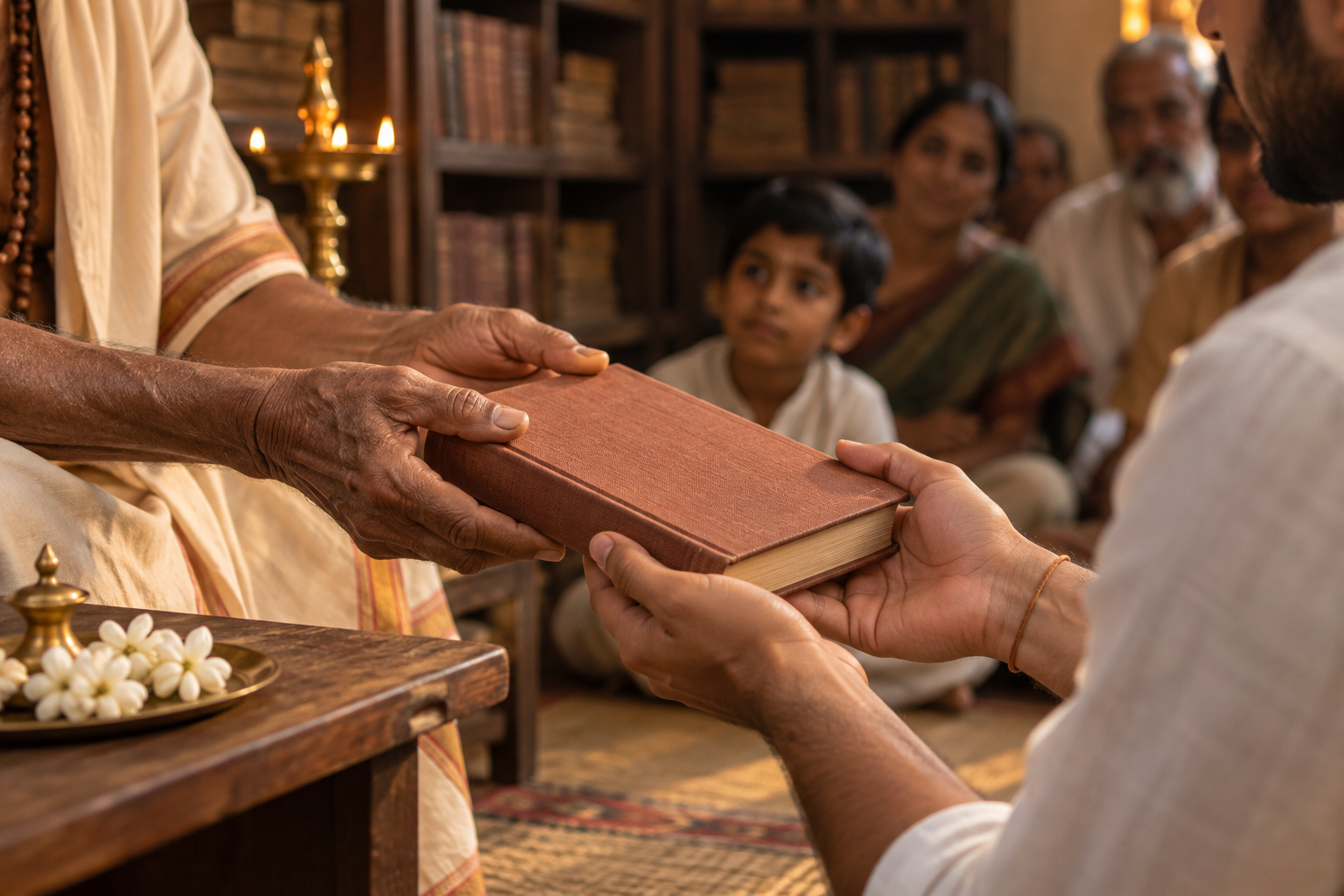
Commemoration can easily become passive. We watch a programme, appreciate the speaker, share a photograph, and move on. Scripture asks more of us. It has to pass from page to voice, from voice to understanding, and from understanding to conduct.
The anniversary year is already placing that transmission in more than one setting. A 2026 Houli retreat centred a session with Srutakirti Prabhu on Srimad-Bhagavatam 6.1.17. An 18 October 2026 morning class with Keshava Swami took up Srimad-Bhagavatam 10.12.18. One belongs to an anniversary retreat; the other belongs to the ordinary discipline of morning instruction.
That difference gives you a useful rule: do not wait for a major festival, a celebrated speaker, or a favourite verse. Let special gatherings renew your intention, but let an ordinary recurring class carry it. A movement’s longevity is not secured by remembering that it has lasted sixty years. It is secured when people can still receive, explain, and live its teachings.
Choose the next class you can realistically attend or hear. Read its assigned passage beforehand and return to your notes afterward. A recording saved for later is only stored content; it becomes part of your sadhana when you give it sustained attention and allow it to correct something in your life.
Keep the passage, teaching, and application distinct

A reference such as 6.1.17 or 10.12.18 is not a caption. It is the address of the teaching. Write the full reference at the top of your page before taking any other notes. This simple habit keeps a memorable illustration or emphatic remark from floating free of the passage being explained.
Then read in clearly marked layers:
- Read the verse and translation carefully. Identify what the passage itself states before deciding what it means for you.
- Read the neighbouring verses. Note who is speaking, what question or event precedes the verse, and what follows it.
- Listen for the teacher’s reasoning. Record how the explanation moves from the passage to a doctrinal point, an illustration, or practical counsel.
- Add your own application last and label it as your application. Do not silently place your conclusion inside the scripture or attribute it to the teacher.
This separation is not cold academic analysis. It is a form of respect. The text deserves to be heard accurately, the teacher deserves to be represented fairly, and your own response deserves honest examination. Reverence and precision reinforce each other.
If a Sanskrit term is unfamiliar, write it down rather than guessing from its sound. Check the spelling and meaning in the edition or glossary you are using, or ask a focused question after class. If an explanation is unclear, frame the question around the passage: “How does this conclusion follow from 6.1.17?” is more useful than a general challenge or a vague request to say everything again.
This method also helps when two teachers emphasise different aspects of a text. Difference of emphasis is not automatically contradiction. Return first to the verse, its immediate context, and the chain of reasoning. You can then see whether the teachers differ over meaning, application, audience, or merely the examples they chose.
Turn each class into a complete practice
Devotional hearing becomes durable when the class has a beginning before the speaker starts and an ending after the speaker stops. Treat preparation, attention, and application as one practice.
Before the class: arrive with the passage in mind
Read the assigned verse and at least one neighbouring verse on either side. Underline repeated names, terms, actions, or contrasts. Write one genuine question. Do not try to manufacture a profound question; identify the first point at which you lose the argument, the narrative sequence, or the connection between the words and their proposed meaning.
Preparation changes the quality of hearing. Instead of spending the opening portion discovering where you are in the text, you can notice how the teacher reads it. You will also recognise when an explanation answers your question and when the question remains open.
During the class: capture structure, not every sentence
Trying to transcribe everything usually leaves you with many words and little shape. Listen for three things: the principal claim, the textual or logical support offered for it, and the consequence for practice. If you are hearing a recording, add a timestamp only beside a point you need to revisit.
Keep illustrations in their proper role. A story can make a principle memorable, but it should not replace the principle or the passage from which it arose. In your notes, place an example beneath the claim it illustrates. If you cannot tell what claim it serves, mark it as a question rather than forcing a connection.
After the class: test what remained
Close the book or recording and write the central point in your own words. Then reopen the passage and check whether your summary still fits it. This exposes the difference between what was actually taught and what you merely found interesting.
Finish with one observable action. “I will remember this teaching” cannot be tested. “Before I open messages or news tomorrow, I will read the assigned verse and write its main claim in one sentence” can. The action need not be dramatic. It needs a clear occasion, a visible behaviour, and a point at which you can honestly say whether you did it.
If you organise a group, send the passage reference before the meeting. Begin by hearing the verse rather than with a long introduction. At the end, invite each participant to name either one application or one unresolved textual question. Do not pressure people into public confession; the purpose is disciplined hearing, not a performance of intimacy.
Use the sixtieth year for a sixty-day discipline

A sixtieth anniversary offers a natural frame for a sixty-day Bhagavatam practice. We would not use those days to race through as much material as possible. Coverage is a poor substitute for assimilation. Follow the sequence taught by your temple, community, or chosen class series so that your private reading and shared hearing support each other.
Keep one continuous record with these fields:
- Date and exact passage reference.
- The passage’s principal statement in your own words.
- The teacher’s central interpretive point.
- One word, connection, or conclusion that needs clarification.
- One action to test before the next entry.
- A brief result: completed, not completed, or revised after further understanding.
On a day without a class, reread the previous passage and resolve one open question, or prepare the next assigned verse. If you miss a day, resume with the next one instead of trying to compensate through hurried listening. The purpose is to establish a truthful rhythm, not to preserve an impressive streak.
At the end of the sixty days, do not judge the practice by the number of pages filled. Ask whether you can locate the passages you studied, distinguish the text from the teacher’s explanation and your response, name a point that corrected your earlier understanding, and identify a habit that continued beyond its first attempt. Those are signs that hearing has become learning.
Keep the part of the routine that carried the most weight. For one person that may be preparation before class; for another it may be the written application or the return to an unresolved question. The anniversary provides the occasion. Repetition turns that occasion into abhyasa, sustained practice.
Key takeaways
- Honour the anniversary by strengthening a repeatable practice of hearing, not by consuming commemorative material alone.
- Write and preserve the exact verse reference so that memorable remarks remain connected to scripture.
- Separate what the passage states, how the teacher explains it, and how you choose to apply it.
- Prepare before a class, capture its reasoning while listening, and test one observable action afterward.
- Use a sixty-day record to reveal continuity, unanswered questions, and genuine changes in practice.
Choose your next Bhagavatam class now. Put its verse reference at the top of a page, read the surrounding passage before you listen, and leave one blank line for the change you will test afterward. That small page can become a more serious anniversary offering than passive admiration.
References
- Dandavats — 1010-5. SB 6.1.17 (Srutakirti prabhu) ISKCON 60’s.聖典博伽瓦譚 6.1.17(徐茹塔奎悌.帕布。慶祝益世康成立60週年. 后里靜修營. 2026十月.
- Dandavats — Morning Class SB 10.12.18 – HH SB Keshava Swami – 18 October 2026

Leave a Reply
You must be logged in to post a comment.