

You may have a Bhagavatam class open in one tab, a Chaitanya-charitamrita passage in another, and the name of a saint you mean to learn about later. The difficulty is rarely a lack of devotional material. It is knowing how to turn that material into a coherent path.
A workable Gaudiya Vaishnava routine joins three things: scripture gives direction, saints show what that direction looks like in a life, and devotional practice turns what you heard into service. If one is missing, study can become dry, admiration can become personality worship, or practice can become mechanical.
Keep scripture, saintly example and practice connected
These three supports have distinct functions. Scripture supplies the language and theological frame through which you understand Bhagavan, the jiva, devotion and the purpose of human life. Saints demonstrate how devotion orders attention, conduct and service. Practice trains you to remember and act on what you have understood.
You can see this range within ordinary Gaudiya teaching: a class may concentrate on CC Adi Lila 5.100-101, another may take up Srimad Bhagavatam 1.8.32, remembrance may centre on Sri Kasisvara Pandit as a devoted servant of Sri Chaitanya Mahaprabhu, and seasonal hearing may take the form of Kartik katha from Vrindavan. These are not interchangeable kinds of engagement. One trains close reading, one opens another scriptural setting, one presents devotion through character, and one places hearing within a sacred season and place.
Key takeaways
- Read the named passage before listening to an explanation of it.
- Keep the scriptural words, the teacher’s interpretation and your own application in separate mental compartments.
- Study a saint by identifying the form of service that defined the saint’s life, not by collecting extraordinary details.
- End every period of hearing with one modest devotional action you can actually complete.
- Use sacred seasons and places to deepen steadiness, not to replace it.
Read a verse closely without losing its setting

A passage reference is a location, not an interpretation. “SB 1.8.32” points you to a verse in the Srimad Bhagavatam. “CC Adi Lila 5.100-101” points you to verses in the Adi-lila of the Chaitanya-charitamrita. The code helps you return to the text, compare explanations and notice whether a teaching remains anchored to the passage.
Do not begin by asking, “What does this mean for me?” Begin by asking, “What is happening here?” Personal application becomes more reliable after you have identified the speaker, listener, setting and immediate subject.
- Locate the passage. Read it in a trusted edition, then read enough of the surrounding section to understand why it appears there.
- Identify the voices. Note who is speaking, who is being addressed and what question, event or prayer gives the words their force.
- State the textual claim. Write one plain sentence describing what the passage actually affirms. Avoid devotional embellishment at this stage.
- Separate the layers. Mark what comes directly from the text, what comes from the teacher’s explanation and what arises as your own reflection.
- Choose an application. Ask what the passage changes in your hearing, remembrance, speech, worship or service.
If you are working with the morning class on SB 1.8.32, keep the text open while you listen. Pause when the explanation moves beyond the verse and note the connection being made. Apply the same discipline to the class on CC Adi Lila 5.100-101. This does not make your hearing suspicious or adversarial. It makes it attentive.
Your notes should be short enough to revisit. A useful entry needs only the reference, the textual claim, one point of explanation, one question and one practice. Copying an entire discourse often creates pages you never read again.
Approach saints through the service that formed them
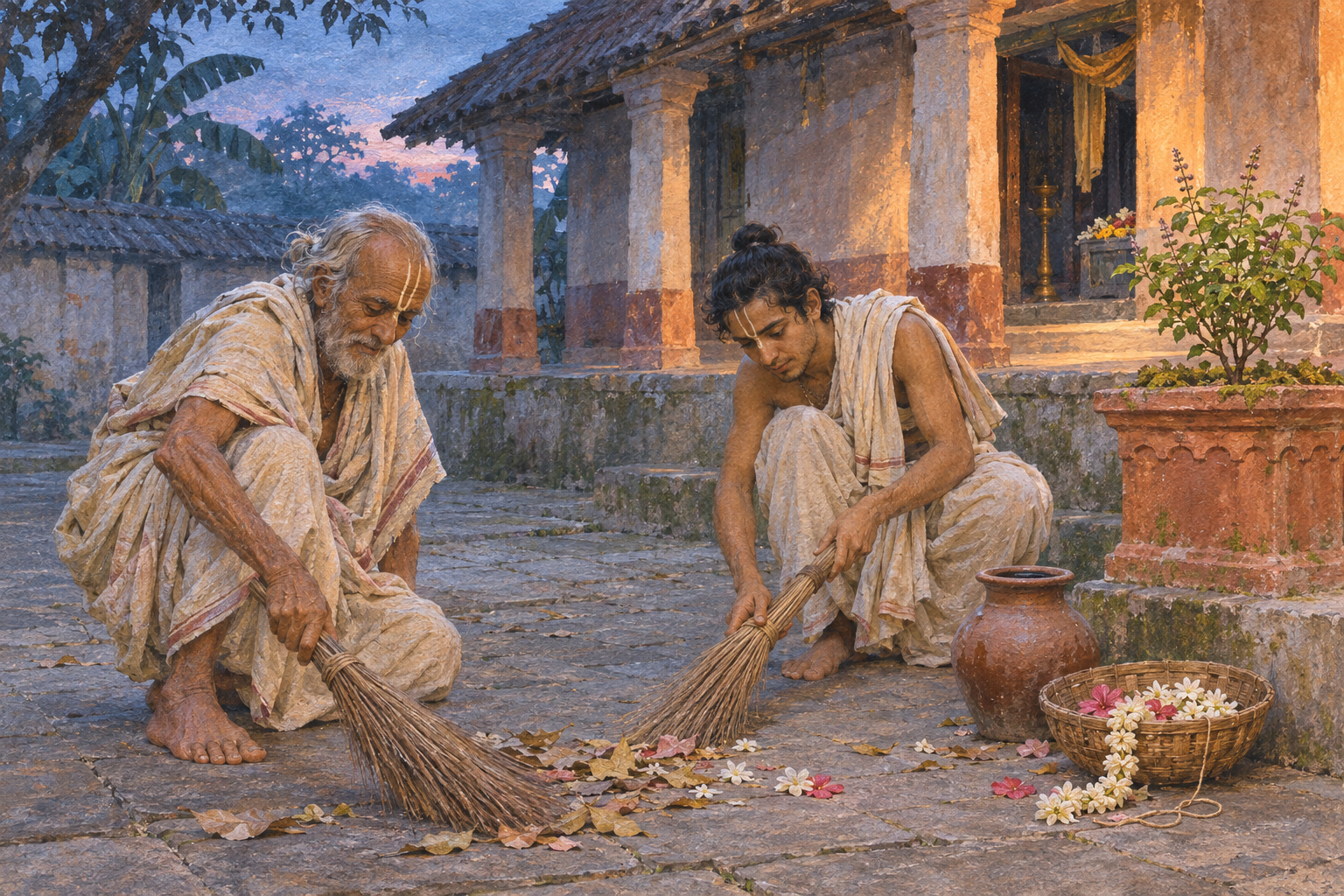
It is easy to treat the saints as a gallery of impressive personalities. Gaudiya remembrance asks for something more demanding: notice how a life became organised around service. Sri Kasisvara Pandit is remembered as a devoted servant of Sri Chaitanya Mahaprabhu. That description directs your attention away from self-display and toward relationship, duty and fidelity.
Use four questions whenever you study a Vaishnava saint:
- Whom did this person serve?
- What form did that service take?
- Which disposition made the service devotional rather than merely efficient?
- What ordinary act in your present responsibilities could embody the same disposition?
The final question prevents biography from remaining remote. You may not share a saint’s circumstances, but you can examine whether your own service is dependable, attentive and free from the need to be noticed.
Resist filling gaps with attractive details. If the account in front of you does not establish a biographical claim, leave it unconfirmed and consult a reliable edition or lineage-based reference before repeating it. Reverence does not require invention. Careful speech is itself part of honouring the Vaishnavas.
Turn hearing into a repeatable devotional loop
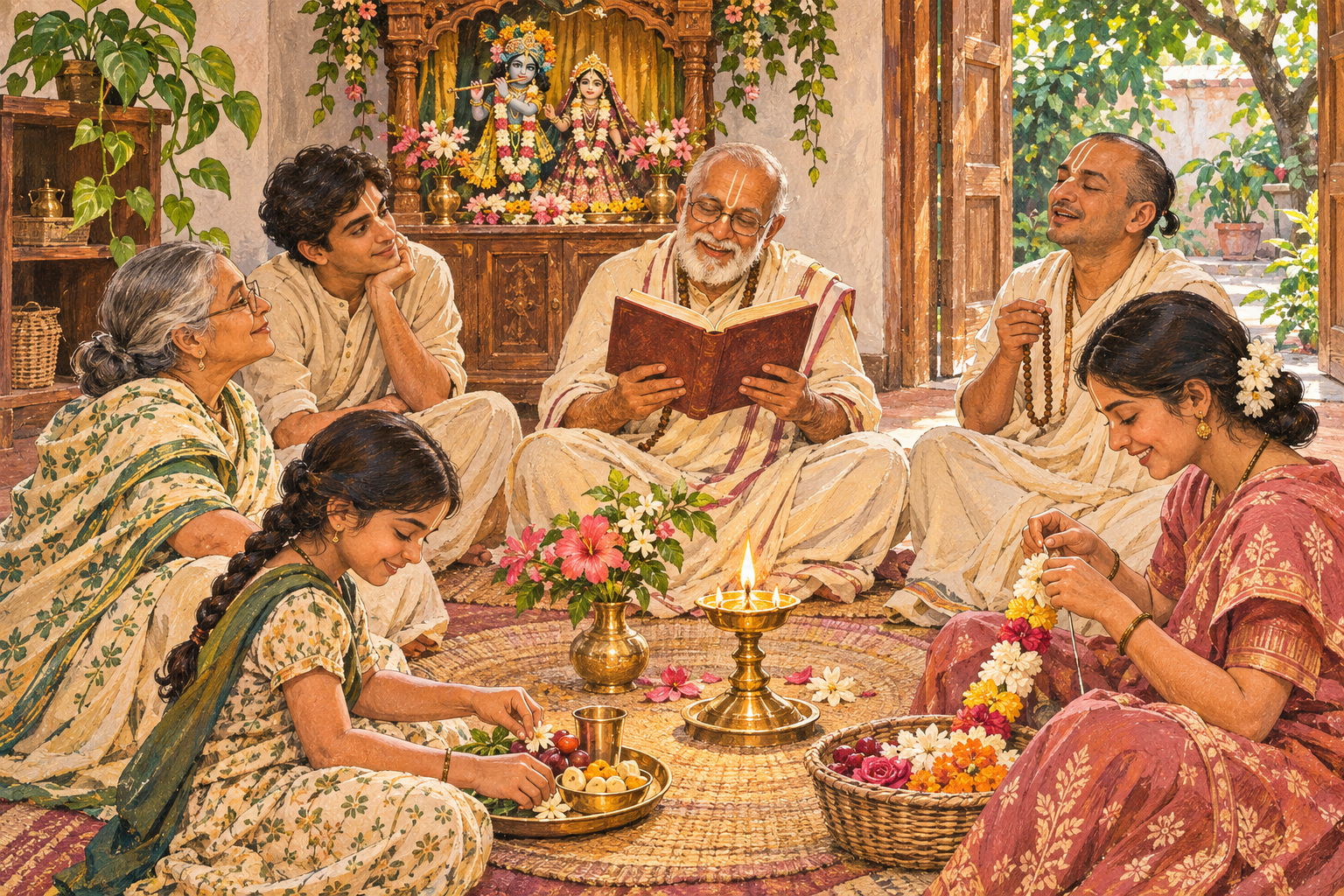
Devotional media can produce the feeling of engagement without changing what you remember or do. The remedy is not to consume more. It is to close the loop between hearing and service.
- Hear or read one coherent unit. Stay with the named passage or the saintly quality under consideration.
- Recall it without looking. Put the central point into your own words. If you cannot do that, return to the passage rather than moving on.
- Bring it into remembrance. Let the lesson inform your chanting, prayer or contemplation instead of keeping study and worship in separate compartments.
- Attach it to service. Select a concrete act: speak more carefully, complete a neglected duty, assist another devotee, prepare for worship or revisit the text with greater attention.
- Review the result. Ask whether the lesson made your conduct more attentive and service-oriented. If not, make the next application smaller and more precise.
Kartik offers a natural setting for intensified hearing and remembrance. A Kartik discourse presented from Vrindavan can help focus the mind on sacred time and place. Yet the value of that hearing is tested after the stream ends. Retain one teaching, connect it to one practice and carry it into the next ordinary day.
This approach also protects household practice from an all-or-nothing mentality. You do not need to imitate a temple schedule you cannot sustain. You need a faithful rhythm in which study feeds remembrance and remembrance feeds service within the duties you actually have.
Choose instruction by checking what it asks you to notice
A familiar speaker, sacred location or devotional title can encourage you to listen, but none of these removes your responsibility to listen carefully. Before you build a conclusion around a class, ask a few direct questions.
- Is an exact scriptural passage identified so that you can read it yourself?
- Can you tell when the teacher is quoting, paraphrasing, interpreting or applying?
- Does the explanation preserve the immediate context of the verse?
- Does a saint’s biography direct attention toward service, or mainly toward marvel and status?
- Does the instruction leave you with a practicable devotional responsibility?
- Can you distinguish a firmly supported claim from an inference or a tradition-specific explanation?
These checks are compatible with humility. Humility is not pretending that every statement has the same authority. Scripture, commentary, oral instruction and personal reflection can all contribute to devotional life, but they do not become identical merely because they appear in the same class.
Begin with one passage, one saintly quality and one service

For your next study period, choose either a Bhagavatam passage or a Chaitanya-charitamrita passage. Read it before hearing the class. Write its central claim in plain language. Then take one saintly quality – Sri Kasisvara Pandit’s devoted service is a clear starting point – and ask how that quality should shape one responsibility already in front of you.
Return to the same note after you have acted. That return is important: it reveals whether you understood the teaching well enough to live by it. Once this small cycle becomes steady, expand your reading. Let depth establish the habit before quantity enlarges it.
References
- Dandavats – Kartik Katha 21 / LIVE FROM VRINDAVAN, 2026
- Dandavats – Sri Kasisvara Pandit | The Devoted Servant of Sri Chaitanya Mahaprabhu
- Dandavats – His Holiness Candramauli Swami Maharaj || CC Adi Lila 05.100-101 || 23-11-2026
- Dandavats – Wyndham Hare Krishna Morning Class – SB 1.8.32 – HG Bhakta Prabhu – 22 Nov 2026

Leave a Reply
You must be logged in to post a comment.