

You may be trying to decide whether a political leader, temple trustee, community organiser, or institutional head deserves your support. Invoking dharma is easy. The difficult question is whether the person’s conduct actually sustains it.
Puranic narratives give you a practical way to make that judgement. The Haryashvas test knowledge before authority. Prithu tests stewardship and legitimacy. Trishanku tests ambition against moral limits. Read in that sequence, their stories become an audit of leadership rather than a collection of royal legends.
Cosmic order is more demanding than political stability
A society can look orderly while moving away from dharma. Obedience may be produced by fear. Prosperity may be produced by exhausting the land. Impressive projects may conceal a leader’s refusal to accept counsel. Stability alone, therefore, cannot prove righteous rule.
The Puranic imagination approaches disorder through relationships: the ruler’s relationship with knowledge, the counsellor, the community, the natural world, and the limits built into existence. Its leadership crises arise when one of those relationships is broken. Vena’s departure from dharma creates a political and moral rupture. The Haryashvas are asked to understand the world before attempting to govern or populate it. Trishanku pursues an extraordinary objective after legitimate counsel has refused to sanction it.
These are three different dangers: authority without righteousness, action without understanding, and aspiration without restraint. You can see them in a kingdom, but also in a family, religious institution, business, or voluntary organisation. Scale changes the consequences; it doesn’t change the moral structure.
When someone uses sacred language to justify power, translate that language into observable duties. Ask what the person has learned, what limits the person accepts, how correction is received, and what happens to the people and resources under that person’s care. A claim to dharma that cannot survive those questions is only a claim.
Three Puranic tests separate service from the pursuit of power
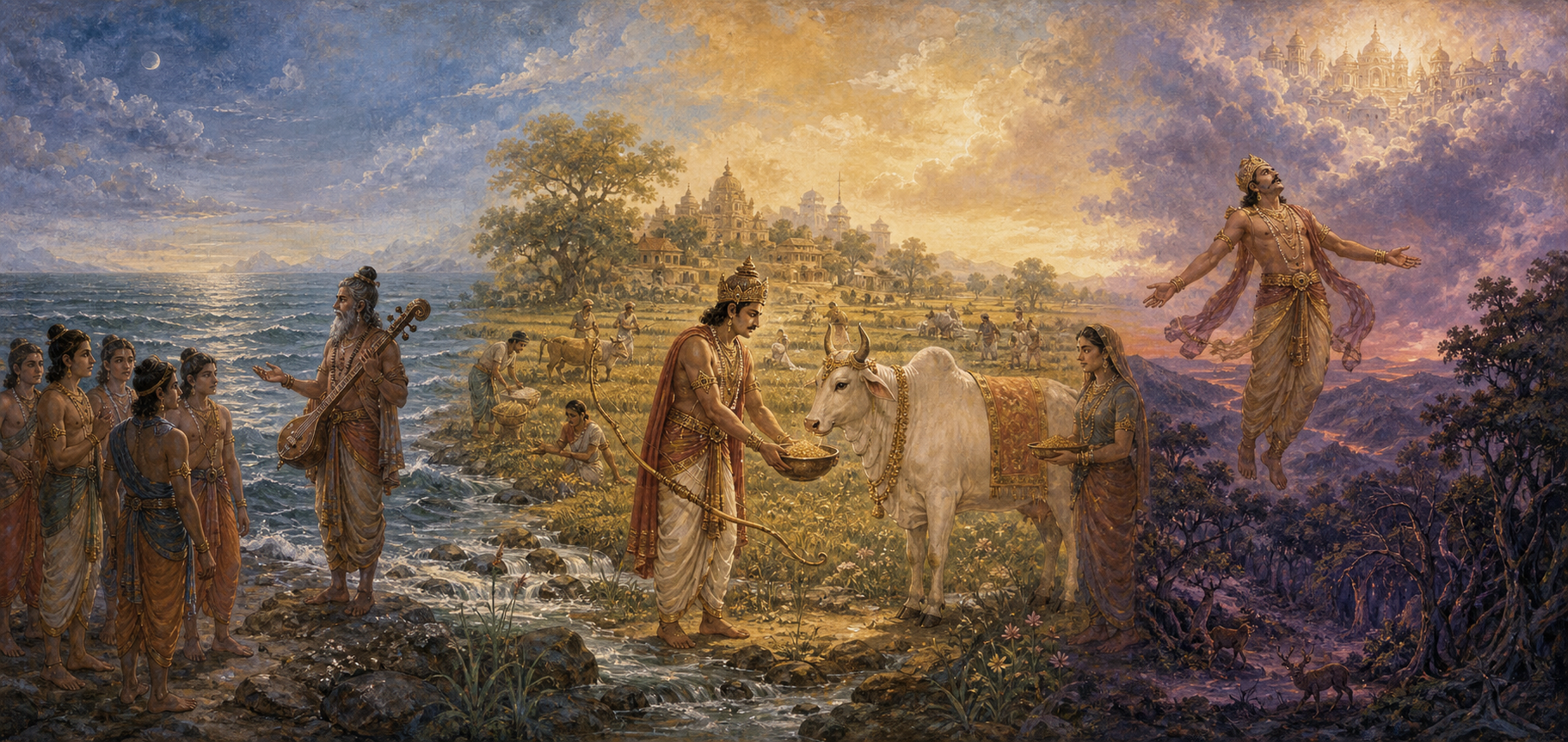
The Haryashvas: know the realm before trying to direct it
Daksha and Asikli bring forth five thousand sons, the Haryashvas, with an immense creative responsibility before them. Narada interrupts their momentum with a foundational challenge: how can they undertake responsibility for a world they haven’t understood? They leave to investigate existence and do not return to the role originally intended for them. The Shabalashvas later follow a similar course after encountering the same demand for inquiry. Knowledge is placed before expansion and reflection before authority.
The lesson isn’t that leadership requires perfect knowledge. No finite person can possess that. It is that responsibility begins with an honest map of the realm: its extent, its inhabitants, its interdependence, and the leader’s own ignorance. Urgency doesn’t cancel this obligation.
Before you entrust someone with authority, ask for four concrete things: what falls within the person’s duty, who will bear the effects of the proposed action, what remains unknown, and what must not be sacrificed to obtain the desired result. A leader who can describe only the goal, but not the realm or the unknowns, is still standing before Narada’s question.
Prithu: legitimacy appears as reciprocal flourishing
Prithu enters the narrative after failed rule, not as the beneficiary of an uncomplicated succession. Anga is remembered as righteous, but his son Vena becomes unruly. Sages intervene in the resulting crisis and bring forth Prithu as a ruler aligned with rajadharma. Under his just rule, the Earth responds with abundance and, within the sacred account, receives the name Prithvi. Rivers and oceans assemble for Prithu’s abhisheka, making the living landscape a participant in the recognition of authority.
This image reverses a common political assumption. The king isn’t presented as the solitary source of order. His authority becomes meaningful because human counsel, sacred duty, water, land, and collective welfare come into alignment. Sovereignty is relational. The world under the ruler’s care is not merely material to be commanded.
You need not turn the symbolism into a simplistic promise that every ethical ruler will produce immediate material abundance. The more reliable test is whether leadership preserves the conditions from which shared life can continue. A short-term gain created by depletion, humiliation, or concealed damage doesn’t resemble Prithu’s pattern merely because it is called development.
Look beyond a leader’s announcements. Examine the direction of the relationships under that leader’s care. Are resources being renewed or merely consumed? Can institutions perform their proper duties? Are communities treated as participants in a common order or as instruments of one person’s prestige? Prithu’s consecration asks whether the wider realm can recognise the ruler’s service, not whether the ruler can stage recognition.
Trishanku: capability does not erase a rightful limit
Trishanku wants to ascend to svarga in his mortal body. Vashishtha refuses to authorise a rite that would violate the order of nature. Trishanku then seeks Vishvamitra’s help. When the gods reject the ascent and cast him down, Vishvamitra arrests the fall and creates a parallel firmament, leaving Trishanku suspended between earth and heaven. The resulting Trishanku Swarga is an in-between condition, not a simple victory over every boundary.
The crucial distinction is between having the power to produce an outcome and having moral warrant to pursue it. Extraordinary resolve produces an extraordinary result, yet the original contradiction remains visible. Neither technical capacity nor intense desire settles the question of legitimacy.
Apply this test whenever a leader describes an accepted limit as an obstacle that exceptional people should be allowed to bypass. Identify the boundary before debating the grandeur of the goal. Ask why it exists, whom it protects, and whether the proposed exception would be defensible if an opponent requested it. If the argument works only when one favoured person stands above the rule, you are looking at the Trishanku problem.
A six-question audit makes rajadharma observable

You can use the three narratives before voting, endorsing a community appointment, joining an institution, or approving a major organisational decision. Write down the answers rather than relying on a general impression of the person.
- What is the actual duty? State the office’s responsibility in plain language. If the discussion begins with the candidate’s greatness rather than the work to be done, restore the proper order.
- What does the person understand about the realm? Look for knowledge of affected people, institutions, resources, dependencies, and acknowledged unknowns. This is the Haryashva test.
- Who is permitted to offer correction? Name the counsellor, process, or body able to say that a proposal violates duty. Advice that can be ignored without explanation is decoration, not counsel.
- What limit will the leader accept? Ask for an example of a desired result that should still be refused because the means are wrong. This exposes whether restraint is a principle or merely a word used against rivals.
- What flourishes, and what quietly pays the cost? Trace consequences beyond the first visible success. Include communities, institutions, land, water, and the future ability of others to perform their duties. This is the Prithu test.
- How is legitimacy recognised? Distinguish voluntary cooperation and durable trust from spectacle, compelled praise, or personal control. Consecration in the Puranic model follows alignment with dharma; it doesn’t manufacture that alignment.
Judge the sequence as carefully as the answers. Inquiry should precede expansion. Counsel should be heard before an irreversible commitment. Limits should be identified before ambition makes every objection look disloyal. Consequences should be assessed before applause is mistaken for legitimacy.
This audit also prevents two opposite mistakes. Charisma doesn’t prove dharma, but one imperfect outcome doesn’t by itself prove adharma. The stronger judgement rests on a pattern: whether the leader seeks understanding, remains correctable, accepts rightful restraint, and preserves the larger order entrusted to them.
A shared Dharmic conversation need not erase differences

These narratives arise within Hindu sacred tradition, and they should remain recognisably Hindu when discussed. Their moral questions can nevertheless support conversation across the broader Dharmic family without pretending that Hinduism, Buddhism, Jainism, and Sikhism are interchangeable systems.
Trishanku’s predicament can be examined through the danger of craving, the discipline of self-restraint, and humility before an order larger than the ego. Buddhist concern with craving, Jain emphasis on restraint, and Sikh humility before hukam don’t turn the traditions into copies of one another. They reveal a useful family resemblance: elevation that enlarges ego while escaping ethical discipline is not genuine spiritual progress.
Prithu’s relationship with Earth and the waters similarly opens a discussion about stewardship, while Narada’s challenge opens one about intellectual humility. The diverse beings associated with Daksha’s lineage belong to one cosmic family, even when their tendencies and roles differ. Unity here doesn’t mean sameness. It means that power must account for a world populated by beings who aren’t extensions of the ruler.
When a Hindu, Buddhist, Jain, and Sikh community must deliberate together, begin with shared moral questions rather than a forced merger of doctrine. Is ego driving the project? What harm may be displaced onto others? Has disciplined inquiry preceded action? Does the decision protect the conditions of collective welfare? Each tradition can answer in its own vocabulary while still contributing to a common ethical judgement.
Key takeaways
- The Haryashvas establish knowledge of the realm as a condition of responsible authority.
- Prithu represents legitimacy recognised through just stewardship and reciprocal flourishing, not self-assertion alone.
- Trishanku shows why extraordinary ability cannot convert every desire into a rightful objective.
- Cosmic order is not the same as quiet streets, institutional obedience, material output, or public spectacle.
- A credible leader can name the duty, the unknowns, the corrective counsel, the non-negotiable limit, and the wider cost of action.
- Shared Dharmic ethics are most useful when they support common questions without erasing doctrinal differences.
The next time someone asks for authority in the name of dharma, don’t begin by asking whether you admire the person. Begin with the realm, the duty, the counsellor, the limit, and the consequences. Put the six questions in writing and require specific answers. That small discipline turns Puranic wisdom into a standard you can actually use.
References
- DharmaRenaissance Blog — When Rivers and Oceans Crowned a King: Prithu’s Epic Anointing in Brahma Purana
- DharmaRenaissance Blog — Daksha’s Lineage Unveiled: How Haryashvas, Devas, and Asuras Arise in the Puranas
- DharmaRenaissance Blog — Trishanku Katha: A Riveting Tale of Ambition, Dharma, and the Birth of a Parallel Heaven
