

You may read the Bhagavatam regularly yet still wonder what the Caitanya-caritamrta adds. Or you may open the Caitanya-caritamrta and feel that its theology assumes a devotional world you haven’t yet absorbed. You don’t need to choose between them.
For a Gaudiya Vaishnava reader, the most useful approach is to give the texts complementary roles. Let the Bhagavatam form your vision of Bhagavan, the devotee, and their relationship. Let the Caitanya-caritamrta sharpen the theological language and show how that vision is received through Sri Caitanya’s life and teachings. Then test your understanding in conduct, not merely in vocabulary.
Give each text a different job

The Bhagavatam and Caitanya-caritamrta are not interchangeable manuals. They work at different levels, even when they lead the reader toward the same center: loving devotion to Bhagavan.
- Read the Bhagavatam for the revealed world of bhakti. Notice who speaks, who listens, what crisis or longing brings them together, and how their relationship with Bhagavan changes the meaning of the scene. Story, prayer, dialogue, praise, and theological statement must be read in relation to one another.
- Read the Caitanya-caritamrta for Gaudiya theological precision. Watch how it distinguishes Bhagavan, His manifestations and energies, the living being, devotional practice, and devotional relationship. Do not reduce these distinctions to a collection of Sanskrit terms.
- Read both for your own formation. Ask what kind of attention, speech, service, restraint, or humility the passage requires from you. A teaching has not reached its practical destination while it remains only an interesting idea.
This division of labor prevents two common errors. Theology without sustained contact with sacred narrative can become a set of slogans. Narrative without theological discipline can become whatever the reader wants it to mean. The Caitanya-caritamrta gives a Gaudiya interpretive lens; the Bhagavatam gives that lens a vast devotional field in which to operate.
You can practice this paired approach with manageable units rather than trying to master entire books at once. Begin with Srimad Bhagavatam 10.8.51 and Caitanya-caritamrta, Adi-lila 5.59-61. Read the verses in your edition before hearing the associated classes. Your initial notes will reveal what you saw for yourself and what the teacher helped you notice.
Use a disciplined reading cycle

Many misunderstandings begin when a reader jumps from a memorable line to a universal conclusion. Slow the movement from words to doctrine to application. Use the following cycle for any short passage.
- Locate the voice and setting. Write down the speaker, the listener, and the immediate situation. A prayer spoken in dependence, a philosophical explanation, and an intimate exchange do not perform the same function.
- Paraphrase before interpreting. Restate the passage in plain language without adding a lesson. If you cannot do this, you are not yet ready to explain what it teaches.
- Mark the load-bearing terms. Identify words concerning identity, manifestation, energy, devotion, grace, knowledge, or relationship. Keep your edition or translation visible so that you do not silently combine different renderings.
- Record the teaching at distinct levels. Complete three statements: “This teaches that…,” “This asks the devotee to become…,” and “Before my next reading, I will….” The first captures doctrine, the second disposition, and the third practice.
- Hear commentary and revise openly. Note what the speaker establishes from the passage, what comes from a wider Gaudiya framework, and what is practical counsel. Change your notes when the explanation warrants it, but do not erase a genuine question merely because you feel you should already understand.
Keep a visible distinction between the words of the verse, your paraphrase, and the teacher’s interpretation. This is not distrust. It is disciplined hearing. It helps you recognize which conclusion is explicit, which depends on context elsewhere, and which is an application offered for a particular audience.
If you use more than one commentary, identify each commentator’s lineage and purpose before combining explanations. Different Dharmic schools may accept the sacred status of a text while interpreting its metaphysics differently. Even within a lineage, a literal explanation, a theological synthesis, and a devotional meditation can answer different questions without competing with one another.
Keep doctrine, devotional mood, and instruction distinct

A strong reading can hold several registers together without confusing them. Doctrine makes a claim about reality. Devotional mood expresses a relationship with Bhagavan. Practical instruction directs the aspirant’s conduct. Trouble begins when a statement in one register is made to settle a question belonging to another.
- Do not turn humility into an ontological definition. A devotee may speak from profound dependence or self-effacement. First receive the devotional mood; then ask whether the passage is also making a formal claim about the soul’s nature.
- Do not turn description into permission. A divine pastime may reveal intimacy without instructing an unprepared reader to imitate its outward form. Ask what the narrative discloses before asking what you should do.
- Do not use divine agency to excuse negligence. Dependence on grace does not make attention, truthfulness, promised service, or correction unnecessary. Let reliance on Bhagavan reduce pride, not responsibility.
- Do not call every confusion “inconceivable.” Some difficulties come from missing context, an undefined term, or a translation choice. Resolve those first.
Acintya-bheda-abheda, the Gaudiya framework of inconceivable simultaneous oneness and difference, requires precision rather than vagueness. When you invoke it, name what is one, what is different, and in what relation. It does not mean that every pair of claims is simply true in the same sense. Nor should it be used to avoid careful reasoning where the text supplies distinctions.
When two passages appear to disagree, copy the exact propositions instead of arguing from memory. Check their speakers, objects, purposes, and levels of discourse. Ask whether one concerns Bhagavan’s nature while another concerns His relationship with devotees, or whether one offers analysis while another voices devotional absorption. If the tension remains, mark it as unresolved and seek guidance from a teacher grounded in the lineage. Forced certainty teaches less than an honest question.
Turn every reading into observable practice
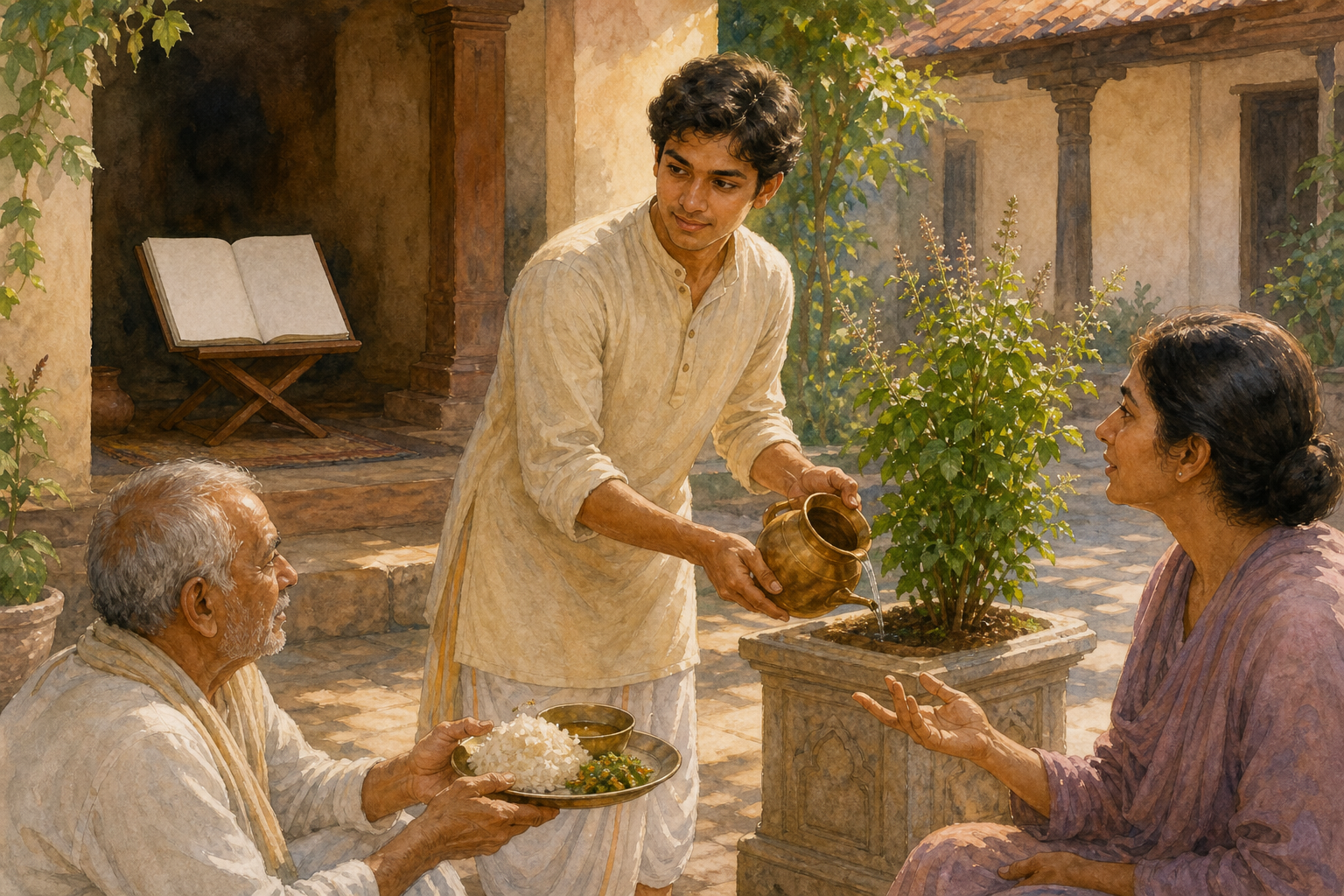
You do not need to manufacture an elevated feeling after every passage. Look instead for a change that can be observed. Has the reading altered how you hear, chant, speak, serve, accept correction, or meet another person? That is a more reliable test than the intensity of the moment.
At the end of a study session, write a compact practice sentence. It should name an action, not an aspiration. “I will become humble” is too vague. “I will hear this correction without composing my defense while the other person speaks” is observable. “I will deepen my devotion” is vague. “I will read and chant without doing a second task at the same time” can actually be practiced.
- If the passage emphasizes hearing, remove the competing task and listen with the text open.
- If it corrects pride, identify the specific defense, comparison, or claim to superiority you need to stop feeding.
- If it concerns service, complete an existing responsibility before creating a dramatic new vow.
- If it makes a philosophical distinction, explain that distinction in plain language without hiding behind Sanskrit terminology.
- If it exposes uncertainty, formulate the question clearly enough to take to a qualified teacher.
Keep the practice small enough to carry until your next reading. Bhakti grows through abhyasa, repeated engagement, not through collecting resolutions that disappear when the devotional mood changes.
A daily Srimad Bhagavatam morning class is listed for 7:30 a.m. The listing does not specify a timezone, so confirm the local schedule before building your routine around it. If you attend or hear a recording, use the class as accountable association rather than as a substitute for opening the passage yourself.
Key takeaways for paired study
- Let the Bhagavatam establish the sacred narrative and relational world of bhakti; let the Caitanya-caritamrta clarify how Gaudiya Vaishnavism understands and lives within that world.
- Identify speaker, listener, setting, and literary function before extracting a universal doctrine.
- Keep the verse, your paraphrase, commentary, and personal application visibly separate in your notes.
- Distinguish metaphysical teaching, devotional mood, and practical instruction instead of forcing every sentence to do all three jobs.
- Use acintya-bheda-abheda precisely: state what is one, what is different, and in which respect.
- End with a modest action that can change your conduct before the next reading.
At your next sitting, work through the linked Bhagavatam verse and Caitanya-caritamrta passage with the same note structure. Do not rush to make one passage prove the other. First let each speak in its own setting; then ask how the Gaudiya theological lens deepens your hearing. Carry the clearest practical instruction into the next part of your day, and carry any unresolved question to someone qualified to help.
References
- Dandavats — Today’s Featured Video: Morning Class SB 10.8.51 – HG Bhakta Prabhu – 9 August 2026
- Dandavats — CC Adi 5.59-61 | HG Prabhupada-priya DD
