
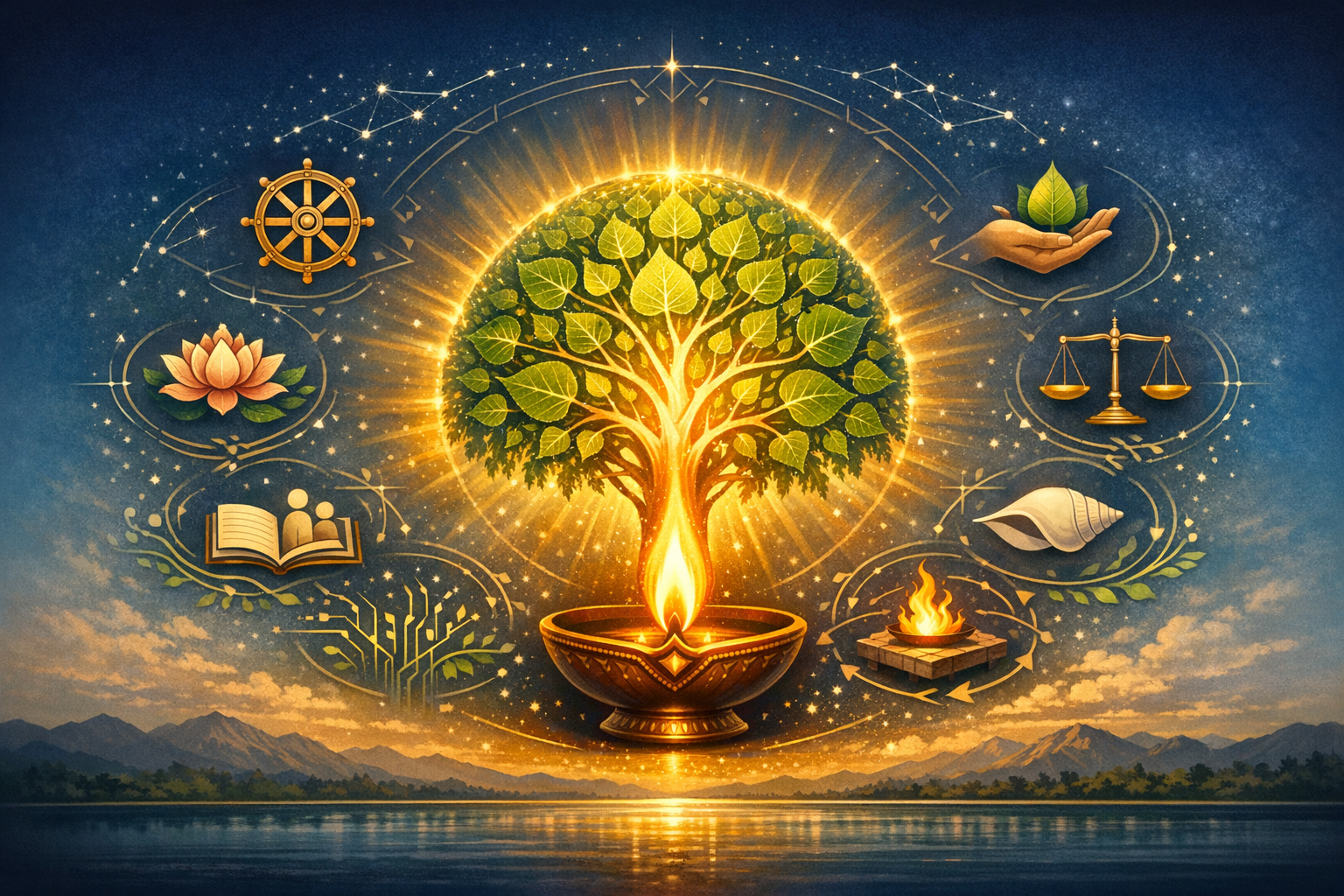
The absence of shared, universal ideals reliably produces moral drift, institutional breakdown, and social stagnation. Hindu wisdom, articulated across the Vedas, Upanishads, Ramayana, Mahabharata, and Puranas, offers a rigorous framework to reverse such decline. These texts present enduring principlesDharma, Ahimsa, Satya, Aparigraha, Seva, and Lokasangrahathat scale from personal conduct to collective governance. Read as a coherent philosophy rather than isolated scriptures, they outline a civilizational architecture designed to transform disorder into resilience and destruction into flourishing.
Universal ideals in Hinduism are not rigid formulas; they are meta-values that enable unity without enforcing uniformity. A foundational Vedic insight, Ekam sat vipra bahudha vadanti, affirms that truth is one, perceived through many lenses. This pluralist stance pairs universality with freedom: standards are common, paths are diverse. The result is a high-trust social ethos where individuals follow distinct margas while sustaining a shared moral horizon.
The Vedas establish Dharma through the interlocking concepts of ṛta (cosmic order), satya (truth), and yajña (reciprocity). Ṛta links inner intention and outer consequence; satya binds speech to reality; yajña encodes mutuality and stewardship. Together they underwrite Vasudhaiva Kutumbakamhumanity as one familycreating an ethic that guides relationships, commerce, and governance while preventing zero-sum rivalry from colonizing public life.
The Upanishads deepen this framework by clarifying the interior sources of universal ethics. Īśāvāsyam idam sarvam asserts the sacred pervasiveness of reality, while tena tyaktena bhunjitha recommends disciplined enjoyment without greed. Sarvam khalvidam brahma and tat tvam asi cultivate empathy by revealing identity-in-connectedness. These insights align strikingly with contemporary sustainability and well-being research: restrained desire, reverence for life, and interdependence produce measurable social and ecological stability.
Upanishadic counsel on discernment is precise. Satyameva jayate prioritizes truth as a public good, and the Katha Upanishad’s contrast of śreya (the good) over preya (the merely pleasant) explains why short-term gratification degrades long-term capability. In psychological terms, these teachings cultivate delayed reward, moral clarity, and pro-social trusttraits repeatedly correlated with high-functioning communities and durable institutions.
The Bhagavad Gita operationalizes these ideals for daily life and leadership. Lokasangraha, the welfare and cohesion of the world, turns ethics outward, specifying the social purpose of personal excellence. Nishkama karma, action without clinging to outcomes, curbs ego-driven volatility while preserving performance. The Gita’s insight that people emulate exemplars (yad yad acarati sresthas) shows why the moral quality of leadership sets the ceiling for societal capacity; absent such anchoring, imitation propagates confusion, not character.
The Gita’s analysis of dispositions (daivi and asuri) further clarifies how norms shape outcomes. Where integrity, compassion, and self-mastery dominate, cooperation and innovation rise; where cruelty, deceit, and excess prevail, social capital collapses. In contemporary systems language, universal ideals function as second-order normsstandards that stabilize other normsthereby preventing tragedies of the commons, endemic corruption, and institutional stalemate.
The Ramayana exemplifies Dharma through maryadaprincipled boundaries that discipline power and protect the vulnerable. Rama’s restraint, fairness, and fidelity to promise illustrate how rule-following, when aligned with compassion, produces legitimacy rather than rigidity. Read as political ethics, rajadharma in the Ramayana shows that order, empathy, and accountability are complementary, not competitive, virtues.
The Mahabharata, with its unflinching complexity, demonstrates the cost of departing from universal ideals. The failure to protect Draupadi, the corrosion of counsel despite Vidura-niti, and the eclipse of justice by expedience all prefigure civilizational crisis. The epic’s repeated refrain that Dharma is subtle is not a plea for relativism; it is a demand for rigorous discernment. Where such discernment lapses, conflict becomes inevitable and pyrrhic victories replace sustainable peace.
Puranic narratives recast the same teaching at a civilizational scale. Yuga cyclesperiods of normative clarity and decaydescribe how cultures periodically forget their anchors and must reconstitute them. Avatara motifs highlight a further principle: restorative intervention is legitimate only insofar as it re-establishes Dharma for all, not dominance for a few. As social allegory, the Puranas insist that regeneration requires ethical renewal, institutional reform, and a re-energized culture of responsibility.
A distinctive strength of the Indic civilizational matrix is that these universal ideals are shared, reinterpreted, and refined across dharmic traditions. Buddhism advances compassion and clarity through the Brahmaviharas and the Noble Eightfold Path; right speech and right action institutionalize truthfulness and non-harm. When communities foreground these practices, polarization diminishes and collective problem-solving improvesoutcomes documented in settings that normalize mindfulness and ethical dialogue.
Jain philosophy contributes method and humility through Anekantavada (non-absolutism) and Syadvada (conditional predication), providing intellectual tools to engage complexity without dogmatism. Its vowsAhimsa, Satya, Asteya, Brahmacharya, Aparigrahatranslate universal ideals into daily disciplines that de-escalate conflict and excess. This is not ethical minimalism; it is ethical precision: harm is reduced at its rootsintention, speech, and actionbefore it can mature into structural violence.
Sikh Dharma synthesizes devotion, dignity, and justice through Naam japna, Kirat karni, and Vand chakna, anchored in the aspiration of sarbat da bhala (welfare of all). The Sangat and Langar institutionalize equality and service, converting ideals into repeatable social practice. In governance terms, this is a blueprint for inclusive prosperity: unite spiritual motivation with honest labor and structured generosity to sustain common good.
Taken together, these streams form a shared basin of universal ideals that counter stagnation and prevent destruction. Across Hinduism, Buddhism, Jainism, and Sikhism, the normative core is strikingly convergent: non-harm, truthfulness, disciplined desire, compassion, generosity, self-study, and responsibility to the whole. The universality lies in the principles; the plurality lies in the methods. Such architecture nourishes unity in diversity without sacrificing the creativity that pluralism invites.
Hindu thought secures this balance through Ishtathe recognition that individuals are entitled to choose a form, ideal, or method consonant with their temperament, while honoring the shared moral horizon. This stance, championed in modern times by Swami Vivekananda, transforms potential rivalry into respectful complementarity. Ishta protects freedom of worship and practice while preventing ethical fragmentation; it is the inner guarantee of Unity in Diversity.
Viewed through the lens of systems theory and political economy, universal ideals serve as trust multipliers. They reduce transaction costs, enable credible commitments, and sustain long time horizonsall prerequisites for innovation and high-quality governance. Law can compel compliance, but only shared ideals cultivate willing integrity. Where ideals are absent, enforcement grows expensive and brittle; where ideals are present, cooperation becomes natural and self-correcting.
Classical statecraft complements this moral architecture. Rajadharma, as reflected in the epics and Dharmashastras, binds power to justice and welfare. The Arthasastra’s administrative clarity, when tempered by the Gita’s ethic of restraint and non-attachment, yields a model of capable yet compassionate governance. The point is not antiquarian revival, but principled adaptation: modern institutions flourish when anchored in time-tested universal ideals.
Ecology is an immediate arena for application. Vedic reciprocity reframes environmental stewardship as yajñaa cycle of giving and receiving that sustains life systems. When Aparigraha (non-accumulation) and Ahimsa (non-harm) inform policy and consumption, emissions fall, biodiversity recovers, and intergenerational equity becomes actionable. The ethical language is ancient; the benefits are empirically current.
Technology and data governance likewise benefit from dharmic anchors. Non-harm as a design constraint curbs extractive algorithms; Satya demands transparency and auditability; Seva reorients product roadmaps toward genuine human welfare. The result is a humane digital commons: fewer perverse incentives, better alignment with human dignity, and more resilient public trust.
Education operationalizes universals by shaping character and competence together. Svadhyaya (self-study) encourages reflective learning; the Guru–Shishya ethos models mentorship and accountability. A curriculum that engages the Upanishads, Dhammapada, Acaranga Sutra, and Guru Granth Sahib in comparative dialogue equips students to hold principled pluralismable to reason rigorously, empathize deeply, and collaborate across difference.
In daily life, small disciplines carry systemic consequence. An individual who affirms a simple sankalpado not harm, speak truth, share resources, practice restraint, and reflect dailychanges how families resolve conflict, how teams make decisions, and how communities allocate scarce goods. Over time, the micro accumulates into macro: fewer brittle escalations, more creative solutions, and a culture that prizes dignity over domination.
Consider relatable situations. A workplace that prizes Satya and Lokasangraha sees leaders model transparency and shoulder responsibility; blame cycles recede, and learning accelerates. A neighborhood that normalizes Seva builds robust mutual aid during crises. A family guided by Aparigraha swaps conspicuous consumption for shared experiences, lowering financial stress and elevating well-being. These are not abstractions; they are the predictable fruits of universal ideals applied consistently.
Universal ideals are sometimes mistaken for cultural uniformity. The dharmic record argues the opposite: universality sets the floor; diversity builds the house. Multiple yogas in the Gita, many darshanas in Hindu philosophy, Anekantavada in Jainism, the Buddhist Middle Way, and the Sikh synthesis of devotion and duty all protect plurality while safeguarding common standards. This is principled pluralismnot relativism, not homogenization.
History shows that when norms decay, reformers return culture to its anchors. The Acharyas, the Buddha, Mahavira, and the Sikh Gurus each recontextualized universal ideals for their eras, renewing social purpose and moral clarity. Their legacies demonstrate a repeatable pattern: diagnose adharma, reaffirm the principles that bind, and rebuild institutions that embody them. Regeneration is not spontaneous; it is ethically led and communally enacted.
In the present, unity across dharmic traditions is a strategic and spiritual imperative. Joint study circles, inter-tradition seva projects, shared celebrations, and policy dialogues grounded in Ahimsa, Satya, and Lokasangraha can repair civic tissue frayed by polarization. Such cooperation does not dilute identity; it dignifies it by placing unique strengths in service of the whole.
The thesis, then, is both ancient and urgently contemporary: cultures stagnate and unravel where universal ideals are absent or unheeded; they innovate and flourish where such ideals are interiorized and institutionalized. Hindu wisdomresonant with the insights of Buddhism, Jainism, and Sikhismsupplies the grammar of that flourishing. By realigning life and policy with Dharma, Ahimsa, Satya, Aparigraha, Seva, and Lokasangraha, societies convert moral clarity into human capability. Satyameva jayate is not a slogan; it is a systems guarantee.
Vasudhaiva Kutumbakam offers the fitting benediction and blueprint: one family, many paths, shared ideals. Anchored in this vision, stagnation gives way to purpose, fragmentation yields to solidarity, and the work of regeneration becomes not only possible but inevitable.
Inspired by this post on Hindu Blog.
