
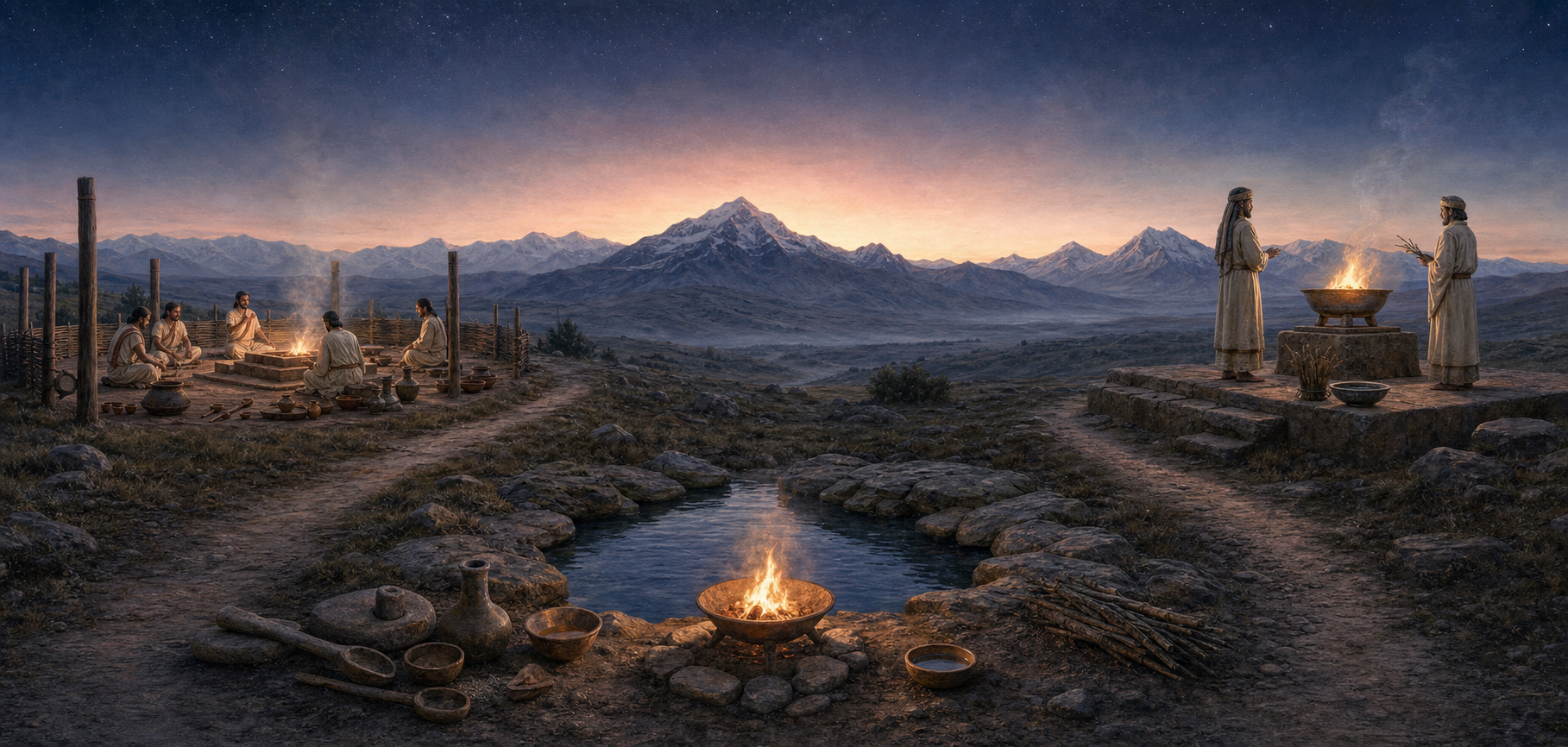
You may have encountered the apparent gotcha: Hindus honour devas, Zoroastrians reject daevas, and the Zoroastrian title ahura is related to the Sanskrit word asura. Does that mean one tradition worships what the other calls demonic?
No. The sound conclusion is narrower and more illuminating. Indo-Aryan and Iranian communities inherited related religious words, then gave those words different moral and ritual roles as their traditions developed. Once you separate the ancestry of a word from the later identity of the being it names, you can read both traditions without reducing either one to a mistranslation, a corruption, or disguised demon worship.
The short answer without a false equivalence
- Deva and daeva share a linguistic root. Sanskrit deva and Avestan daeva descend from Proto-Indo-European *deiwos, associated with brightness and the daylight sky.
- Asura and ahura are also cognates. Their older semantic range involved lordship, might, or extraordinary potency rather than an inherently evil nature.
- The Indian development happened in stages. In the Ṛgveda, asura can be an honourable epithet. In later Vedic and Purāṇic usage, it increasingly names a class opposed to the devas.
- The Iranian development is explicitly theological. The Gāthās reject the daevas as aligned with druj, the Lie, while devotion is centred on Ahura Mazdā and aša, truth and right order.
- The result is a reversal of valuation, not an exchange of complete divine personalities. A Vedic deva is not simply a Zoroastrian daeva with the moral sign changed, and an Avestan ahura cannot be translated mechanically as a later Purāṇic asura.
The practical rule is simple: whenever someone makes a claim about this reversal, ask which language, which textual period, and which theological system the word belongs to. Without those three answers, the comparison is likely to mislead you.
One inherited vocabulary produced two moral maps

The first discipline is to keep etymology and theology in separate columns. Etymology asks where a word came from. Theology asks what a particular community eventually taught about the beings bearing that name. A shared origin answers the first question; it does not settle the second.
| Word relationship | Older semantic range | Later mainstream Indian valuation | Zoroastrian valuation |
|---|---|---|---|
| Sanskrit deva / Avestan daeva | Bright or celestial being, from *deiwos | Deva becomes the normal designation for honoured gods | Daeva designates beings rejected as false or malevolent |
| Sanskrit asura / Avestan ahura | Lordly, mighty, or possessing exceptional potency | Asura moves from a positive or ambivalent epithet toward an adversarial class | Ahura remains an honoured designation, foremost in Ahura Mazdā |
This is why the phrase Indo-Iranian reversal is useful but incomplete. It captures the crossed valuations of two cognate word families. It does not mean that fully formed Hindu and Zoroastrian pantheons once traded places. Each tradition reorganised inherited vocabulary inside its own account of sacrifice, truth, order, worship, and moral responsibility.
The chronology also resists a simple tale of one side reacting to the other. The oldest Ṛgvedic hymns and the Gāthās are commonly placed within broad, partly overlapping windows from the late second to the early first millennium BCE, but their precise dating and sequence remain debated. The linguistic relationship and later divergence are much clearer than any claim about a single moment when the meanings supposedly flipped.
Philology can establish cognacy and trace semantic change. These two word pairs cannot, by themselves, settle a migration chronology, identify one political event as the cause, or prove that one community deliberately corrupted the religion of another. If an argument leaps from the vocabulary to one of those conclusions, it has skipped the evidence that would be needed in between.
How each tradition sharpened its boundary
In the Vedic and Purāṇic world, an epithet became a camp
Early Vedic usage does not yet present asura as the fixed name of a demonic species. Varuṇa and Mitra receive the epithet, and even Agni and Indra can be praised with it. In that setting, the word points toward sovereignty, mysterious power, or commanding might. Importing the later Purāṇic meaning into every Ṛgvedic occurrence produces a false reading.
The semantic field narrowed as Vedic religion gave greater narrative and ritual prominence to deities such as Indra, Agni, and Soma. Conflict myths, including Indra’s defeat of Vṛtra, made the contrast between the devas and their opponents increasingly useful for expressing the defence of cosmic and sacrificial order. A term that had once described a kind of potency gradually became the name of the opposing side.
Purāṇic genealogy then gave that opposition a memorable family structure. Aditi’s sons are the Ādityas, while Diti’s offspring are the Daityas; both lines share the sage Kaśyapa as father. The cosmic rivals are therefore kin. That detail matters because it keeps the conflict from becoming an absolute dualism between two unrelated, eternally separate substances.
You should also treat the explanation of asura as a-sura, or one who does not partake of sura, as later interpretive wordplay. It may communicate a theological point within a particular story, but it cannot explain the older history of the word or its relationship to Avestan ahura. When a modern explanation presents the wordplay as the original etymology, it has confused a living tradition’s reinterpretation with linguistic descent.
In the Gāthic and Avestan world, worship was ethically pruned
The Gāthās draw a deliberate moral boundary around the daevas. They are rejected as beings associated with druj, falsehood and disorder, while Ahura Mazdā, the Wise Lord, stands at the centre of worship aligned with aša, truth and right order. This is not an accidental dictionary change. It is a theological judgement about which powers and practices lead a community toward truth.
Later Avestan tradition maintains that judgement. Daevas remain hostile or deceptive beings, while the Amesha Spentas and the yazatas, those worthy of worship, participate in the ordered sacred world centred on Ahura Mazdā. Even Indra appears among demonised figures, marking a clear break from his honoured place in Vedic worship.
Zarathustra’s rejection of the daevas is often understood as a reformist response to ritual practices he regarded as morally and cosmically mistaken. The exact historical circumstances cannot be recovered merely from the vocabulary, but the theological direction is unmistakable: inherited divine names were judged according to their relationship with truth, right order, and proper worship.
The Indian narrowing of asura and the Iranian rejection of daeva therefore need not have occurred simultaneously, for identical reasons, or as direct retaliation. Both developments show religious boundary-making. Each community selected, criticised, and rearranged parts of a shared inheritance while clarifying its own ritual and ethical grammar.
Shared foundations survive beneath the disagreement

The divergence becomes easier to understand when you notice what did not disappear. Vedic ṛta and Avestan aša both orient religious life toward truth and cosmic order. Sacred fire mediates purity and divine presence in both worlds. Mitra and Mithra retain associations with contracts, trust, and right relations across the linguistic divide. These are strong continuities, although they should be read as resonances within distinct traditions rather than proof that every later doctrine remained identical.
The continuity also explains why the reversal should not be narrated as a crude battle between a religion of good gods and a religion of bad gods. Both sides are asking how human beings align themselves with an order larger than appetite, deceit, and arbitrary power. Their answers developed through different names and ritual structures, but truth, order, fire, and right relationship remain visible across the divide.
Hindu narratives add another safeguard against moral essentialism. Bali can be remembered for generosity and devotion even though he belongs to the Daitya line. Prahlāda’s steadfast bhakti makes him exemplary despite his birth in the house of Hiraṇyakaśipu. During the Samudra Manthan, devas and asuras must labour together before the treasures of the ocean can emerge. Group identity shapes the conflict, but it does not mechanically determine the worth of every individual.
That distinction is deeply Dharmic. Dharma and adharma are disclosed through intention, conduct, discipline, and relationship to truth, not merely through inherited labels. A deva may occupy a high cosmic station without representing final liberation, while someone born among the devas’ adversaries may display devotion or virtue worthy of remembrance.
Buddhist and Jain cosmologies sharpen this point by retaining devas as radiant, long-lived beings who nevertheless remain within saṃsāra. Their celestial status does not free them from conditioned existence. Sikh teaching redirects attention still more decisively toward Ik Onkār, remembrance of the One, and truthful living. Across these Dharmic settings, the useful question is not simply which class possesses a luminous name. It is which way of living leads beyond ignorance, attachment, violence, and falsehood.
The long presence of the Parsi community in Bharat supplies a civic counterpart to that theological lesson. Communities can preserve sharply different sacred vocabularies without turning an ancient semantic reversal into civilisational hostility. Shared life does not require pretending that the doctrines are identical; it requires understanding the difference accurately enough that caricature loses its force.
Use this five-question test on claims about the reversal
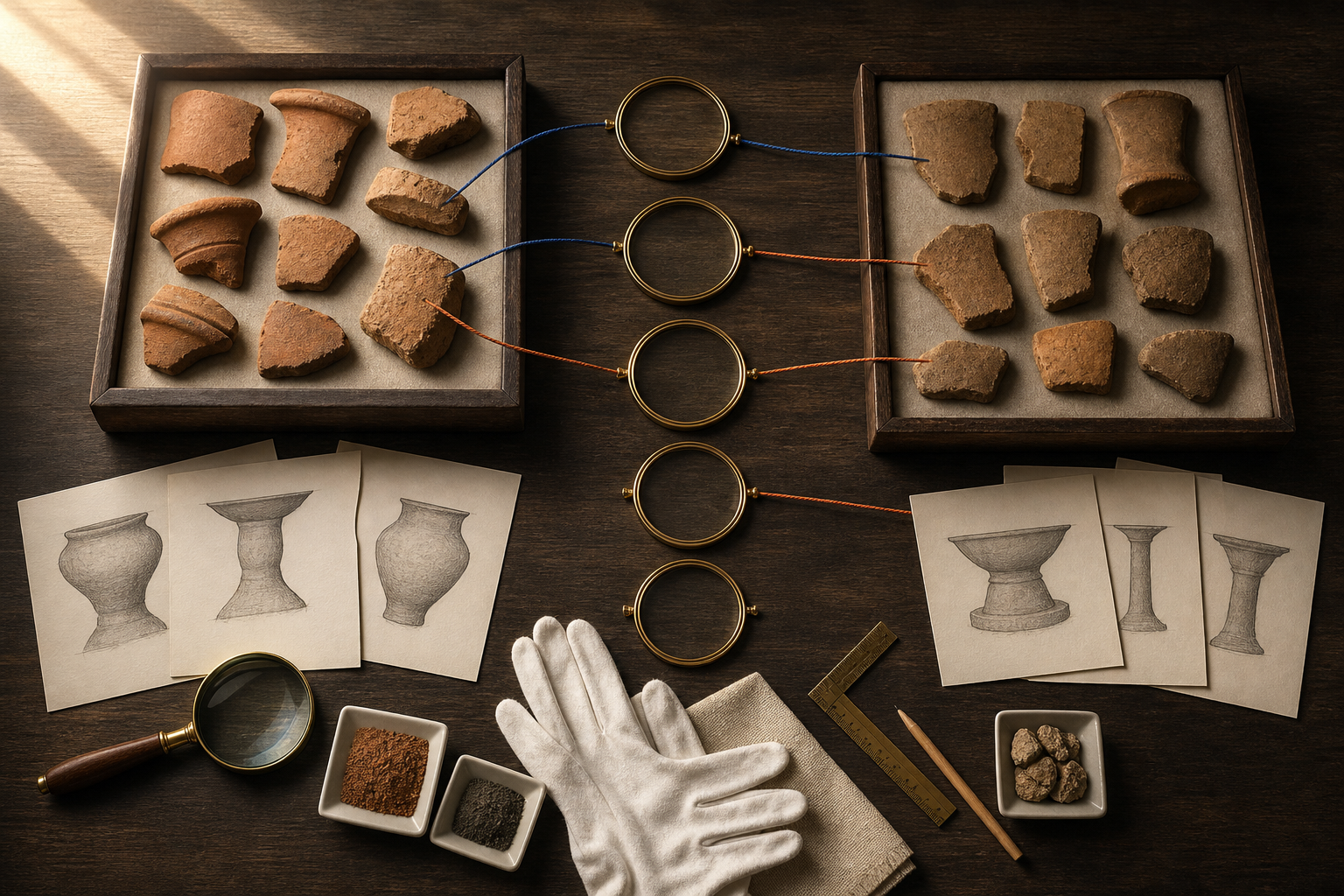
A viral chart can place deva opposite daeva and asura opposite ahura in seconds. Testing what the chart implies takes more care. Work through these questions before accepting its conclusion.
- Which original word is actually present? Record whether the term is Sanskrit deva or asura, or Avestan daeva or ahura. Cognates are historically related; they are not automatically interchangeable translations.
- Which textual layer uses it? Distinguish the Ṛgveda from later Vedic literature and Purāṇic narratives. On the Iranian side, distinguish the Gāthās from later Avestan development. A claim with no textual layer has no reliable chronology.
- What job does the word perform there? It may be an epithet praising sovereignty, the name of a narrative class, a polemical label for rejected beings, or a designation of legitimate lordship. Those functions cannot be collapsed into one timeless definition.
- What is the local moral axis? Look for the surrounding concern: ṛta, sacrifice, divine kingship, bhakti, aša, or opposition to druj. The term receives its theological force from that local structure.
- How far does the evidence permit you to go? The vocabulary supports a shared Indo-Iranian inheritance and later semantic polarisation. By itself, it does not prove that Zoroastrians worship Hindu demons, that Hindus worship rejected Iranian beings, or that one ethnic group merely inverted another’s religion.
Three common claims you can now correct
Claim: Varuṇa is called an asura, so the Vedas call him demonic. This imports a later adversarial meaning into an earlier use where asura could praise sovereign power. The same written form does not guarantee the same semantic value across centuries.
Claim: Zoroastrians worship asuras because they worship Ahura Mazdā. This substitutes the later Sanskrit theology of asura for the Avestan meaning of ahura. The words are cognate, but Ahura Mazdā belongs to a Zoroastrian framework organised around aša and opposition to the daevas.
Claim: Asura originally means a non-drinker of sura. That interpretation is later wordplay. It cannot account for positive Ṛgvedic uses of asura or the corresponding Avestan form ahura.
Correcting these claims does not weaken Hindu categories or erase genuine disagreement with Zoroastrian theology. It protects both traditions from anachronism. Sanātana Dharma does not need a historically inaccurate equation in order to affirm the devas, and respect for the Parsi tradition does not require pretending that its judgement of the daevas matches the Vedic one.
The next time someone presents the reversal as a two-column proof about gods and demons, ask for the exact word, the exact textual layer, its role in that passage, and the moral structure around it. If those details are missing, pause before repeating the claim. Precision is the most useful response: it reveals a shared civilisational ancestry without dissolving the real paths that Indian and Iranian traditions chose.