

Conscious death, in the two scriptural readings considered here, is not a technique reserved for the final breath. It is the culmination of habits formed through duty, renunciation, sacred sound, and a sustained reorientation of attention.
The account of Pṛthu and Arci approaches this threshold through devotion to Kṛṣṇa, while the Nadabindu Upanishad approaches it through Om, inward listening, and knowledge of Brahman. Reading them together clarifies their shared discipline without erasing their different understandings of liberation.
The last thought begins long before the last breath
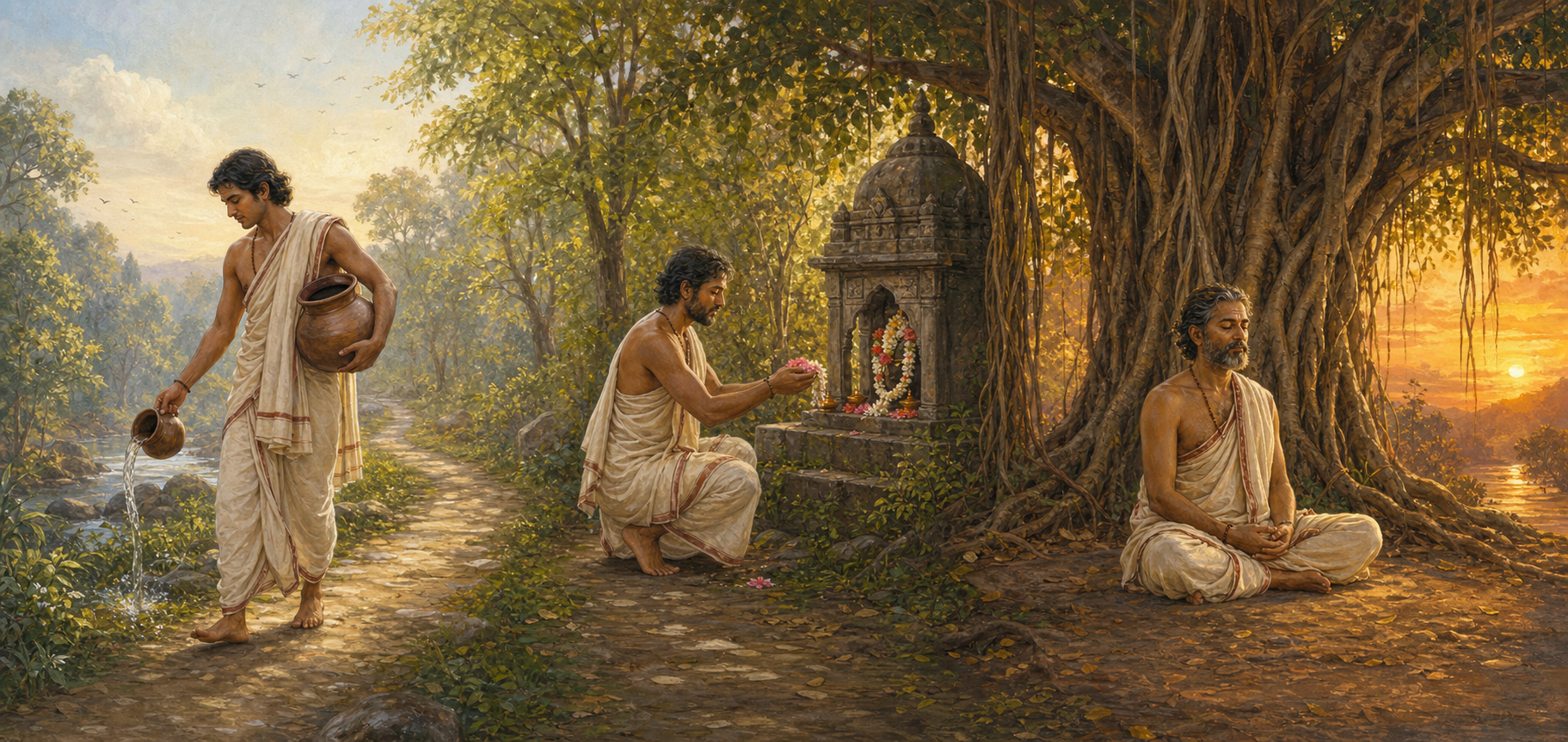
The Bhāgavata reading of Pṛthu and Arci and the study of the Nadabindu Upanishad converge on a central principle: the condition of consciousness at death reflects the direction in which consciousness has repeatedly moved during life. Neither source presents final remembrance as an emergency formula capable of replacing lifelong practice.
According to the Bhāgavata article, Pṛthu first completes the responsibilities of kingship, including protection and public welfare, and only then relinquishes power. Retirement is presented as the next stage of responsible life rather than an escape from unfinished obligations. The ruler who had governed a kingdom turns toward governing his senses, mind, and life air. His final departure therefore completes an integrated arc of service, restraint, yogic concentration, and remembrance of Kṛṣṇa.
The Nadabindu article expresses the same continuity through the language of mental impressions and contemplative training. It reports that the final movement of awareness carries tendencies formed by conduct, attachment, fear, insight, and spiritual discipline. Meditation on Om before death is consequently described as the flowering of established sadhana, not a last-minute attempt to manufacture serenity.
This shared principle gives conscious death a practical meaning. It does not necessarily imply control over the circumstances or timing of death. It means developing a consciousness that has learned where to turn when ordinary supports fall away. The question is less whether a person can produce one ideal final thought than whether remembrance has become habitual enough to arise under pressure.
The account of Arci also shows that spiritual awareness need not eliminate human grief. The Bhāgavata article reports that she laments briefly when Pṛthu ceases to show signs of life and then performs the required rites. Grief is acknowledged, but it does not wholly displace the narrative’s understanding of the soul and the destination of a consciousness absorbed in devotion.
Liberation in two distinct spiritual grammars

The two sources do not define the highest attainment in identical terms. The Bhāgavata article presents Pṛthu’s destination through the personal and relational language of bhakti: attraction to Kṛṣṇa, remembrance of the Lord’s lotus feet, and return to Godhead. It reports that Pṛthu employs yogic and philosophical disciplines, including raising the life air and withdrawing bodily elements into their sources, but places those disciplines under the governing purpose of devotion.
Arci’s destination is likewise interpreted through shared spiritual absorption rather than biological relationship alone. Her companionship matters because it has become a form of consecrated consciousness. Within this devotional framework, liberation is not merely separation from matter; it is the fulfilment of a relationship toward which the mind, speech, and body have been directed.
The Nadabindu article uses a different contemplative map. It describes A, U, and M as parts of Om and the ardhamatra as the subtle measure beyond audible utterance. It also reports a sequence of twelve matras associated with progressively subtler destinations. The early stages include earthly or celestial conditions, while the twelfth, Brahmi, culminates in eternal Brahman. Even elevated worlds are therefore presented as intermediate rather than ultimate.
These accounts should not be flattened into interchangeable terminology. The Pṛthu narrative gives liberation a strongly devotional orientation, whereas the Nadabindu teaching emphasizes absorption, knowledge of the Self, and transcendence of conditioned states. Their agreement lies at another level: temporary achievement, whether earthly or celestial, cannot by itself satisfy the deepest purpose of human consciousness.
This convergence also sharpens each source’s criticism of misdirected ambition. The Bhāgavata article describes exhaustive labor for temporary results as a misuse of rare human opportunity, without condemning responsible work itself. The Nadabindu article extends the scale of that critique by placing even refined heavenly attainments below realization of Brahman. Together they distinguish useful action from the assumption that accumulation, status, or unusual experience equals liberation.
Sacred sound as preparation for release

Sacred sound joins the two approaches, although it functions differently in each. In the Bhāgavata article, the closing phala-śruti commends hearing, reading, chanting, and describing Pṛthu’s life. Narrative remembrance becomes a form of association: sustained attention to responsibility, generosity, restraint, surrender, and devotion can gradually reorder the listener’s aspirations.
The Nadabindu teaching makes sound itself the field of contemplation. Om moves from audible articulation toward subtler vibration and finally toward the silence represented by the ardhamatra. The article emphasizes that this is not mechanical recitation. Sound refines attention until the usual division between the listener, the act of listening, and what is heard begins to lose its hold.
One approach works through the meaningful remembrance of a sacred life; the other follows sound inward toward its increasingly subtle ground. Both nevertheless treat listening as transformative rather than merely informative. Repetition matters because it forms attention, and formed attention influences what the mind reaches for at the final threshold.
Neither source portrays sound as magic independent of character. The Bhāgavata article cautions against reducing promised benefits to a mechanical transaction, while the Nadabindu article rejects the idea that Om can function as an improvised deathbed device. In both, sound becomes liberating only as part of a larger discipline involving understanding, conduct, and sustained orientation.
Renunciation without romanticizing harm

The account of Arci requires particular ethical care. The Bhāgavata article describes her voluntary movement from royal comfort to forest austerity as an expression of agency and devotional companionship. It also discusses her entry into Pṛthu’s funeral fire, an episode the source presents as extraordinary within an ancient sacred narrative.
The same article explicitly warns that this act must not become a contemporary prescription or a justification for coercion, social pressure, self-harm, or bodily destruction. The transferable spiritual principle is complete inner dedication, not imitation of a dangerous external act. Any responsible application must preserve agency, compassion, and the protection of life.
Pṛthu’s retirement supplies a complementary safeguard. Renunciation follows the fulfilment of responsibility; it does not excuse neglect. The Nadabindu article similarly presents contemplation of death as a way to live with clarity rather than as a rejection of embodied life. In both sources, preparation for death is valuable because it exposes shallow attachments and redirects present conduct.
A balanced reading therefore avoids two extremes: treating death as a subject too disturbing for spiritual reflection, and becoming preoccupied with dramatic methods of departure. The sources place the emphasis on the slower work of loosening identification, disciplining attention, fulfilling duties, and choosing an enduring object of remembrance.
Key takeaways
- Final remembrance is portrayed as the result of lifelong formation, not an isolated technique used at the moment of death.
- Pṛthu’s path directs yoga and renunciation toward devotion to Kṛṣṇa, while the Nadabindu path uses Om to move toward realization of Brahman.
- Both sources place temporary rewards below liberation, whether those rewards take the form of worldly success or elevated celestial experience.
- Sacred sound prepares consciousness through repeated attention: narrative hearing in the Bhāgavata account and increasingly subtle listening in the Nadabindu teaching.
- Scriptural descriptions of extreme austerity require life-affirming interpretation and must never be used to legitimize coercion or self-harm.
The practical horizon is therefore the present, not speculation about a distant final moment. Regular remembrance, responsible duty, voluntary simplicity, and ethically grounded study can begin forming the consciousness with which death will eventually be met.
References
- DharmaRenaissance Blog — Powerful Bhagavatam 4.23 Lessons: Pṛthu, Arci, and the Courage of Devotion
- DharmaRenaissance Blog — Nadabindu Upanishad: Profound Teaching on Om Before Death and Liberation