

You may trust that divine reality exceeds the human mind and still feel uneasy when the Srimad-Bhagavatam describes something you cannot picture. Should you force yourself to imagine it, reduce it to symbolism, or stop asking questions? None of those responses is adequate.
The phrase conceiving the inconceivable names a disciplined task. You use reason carefully without pretending that reason can contain everything. Srimad-Bhagavatam 4.6.33 shows how: attend to the text, respect the limits of your mental picture, notice the spiritual disposition embodied by Lord Siva, and turn what you have understood into practice.
The verse gives you a scene, not a puzzle to defeat

The immediate scene is precise. The devas see Lord Siva seated beneath a great banyan tree. The place is associated with profound yoga and offers shelter to those seeking liberation. Siva appears to have set aside anger and is grave like Time itself. The surrounding chapter concerns the effort to restore order after the rupture surrounding Daksa’s sacrifice.
That sequence matters. The devas do not encounter a theory about transcendence. They encounter a person whose stillness reveals mastery after conflict. The setting is vast, but the verse directs your attention toward shelter, meditation, composure and the presence of Siva. It moves from an extraordinary environment to a spiritually intelligible posture.
Begin there whenever a scriptural passage exceeds your imagination. Before deciding whether a detail is literal, symbolic or both, identify what the text actually places before you:
- Who is seeing? Here, the devas are the observers. The narration gives their encounter rather than a detached diagram of reality.
- What do they see? They see Siva seated. His posture is part of the teaching, not incidental scenery.
- What is the place for? It shelters those seeking release and supports deep spiritual absorption.
- What has changed? Anger no longer governs the encounter, although anger and destruction shaped the preceding crisis.
- What comparison is made? Siva’s gravity is compared with Time. A comparison discloses a quality; it does not erase every distinction between the two terms.
This method prevents two common mistakes. You do not rush past the concrete scene to announce an abstract doctrine, and you do not become so preoccupied with visual reconstruction that you miss what the scene is doing spiritually.
Try a simple test in your next reading. Write one sentence beginning with The verse states. Then write another beginning with I understand this to mean. If the second sentence contains claims absent from the first, you have identified interpretation. Interpretation is necessary, but labelling it keeps you honest.
Acintya marks a boundary, not the end of thought

The Sanskrit term acintya refers to what cannot be fully encompassed by thought. It does not mean nonsense, and it does not turn every difficult claim into truth. A contradiction does not become sacred merely because someone calls it mysterious. Acintya begins where a coherent reality exceeds the mind’s power to contain it, not where words have ceased to mean anything.
This distinction is essential in Dharmic reading. If the inconceivable meant that nothing meaningful could be known, scripture could not teach, names could not indicate, and sadhana could not orient you. Yet the Bhagavatam speaks with great specificity about relationships, qualities, actions and responses. Its claim is not that divine reality is unknowable in every respect. The claim is that your knowledge is real without being exhaustive.
You already use this distinction elsewhere. Knowing a person truly is not the same as possessing a complete mental inventory of that person. A name, promise or relationship can convey genuine knowledge while leaving depths undisclosed. The difference becomes immeasurably greater when finite intelligence approaches transcendent reality.
Acintya therefore performs three useful disciplines:
- It prevents you from reducing the sacred to whatever fits your current model of the world.
- It prevents you from dismissing a passage merely because ordinary experience supplies no easy comparison.
- It prevents you from mistaking a vivid mental image for complete realization.
Reason still has work to do. It checks whether you have read the words accurately, followed the narrative, preserved relevant distinctions and represented a tradition fairly. What reason cannot do is transform its own limited picture into the measure of everything that may be real.
When you feel the pressure to choose between blind assertion and immediate disbelief, refuse the false choice. Say precisely what you understand, state what remains beyond your grasp, and keep the unresolved question attached to the passage. That is intellectual humility, not evasion.
Lord Siva’s posture teaches you how to approach mystery
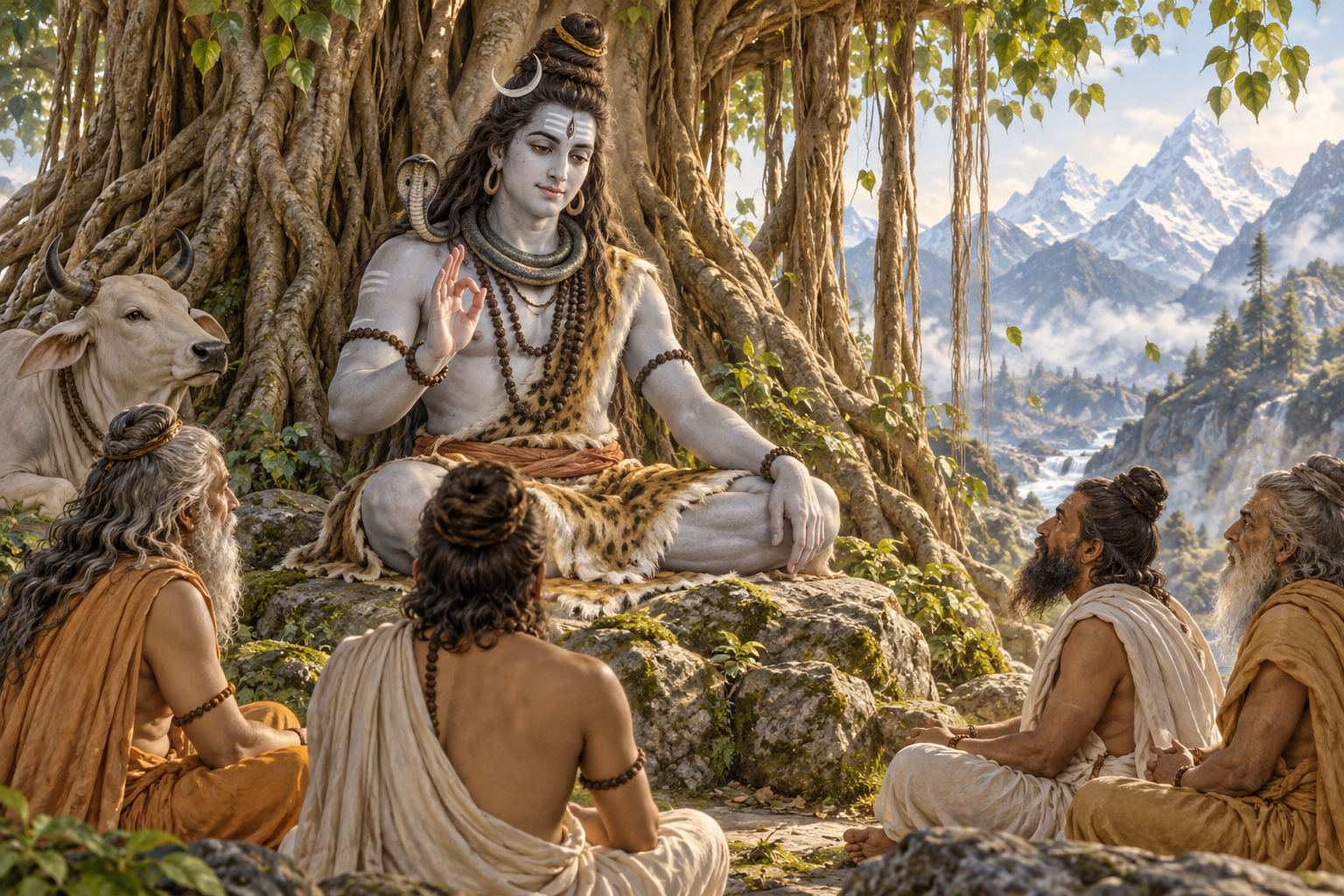
Srimad-Bhagavatam 4.6.33 does not present inconceivability as an excuse for mental excitement. It places Siva before you seated, grave and no longer governed by anger. The one associated with formidable power is shown in stillness. The seekers of liberation find shelter where agitation has been mastered.
This joins knowledge to character. A restless mind can collect information, but it tends to force every unfamiliar thing into a quick verdict. A resentful mind reads opponents into the text. A proud mind prefers novelty, certainty and victory over patient understanding. Calmness does not by itself prove an interpretation true, but reactivity makes careful reading harder.
Use the verse as a short discipline when you encounter a passage that strains belief or imagination:
- Read beyond the isolated line. Read the adjacent verses and identify the event that brought the speakers or observers to this place.
- Mark the verbal limits. Separate what is stated, what is compared, what is implied by the context and what a commentary supplies.
- Notice your reaction. Curiosity, embarrassment, defensiveness and the desire to win an argument are not interpretations. Name them so they do not silently become interpretations.
- Hold one term in remembrance. Return to a word such as shelter, yoga, anger, gravity or liberation during japa, prayer or quiet contemplation.
- Choose a corresponding act. If the verse shows power without rage, enter your next disagreement without feeding anger. If it presents shelter, make your conduct safer for someone seeking sincere guidance.
The final step matters. Scripture has not been understood merely because you can repeat an explanation. If contemplation of Siva’s composure makes you harsher, more sectarian or more eager to humiliate a questioner, you have acquired a weapon rather than wisdom.
This is especially important when teaching across Dharmic traditions. A Vaisnava and a Saiva may place Siva within different theological frameworks. The responsible response is to name the framework being used, interpret the verse within its actual setting and refuse cheap denigration. Here the devas approach Siva as the spiritually commanding centre of the scene. Any explanation that makes him trivial has failed to attend to the passage.
Three shortcuts weaken your reading of extraordinary descriptions

Scriptural descriptions of unusual scale, beings or realms can provoke immediate pressure to explain them away or prove them by modern means. A mature reader resists three shortcuts.
Do not shrink reality to present experience
Your inability to picture something is a fact about your present imagination. It is not, by itself, a fact about what can exist. Human perception is selective, memory is incomplete, and every mental image borrows from things already encountered. It is therefore reasonable to withhold dismissal when a sacred cosmology exceeds familiar scale.
Withholding dismissal is not the same as pretending certainty. You can say that you do not yet know how a description should be understood. That sentence protects both openness and truthfulness.
Do not manufacture scientific confirmation
Another shortcut assigns a modern equation, technology or scientific discovery to every extraordinary scriptural image. This may feel like a defence of dharma, but an unsupported equivalence makes the text depend on a claim it never made. It also confuses different kinds of discourse.
If a passage describes a sacred realm, say that it describes a sacred realm. If you propose a physical correspondence, label it as a proposal and supply independent evidence. Do not present resemblance as proof. Sraddha does not need careless apologetics.
Do not dissolve every difficulty into metaphor
Calling every uncomfortable detail symbolic is equally premature. A symbol is not a disposal bin for whatever a reader finds implausible. Ask what in the wording, genre, context or interpretive tradition supports a symbolic reading. Then ask whether the symbol supplements the narrated reality or replaces it. Those are different claims.
A dependable way to speak about a difficult passage is to distinguish four levels:
- The text explicitly states the words and actions that can be checked on the page.
- The immediate context establishes the conflict, relationship or purpose surrounding those words.
- A named tradition or commentary interprets the passage through a particular theological lens.
- Your present inference proposes an application, analogy or possible explanation.
Use those labels when speaking to children, a study circle or a sceptical friend. They do not weaken conviction. They show exactly where conviction rests and prevent a personal speculation from being passed off as the Bhagavatam itself.
Key takeaways
- Inconceivable means that reality cannot be fully contained by thought; it does not mean incoherent or immune to careful reasoning.
- Begin with the scene, speakers, actions and comparisons before constructing a doctrine from an isolated phrase.
- Keep the text, its narrative context, a commentary and your own inference visibly distinct.
- Lord Siva’s stillness shows that approaching mystery requires mastery of reaction, not abandonment of intelligence.
- A sound interpretation should deepen remembrance and improve conduct, not merely furnish an argument.
On your next reading, open the whole chapter before returning to 4.6.33. Write down one thing the verse clearly reveals, one thing you cannot yet conceive and one change its image of Siva asks of your conduct. Keep the unanswered part without embarrassment. Let it draw you back to study, sadhana and a quieter mind.
References
- Dandavats — SB 4.6.33 – Conceiving the Inconceivable (San Diego 1994)
- Bhaktivedanta Vedabase — Srimad-Bhagavatam 4.6.33

Leave a Reply
You must be logged in to post a comment.