

If you keep waiting to feel pure, focused, or spiritually enthusiastic before entering devotional practice, you have put readiness in the wrong place. Readiness often develops after you begin. The useful question is not, “Am I devotional enough?” It is, “What act of devotion can I faithfully enter now?”
Caitanya’s empowerment should not be reduced to a burst of religious emotion or a claim to special spiritual status. It becomes visible as an increased capacity to chant, hear, serve, accept correction, and return after distraction. You do not manufacture that capacity by effort alone, but you do make yourself available to receive and exercise it.
Showing up is more than occupying a devotional space
You can stand in a kirtana, visit a temple, or sit through a discussion while remaining inwardly absent. The body has arrived, but attention, voice, and responsibility have not. That does not make physical attendance worthless. Arriving is often the first necessary act. It simply means that arrival is a doorway rather than the whole journey.
Devotional participation ordinarily deepens through four movements:
- Arrive. Enter the place, time, or daily practice you had intended to enter.
- Attend. Listen to the mantra, teaching, prayer, or person in front of you instead of treating the occasion as background activity.
- Contribute. Lend your voice, complete a service, ask a sincere question, or help another participant.
- Return. Come back after the novelty fades, after an imperfect session, and after a lapse.
The fourth movement is where many devotional intentions quietly collapse. A person mistakes inconsistency for disqualification. One distracted round of japa becomes a reason to avoid the next. One missed gathering becomes evidence that the whole commitment was insincere. This gives a temporary failure more authority than it deserves.
If your capacity is low, participation may mean arriving and listening without pretending to possess an exalted mood. If your capacity is stronger, it should include responsibility. In either case, the honest act is better than the performed image. Caitanya’s invitation is not limited to people who can already display the fruits of mature devotion.
Participation gives grace somewhere to land

Bhakti becomes distorted when effort and grace are made into enemies. One distortion says that enough disciplined effort can compel the Divine. Another says that because grace is freely given, disciplined participation is unnecessary. The first turns devotion into a transaction. The second turns receptivity into passivity.
The practical claim is that Caitanya empowers those who show up. Showing up does not purchase grace or place the Lord under obligation. It is the devotee’s consent to enter the activities through which grace can be received, answered, and carried into conduct.
Srimad-Bhagavatam 1.2.24 describes a movement from tamas through rajas toward sattva, associating sattva with brahma-darsana, spiritual vision. This gives us a sober way to understand repeated devotional contact. Your perception is not independent of the conditions you repeatedly inhabit. What you hear, repeat, serve, and remember helps shape the quality of attention with which you approach spiritual reality.
This does not turn bhakti into a mechanical technique. Chanting is not a button that forces a predictable spiritual experience. Seva is not a deposit into a divine account. Participation matters because it places the whole person within a relationship: the voice calls, the ear receives, the body serves, the intelligence reflects, and the will chooses to return.
- Participation does not control grace; it answers grace.
- Effort does not prove spiritual superiority; it expresses willingness.
- Readiness is not always the condition for practice; it is often one of practice’s fruits.
- Empowerment does not eliminate dependence; it increases your ability to serve within that dependence.
This distinction protects you from two opposite mistakes. You need not take personal credit for every improvement, and you need not use humility as an excuse for remaining uninvolved. You can acknowledge dependence on Caitanya’s mercy while still becoming punctual, attentive, and useful.
Build a rule of participation you can actually keep

A vague wish to become more devotional usually loses to the first crowded day. A workable rule connects devotion to a known time, place, action, and form of responsibility. It should be small enough to survive an ordinary difficult day and substantial enough to require a real choice.
- Choose a daily doorway. Attach one practice to a stable part of your day, such as waking, bathing, or the period before your first meal. Decide in advance whether that doorway will be japa, prayer, reading, or quiet hearing.
- Name the communal practice. Put a particular kirtana, temple programme, or study gathering into your calendar. “I should associate with devotees more often” is an aspiration, not an arrangement.
- Accept bounded seva. Choose a task with a clear owner and a visible finish. Preparing a space, welcoming participants, cleaning after worship, or completing an assigned communication is easier to honour than a general promise to help.
- Create a return rule. When you miss the practice, resume at the next available occasion. Do not demand an emotional apology from yourself before returning, and do not invent an extreme compensatory routine that you cannot sustain.
- Examine the fruit. At the end of the week, ask where you became more attentive, where you remained a spectator, and what repeatedly prevented participation. Adjust the arrangement rather than merely renewing the same vague intention.
A mechanical day does not automatically make the practice false. Sometimes repetition carries you when feeling cannot. But persistent inattention is information. If you chant while continually switching to messages, remove the competing device. If you attend a gathering but never engage, take one defined responsibility. If your rule repeatedly fails at the same point, move the practice to a more stable part of the day.
Do not increase the scale merely because the arrangement looks modest. First establish the act of return. A smaller practice that you can honestly inhabit is a sounder foundation than a dramatic vow that produces avoidance, concealment, or resentment.
Community matters here because private intention can excuse itself indefinitely. A shared practice gives your devotion a place, a rhythm, and people who are affected by your presence. Recurring seva goes further: others can rely on you. That responsibility converts spiritual interest into participation without making social recognition the goal.
Measure empowerment by capacity, not intensity
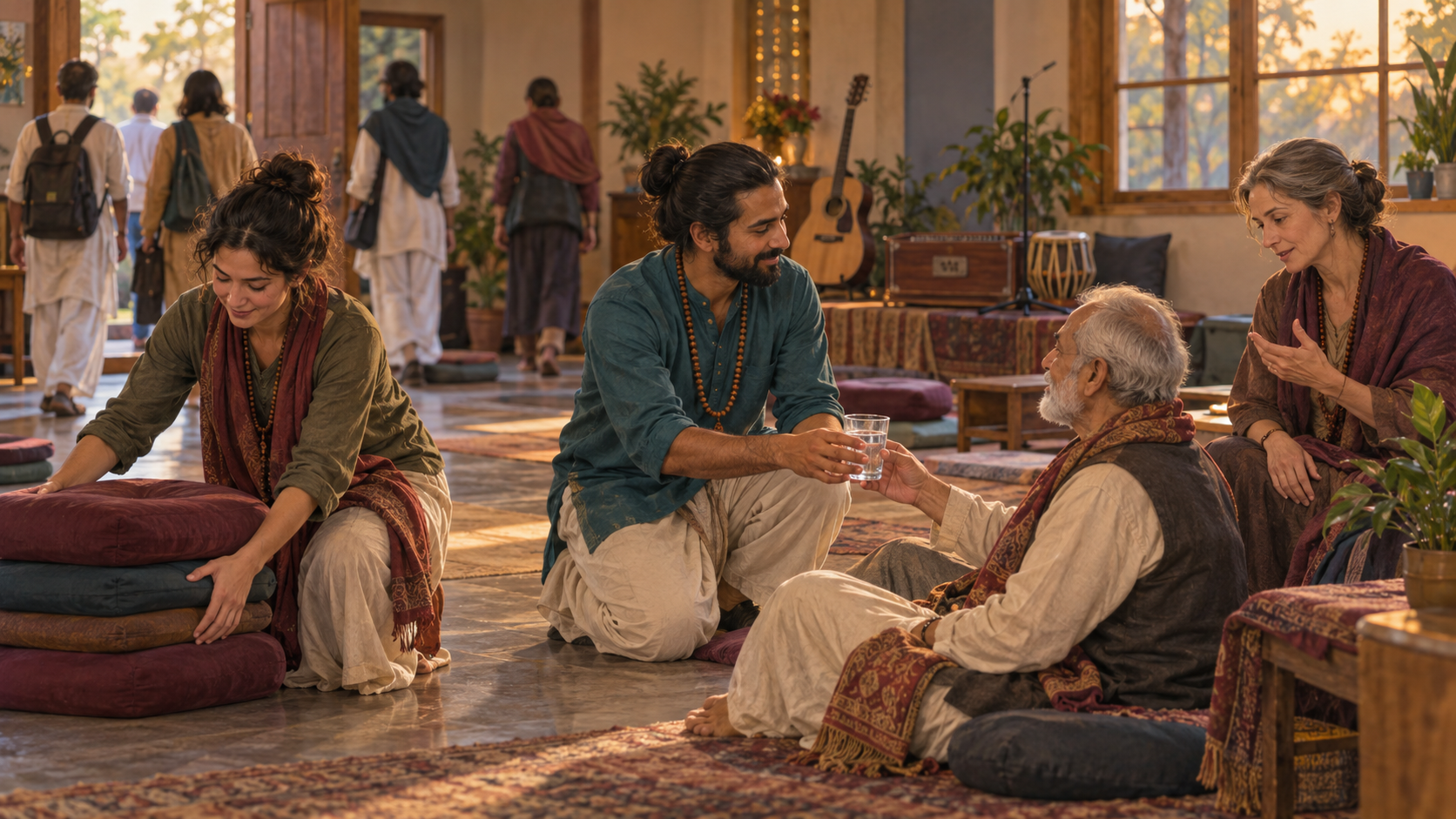
A powerful kirtana, an absorbing discussion, or a sudden devotional emotion can be meaningful. None of them, by itself, proves durable spiritual change. Intensity describes what an experience felt like. Empowerment is better noticed in what you can now faithfully do.
Look for changes that remain relevant after the atmosphere has passed:
- You return to chanting sooner after distraction instead of abandoning the session.
- You can hear devotional teaching without immediately turning it into a judgement of someone else.
- You complete unglamorous service even when nobody notices.
- You receive correction without allowing embarrassment to end your participation.
- You become more dependable while feeling less need to advertise your dependability.
- You notice the needs of the devotional community, not only the experience you hope to receive from it.
These signs are deliberately ordinary. Caitanya’s empowerment does not have to make you appear extraordinary. It may make you capable of sustained attention where you were scattered, service where you were passive, and return where you previously withdrew.
There are warning signs as well. If participation makes you harsher toward beginners, hungry for rank, impatient with correction, or interested mainly in visibility, increased activity should not be confused with increased devotion. Busyness can enlarge the same ego that bhakti is meant to reorient.
Use humility as a diagnostic, not as self-denigration. The useful question is not whether you can persuade yourself that you are spiritually insignificant. Ask whether your practice makes you more available to the holy name, to instruction, and to the needs of others. Genuine dependence on grace should deepen responsibility rather than dissolve it.
Key takeaways
- Do not wait for devotional feeling before acting. Choose the faithful act that is available now.
- Treat arrival as the doorway. Add attention, contribution, and return so that attendance becomes participation.
- Hold grace and effort together. Your practice cannot compel Caitanya, but it can express a real willingness to receive and serve.
- Anchor devotion to a stable daily cue, a named communal practice, and a bounded form of seva.
- After a lapse, resume at the next opportunity instead of turning inconsistency into an identity.
- Judge empowerment by increased capacity for remembrance, service, teachability, and steadiness, not by emotional intensity or public visibility.
Before your next devotional opportunity arrives, decide exactly how you will participate in it. Name the practice, the place, and the responsibility. Then enter without waiting to become the person you hope devotion will help you become. Showing up is not the completion of Caitanya’s work in you, but it is a concrete way of consenting to that work.
References

Leave a Reply
You must be logged in to post a comment.