

If you have reached Caitanya’s Vrindavan journey wondering what to do with its intense devotional emotion, do not begin by asking whether you could feel the same thing. Begin by asking what Caitanya perceives that an ordinary traveller might miss.
That question turns the episode from a spectacle into a spiritual discipline. You can then read Caitanya’s ecstasy without reducing it to unusual behaviour, imitating its outer form, or treating Vrindavan as scenery around the real story.
Read the scene as recognition, not spectacle
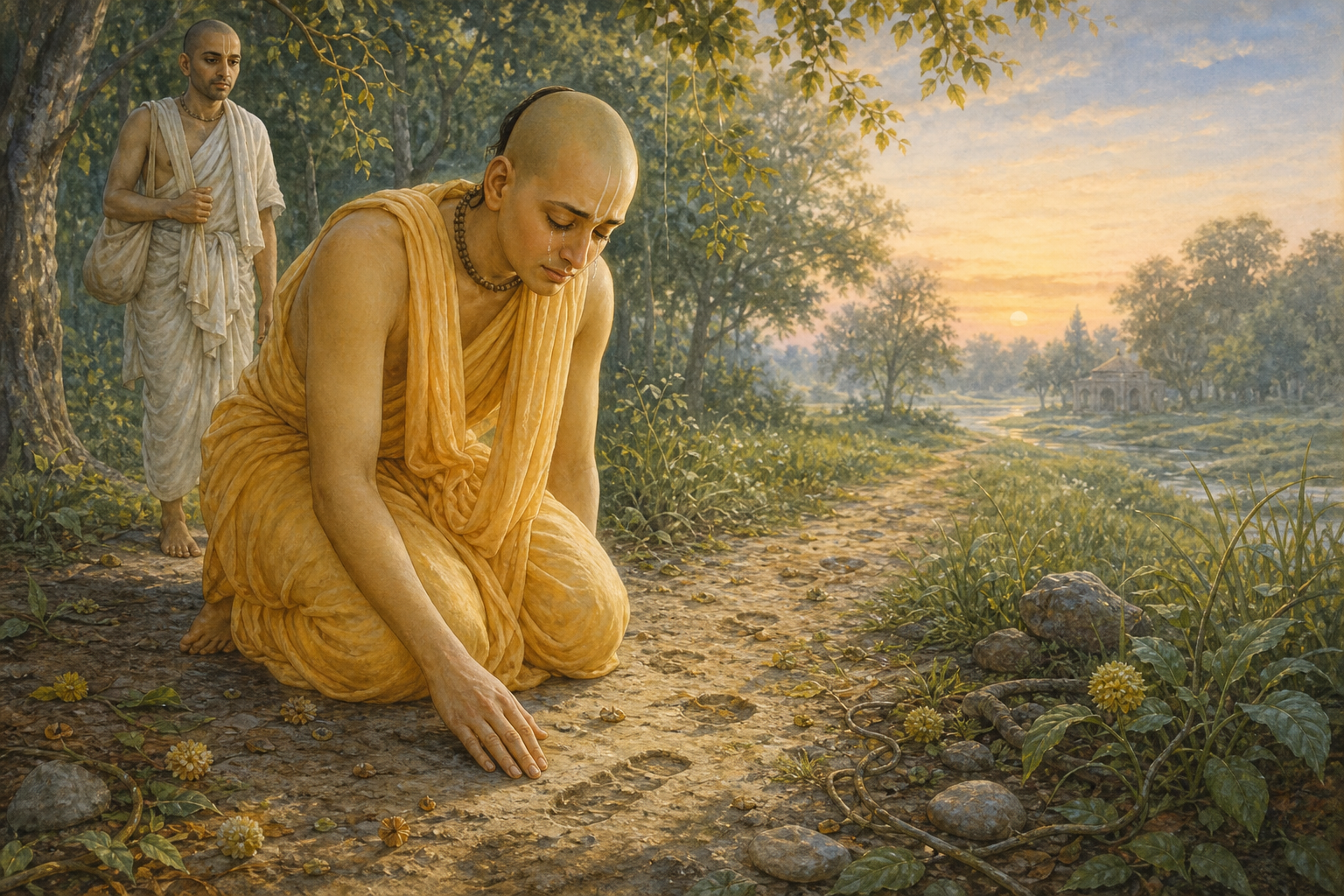
The sequence in Śrī Caitanya-Caritāmṛta, Madhya 17.180-183 is compact enough to read slowly. Resist the urge to jump immediately to a general lesson about devotion. First trace what happens inside the scene.
- Notice the encounter: What does the text place before Caitanya?
- Identify the association: What connection with Krishna is stated, or supplied by the immediate context?
- Observe the response: What changes in Caitanya’s attention, speech, movement, or devotional absorption?
- Test your interpretation: Which exact word or action supports what you think the scene means?
The order matters. Caitanya’s response is not presented as free-floating excitement. Something is perceived through a consciousness wholly oriented toward Krishna. The visible ecstasy is therefore the end of a devotional movement: perception becomes remembrance, and remembrance becomes embodied response.
If you concentrate only on the extraordinary response, you lose the relationship that gives it meaning. If you catalogue only the places and events, you lose the transformed vision at the heart of the journey. Read for both the object seen and the devotional consciousness through which it is seen.
Vrindavan changes what counts as seeing

Within Gaudiya Vaishnava understanding, Vrindavan is a dhama, a sacred abode inseparable from Krishna’s lila. Its significance cannot be reduced to coordinates, monuments, or historical associations. Place and remembrance belong together.
This changes the unit of attention. A path is not merely a route between destinations. Water is not merely part of a view. Trees and living beings are not incidental decoration. Each can become a point at which Krishna-centered memory gathers force. Nothing has to stop being materially ordinary before it can become devotionally meaningful.
Caitanya’s journey therefore asks you to examine the quality of your own attention. Two people can stand in the same place while inhabiting very different worlds. One searches for an impressive sight; another receives a reminder of the divine. The difference is not simply information. It is the relationship that directs perception.
If you visit Vrindavan, carry one passage rather than trying to collect as many destinations as possible. Read it before entering the place to which it directs your attention. Remain still long enough to notice what your itinerary would normally make you pass. Hear the place’s devotional meaning before reaching for a camera.
If you cannot travel, the principle is still available. Attach remembrance to something you encounter repeatedly: the threshold you cross each morning, the food you offer before eating, or the place where you chant. The aim is not to pretend that your surroundings are Vrindavan. It is to train attention so that sacred remembrance is not confined to exceptional occasions.
This vision should also produce care. Treating a sacred place, its residents, or its living environment as obstructions to a personal experience defeats the purpose of pilgrimage. If seeing becomes devotional, conduct should become more considerate rather than less.
Caitanya’s ecstasy is not an instruction to perform
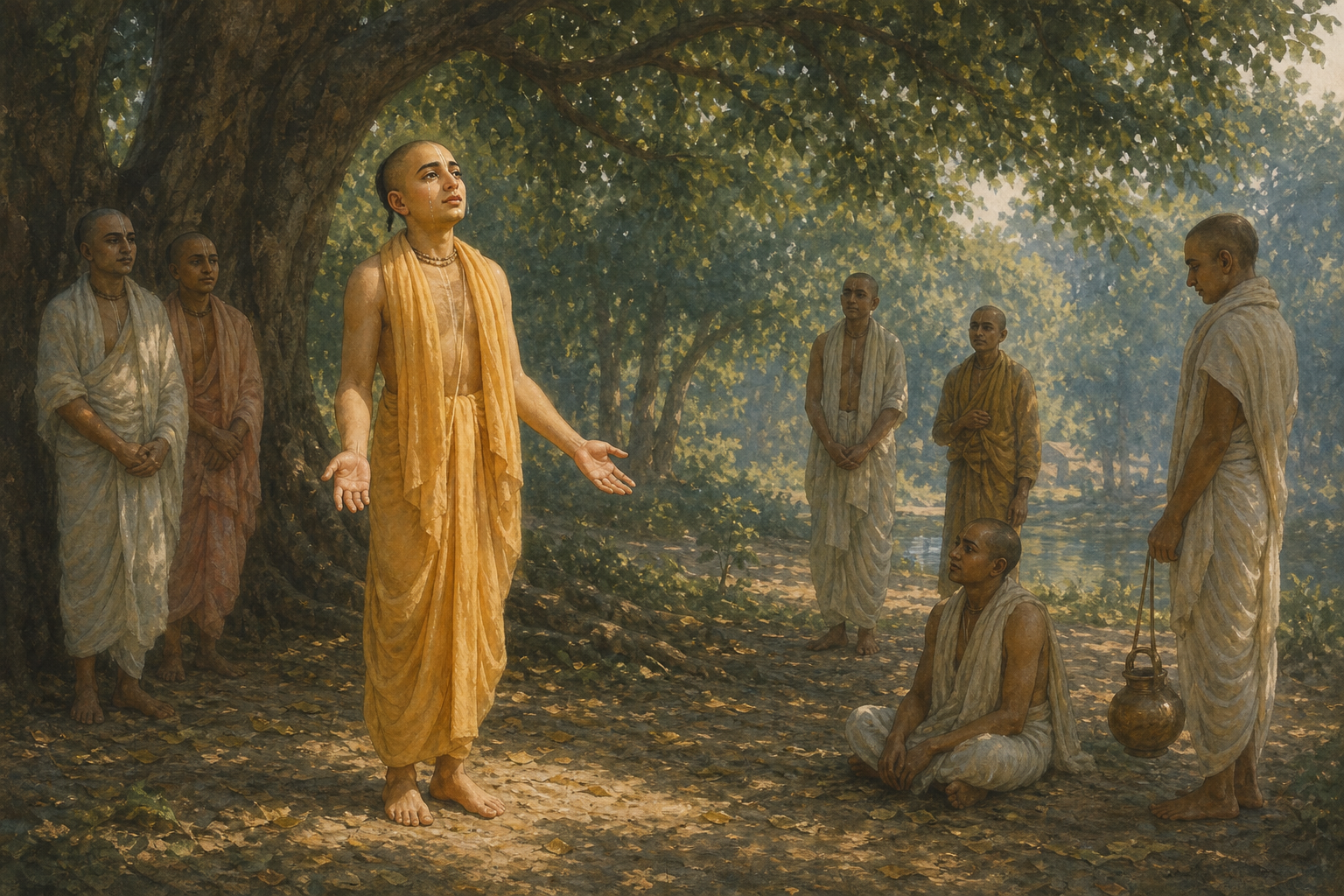
A sacred biography can reveal a saint’s devotional intensity without commanding every reader to reproduce its outward signs. In Caitanya’s journey, the outward response matters because it discloses inward absorption. It is not presented as a technique for manufacturing spiritual credibility.
That distinction protects you from three common mistakes:
- Imitation: Trying to produce an outward sign because you associate it with advanced devotion reverses the movement of the episode. The response should arise from remembrance; the appearance of a response cannot create the remembrance it is meant to express.
- Dismissal: Calling every intense devotional state mere emotionalism avoids the text’s central claim that love of Krishna can involve the whole person, including the body and senses.
- Comparison: Ranking yourself or other devotees by visible emotion turns attention away from Krishna and toward performance, status, and spectatorship.
A better test concerns what remains after the feeling passes. Does remembrance become steadier? Does speech become less harsh? Does service become less dependent on recognition? Does the encounter make you more attentive to others? These changes are harder to display and more useful to cultivate.
Whether dramatic emotion appears is not a sound measure of your worth as a practitioner. Your responsibility is to prepare the conditions of honest devotion: hearing carefully, chanting attentively, remembering Krishna, serving without display, and refusing to counterfeit a state you do not possess.
A close-reading practice for Madhya 17.180-183
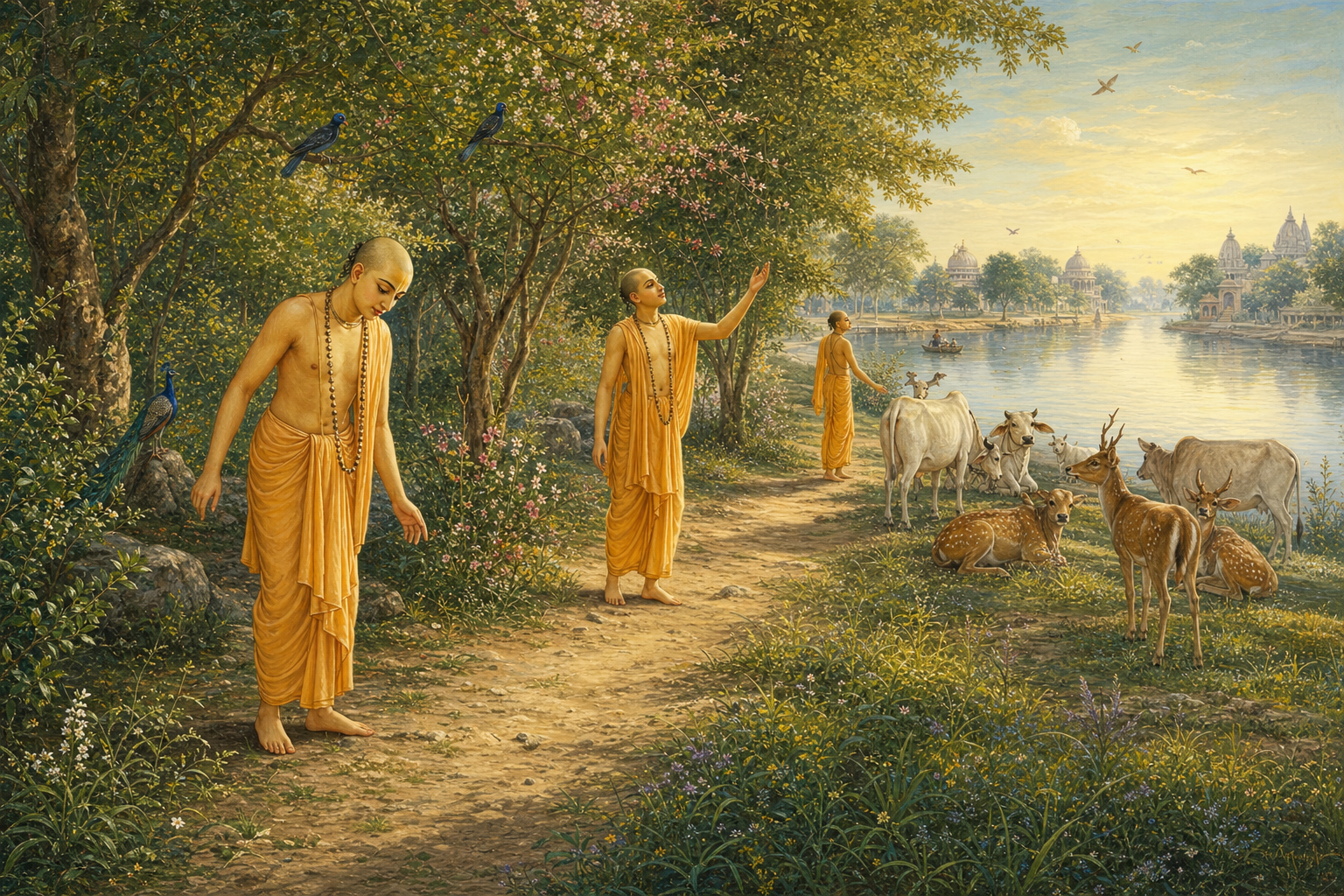
You can use these four verses as a disciplined reading exercise rather than consuming them as another memorable episode.
- Bound the passage. Open Madhya-lila chapter 17 and isolate verses 180-183. Then read the immediately surrounding context so that the scene is not detached from the journey.
- Read once for movement. Follow the narrative without stopping to explain it. Notice where attention shifts and where the emotional intensity changes.
- Read again for exact language. Mark the nouns that identify what is encountered and the verbs that show what Caitanya does. This keeps interpretation anchored to the text.
- Separate text from commentary. In your notes, label what the verse explicitly states, what a trusted commentary explains, and what you personally infer. Do not let an attractive inference silently become part of the verse.
- Trace the devotional sequence. Ask whether the passage moves from perception to association, from association to remembrance, and from remembrance to response. If it does, identify the words supporting each movement.
- Turn one insight into practice. Choose a modest response: chant with closer attention, read the relevant Krishna-lila, serve the sacred place, or pause before a familiar object that can honestly prompt remembrance.
If you discuss the passage with others, ask each person to point to the phrase supporting an interpretation. This simple discipline prevents a conversation about scripture from dissolving into impressive but ungrounded spiritual language.
It also leaves room for layers of meaning. A literal event, a theological claim about the dhama, and a practical lesson about attention can coexist. They should not be collapsed into one another. Naming the layer you are discussing makes the reading clearer and more faithful.
Key takeaways
- Caitanya’s visible ecstasy becomes intelligible when you trace the Krishna-centered recognition that precedes it.
- Vrindavan functions as sacred geography: place, lila, memory, and devotional relationship illuminate one another.
- The episode invites attentive following, not imitation of extraordinary outward states.
- A sound reading distinguishes the verse’s words, a commentary’s explanation, and your own inference.
- The most useful response is a concrete act of remembrance, service, or greater care for the sacred place and those within it.
On your next reading, carry one question through all four verses: what is Caitanya recognizing that ordinary sight overlooks? Then choose one daily encounter and let it become a truthful reminder of Krishna. That small discipline is a better beginning than trying to borrow the appearance of someone else’s ecstasy.
References
