

You may not carry a mace or command the devas, but you can still enter the danger described in Srimad-Bhagavatam 3.17.21-22: a useful strength begins to feel like proof that you are beyond correction. These verses give you a compact way to catch that change before it hardens into conduct.
The passage chosen for Bhakti Ashraya Vaisnava Maharaj’s discourse is more than a distant portrait of a formidable asura. It asks a question that belongs in your spiritual life, family, temple community and public work: what does your power make possible, and what does it make difficult for other people to tell you?
The scene reveals power without self-mastery
The two selected verses unfold in a revealing order. Verse 21 begins with what can be seen and heard. Hiranyaksha has a temper that is difficult to control. Golden anklets sound at his feet, a gigantic garland adorns him, and an immense mace rests on his shoulder. Verse 22 then identifies the inward engine of the display: mental and bodily strength, joined to a boon, have made him proud. He considers himself beyond restraint and fears no one. The social consequence follows immediately. The devas hide from him as serpents hide from Garuda.
That sequence matters. The Bhagavatam does not ask you to condemn strength, ornament, confidence or ability in themselves. A mace can defend as well as threaten. Intelligence can clarify as well as manipulate. Authority can protect as well as dominate. The decisive issue is whether a capacity remains governed by dharma and open to correction.
Hiranyaksha’s outer magnificence is paired with an ungoverned temper. He can project control without possessing self-control. That distinction is easy to miss because visible power attracts attention, while the condition of the heart is disclosed through consequences. Look beyond how impressive a person appears. Notice what happens when that person is contradicted, delayed, refused or corrected.
Apply the passage inward before applying it to anyone else. Ask where you rest your own symbolic mace. It may be scriptural fluency, professional knowledge, physical presence, wealth, family seniority, institutional rank, a public audience or a reputation for devotion. None of these is inherently corrupting. The danger begins when possession becomes entitlement and entitlement makes restraint feel unnecessary.
False fearlessness depends on insulation

Verse 22 connects Hiranyaksha’s pride with mental strength, bodily strength and a boon. The problem is not that he possesses advantages. The problem is the conclusion he draws from them: no one can check me, so I have nothing to fear.
False fearlessness has a recognizable inner grammar: I am able to do this; nobody here can stop me; therefore doing it must be right. The last step does not follow from the first two. Capacity answers whether you can impose an outcome. Dharma asks whether you should, for whose benefit, under what restraint and with what effect on others.
Abhaya in bhakti is different from invulnerability. Spiritual courage does not require you to be unopposed or immune from consequences. It grows from shelter in Bhagavan while remaining answerable to guru, sadhu and shastra. Because its foundation is not the need to appear unbeatable, it can acknowledge error, accept a limit and change direction without experiencing correction as annihilation.
You can test whether your confidence is rooted in conviction or insulation by examining what protects it. Use questions that name the protection precisely:
- What mental strength am I relying on: memory, argument, planning ability, doctrinal fluency or control of information?
- What practical strength lets me impose the result: position, money, physical presence, an audience or the power to reward and exclude?
- What functions like a boon: a special exemption, a protected reputation, influential allies or a role that makes others reluctant to challenge me?
- Who has genuine permission to tell me to stop, and what happened the last time that person disagreed?
If you cannot name anyone who can check you, the problem is not merely that you are strong. Your strength has become structurally unanswerable. The remedy is not theatrical self-belittlement. It is to restore a real channel of correction before your judgment is tested by a larger failure.
Other people’s silence is not proof that you are right
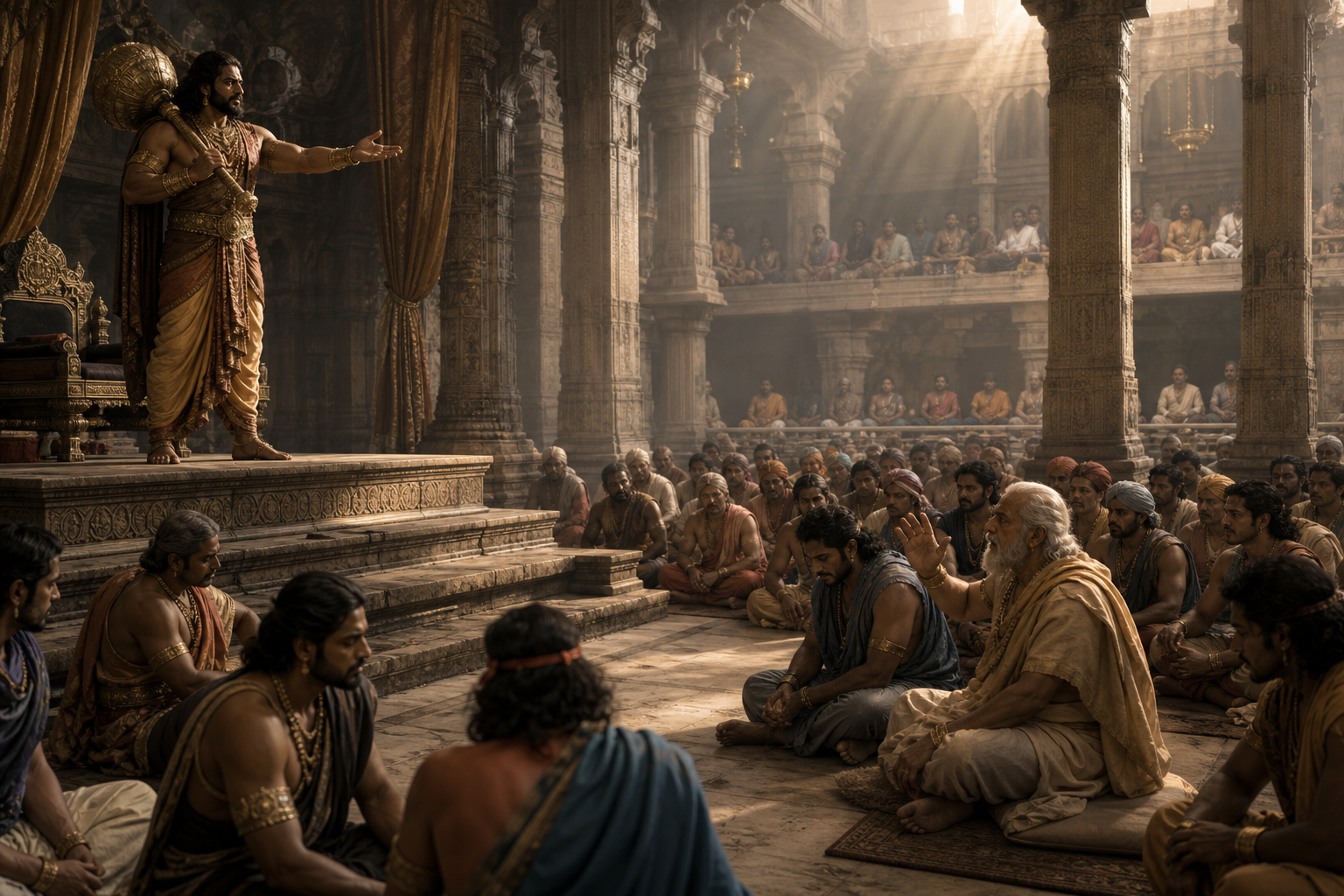
The devas withdraw from Hiranyaksha because they are afraid. Their disappearance may look like his victory, but the narrative does not confuse retreat with moral agreement. His presence has made open engagement unsafe.
This is the most practical warning in the passage. A quiet room can flatter the strongest person in it. A leader may interpret silence as consent, instant agreement as respect, or the absence of direct criticism as proof that no serious criticism exists. Yet people also become quiet when they conclude that speaking will bring humiliation, retaliation or a futile argument.
Watch for changes in the pattern of speech around you. Objections may appear only after a meeting. People may ask what you think before revealing their own view. Feedback may become vague and excessively polite. Those with the least status may stop attending, contributing or asking questions. None of these signs proves that you have acted wrongly, but together they give you a reason to test whether fear has replaced trust.
Ask one direct question: ‘What becomes harder to say when I am present?’ Do not defend your intention while the answer is being given. First repeat the concern in words the other person recognizes. Then separate three matters that pride tends to collapse: whether your intention was good, whether your action was justified, and whether its effect requires repair. A sincere intention does not automatically settle the other two.
Vaishnava leadership should make truthful speech easier, not cultivate devotional flattery. The stronger person carries the greater responsibility for making correction safe. This does not mean surrendering every decision to the loudest objection. It means that disagreement must be heard without personal punishment, and a final decision must be explainable in terms of service and dharma rather than status alone.
Turn the passage into a practice of accountable strength
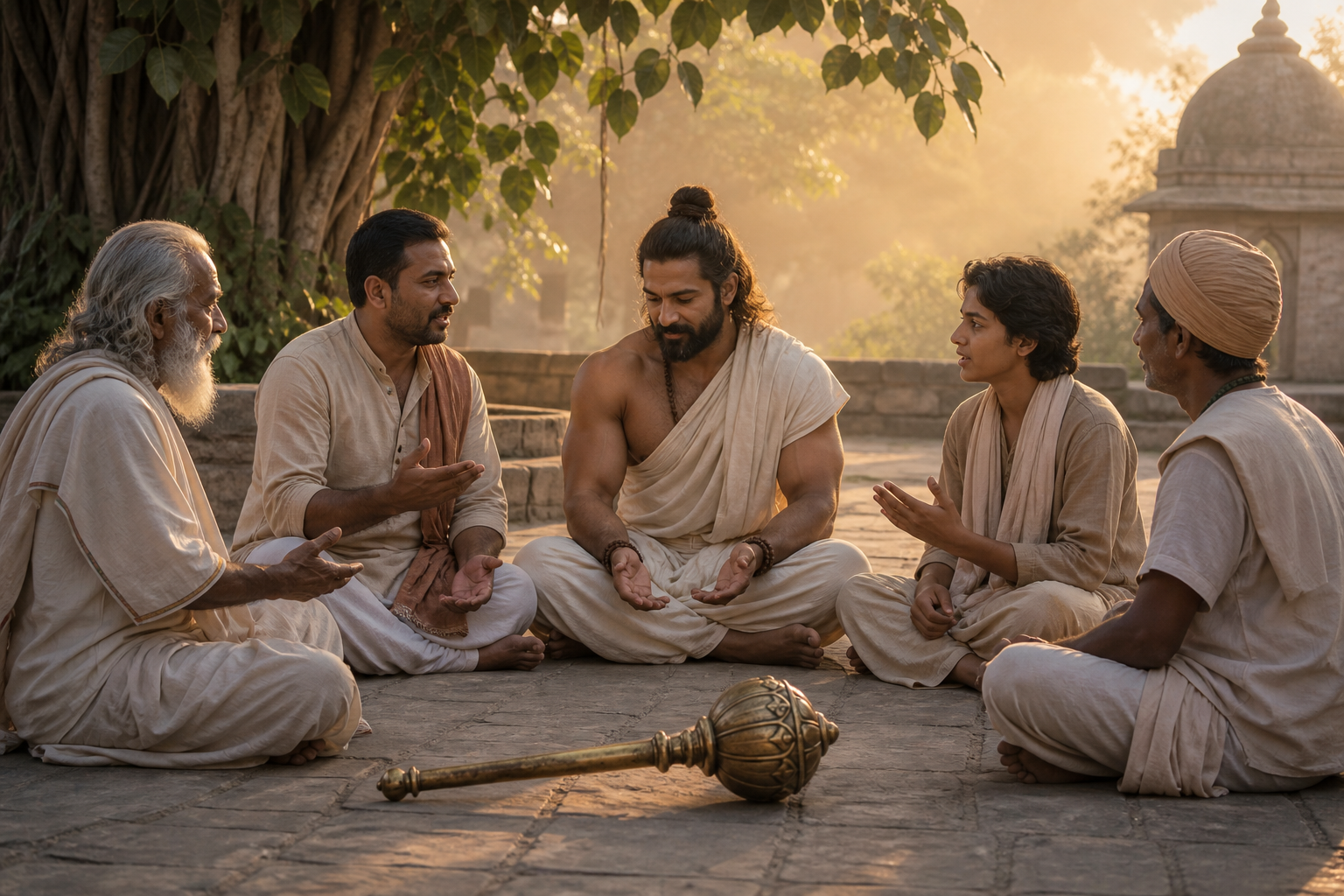
Read these verses when you feel unusually justified, admired or resisted. Those are the moments when self-examination is most easily postponed. Use the movement of the passage – appearance, inner condition and effect on others – as a practical examination:
- Read in sequence. Notice the impressive appearance, the difficult temper, the pride produced by strength and protection, and finally the fear experienced by others. Do not isolate the grandeur from its consequence.
- Name your mace. Identify the capacity currently giving weight to your words or decisions. Describe it without pretending that you do not possess it.
- Name your boon. Identify what reduces the ordinary consequences of being wrong. Reputation and rank are especially dangerous when they make correction costly for everyone except you.
- Locate withdrawal. Consider who has become quieter, more indirect or less present. Ask what changed before deciding why it changed.
- Submit the intention to dharmic scrutiny. Ask not only whether an action is permitted, but whether it reflects truthfulness, humility, restraint and service.
- Redirect the capacity into seva. Use knowledge to clarify without humiliating, authority to protect without silencing, wealth to support without controlling, and reputation to create room for less powerful voices.
The application should remain first-person. Ordinary disagreement does not make another person Hiranyaksha, and a frightened colleague does not thereby become a deva. Scriptural analogy helps you inspect conduct; it does not authorize you to assign cosmic identities to rivals. Using sacred knowledge as a weapon against every critic would reproduce the very pattern the verses expose.
Suppose you know a text better than someone else in a discussion. Your knowledge is the capacity. Your reputation may be the protection. Seva means explaining without making the other person ashamed to ask again. If you lead a temple team, decision-making authority is the capacity. Seva means setting necessary boundaries while preserving a trustworthy route for private correction. If you are a family elder, seniority is the capacity. Seva means ensuring that a younger relative can disagree without retaliation.
This is not weakness disguised as spirituality. Self-restraint lets power remain usable for dharma. A person who cannot receive a truthful objection is already being governed by the objection, because so much energy must be spent suppressing it. Bhakti offers another use for strength: place it in service, where it can be disciplined without being denied.
Key takeaways
- Srimad-Bhagavatam 3.17.21-22 does not condemn strength; it exposes strength joined to uncontrolled temper, pride and freedom from correction.
- False fearlessness depends on a protective boon or advantage. Spiritual courage remains answerable to dharma even when correction is uncomfortable.
- Silence, retreat and instant agreement can indicate fear rather than respect. Test the environment before treating quiet as consent.
- Use Hiranyaksha as a mirror before using him as a label. The passage is most useful when it examines your conduct rather than condemns your opponent.
- Your strongest capacity becomes safer when it is consciously redirected toward seva, protection and truthful dialogue.
When you next read these verses, write down the capacity you rely on most and the person whose correction you resist most. Then use that capacity in a way that makes truthful correction easier. That small turn – from insulation toward service – is where power begins to come under the shelter of bhakti.
References
