
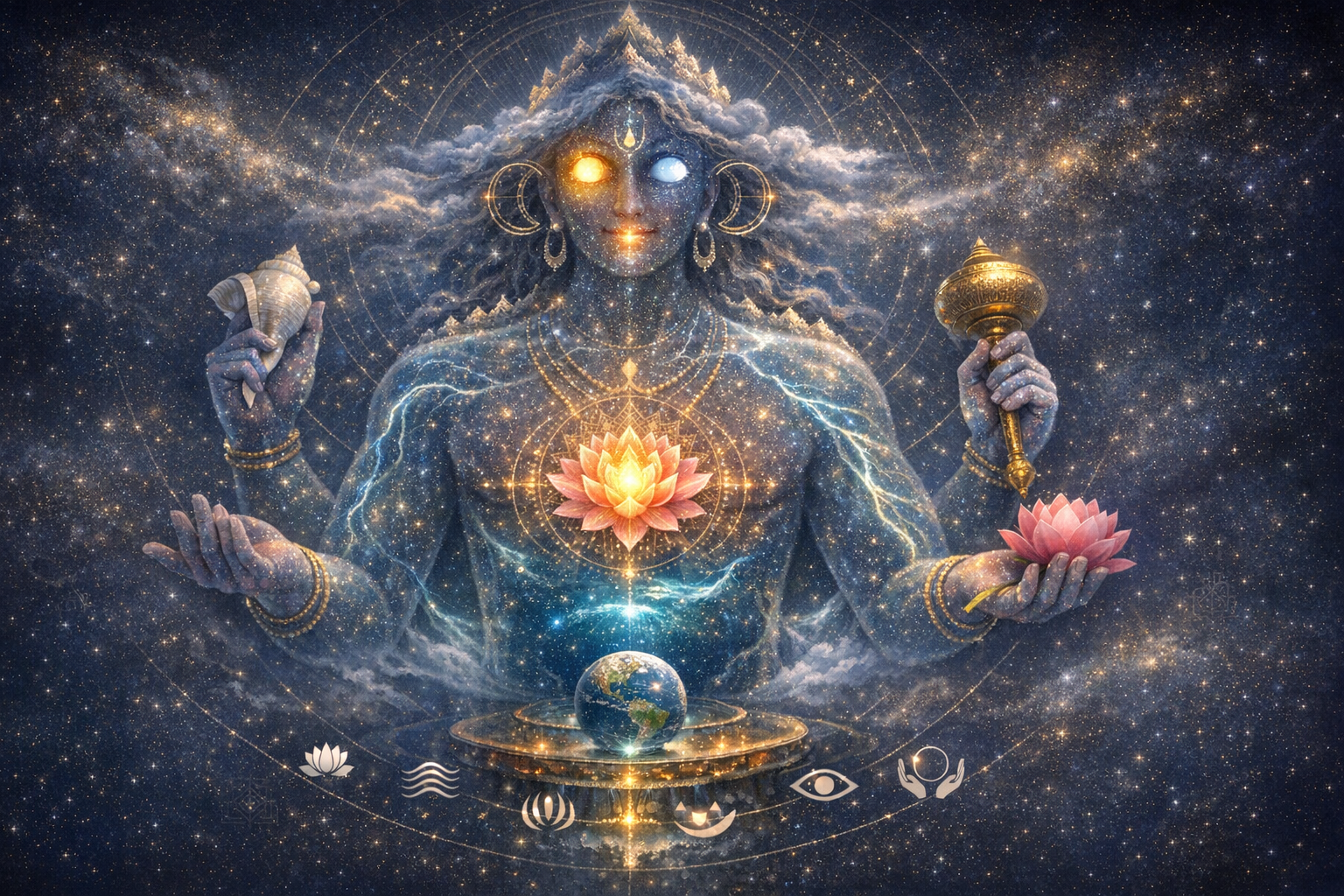
Contemplating the cosmic body of Bhagavan Vishnu, the Virat Purusha, through sustained dhyana (meditation) stands among the most elevated modes of Vaishnava practice. This contemplative discipline invites a direct, imaginal encounter with the universal form wherein all worlds, beings, and forces appear as limbs and functions of the Divine Person. As a meditative map, the Virat Purusha integrates scriptural revelation, philosophical clarity, and experiential devotion into a single, unifying vision.
Classical sources consistently present this vision. The Purusha Sukta (Rig Veda 10.90) hymns a primeval Person whose sacrifice structures the cosmos. The Bhagavad Gita’s Vishvarupa-darshana (chapter 11) offers an overwhelming portrayal of the Universal Form as seen by Arjuna. The Puranic literature, notably the Vishnu Purana and the Bhagavata Purana (for example, second skandha), elaborates correspondences between cosmic regions and aspects of the Divine body. Within Vedanta, Virat denotes the gross universal embodiment of Ishvara; in this framework, meditating on Virat functions as a powerful gateway to recognizing the Divine’s all-pervading presence.
The metaphysical architecture commonly outlined in Vedantic teaching distinguishes three universal standpoints: Virat (gross, cosmic body), Hiranyagarbha (subtle, cosmic mind-life principle), and Ishvara (causal, omniscient ground). For practice, Virat serves as an accessible entry point because form, symmetry, and cosmic order can be vividly contemplated. This contemplative ascent moves, as capacity matures, from the personal and cosmic (saguna upasana) toward recognition of the non-dual substratum (nirguna tattva) without negating devotional intimacy.
Dhyana on the Virat Purusha holds both theological and soteriological value. Theologically, it safeguards a panentheistic insight: the Divine both pervades and transcends the universe. Soteriologically, it refines attention (dharana), deepens absorption (dhyana), and predisposes the mind toward samadhi by harmonizing awe, devotion (bhakti), and discernment (jnana). Practitioners often describe a spontaneous sense of vastness, humility, and belonging that reorients daily life toward compassion and responsibility.
Sound preparation anchors the practice. Foundational ethical disciplines (yamas and niyamas) stabilize intention, while a clear sankalpa (purpose statement) focuses the session. Many lineages favor the quiet of brahma-muhurta (pre-dawn) or the transitions at sunrise and sunset (sandhya) to attune breath, attention, and subtle affect. The seat is steady and comfortable, the spine upright yet at ease, with the gaze gently lowered or softly closed.
Gentle pranayama supports pratyahara (sensory withdrawal). Even pacing of inhalation and exhalation, or a mild 1:1 or 1:2 rhythm as comfort permits, enhances vagal tone and eases mental agitation. The goal is not coercive breath control but a steady, unforced cadence that quiets the autonomic system and prepares attention for visualization. Short preparatory cycles of nadi-shodhana (alternate-nostril breathing), when learned properly, can be especially helpful.
Mantra centers awareness and imbues it with devotion. Vaishnava traditions commonly employ Om Namo Narayanaya, portions of the Purusha Sukta, or passages from the Vishnu Sahasranama. A concise anga-nyasa may also be used to sacralize the body as a field of contemplation, ritually aligning hands, heart, head, and senses with the mantra’s syllabic potency. These acts prime the shift from scattered cognition to consecrated vision.
The initial focus often rests in the hridaya the heart-lotus as a radiant sanctuary where Narayana is intuited. From this center, visualization extends in two synergistic arcs: a microcosmic arc that honors the sanctity of one’s own embodied life, and a macrocosmic arc that recognizes all beings and elements as articulated expressions of the same Divine Person. This ensures the meditation remains both intimate and immeasurable.
Classical correspondences provide the scaffolding for visualization. The heavens (dyu) may be intuited as the head, the sun and moon as eyes, the directions as ears, fire as the mouth, the Vedas as breath, mountains as bones, rivers as veins, herbs and forests as body-hair, clouds as locks, oceans as the belly, and the earth and nether regions as the feet. Such mappings, presented in the Bhagavata Purana and other texts, are contemplated not as rigid anatomy but as contemplative metaphors that internalize the truth of pervasive divinity.
As attention steadies, the contemplative field expands toward the Vishvarupa. Countless forms, beings, and timescales are seen as facets of a single, indivisible Life. Where the mind tends to isolate, the Virat Purusha meditation reveals continuity: species, ecologies, planets, and luminous worlds co-appear within the embrace of Vishnu’s cosmic body. This grand vista elicits reverence, dissolves pettiness, and reorders values toward dharma and care for all beings (sarva-bhuta-hita).
Practice structure is best incremental. Short sessions (15–20 minutes) cultivate stability before extending to 30–45 minutes. A typical cycle includes preparation (posture, breath, mantra), centering in the heart-lotus, progressive visualization of the cosmic correspondences, a brief period of formless abiding where the subject-object polarity softens, and a measured return to the breath and body. Closing with gratitude and a resolve toward service integrates insight into conduct.
Common obstacles mirror those identified in the Yoga Sutras: distraction (vikshepa), dullness (laya), latent coloring (kashaya), and premature delight in subtle states (rasasvada). Gentle perseverance (abhyasa) and dispassion (vairagya), supported by ethical clarity and devotional warmth, gradually refine attention. If intense affect, fear, or destabilizing imagery arises, returning to breath, mantra, and heart-centering reliably restores equilibrium.
Psychophysiologically, steady visualization and slow, even breathing shift the nervous system toward parasympathetic dominance, enhancing calm alertness. While this is not a medical intervention, many practitioners report improved emotional regulation, clearer attention, and a sustained sense of connectedness after regular practice. The contemplative imagery also appears to strengthen prosocial emotions reverence, gratitude, and compassion which then infuse speech and action.
Philosophically, the meditation nurtures a panentheistic clarity consonant with Vedanta and Vaishnava theology: the world is not separate from the Divine, yet the Divine exceeds the world. In devotion, this takes the form of surrender and trust; in knowledge, it matures into discernment that every appearance shines with the One Reality. These poles bhakti and jnana do not compete; they converge in contemplative immediacy.
Inter-dharmic resonances reinforce the universality of this insight and the unity of dharmic traditions. In Mahayana Buddhism, the figure of Vairocana (Mahavairocana) exemplifies a cosmic Buddha principle and mandalic vision of all phenomena inter-illumining each other. Jain cosmography depicts the loka in the outline of a Purusha-like form (loka-purusha), inviting reflection on a morally ordered, law-governed cosmos. Sikh teachings emphasize Ik Onkar, the One pervading all, and encourage remembrance (simran) and service (seva) to embody that oneness. Such parallels affirm that dhyana on the Virat Purusha harmonizes naturally with shared commitments to ahiṁsa, karuṇā, satya, and seva across Hinduism, Buddhism, Jainism, and Sikhism.
Care in guidance and context remains important. Those with a history of severe psychological distress may benefit from supervision by an experienced teacher and, where appropriate, consultation with qualified health professionals. The contemplative intent is integrative, not escapist; the fruit is measured in humility, clarity, ethical steadfastness, and a felt kinship with all life never in claims of special status.
Advanced practice may, at times, allow the form of the Virat to dissolve into luminous presence without image, then to re-crystallize as the compassionate face of Bhagavan Vishnu. This rhythmic movement between form and formlessness preserves devotion, anchors wisdom, and prevents reification. The practitioner learns to recognize the same Vishnu in the silence between breaths, in the mantra’s resonance, in a river’s flow, and in another’s well-being.
In daily life, the contemplative vision translates into dharmic action. Stewardship of the environment honors mountains, rivers, and forests as the living body of the Virat Purusha. Ethical commerce and truthful speech regard society as sustained within the Divine heart. Acts of care from feeding, teaching, and healing to protecting the vulnerable become extensions of worship, reflecting the Gita’s call to lokasangraha (the welfare of the world).
In summary, dhyana on the Virat Purusha integrates scriptural fidelity, philosophical depth, and contemplative method. Grounded in the Purusha Sukta, illuminated by the Bhagavad Gita’s Vishvarupa, and artfully elaborated in the Puranas, it offers a practice both rigorous and encompassing. Undertaken with devotion, discernment, and ethical care, it reveals a cosmos already sanctified and a life already held within the immeasurable embrace of Vishnu.
Inspired by this post on Hindu Blog.
