
You may be considering leaving a job, a public duty, a relationship, or a spiritual commitment because continuing feels compromised. The difficult part is not finding a noble reason to withdraw. It is knowing whether withdrawal expresses truthfulness or merely gives an agitated mind the relief it wants.
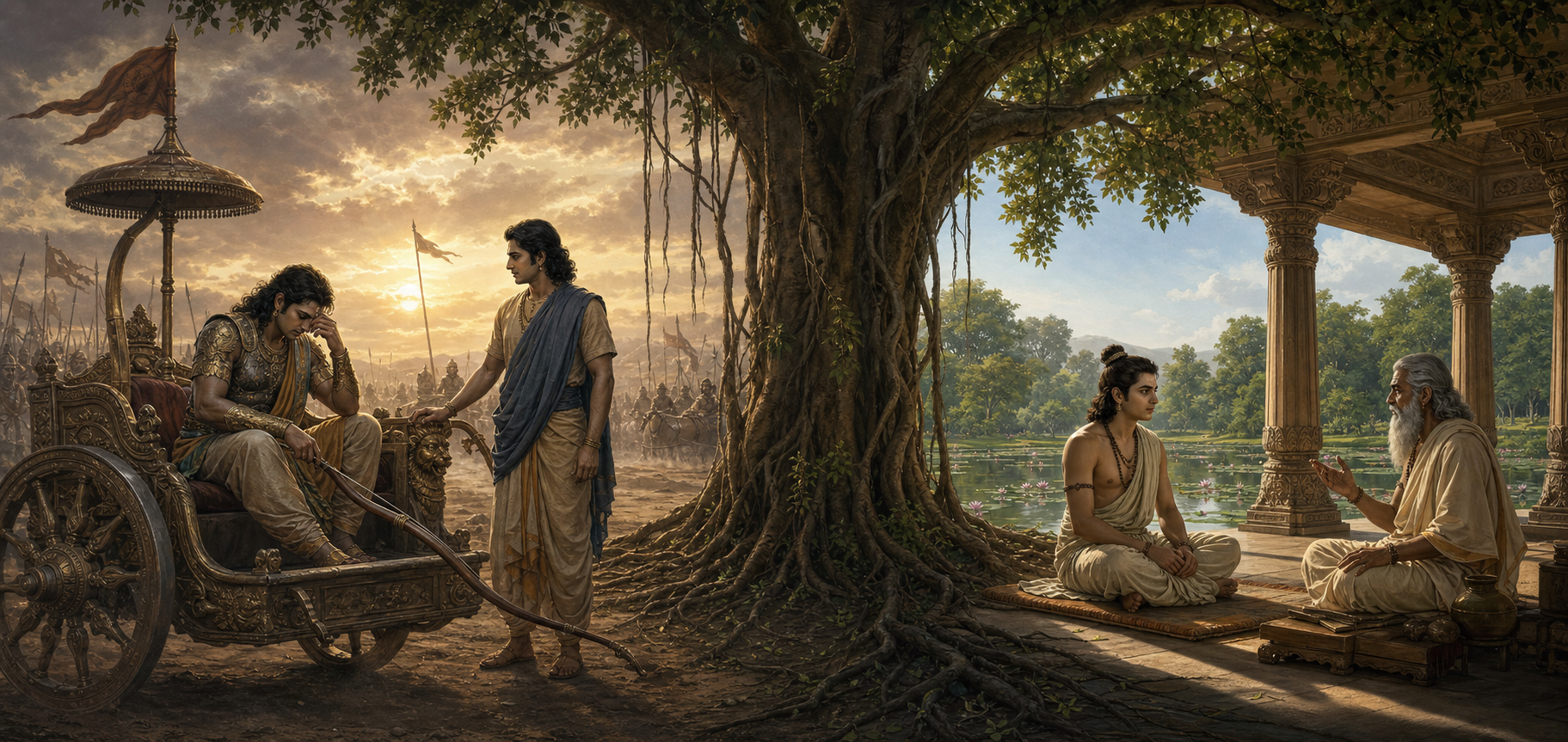
Arjuna and Rama give you two sharply different maps of this moment. Arjuna wants to stop because grief and attachment have confused his judgment. Rama becomes quiet because sustained discernment has loosened his fascination with transient things. One needs disciplined action before making renunciation meaningful. The other is ready for disciplined inquiry. Choosing the wrong medicine can turn avoidance into spirituality or turn genuine dispassion into another round of compulsory activity.
Diagnose the mind before judging the outward action
Arjuna and Rama both appear to withdraw. That surface resemblance is misleading. Dharmic renunciation is not proved by sitting still, leaving a role, surrendering possessions, or refusing a difficult task. Its quality depends on what has been relinquished within the mind.
Moha is confusion intensified by attachment. It narrows attention until the mind can see only the pain of acting, the imagined purity of refusing, or the outcome it desperately wants to prevent. Emotion itself is not the problem. Arjuna’s compassion for teachers, relatives, and friends is real. The problem is that grief overwhelms his capacity to distinguish compassion from duty, consequence from fear, and moral reasoning from the wish to escape an unbearable decision.
Vairagya has a different texture. It is not disgust with life or resentment toward the people in it. It is a lucid recognition that possessions, pleasures, status, moods, and even cherished identities cannot provide permanent security. The mind becomes less demanding, not more dramatic. It can examine experience without urgently bargaining for relief.
You can begin with a simple diagnostic: notice whether your attention is contracting or clearing. Moha repeats its case, imagines only a few catastrophic choices, and wants the decision finished so the discomfort will stop. Vairagya remains steady when circumstances improve or worsen. It can ask questions without secretly requiring a particular answer.
This test is more reliable than asking whether your proposed sacrifice looks spiritual. A large sacrifice can still be driven by fear, wounded pride, or exhaustion. Remaining in an ordinary role can embody profound renunciation when possessiveness and self-importance have been surrendered.
Arjuna’s lesson: renounce ownership, not necessary action
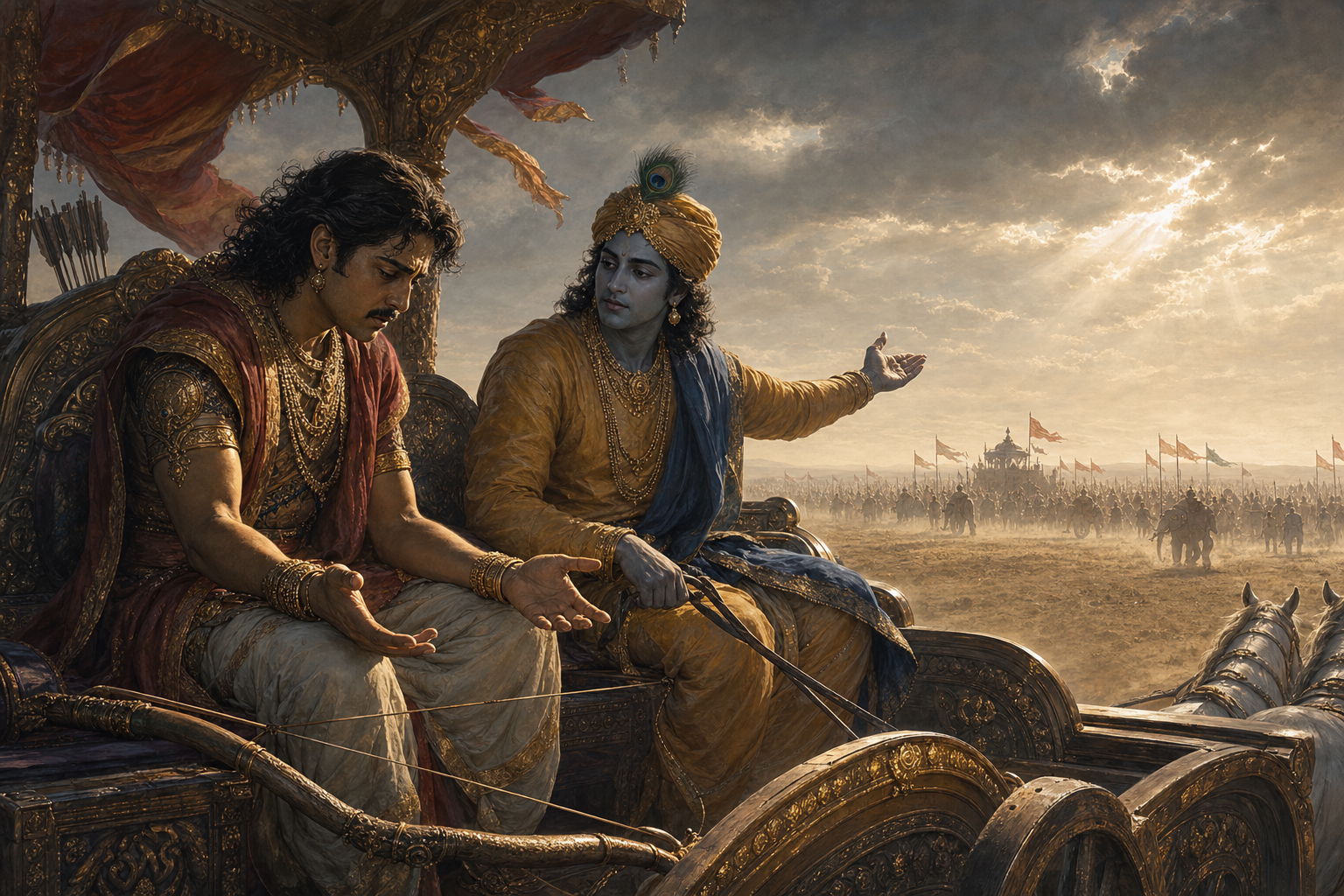
At Kurukshetra, Arjuna sees teachers, kinsmen, and companions on both sides. His crisis is physical as well as intellectual: his bow slips, his body burns, and he cannot remain steady. He foresees sin, family destruction, and social disorder, then concludes that he will not fight.
His moral vocabulary does not make his conclusion sound. Arjuna eventually recognizes karpanya-dosha, a collapse into faint-hearted self-pity, and describes his consciousness as dharma-sammudha-cetah, bewildered about dharma. That admission changes the situation. Instead of treating his present feeling as final wisdom, he becomes a disciple and asks Krishna to teach him what is truly beneficial.
The correction is not a command to suppress compassion. It is a discipline for separating compassion from attachment. In Bhagavad Gita 3.4, mere refusal to act does not produce freedom from action. In 2.48, Arjuna is told to act while established in yoga. The battlefield remains, but the actor’s relationship to duty, success, failure, and personal reward must change.
If your condition resembles Arjuna’s, use karma-yoga as a sequence rather than as a slogan:
- Clarify svadharma. Identify the responsibility that is actually yours, not the role your vanity wants and not every demand another person places on you.
- Test the action ethically. Ask whether it protects or harms those who depend on you, whether it serves justice, and whether refusing would merely transfer the cost to someone more vulnerable.
- Consecrate the work. Perform it as service to the highest principle you recognize, rather than as a project for defending your image.
- Relinquish ownership of the fruit. Plan carefully and work competently, but stop treating one preferred outcome as the condition of your inner stability.
- Stay steady through praise, blame, gain, and loss. Equanimity is part of the action, not a reward postponed until the action succeeds.
Relinquishing fruits does not mean neglecting consequences. You still prepare, choose means proportionate to the duty, and correct mistakes. What you relinquish is the possessive claim that the world must obey your plan before you can remain composed.
Bhagavad Gita 18.4-9 makes the distinction sharper. Abandoning duty through confusion is tamasic. Abandoning it because it is troublesome or painful is rajasic. Sattvic renunciation performs necessary duty while releasing attachment to the act and its reward. This is why an uncomfortable duty cannot be dismissed merely by calling withdrawal sannyasa or tyaga.
None of this turns every conflict into a sacred war. Arjuna faces a tragic and highly specific struggle involving justice, order, and responsibility. The transferable principle is narrower: do not use elevated language to evade a just and unavoidable obligation. Dharma still requires examination of the action, its means, and those it will affect.
The mature result is the steadiness associated with the sthita-prajna in 2.55-72. Such a person is not inert. The senses are governed, insight is stable, and action no longer depends on emotional turbulence. Arjuna’s transformation is therefore a recovery of agency: he acts without returning to the possessiveness that first distorted his judgment.
Rama’s lesson: let clear dispassion mature into inquiry
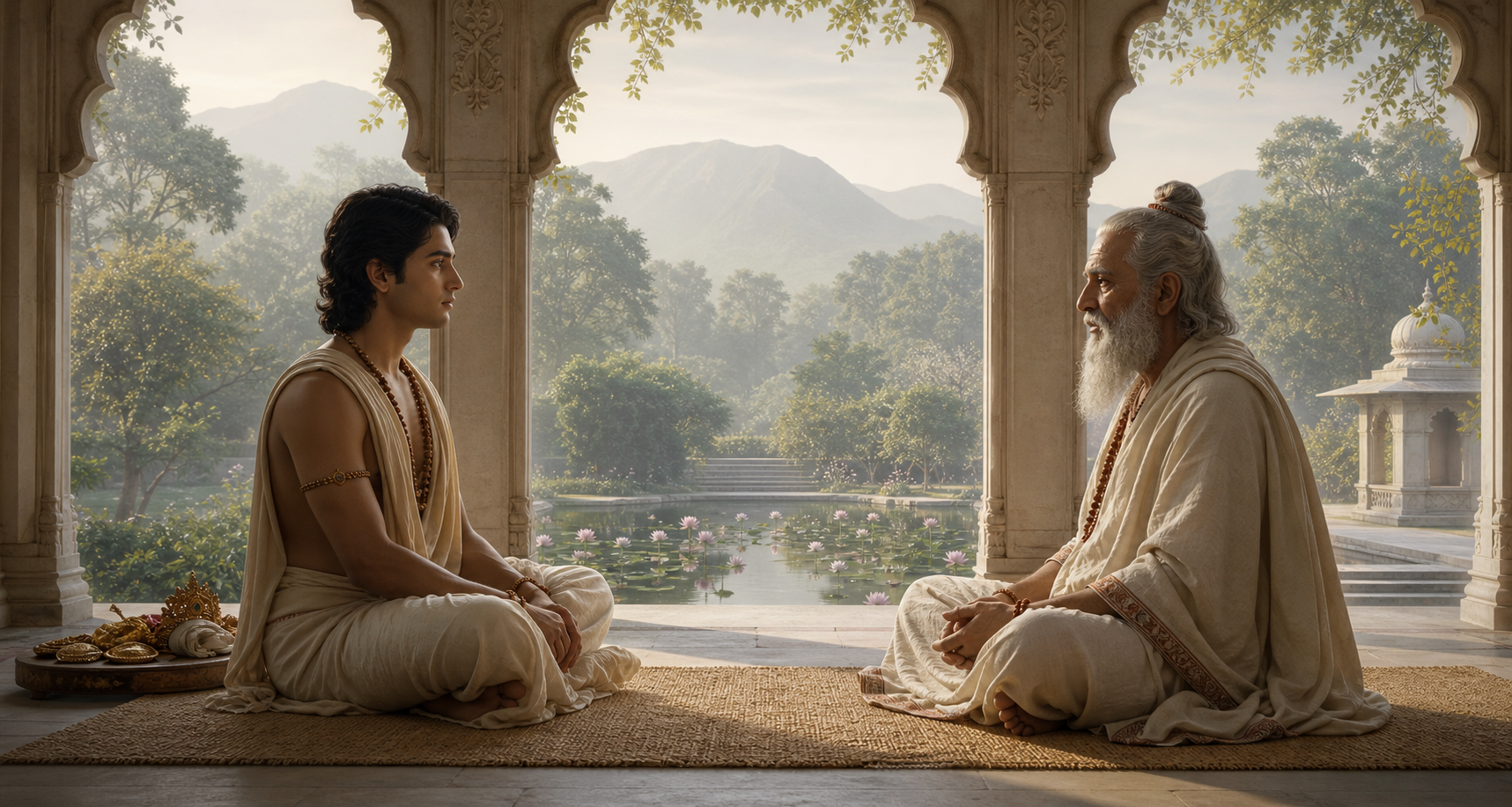
Rama’s silence arises under different conditions. After pilgrimage and sustained exposure to the changing conditions of human life, he sees the instability of pleasure, status, youth, possession, and the mind’s projections. His withdrawal is not an attempt to escape one intolerable assignment. It is a calm disenchantment with the promise that transient experience can yield permanent fulfilment.
This is nirveda or vairagya: dispassion ripened by discernment. Because the mind is already capable of quiet attention, the appropriate discipline is vichara, sustained inquiry into experience, causality, mind, identity, bondage, and freedom. Vasishta does not try to restore Rama’s appetite for ordinary rewards. He helps Rama discover what remains when those rewards are no longer treated as ultimate.
The traditional six-part progression through Vairagya, Mumukshu Vyavahara, Utpatti, Sthiti, Upashama, and Nirvanam is itself instructive. Dispassion is a beginning, not a certificate of realization. It must mature into a disciplined desire for liberation, examination of how experience appears, understanding of how mental constructions persist, quieting of those constructions, and stabilized freedom.
You can translate vichara into questions that expose where the mind is granting ultimacy to something transient:
- What exactly is changing in this situation, and what am I pretending should remain permanent?
- Which part of my suffering comes from the event, and which part comes from the identity I have attached to it?
- What story is the mind adding through memory, anticipation, comparison, or possession?
- If success could not complete me and failure could not diminish the Self, what action would still be appropriate?
- Can I continue or leave without resentment, superiority, or the need to make someone else validate my choice?
The last question matters because genuine vairagya does not need to punish the world. It neither clings to activity nor makes a possession of inactivity. Rama can return to governance because knowledge has removed the compulsion that previously made worldly life seem either fascinating or intolerable.
Jivanmukti, freedom while living, is the practical culmination. A liberated person may govern, teach, parent, serve, or retire according to circumstances. The outer form does not establish freedom; the absence of grasping does. Rama’s return to just rule therefore does not cancel his renunciation. It demonstrates that dispassion and responsible participation can occupy the same life.
This grammar is recognizable across the wider dharmic family. Buddhist ethics, concentration, and wisdom prevent insight from becoming morally indifferent. Jain vairagya and aparigraha join right vision to non-possession. Sikh seva and nirvair unite service with freedom from hostility. The forms differ, but non-clinging is not treated as permission to abandon compassion.
A dharma-first test for your own decision
Compare the two conditions before choosing a discipline
| Question | Arjuna-like condition | Rama-like condition |
|---|---|---|
| What is the energetic tone? | Agitated, constricted, fragmented, or desperate for relief | Quiet, spacious, stable, and capable of patient attention |
| What has triggered withdrawal? | A painful duty, conflict, feared loss, or attachment under pressure | Durable discernment about impermanence and the limits of worldly fulfilment |
| How does the mind treat action? | Action feels unbearable, while refusal is imagined as immediate purity | Action and non-action can both be examined without compulsion |
| What is the central danger? | Avoidance disguised as compassion or spirituality | Dispassion left immature, without sustained inquiry or ethical grounding |
| What is the first discipline? | Clarify duty, purify intention, act, and relinquish the fruits | Practise vichara and contemplation until understanding becomes stable |
| What shows maturation? | Responsible action with equanimity | Freedom from grasping expressed through appropriate action or non-action |
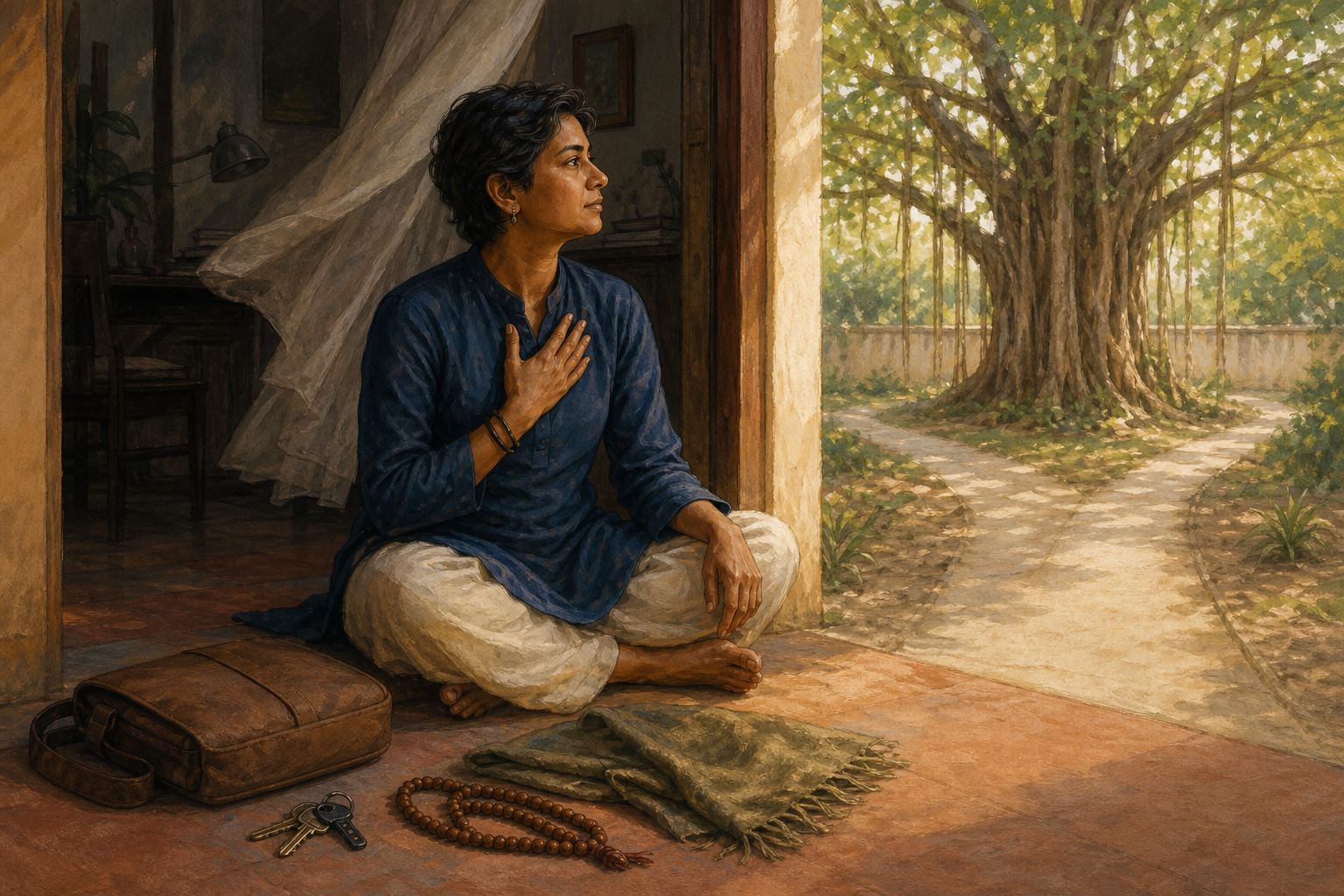
Many real decisions contain both conditions. You may possess genuine insight into the emptiness of status while also feeling wounded by a recent humiliation. You may understand that a role is temporary while still wanting to leave before completing a responsibility. When the states are mixed, address the agitation first. A mind seeking relief can recruit sound philosophy to defend an unsound conclusion.
Pass the decision through six gates
- Name the proposed withdrawal concretely. Replace “I need to renounce” with a plain statement such as “I intend to stop doing this duty, and these people will carry the consequences.” Concrete language exposes what spiritual language can hide.
- Separate duty from ego. List what justice, truth, promises, dependants, and legitimate responsibilities require. Then separate those obligations from your wish to be admired, indispensable, victorious, or morally spotless.
- Check for adharma and immediate danger. Dharma does not mean obeying every authority or remaining passively available to harm. If safety is at stake, secure it first. If the role itself demands injustice, refusing that demand may be the dharmic action rather than an abandonment of dharma.
- Test the motive without flattering it. Ask whether you would make the same choice if nobody praised your sacrifice, if leaving brought no prestige, and if discomfort continued afterward. A choice dependent on imagined relief needs further purification.
- Match the discipline to the state. If attention is agitated, perform the next rightful and reversible action as karma-yoga while relinquishing the demand for a preferred result. If attention is calm and durable, give vichara real space before deciding whether outer withdrawal is necessary.
- Judge the movement by what it produces. Sound renunciation should increase lucidity, compassion, non-possessiveness, and responsible conduct. Growing resentment, indifference, superiority, or obsession with how others view your choice indicates that clinging has changed costume rather than ended.
At work, this may mean not resigning in the immediate aftermath of humiliation. Complete what is legitimately due, let the emotional surge settle, and then examine whether the role still serves dharma. If you ultimately leave, provide an honest handover rather than using non-attachment to excuse disorder.
In family life, a necessary boundary and the abandonment of a dependant are not the same act. Ask what protection, truth, and responsibility require before calling distance renunciation. In public or community service, you may need to relinquish recognition rather than relinquish service itself. In spiritual practice, you may need to surrender the identity of being advanced rather than collect a more impressive form of austerity.
The point is not to force every person back into the role they already occupy. It is to prevent an unexamined inner movement from deciding the outer question. Sometimes dharma requires staying. Sometimes it requires leaving. In both cases, the decision becomes cleaner when fear, possessiveness, and the hunger for vindication no longer cast the deciding vote.
Key takeaways
- Outer withdrawal is not proof of renunciation. Examine whether the mind is clouded by moha or clarified by vairagya.
- An Arjuna-like crisis begins with agitation and confused duty. Its first medicine is karma-yoga: discern the responsibility, purify the intention, act steadily, and release ownership of the result.
- A Rama-like dispassion is calm, durable, and inquisitive. Its first medicine is vichara supported by contemplation, not a hurried return to distraction.
- Svadharma is not blind obedience. The action itself must be tested against justice, protection, truth, and its effects on the vulnerable.
- Authentic renunciation makes compassion and responsibility more stable. It does not use transcendence to excuse neglect.
Before your next irreversible decision, write two sentences: “The duty that remains mine is…” and “The fruit I am demanding is…” If the second sentence is controlling the first, begin with Arjuna’s discipline. If the mind can release that demand and remain quietly intent on truth, begin Rama’s inquiry. Let the next step reveal renunciation through clarity, not through appearance.