
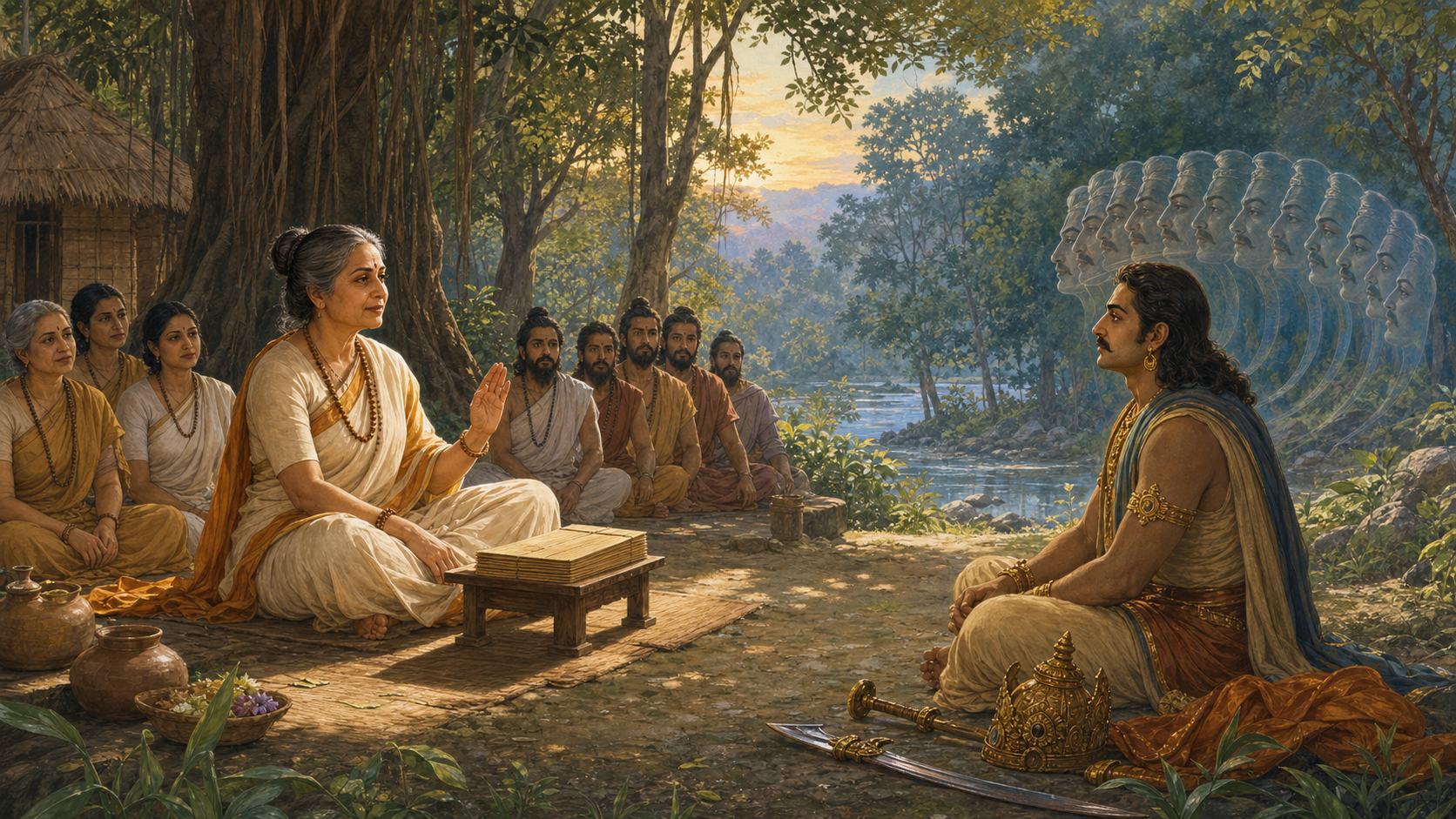
You may have heard that Anasuya defeated, corrected, or humbled Ravana in a Vedic debate. If you are deciding whether to repeat that claim in a temple talk, study circle, classroom, or online discussion, you do not have to choose between uncritical repetition and dismissing the tradition altogether.
The defensible answer is more useful: the formal debate belongs to living kathā and later retelling, not to the episode preserved in critical editions of Vālmīki’s Ramayana. Anasuya’s authority, however, does not depend on that debate being an early textual event. Her place as a learned teacher is already secure, and it belongs to a much wider record of women speaking with Vedic, philosophical, and ethical authority.
Begin with the claim the textual record can support
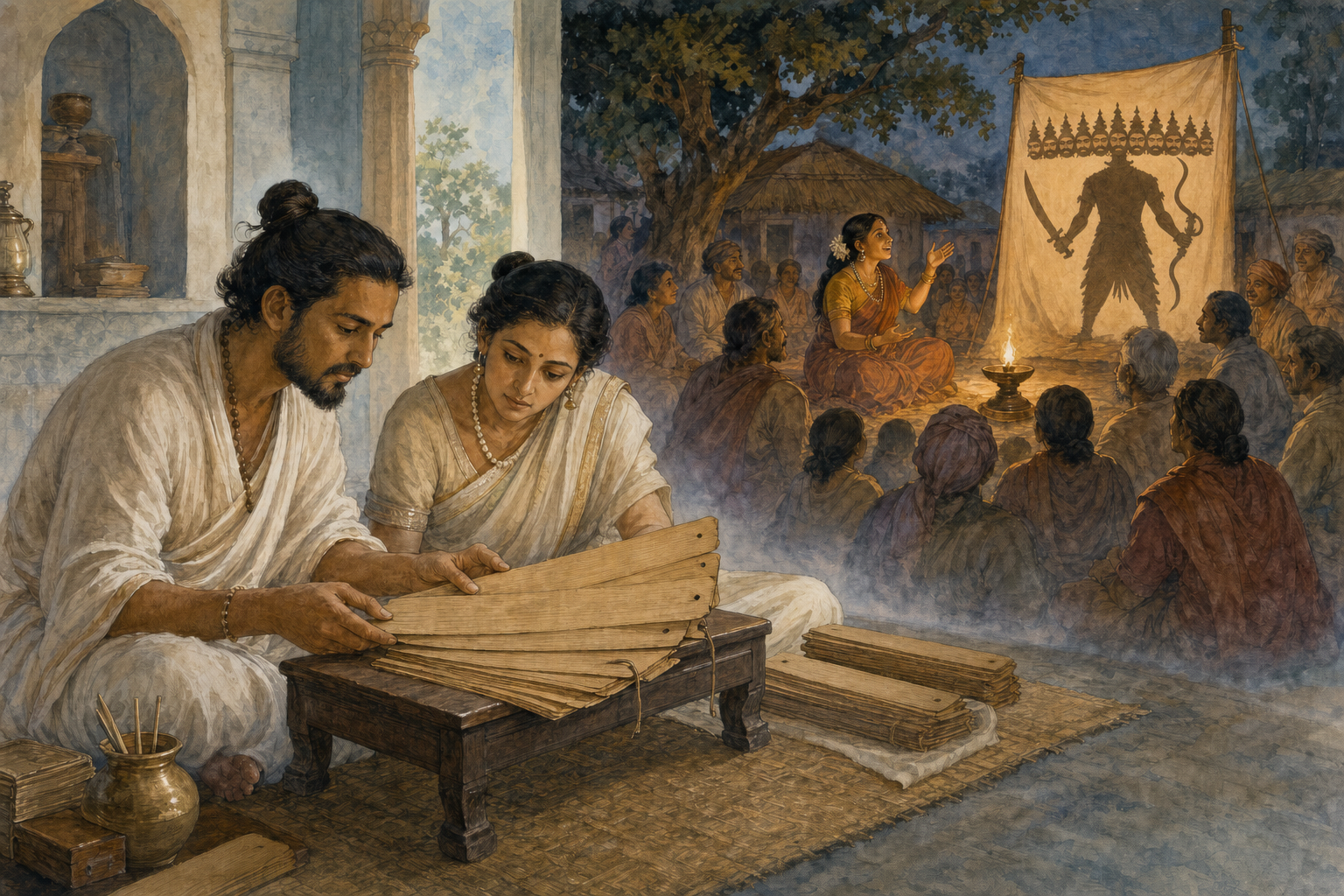
A formal, line-by-line exchange between Anasuya and Ravana is not preserved in critical editions of Vālmīki’s Ramayana. What the Ramayana does preserve is substantial: during the forest exile, Anasuya receives Sita, blesses her, and teaches about marriage, self-mastery, and compassionate duty.
Later narrators extend that established authority by placing Anasuya before Ravana, the learned king whose desires have escaped ethical restraint. The resulting confrontation works because its characters already embody a recognizable tension: disciplined wisdom faces scholarship corrupted by ego. That coherence explains the motif’s appeal, but coherence is not the same thing as textual attestation.
| Layer of tradition | What you can responsibly say | What it does not establish |
|---|---|---|
| Vālmīki Ramayana and the itihāsa setting | Anasuya counsels Sita with recognized ethical authority. | A recorded formal debate between Anasuya and Ravana. |
| Purāṇic remembrance | Anasuya’s austerities, including the episode involving Brahmā, Viṣṇu, and Śiva, magnify her stature as a woman of tapas. | That every later Anasuya narrative occurs in Vālmīki’s account. |
| Regional and oral kathā | Narrators may stage Anasuya’s correction of Ravana to teach restraint, humility, and righteous kingship. | A verbatim passage from the critical Ramayana text. |
| Wider Vedic and classical tradition | Named women act as seers, philosophical interlocutors, and ethical teachers. | The historicity of one particular meeting between Anasuya and Ravana. |
Three labels will keep your language precise. Call an episode textually attested when the relevant text preserves it. Call it tradition-attested when later or oral communities transmit it. Call an interpretation thematically consonant when it agrees with the ethical architecture of the older narrative. The Anasuya-Ravana debate is tradition-attested and thematically consonant; Anasuya’s instruction of Sita is textually attested.
This is not a contest between faith and scholarship. A later kathā does not become worthless because it is later, and an ethically fitting scene does not become an early textual passage merely because it ought to have happened. Naming the layer lets you receive each form of tradition for what it actually offers.
Anasuya’s authority exists before Ravana enters the scene
If you remember Anasuya only as the devoted wife of Sage Atri, you will miss how her narrative role works. Her pativratā-dharma and her intellectual authority are not competing identities. Her discipline gives force to her teaching; it does not reduce her to silence.
Vālmīki’s forest episode places a central moral figure, Sita, in conversation with an elder woman whose words merit attention. Anasuya does more than display private virtue. She interprets duty, blesses, advises, and helps shape the moral horizon within which Sita’s own decisions are understood. Her Ramayana counsel and celebrated Purāṇic tapas provide independent grounds for recognizing her as a strī-ācāryā, a woman teacher.
That distinction matters when you discuss women’s Vedic authority. Authority in the Dharmic record is not one office with one entrance examination. It appears in several forms:
- A ṛṣikā is remembered in relation to Vedic revelation and hymn.
- A philosophical interlocutor tests a proposition through disciplined questioning.
- An ethical teacher interprets dharma for another person facing consequential choices.
- A tapasvinī acquires moral weight through austerity and self-mastery.
- A counselor addresses a ruler, household, or community whose conduct affects others.
Anasuya’s strongest attested role is not that of a contestant collecting a rhetorical victory. It is that of a teacher whose speech is credible because knowledge and discipline agree in her life. If you evaluate her only by whether she publicly defeats a famous man, you quietly accept the wrong standard: that a learned woman becomes authoritative only after male power certifies her.
A better reading asks three questions of the forest encounter. Who is permitted to explain dharma? What makes the listener take that speech seriously? What kind of life stands behind the instruction? In each case, Anasuya is an active bearer of knowledge rather than a decorative emblem of virtue.
Women scholars are a pattern, not an isolated exception
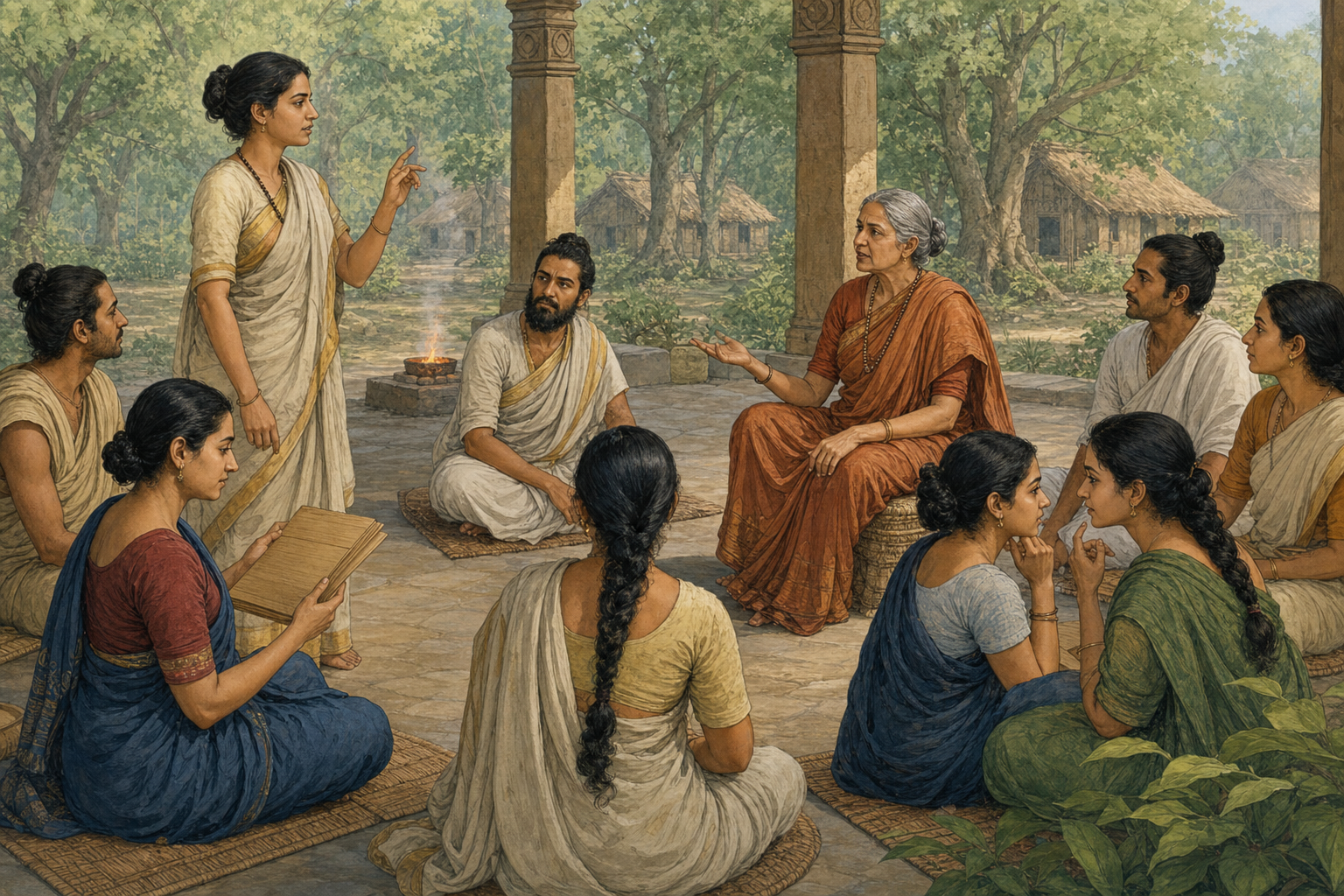
No single celebrated woman can settle every historical question about education, access, or social equality in ancient India. It would be too broad to claim that every woman in every period enjoyed the same institutional opportunities as every man. The opposite claim is also untenable: women are not absent from the tradition’s recognized forms of intellectual authority.
The record gives you a series of named women rather than an anonymous ideal. The Ṛgveda remembers ṛṣikās including Vāk Ambhṛṇī, Lopāmudrā, Ghoṣā, Apālā, and Viśvavārā. Vāk Ambhṛṇī is associated with the Devī Sūkta. The Upanishadic world preserves Gargī Vācaknavī’s demanding exchange with Yājñavalkya and Maitreyī’s philosophical reflections. The Mahābhārata presents Sulabhā in a searching dialogue with King Janaka.
These women do not all exercise the same kind of authority, and that is precisely the point. Vāk’s place in Vedic memory is not identical to Gargī’s questioning, Maitreyī’s reflection, Sulabhā’s royal dialogue, or Anasuya’s counsel to Sita. Treating them as interchangeable would erase the evidence you are trying to honor. Read them as a continuum of distinct intellectual roles.
- For Vedic participation, begin with the named ṛṣikās and the hymnic tradition in which they are remembered.
- For philosophical argument, turn to Gargī and Maitreyī rather than making Anasuya carry the entire claim.
- For a woman challenging royal confidence, Sulabhā’s dialogue with Janaka offers a textually grounded comparison.
- For ethical instruction joined to tapas, Anasuya’s counsel to Sita supplies the clearest basis.
This method produces a narrower but stronger conclusion: women appear within the Vedic and classical archive as knowers, questioners, teachers, and disciplined interlocutors. You do not need to exaggerate that conclusion into a claim of universal social equality. Nor should you weaken it into the idea that a few women were merely ornamental exceptions.
A wider Dharmic view reveals comparable forms of learned and disciplined female agency, but the traditions should not be flattened into one institution. The Therīgāthā preserves the voices of Buddhist elder nuns, while Dhammadinnā’s dialogue in the Cūḷavedalla Sutta, MN 44, displays doctrinal precision. Śvetāmbara Jain remembrance regards Mallinātha as a female Tīrthaṅkara, and learned sādhvīs belong to Jain religious life. Sikh history honors Mata Khivi’s work in sustaining langar, Bibi Bhani’s stewardship in the Guruship lineage, and Mai Bhago’s resolute leadership.
Those Buddhist, Jain, and Sikh examples are not evidence of Vedic authorship, and they should not be presented that way. They establish a related civilizational point: Dharmic cultures have remembered women through teaching, renunciation, philosophical precision, institutional service, and courageous leadership. Unity becomes more credible when it preserves these differences.
Ravana makes the test of knowledge ethical, not merely intellectual

The Anasuya-Ravana motif loses its force if Ravana is reduced to an ignorant villain. His danger lies in the opposite direction. His lineage runs through Pulastya; he is remembered for Vedic and musical learning and for devotion to Śiva. Learning, lineage, devotion, and formidable power coexist in him with a failure of self-restraint.
That makes Ravana a sharper warning than a simple caricature. Information can enlarge a person’s power without correcting the person who uses it. Vidyā becomes wisdom only when it is accompanied by vinaya, continuing self-examination, and control of desire. Ravana can master bodies of knowledge while failing to master himself.
The imagined confrontation with Anasuya therefore places two kinds of power side by side. Ravana has sovereignty, accomplishment, and the capacity to compel. Anasuya has tapas, clarity, and speech that does not need coercion. The question is not who can speak more impressively. It is whose knowledge produces conduct aligned with dharma.
Rājadharma makes that test especially demanding for a ruler:
- Desire and anger must be bound by the welfare of those subject to royal power.
- Promises, hospitality, and non-injury limit what a ruler may do, even when he has the strength to do otherwise.
- The dignity and autonomy of women are not private inconveniences that sovereignty may override.
- Learning must produce humility and restraint rather than furnish excuses for domination.
Once royal desire violates a woman’s dignity, the failure is not merely personal. It corrodes the moral basis of rule. This is why the feminine voices surrounding Ravana matter. Sita’s reasoning in Aśoka-vātikā refuses his moral premises. Mandodari’s admonitions supply foresight he will not accept. Anasuya’s counsel, whether addressed to Sita in the attested episode or extended toward Ravana in later kathā, represents the disciplined wisdom he lacks.
You can apply the same test beyond the epic whenever impressive learning asks for your deference. Does knowledge make the speaker more humble? Does the person accept limits when desire or anger is frustrated? Does power protect the dignity of those who cannot compel it? Does instruction bear the fruit of service, justice, and self-command? Credentials may answer the first question of competence. They cannot answer the remaining questions of character.
Use a five-step method when teaching the tradition
You can preserve both rigor and reverence by making the status of a story visible. The following method works for a family kathā, a public lecture, a social-media claim, or a study of regional Ramayana traditions.
- Write down the exact claim. “Anasuya corrects Ravana in later retellings” is different from “Vālmīki records a debate between them.” Do not investigate a vague memory when the disputed wording is specific.
- Identify the textual layer. Ask whether the claim belongs to śruti, itihāsa, purāṇa, a regional telling, or oral upākhyāna. These categories can interact without becoming interchangeable.
- Separate attestation from interpretation. Whether a scene is present is one question. What moral truth a later community communicates through it is another. Answering the second cannot substitute for answering the first.
- Test the motif against attested character and ethics. Anasuya’s role as teacher, Ravana’s learned arrogance, and the Ramayana’s repeated use of women’s counsel explain why the later confrontation feels fitting. This supports its interpretation, not an invented citation.
- Choose language that matches your confidence. Say “the critical text preserves” for an attested episode, “later kathā imagines” for a transmitted elaboration, and “the motif expresses” for your ethical reading.
If you need a three-sentence explanation for a study circle, use this structure:
- Textual status: Critical editions of Vālmīki’s Ramayana do not preserve a formal Anasuya-Ravana debate; they do preserve Anasuya’s authoritative counsel to Sita.
- Interpretive meaning: Later kathā brings her disciplined wisdom into conflict with Ravana’s learning without restraint.
- Wider evidence: Named ṛṣikās and interlocutors such as Vāk, Gargī, Maitreyī, and Sulabhā show that women’s intellectual authority does not rest on this later scene.
This formulation also avoids two common overclaims. Do not say that the motif proves complete equality for all women throughout ancient India. A set of distinguished figures cannot establish that. Do not say that women’s authority was foreign to the Vedic and Dharmic world. The named figures make that absolute denial impossible to sustain.
Key takeaways
- The formal Anasuya-Ravana debate is not preserved in critical editions of Vālmīki’s Ramayana.
- A later kathā can carry genuine ethical teaching without being misidentified as an early textual passage.
- Anasuya’s authority is independently grounded in her counsel to Sita and her remembered tapas.
- Women appear in Vedic and classical tradition through several distinct roles: ṛṣikā, philosopher, questioner, ascetic, counselor, and teacher.
- Ravana demonstrates why mastery of knowledge is not enough; vidyā requires vinaya, self-restraint, and just conduct.
- Cross-Dharmic parallels are strongest when Buddhist, Jain, Sikh, and Hindu forms of female authority are connected without being treated as identical.
The next time you encounter the motif, make two notes before repeating it: where the episode is attested, and what moral work the retelling is doing. That small discipline protects the credibility of Dharma while allowing Anasuya to stand where the tradition’s evidence places her: not as a prop in a doubtful quotation, but as a learned voice whose authority survives honest scrutiny.