
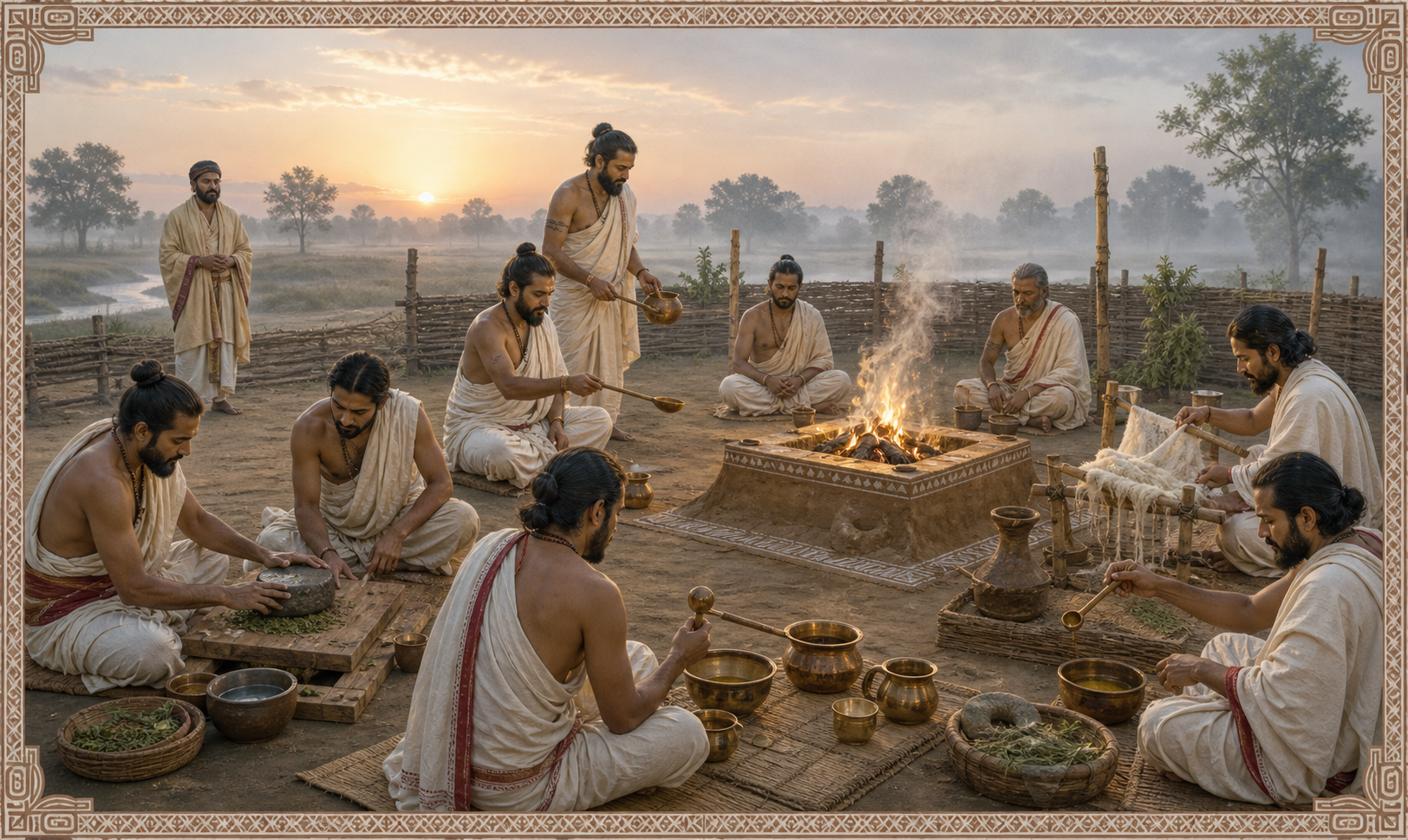
If you have encountered the name Abhiplava Yajna and want to know what ceremony it describes, resist the urge to begin with a guessed sequence of offerings. The first useful question is where Abhiplava belongs within the Vedic ritual system.
That change of approach matters. It lets you distinguish a secure description of the rite from a modern reconstruction that may borrow an ancient name without preserving its original ritual setting.
Start with the ritual map, not a guessed procedure
In this context, yajna does not simply mean worship in a general sense. It denotes an ordered sacrificial performance shaped by sacred offerings, mantra and prescribed ritual relationships. The name of a Vedic yajna therefore identifies more than an isolated devotional act.
Abhiplava is a significant Vedic rite belonging to the Soma group of sacrifices and forming part of Gavamayana. Gavamayana is itself an extensive and complex ritual arrangement. You should consequently read Abhiplava at several nested levels:
- Vedic yajna is the broad sacrificial setting.
- Soma sacrifice identifies the ritual family in which Soma is the central sacred offering.
- Gavamayana supplies the larger ceremonial framework.
- Abhiplava is a named rite situated within that framework.
This map prevents a common mistake: treating every named yajna as a complete, independent ceremony. Calling Abhiplava a Soma sacrifice is correct, but it is only the beginning of the explanation. Its connection to Gavamayana is part of its identity, not an optional historical footnote.
What Soma tells you about the character of the rite
Soma is not merely a decorative substance added to an otherwise generic fire ritual. The Soma sacrifices are centered on the offering of a sacred plant understood to possess divine qualities. Material, offering and sacred meaning are joined in the ritual category itself.
When you see Abhiplava classified among Soma sacrifices, you can therefore make two responsible deductions. Soma belongs near the ritual center rather than at its margins, and Abhiplava must be interpreted through the ceremonial world built around that offering.
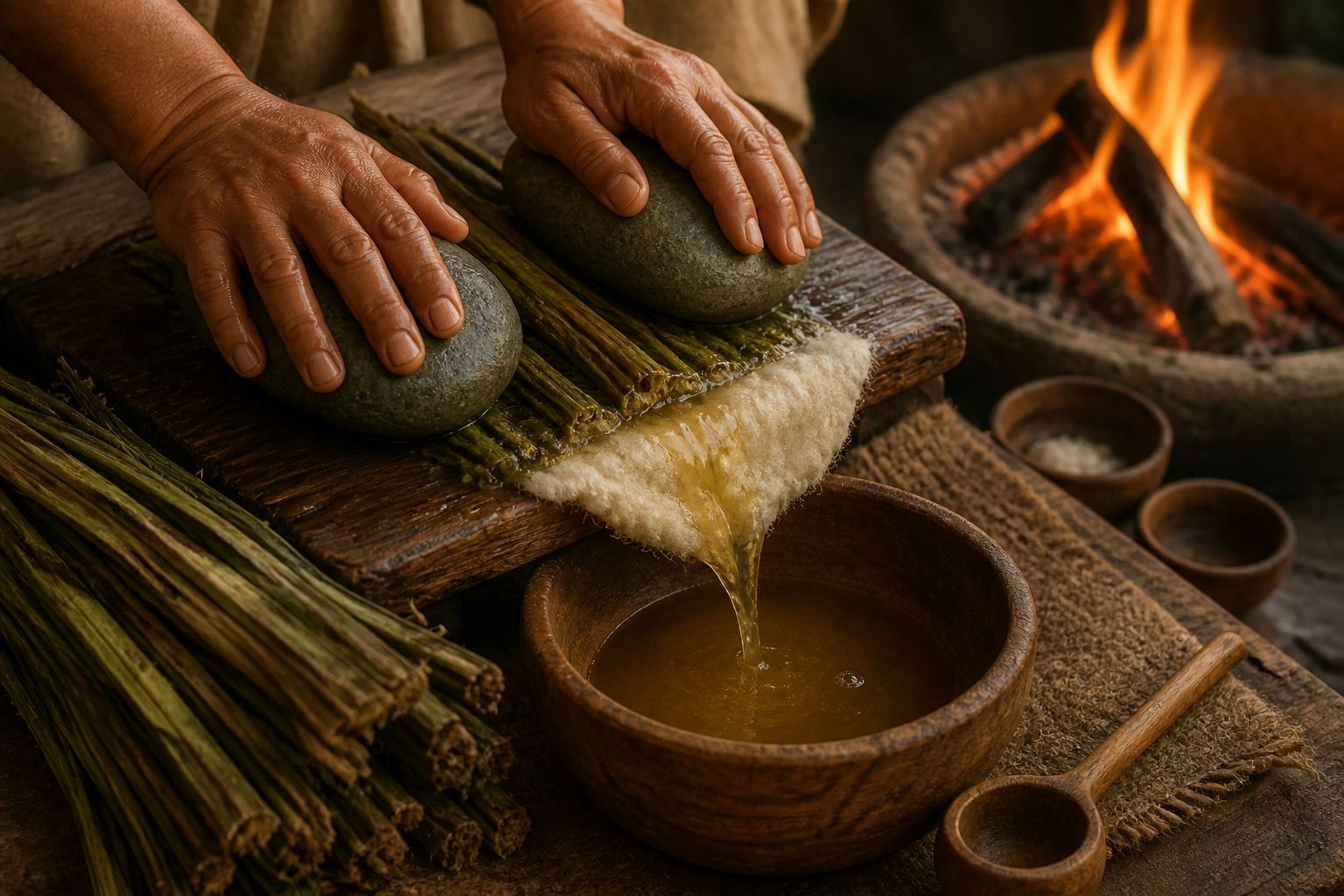
You cannot, however, move from that classification to an exact botanical identification, preparation method or claim about physical effects. Those are separate questions. A plant name does not turn a sacrificial system into a recipe, and a sacred description should not be recast as a modern medical or intoxicant claim without specific evidence.
Why the Gavamayana setting changes the interpretation
A rite embedded in an extensive ceremonial structure acquires meaning through its place in the whole. Its timing, relationships and liturgical purpose cannot safely be reconstructed from its name alone. This is why a short definition of Abhiplava can establish its classification while still leaving the detailed performance undescribed.
Use that distinction whenever you encounter a contemporary explanation. First determine whether it is offering a historical description, preserving a tradition-specific practice or proposing a modern devotional adaptation. These may all be legitimate subjects of discussion, but they are not interchangeable.
If a one-session household ceremony is presented under the Abhiplava name, look for an explicit explanation of how the ancient Gavamayana context has been adapted. Without that bridge, you should not assume that the modern procedure and the Vedic rite are identical. The responsible description is narrower: the modern ceremony uses or adapts the name.
Keep firm boundaries between knowledge and reconstruction
The following distinctions will help you assess an explanation without either dismissing the tradition or accepting unsupported detail:
| Question | What can be stated securely | What requires further authority |
|---|---|---|
| What is Abhiplava? | A named Vedic ritual belonging to the Soma group of sacrifices. | Its complete sequence of actions, recitations and offerings. |
| Where does it belong? | It forms part of the larger Gavamayana ritual arrangement. | Its precise function at every point in that extensive arrangement. |
| What is central to its ritual family? | The offering of Soma, a sacred plant associated with divine qualities. | An exact botanical identification or modern preparation method. |
| Can its name serve as a performance manual? | No. The name establishes classification and context. | Procedural instructions require a competent tradition and appropriately detailed ritual authority. |
| What benefits does it promise? | The classification alone establishes no specific personal result. | Claims about health, wealth, protection or other outcomes need their own textual or traditional basis. |
This disciplined boundary is especially important with elaborate Vedic rites. More detail does not automatically mean more accuracy. A confident list of ingredients, benefits or abbreviated steps may tell you more about a modern adaptation than about Abhiplava in its Gavamayana setting.
Key takeaways
- Read Abhiplava relationally: it is a Vedic Soma rite situated within Gavamayana, not just a free-floating name for sacrifice.
- Keep Soma’s sacred and sacrificial role in view; do not reduce the rite to a plant-identification puzzle.
- Ask whether an explanation is historical, tradition-specific or a modern adaptation before treating its instructions as ancient practice.
- Do not infer an exact procedure, promised benefit or botanical identity from the ritual classification alone.
- When practical performance is the goal, seek a competent ritual lineage and a detailed authority rather than improvising from a brief definition.
If you are adding Abhiplava to study notes, begin with one careful sentence: it is a Vedic Soma rite that forms part of Gavamayana. Mark questions about its detailed sequence, Soma preparation and claimed results as open until you can ground them in an appropriate ritual authority. That small habit preserves the structure of the tradition instead of filling its gaps with guesswork.


References
