
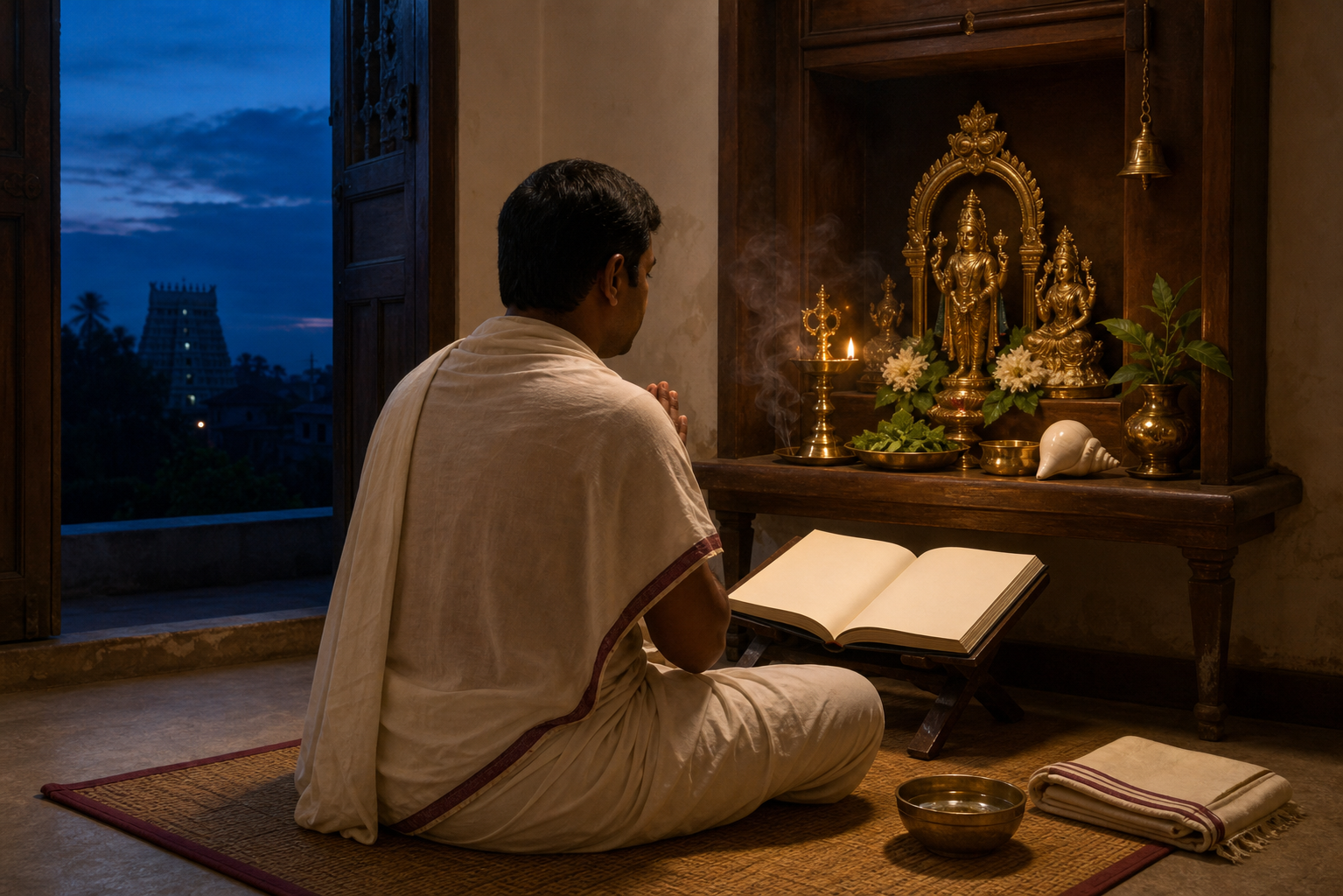
If you want to observe Dhanurmasam but cannot reach a temple every morning, the real question is practical: what should you do before dawn, how should Tiruppavai shape the rest of the day, and how can you keep the vrata steady after the first burst of enthusiasm?
You do not need to reproduce a temple ceremony at home. You need a repeatable rhythm: rise early, approach Sri Vishnu with cleanliness and attention, chant Andal’s words, understand the day’s pasuram, restrain one habit, and turn remembrance into service. That modest structure contains the essential movement of the observance.
Begin with the purpose of Andal’s vrata

Tiruppavai consists of thirty Tamil pasurams composed by Andal, the only female Alvar in the Sri Vaishnava tradition. They are recited during Margazhi, the Tamil month that falls roughly between mid-December and mid-January and corresponds to the winter season of Dhanurmasam worship. The hymns do more than provide words for morning parayanam. They teach you how a devotional life is assembled.
Andal speaks in a collective voice. Companions call one another to wakefulness, undertake a shared pavai nombu, praise the Lord, seek His grace, and move toward service. The waking is therefore both physical and spiritual. Getting out of bed before dawn matters, but so does waking from distraction, self-importance, resentment, and forgetfulness.
The discipline unfolds through collective vrata, daily remembrance, surrender, and kainkaryam. These are not four unrelated devotional options. Community helps you remain disciplined. Discipline makes remembrance regular. Remembrance softens the urge to control every result. Surrender then finds its visible form in service.
This sequence also corrects a common misunderstanding. Completing a recital is not the final objective. The mature aim is proximity to Sri Vishnu expressed through a life that belongs to Him. Accurate chanting matters, but the sound should gradually alter your habits, your speech, and the way you treat other people.
Build a dawn routine you can sustain for the month
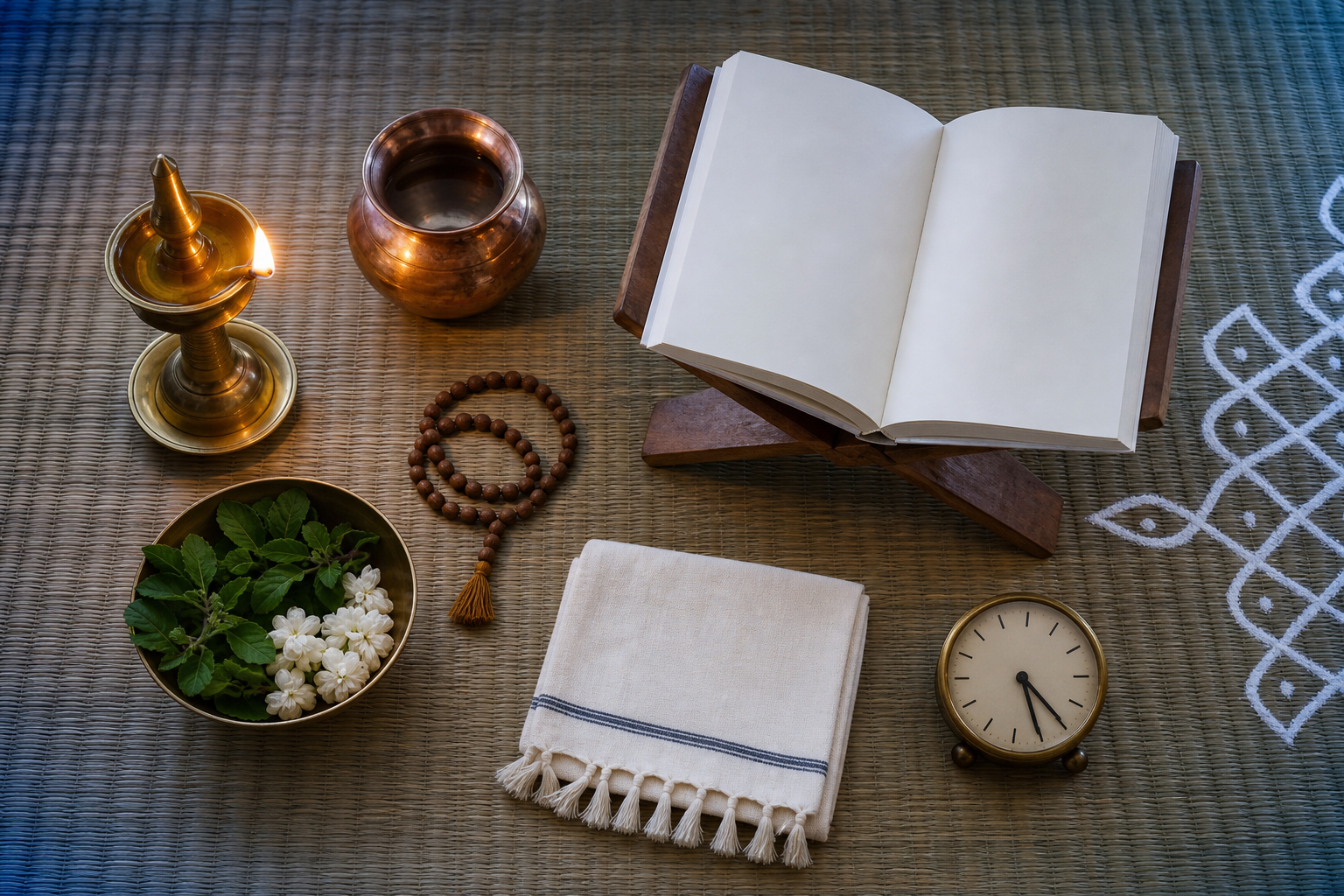
A useful Dhanurmasam routine begins the previous night. If you leave the text, pronunciation, waking time, and place of worship undecided, the morning starts with negotiation. Put your Tiruppavai text and meaning beside the place where you will sit. Keep whatever your household normally uses for worship ready. Settle on the form of recitation before going to sleep.
If your family, temple, or acharya has given you a procedure, that received practice takes priority. If you are beginning without a detailed household tradition, the following structure is a sound and manageable doorway:
- Rise before dawn. Early worship is not decorative to Dhanurmasam; it creates the quiet in which the month’s discipline becomes distinct from an ordinary day. Choose a waking time you can keep without turning every morning into a struggle caused by avoidably late nights.
- Become clean and make the place orderly. Bathe or follow the morning purification customary in your home. Light a lamp if that belongs to your practice. The point is to cross consciously from sleep and distraction into worship.
- State the intention of the vrata. You may use a simple personal prayer: you are observing Dhanurmasam for remembrance of Sri Vishnu, openness to His grace, and readiness for service. Do not present improvised words as a traditional mantra; their purpose is to keep your intention honest.
- Chant the Tiruppavai assigned to the day. A practical pattern is to give one pasuram particular attention each day, allowing the thirty hymns to lead you through the month. If your received custom prescribes a fuller parayanam, follow it.
- Read the meaning after recitation. Identify whom Andal is addressing, what kind of wakefulness is being requested, and what attitude toward the Lord appears in the verse. Even a brief engagement with meaning prevents the month from becoming a pronunciation exercise alone.
- Remain in remembrance. Continue with the divine name, a hymn already customary in your home, or a short period of quiet attention. The aim is not to accumulate the largest possible number of practices. It is to let the pasuram settle before ordinary activity begins.
- Name the day’s act of kainkaryam. Decide how devotion will leave the prayer space. Help a family member without being asked, give time to temple or community work, share food, support someone who is isolated, or correct a harsh habit in speech. Make the act concrete enough that you will know whether you did it.
On a constrained morning, shorten the practice without making it careless. Become clean, chant the day’s pasuram, read its meaning, bow, and carry one instruction from it into the day. A smaller observance performed attentively is more useful than an elaborate schedule that repeatedly collapses.
Do not let that shorter form become your automatic ceiling, however. Use days with more room for fuller recitation, study, family singing, or temple participation. The essential distinction is between flexibility and indifference: flexibility protects the vrata, while indifference slowly empties it.
Pronunciation can be learned gradually. Use a dependable Tamil text, transliteration, meaning, and a recitation taught within the tradition. Listen phrase by phrase and repeat without rushing. If you make a mistake, correct it and continue; anxiety about flawless performance can become another form of self-absorption. Reverence asks for care, not paralysis.
Carry the four disciplines beyond the prayer room
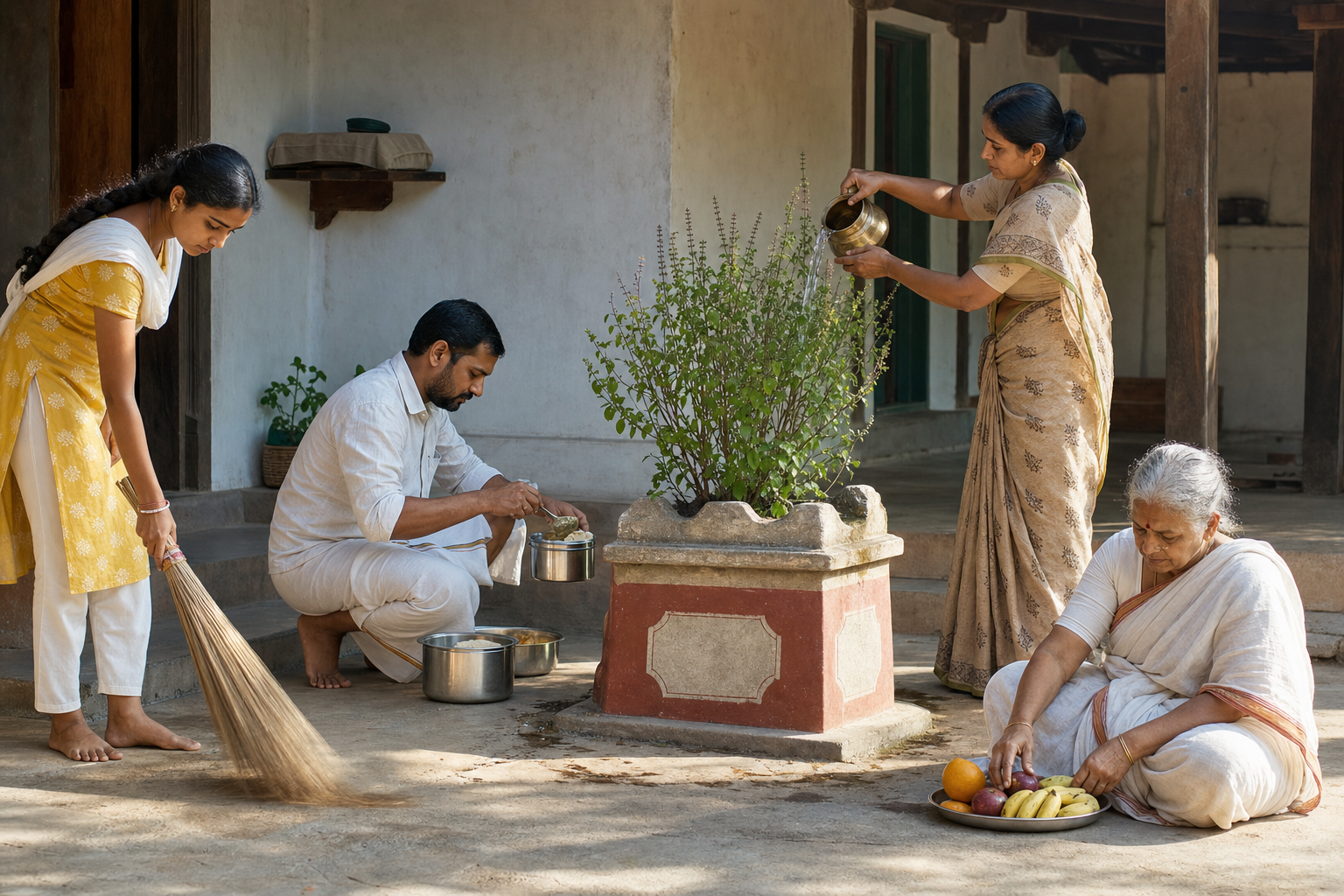
The morning recital gives the day its direction, but the vrata is tested after you stand up. Each of Tiruppavai’s central movements needs an ordinary, visible expression.
Vrata: choose restraint that exposes a real habit
Restraint becomes meaningful when it touches something that normally governs you. Reducing late-night entertainment may protect pre-dawn worship. Refraining from hostile or needless speech may make devotion audible in your conduct. Limiting impulsive consumption may reveal how often desire disguises itself as necessity.
Choose a discipline you can observe and examine. “I will be more spiritual” cannot guide a decision when temptation appears. “I will put the phone away early enough to rise for parayanam” can. These practical restraints are ways of supporting the vrata; they do not replace dietary or ritual rules received from your family, temple, or acharya.
Remembrance: give the pasuram a place in the day
Morning remembrance fades when it has no later cue. Select a natural transition—beginning work, preparing food, travelling, or returning home—and recall the divine name or the central thought of the day’s verse. The cue matters because it reconnects worship with the part of life in which distraction usually wins.
If you are studying a pasuram in translation, write down its main movement in plain language: wake up, join the devotees, praise rather than demand, depend on grace, or serve. You are not rewriting Andal. You are giving your mind a handle by which it can return to her teaching during the day.
Saranagati: act fully without claiming control
Surrender is not passivity. You still wake, chant, study, repair mistakes, and fulfil your duties. What changes is the claim you make over the result. Sri Vaishnava devotion places decisive weight on the Lord’s compassion rather than treating spiritual attainment as a possession manufactured by personal merit.
This is especially useful when the vrata exposes inconsistency. Do not answer a missed morning with either prideful excuses or despair. Resume the practice, make the practical correction that is needed, and offer the result. A lapse followed by honest return can teach dependence on grace more clearly than a month spent congratulating yourself.
Kainkaryam: serve without turning service into display
Service is where the month becomes verifiable. Choose work that is needed, not merely work that is visible. At home, that may mean taking responsibility for an overlooked task. In a temple, it may mean accepting an unglamorous duty. In the wider community, it may mean giving time, food, attention, or material help without making the recipient carry your need for recognition.
Link the act inwardly to Sri Vishnu. Otherwise, service can become another personal achievement. Kainkaryam is not simply being useful; it is usefulness offered with the understanding that your capacity, opportunity, and result rest within divine grace.
Use temple observances to deepen the home practice

A temple reveals the communal scale of Dhanurmasam. Pre-dawn Tiruppavai, Vedic recitation, archana, alankaram, naivedyam, lamps, tulasi, and collective darshan create a rhythm that a solitary room cannot reproduce. You need not imitate every element at home. Let temple worship teach you attention, order, and participation.
Vaikunta Ekadashi and Adhyayanotsavams are important points within this devotional season. Vaikunta Ekadashi is associated with special darshan arrangements, nama-japa, sacred hymns, and Ekadashi vrata. Adhyayanotsavams extend the month’s scriptural dimension through sustained recitation and listening. Together with daily worship, these observances show that Dhanurmasam joins devotion, disciplined conduct, and study rather than setting them against one another.
Plan temple participation deliberately. Check the temple’s published schedule for Tiruppavai parayanam, special sevas, Vaikunta Ekadashi, and Adhyayanotsavams, since timings and access arrangements are local. Expect greater footfall on major observances and weekends. Arriving early supports a less hurried darshan, while a weekday morning may allow more space for listening and quiet prayer.
Before going, learn the meaning of the pasuram being recited. During worship, listen for it rather than treating the chanting as background sound. After darshan, carry one phrase, divine name, or instruction back into your home routine. That simple before-during-after pattern turns a temple visit from an isolated event into nourishment for the whole vrata.
If your lineage observes food-related rules for Ekadashi or Dhanurmasam, receive those rules from an appropriate family elder, temple authority, or acharya. Do not assemble a severe regimen from disconnected customs and then mistake severity for devotion. The point of discipline is greater wakefulness and surrender, not competition over who can impose the most hardship.
Avoid the habits that empty the vrata of meaning
- Do not measure the month only by completed recitations. Keep the count if it helps consistency, but also ask whether your speech, patience, and willingness to serve are changing.
- Do not turn a collective hymn into a private self-improvement project. Chant with family or community when possible, encourage another devotee, and allow others to support your discipline.
- Do not separate sound from meaning. Careful recitation honours the hymn; studying the pasuram allows it to question your assumptions and direct your conduct.
- Do not confuse surrender with neglect. Prepare properly, make the effort, and accept that grace—not your devotional résumé—is decisive.
- Do not make austerity a source of superiority. A restraint that feeds comparison and contempt has strengthened the wrong tendency.
- Do not abandon the observance because one morning went badly. Identify the preventable cause, correct it that evening, and return at the next dawn.
One further mistake deserves attention: treating Dhanurmasam as a beautiful seasonal exception with no claim on the rest of the year. The special month concentrates practices that should remain recognizable afterward—early remembrance, companionship in dharma, reliance on grace, scriptural attention, and service. The seasonal vrata succeeds when at least part of its order survives beyond the season.
Key takeaways
- Tiruppavai’s thirty pasurams give Dhanurmasam an inner path: shared discipline, remembrance, surrender, and service.
- A workable home routine begins before dawn with cleanliness, intention, chanting, attention to meaning, remembrance, and a concrete act of kainkaryam.
- If you have received a family or acharya-led procedure, follow it; a simplified routine is a doorway for those who do not yet have detailed instruction.
- Choose restraints that directly protect worship or purify conduct instead of collecting harsh rules for their own sake.
- Use temple parayanam, Vaikunta Ekadashi, and Adhyayanotsavams to strengthen daily practice rather than replace it.
- When the routine breaks, correct the cause and resume. Steady return expresses saranagati better than either pride or discouragement.
Tonight, put the Tiruppavai text and its meaning where you will sit, prepare the place, decide when you will rise, and name the restraint and service that will accompany the next dawn. If the month is already underway, join the pasuram being observed in your community and study the earlier verses separately. Begin from where you are, but begin with enough clarity that Andal’s call follows you into the day.
References
- DharmaRenaissance Blog — Andal’s Tiruppavai: Four Transformative Steps to Attain the Divine Presence of Vishnu
- DharmaRenaissance Blog — Dhanurmasam at Yadagirigutta: Sacred Dawn Pooja, Vaikunta Ekadashi & Adhyayanotsavalu 2025–26
