

If the young person in front of you knows how to perform a ritual but cannot explain what dharma asks when a promise becomes inconvenient, a rumour begins to spread, or family duty conflicts with personal preference, more information alone will not solve the problem. The missing link is guided practice in moral judgment.
Your task as a parent, teacher, temple volunteer, or youth leader is not to deliver an encyclopedia of rules. It is to show a young Hindu how to move from a real question to a trustworthy source, from the source to careful reasoning, and from reasoning to conduct. That method makes Dharmashastra a living discipline rather than a collection of quotations.
Define success before choosing a text
A public call to guide youth through Dharmashastra at a Navratri programme in Bhilai names a genuine concern: young people need direction. Direction, however, must be translated into teachable outcomes. Otherwise, a class can produce confident repetition without understanding.
For teaching purposes, approach Dharmashastra as disciplined inquiry into dharma, duty, conduct, custom, and responsible judgment within Hindu textual and living traditions. Do not present it as a single modern handbook containing an instant rule for every situation. A useful programme should help the learner develop five capabilities:
- Recognition: noticing that a choice involves duty, truthfulness, restraint, responsibility, or the welfare of another person rather than mere preference.
- Source literacy: knowing whether a claim comes from a primary passage, a commentary, a sampradaya, a teacher, a family custom, or an unverified online assertion.
- Context: asking who is being addressed, what circumstances surround a teaching, and whether its scope is general or limited.
- Judgment: weighing relevant duties and explaining a decision without hiding behind a slogan.
- Practice: carrying the lesson into speech, study, family life, friendship, worship, service, or use of digital media.
Write the purpose of your course in one sentence before selecting readings. A workable objective is: “The learner will be able to identify a dharmic question, locate and describe a relevant teaching, explain its context, apply it carefully, and review the resulting conduct.” That sentence gives you a standard for deciding what belongs in the curriculum.
It also prevents a common mistake. Memorisation can support education, but it is not the final test of education. A student who remembers a line yet cannot distinguish the line from a teacher’s interpretation is not ready to use it responsibly. A student who can explain a principle but never attempts to practise it has completed only half the lesson.
Use a repeatable path from dilemma to conduct

Begin with a situation the learner can recognise. A friend asks for help concealing misconduct. A group chat circulates a humiliating allegation. A festival commitment clashes with another responsibility. An elder’s request feels unreasonable. These situations create an opening for study because the student has something concrete to examine.
Use the following sequence for a home discussion or youth class:
- Present the case without announcing the approved answer. Keep the description short and include only the facts needed to make a choice.
- Ask the learner what should be done and why. Record the first answer without ridicule or immediate correction; it reveals the assumptions the lesson must address.
- Name the dharmic question. Ask which duties, relationships, promises, harms, or responsibilities are involved. Separate “What do I want?” from “What ought I to do?”
- Introduce one relevant passage or teaching from a source trusted within your tradition. Identify the text or teacher, the translation or explanation being used, the immediate context, and the tradition through which you are presenting it.
- Test the application. Ask what changes if the person’s role, knowledge, intention, or circumstances change. A teaching understood only in the easiest case has not yet become a reliable guide.
- Return to the original dilemma. Let the learner revise the first answer, explain the revision, and state any uncertainty that remains.
- Choose one observable practice. At the next meeting, review what happened, what proved difficult, and whether the original interpretation still seems sound.
The countercase is especially important. Suppose a learner says that truthfulness requires saying everything one knows. Ask whether the same answer applies when information is private, incomplete, maliciously requested, or likely to be misunderstood. You do not need to supply a universal formula. The purpose is to make the learner examine the scope of a claim before treating it as absolute.
Prepare each lesson with a small teaching card. It should contain the case, the precise source, the explanation you are relying on, the scope of the teaching, the hardest likely objection, the action the learner can attempt, and the question you are not yet able to answer. The last item gives the teacher permission to be honest. “I do not know; let us verify it” models more respect for shastra than an improvised answer delivered with certainty.
Keep the action proportionate to the lesson. A discussion of speech may end with verifying a claim before forwarding it. A lesson on responsibility may end with completing an agreed duty without being reminded. A lesson on self-restraint may end with noticing the moment between an angry impulse and a response. The action should be visible enough to review but not turned into a performance for approval.
Teach learners to label authority and context
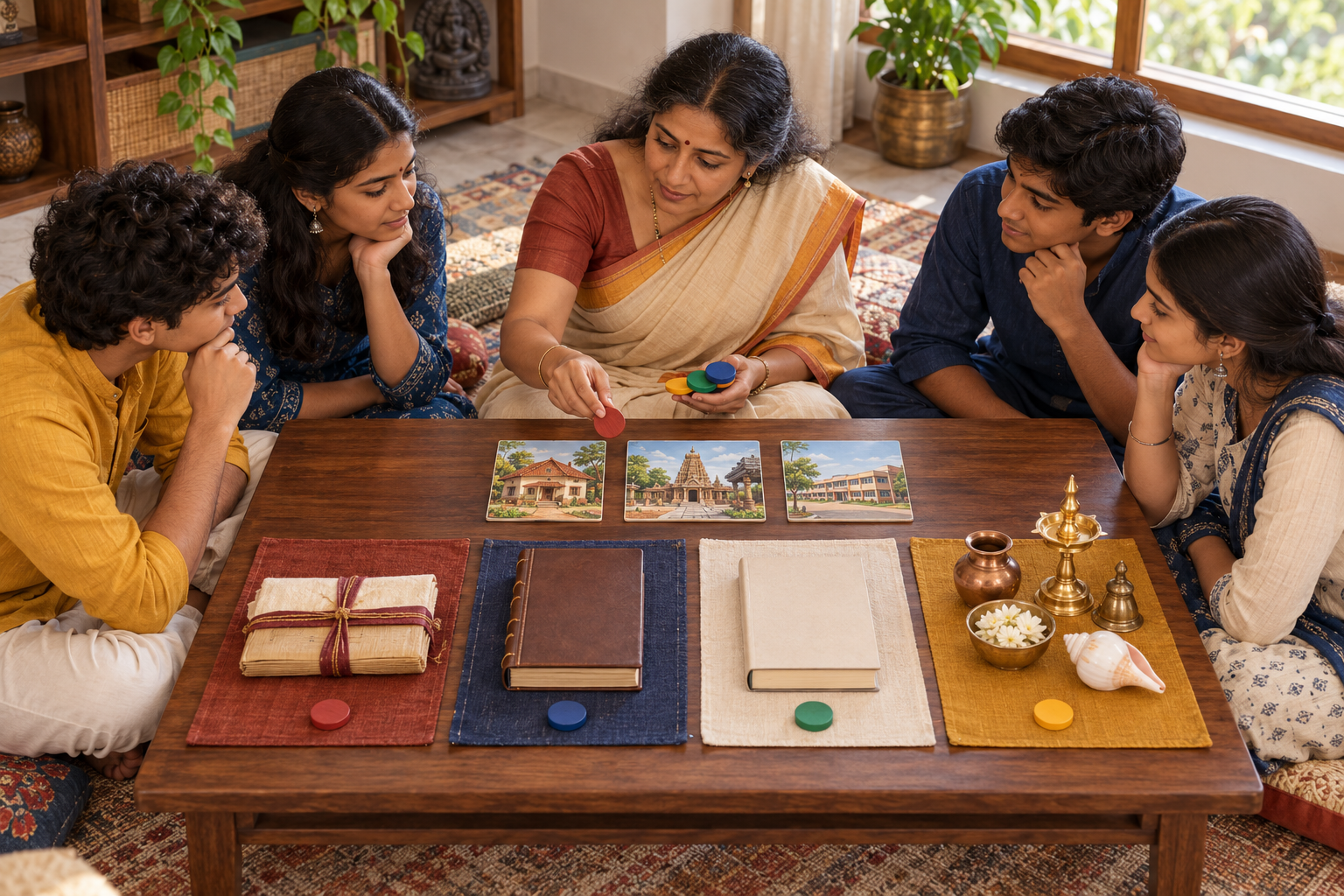
Young Hindus now encounter religious claims in classrooms, family conversations, short videos, forwarded messages, temple talks, and public debate. A claim can sound traditional merely because it contains a Sanskrit term or appears beside an image of a deity. Dharmashastra education must therefore include a method for checking authority.
Place a clear label beside every claim used in a lesson:
- Primary passage: the actual words being studied, accompanied by enough information to locate them again.
- Commentary or translation: another person’s rendering or explanation of those words.
- Sampradaya teaching: the way a particular lineage or community understands and transmits the matter.
- Family, regional, or temple custom: a living practice whose authority and scope should be stated accurately.
- Teacher’s synthesis: your own attempt to connect the material to the case under discussion.
- Unverified assertion: a claim that still needs a reliable provenance before it is taught as dharma.
These labels do not declare every category equal. They stop one category from being disguised as another. A family observance should not be falsely advertised as the universal practice of all Hindus. A teacher’s inference should not be placed inside quotation marks as though it were the primary passage. A popular message should not gain authority merely through repetition.
Train the learner to apply three filters. First, provenance: where did this claim come from, and can it be found again? Second, scope: to whom and under what conditions is it being applied? Third, interpretation: whose explanation connects the words to the present situation? Writing those three answers beside a quotation can prevent many avoidable arguments.
When Hindu traditions differ, name the difference at the correct level. You can say, “This is how our sampradaya teaches the matter,” or, “This temple follows this discipline for its participants.” You can also acknowledge that another commentary, community, or family follows a different interpretation. Precision does not weaken conviction. It keeps conviction from becoming a false claim about everyone else.
Do not rush to manufacture agreement where it does not exist, and do not teach disagreement as a reason for contempt. The educational task is to show the learner how to locate a position, understand its authority, follow the tradition being taught, and describe other positions truthfully. That combination forms confidence without carelessness.
Match the method to maturity and measure visible growth

For younger children
Use a short story, a familiar relationship, and one observable action. Ask who made a promise, who needed help, what choice was made, and what could be done differently. Let ritual participation, respectful speech, care for shared spaces, gratitude, and keeping small commitments provide the field of practice. Technical disputes and abstract classifications can wait until the child can connect a teaching to conduct.
For adolescents
Use cases in which duties appear to compete. Invite objections and require reasons. Give the learner a viral religious claim and ask for its provenance, scope, and interpretation before discussing whether it is sound. Adolescents should be allowed to discover that an initial answer can be sincere yet incomplete. Correcting a view after finding better evidence is intellectual discipline, not defeat.
For older youth
Ask them to distinguish a primary passage from its translation and commentary, compare how explanations reach practical conclusions, and identify where uncertainty remains. Let them prepare a case discussion, assist a younger group, participate in a suitable act of service, or examine how a local custom is explained by the people who practise it. Responsibility deepens learning when it includes preparation and review.
Methods that sabotage the lesson
Avoid treating every question as disloyalty. If a student is punished merely for exposing confusion, the student may learn to conceal uncertainty rather than resolve it. Require respectful questions, but answer the substance of those questions.
- Do not use shame as a substitute for explanation. State the duty, the reason, the source, and the expected conduct.
- Do not extract a sentence from its setting and pretend context cannot affect application.
- Do not confuse personal taste, family habit, and universal obligation. Label each accurately.
- Do not turn every lesson into a political monologue. Public events can provide cases, but the student must still examine truthfulness, duty, restraint, evidence, and conduct.
- Do not train only for debate. A learner who defeats an opponent but cannot govern speech or fulfil a responsibility has missed the formative purpose.
- Do not hide uncertainty behind Sanskrit vocabulary. Define a term in language the learner understands, then show how the term is being used in the teaching at hand.
Measure progress through work you can actually inspect. Can the learner distinguish quotation from interpretation? Can the learner locate the authority behind a claim? Can the learner identify the people and duties affected by a decision? Can the learner state when a teaching is tradition-specific? Can the learner revise a conclusion when the evidence changes? Can the learner connect the discussion to a practice and report honestly on the result?
Agreement with the teacher is not, by itself, sufficient evidence of learning. Look for better questions, more precise attribution, less impulsive certainty, and a clearer connection between conviction and behaviour. We should want young Hindus to inherit confidence in dharma, but confidence becomes durable when it is joined to disciplined reading, humility, and practice.
Key takeaways
- Teach Dharmashastra for judgment and conduct, not merely for recall or identity assertion.
- Build each lesson around a real dilemma, a clearly identified teaching, contextual examination, an action, and later review.
- Label primary passages, commentary, sampradaya teaching, local custom, teacher interpretation, and unverified claims instead of blending them together.
- Give younger learners concrete actions, adolescents contested cases, and older youth deeper responsibility for sources and application.
- Measure growth by source literacy, careful reasoning, willingness to revise, respectful conviction, and visible practice.
Begin with one dilemma already present in the young person’s life. Prepare one reliable teaching, state exactly where your explanation comes from, and end with one action to review at the next meeting. That small cycle is enough to move Dharmashastra from inherited vocabulary into a disciplined way of living.
References

Leave a Reply
You must be logged in to post a comment.