

You may support Hindutva and still wonder what unity should demand from a convention, a law, or a political leader. The useful question is not whether mobilization looks powerful. It is whether that power leaves dharmic diversity, personal conscience, and public institutions stronger.
That gives you a practical standard. Judge every appeal through four tests: civilizational breadth, freedom from coercion, service-linked governance, and accountability after the crowd disperses.
Start by deciding what kind of unity you mean

Hindutva is used in more than one way, and political disagreement over its meaning will not disappear through repetition. When Dattatreya Hosabale described Hindutva as the "soul of Bharat" in Indore on December 1, 2025, he expressed a civilizational position: Bharat has a cultural personality deeper than any election or party organization.
In its broadest dharmic reading, that civilizational inheritance includes Hindu, Buddhist, Jain, and Sikh traditions. They do not teach identical doctrines, follow identical disciplines, or organize religious authority in the same way. Their unity therefore cannot mean theological sameness. It must mean the ability to protect a shared civilizational home while allowing each path to remain recognizably itself.
You can make this clearer by separating three different kinds of unity:
- Civilizational belonging is a shared relationship with Bharat’s sacred geography, historical memory, languages, communities, and inherited traditions.
- Ethical cooperation is practical agreement around duties such as ahimsa, satya, compassion, discipline, and seva, even where metaphysical beliefs differ.
- Political alignment is a temporary agreement about leaders, laws, priorities, or electoral strategy. It is narrower than civilization and must remain open to scrutiny.
Confusing these layers creates avoidable division. A person can belong deeply to the civilization without endorsing every organization that invokes it. Likewise, disagreement over a candidate does not by itself amount to rejection of dharma or Bharat.
Use a simple substitution test when you hear a claim made in Hindutva’s name. Imagine that the party, speaker, or candidate named in the claim were replaced by a political rival. If the principle suddenly stops applying, you are probably hearing a partisan demand presented as a civilizational duty. A durable principle should bind allies as well as opponents.
Key takeaways
- Dharmic unity requires cooperation without erasing the distinct identities of Hinduism, Buddhism, Jainism, or Sikhism.
- A large gathering demonstrates organizational capacity, not automatically moral legitimacy or a complete public mandate.
- Political leadership should be judged through governance commitments, public conduct, and follow-through, not recognizability alone.
- Protection from forced or fraudulent conversion must coexist with adult autonomy, voluntary religious choice, and due process.
- Your support can be principled and conditional: ask what freedom is protected, what duty is accepted, and what public result will be measured.
A convention is a tool, not proof of unity

A major RSS-BJP Hindu convention is reportedly planned in Lucknow ahead of the 2027 Uttar Pradesh assembly election. The initiative is widely interpreted as an effort to consolidate Hindutva-oriented voters and elevate Yogi Adityanath as a principal political face of that constituency.
The organizational logic is easy to understand. A large convention can concentrate attention, energize local workers, simplify campaign communication, and associate a recognizable leader with cultural continuity, administration, and law and order. Those are real political functions. They do not, by themselves, answer whether the event strengthens unity in the deeper civilizational sense.
If you attend, endorse, organize, or even forward material from such a gathering, ask five questions before treating its message as a dharmic mandate:
- What does unity require from the organizers? Look for duties such as restraint, truthful speech, service, and equal application of standards. Identity without obligation is only branding.
- Which public problems receive concrete attention? Security and cultural preservation matter, but so do welfare, education, economic opportunity, and competent local administration. A governing vision must connect heritage to daily life.
- Who is allowed to shape the agenda? Youth and women should have substantive roles rather than appearing merely as audience categories. Buddhist, Jain, and Sikh participation should reflect genuine civilizational partnership, not decorative inclusion.
- How is the host city’s social character treated? Lucknow’s Ganga-Jamuni tehzeeb is part of its living history. Cultural confidence does not require contempt for local traditions of coexistence.
- What remains after the event? Look for recorded commitments, responsible office-holders, accessible channels for questions, and a dated public follow-up. Applause is immediate; accountability begins later.
Leadership deserves a separate test. A recognizable face can make a movement coherent and communicate administrative continuity. It can also tempt supporters to substitute personal identification for evidence. Judge the leader against the goals announced in the leader’s name: public order under law, delivery of services, treatment of disagreement, cultural stewardship, and willingness to answer for results.
This framework does not tell you which party to support. It tells you what to demand before giving any party, organization, or public figure your vote, time, money, or reputation. Support that cannot survive questions is loyalty to a personality, not disciplined political participation.
Anti-conversion policy reveals whether the principles are real

The hardest test of civilizational politics appears where cultural continuity meets individual freedom. Hosabale’s Indore remarks included a call for strict anti-conversion laws. Yet the word "strict" does not resolve the central policy problem. A workable safeguard must protect people from force, fraud, misrepresentation, and undue inducement without treating every change of faith as presumptively illegitimate.
Two freedoms have to be defended at the same time. A person must be free from coercive conversion, and a competent adult must remain free to make a genuine spiritual choice. A law that recognizes only the first freedom can become a tool of control. A system that recognizes only the second may fail people subjected to threats, deception, or exploitation.
If you are assessing a proposed law or defending the principle behind one, do not stop at its title. Examine whether its design includes the following protections:
- Precise definitions of force, fraud, misrepresentation, coercion, and material inducement. Vague terms invite selective enforcement.
- Explicit protection for voluntary conversion and adult autonomy. The state may verify consent through a fair process, but it should not replace the adult’s conscience with official preference.
- Protection for interfaith marriages based on free adult choice. Marriage should not be treated as proof of coercion merely because the spouses follow different religions.
- A clear distinction between charitable service and conditional benefit. Food, education, medical help, or relief work should not be presumed coercive when it is provided without a religious condition.
- Time-bound procedures, multilingual consent material, and accessible grievance channels. A nominal right is weak when the affected person cannot understand or navigate the process.
- Independent review with civil-society participation rather than unchecked administrative discretion. District-level review boards are one possible structure.
- Periodic public reporting on complaints, findings, delays, and outcomes. Transparency helps reveal whether a safeguard is protecting vulnerable people or being used selectively.
These are tests for policy design, not a claim about the wording or operation of every law already in force. Actual legal rights and procedures depend on the applicable jurisdiction. Anyone directly facing a complaint, investigation, marriage-related obstruction, or conversion proceeding should obtain advice from a qualified lawyer rather than relying on political summaries.
You can also apply a symmetry test. Would you accept the same evidentiary standard, review procedure, and protection of consent if the religious identities of the complainant and accused were reversed? If the answer is no, the proposal is not yet a neutral protection of conscience. It is discretionary power, and discretionary power can eventually be turned against the people who first welcomed it.
This is where ahimsa and satya become institutional principles rather than ceremonial vocabulary. Ahimsa requires protection from coercion. Satya requires honest evidence and accurate definitions. Seva requires that help remain service, not leverage. Respect for conscience requires room for a voluntary decision that one’s family or community may dislike.
Turn mobilization into durable civic work
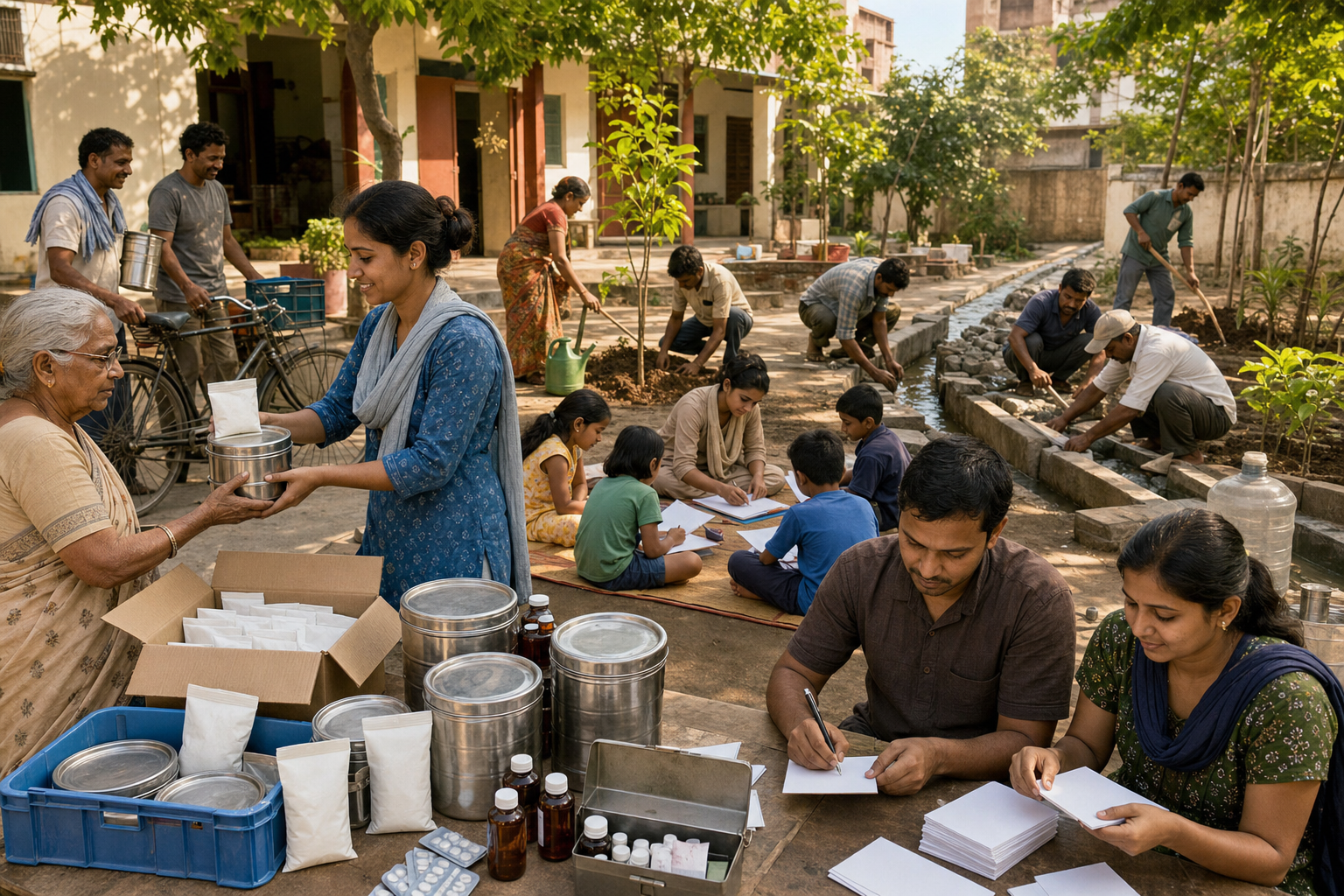
Political mobilization is not inherently opposed to spiritual seriousness. Communities need organization to preserve institutions, present grievances, develop leaders, and participate in democratic life. The danger begins when the emotional intensity of mobilization becomes a substitute for duty.
You can keep your participation grounded by following a practical sequence:
- Before endorsing an event, find its published agenda. Separate cultural celebration, organizational recruitment, policy advocacy, and electoral campaigning in your own mind. They may occur together, but they are not the same activity.
- Before accepting a unity claim, identify who is included and what each participant is expected to contribute. Inclusion without voice is symbolic; unity without reciprocal duty is fragile.
- During a speech, distinguish applause lines from commitments. Record the promised action, the institution responsible for it, and the way the public will learn whether it happened.
- After the gathering, look for evidence of follow-through. Public meetings, accessible grievance mechanisms, service activity, and transparent reporting matter more than repeated circulation of rally images.
- Put seva beside advocacy. Work on a concrete community need without making assistance conditional on political agreement or religious conformity. That is how civilizational confidence becomes public trust.
- Correct excesses from your own side. A movement proves its discipline when it can reject false claims, collective blame, coercion, and contempt even when those tactics appear politically convenient.
A politically effective Hindutva may assemble supporters around a leader or election. An ethically durable Hindutva must do more: protect the freedom it claims for itself, accept limits on state power, honor the plurality within the dharmic family, and translate cultural memory into competent service.
Before your next public endorsement, write down the freedom it protects, the duty it creates, and the public outcome it promises. If you cannot identify all three, withhold judgment until the organizers make them clear. That small discipline is how mobilization becomes responsible citizenship rather than a temporary surge of emotion.
References
- DharmaRenaissance Blog – Hindutva as Bharat’s Soul: Hosabale Calls Ethical Anti-Conversion Safeguards for Unity
- DharmaRenaissance Blog – RSS-BJP Lucknow Convention Signals Push to Elevate Yogi Adityanath Before 2027 UP Polls
