
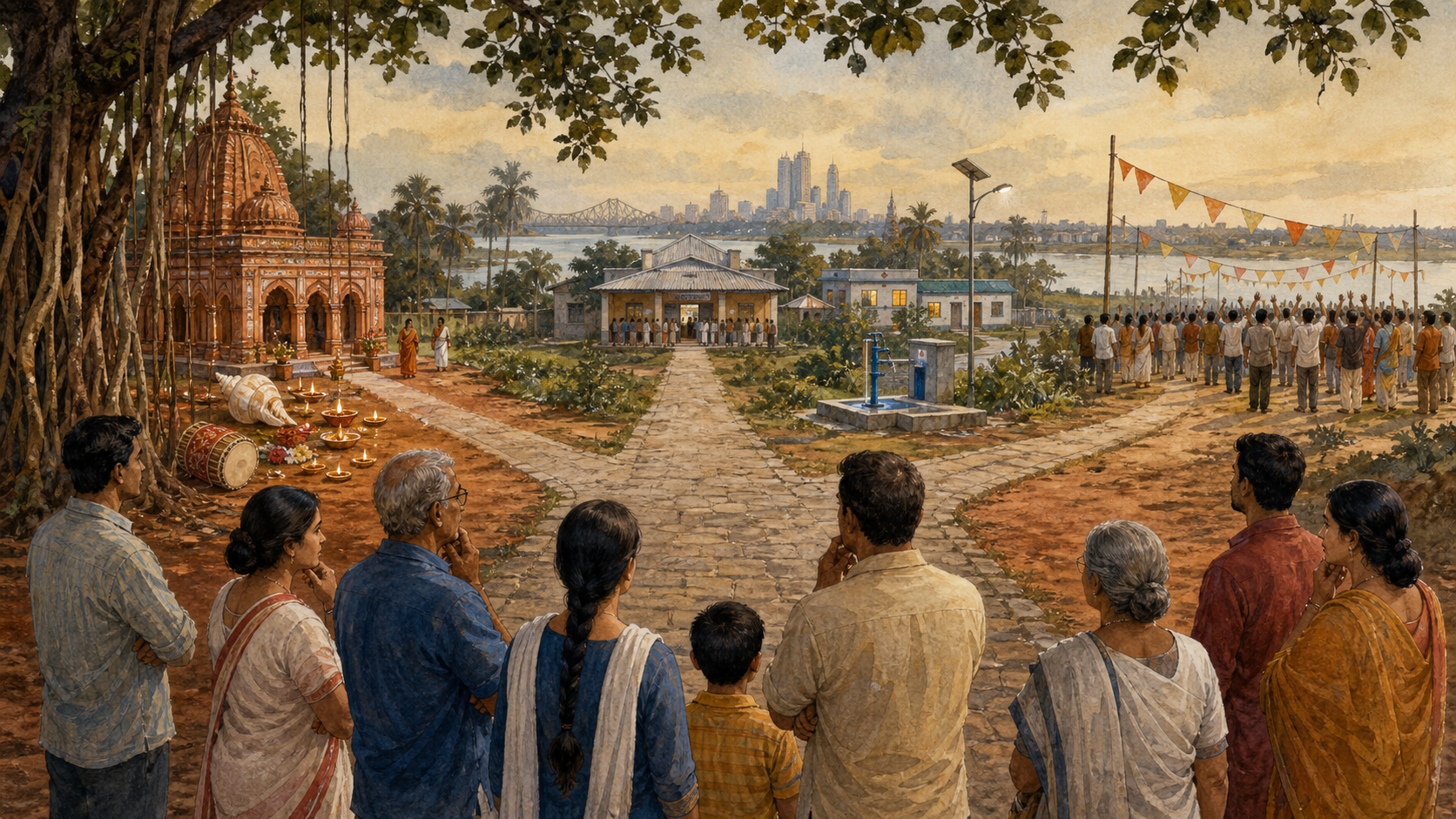
If you are trying to decide whether a party’s Hindu appeal in Bengal represents cultural respect or election-season packaging, a slogan cannot answer the question. Neither can one temple visit, one festival appearance, or one charged speech.
You need a harder test: what does the appeal recognize, what does it promise, who benefits, what has been delivered, and what kind of civic conduct does it encourage? That test lets you take Hindu concerns seriously without surrendering your judgement to any party.
What Bengal’s competing Hindu appeals are trying to do
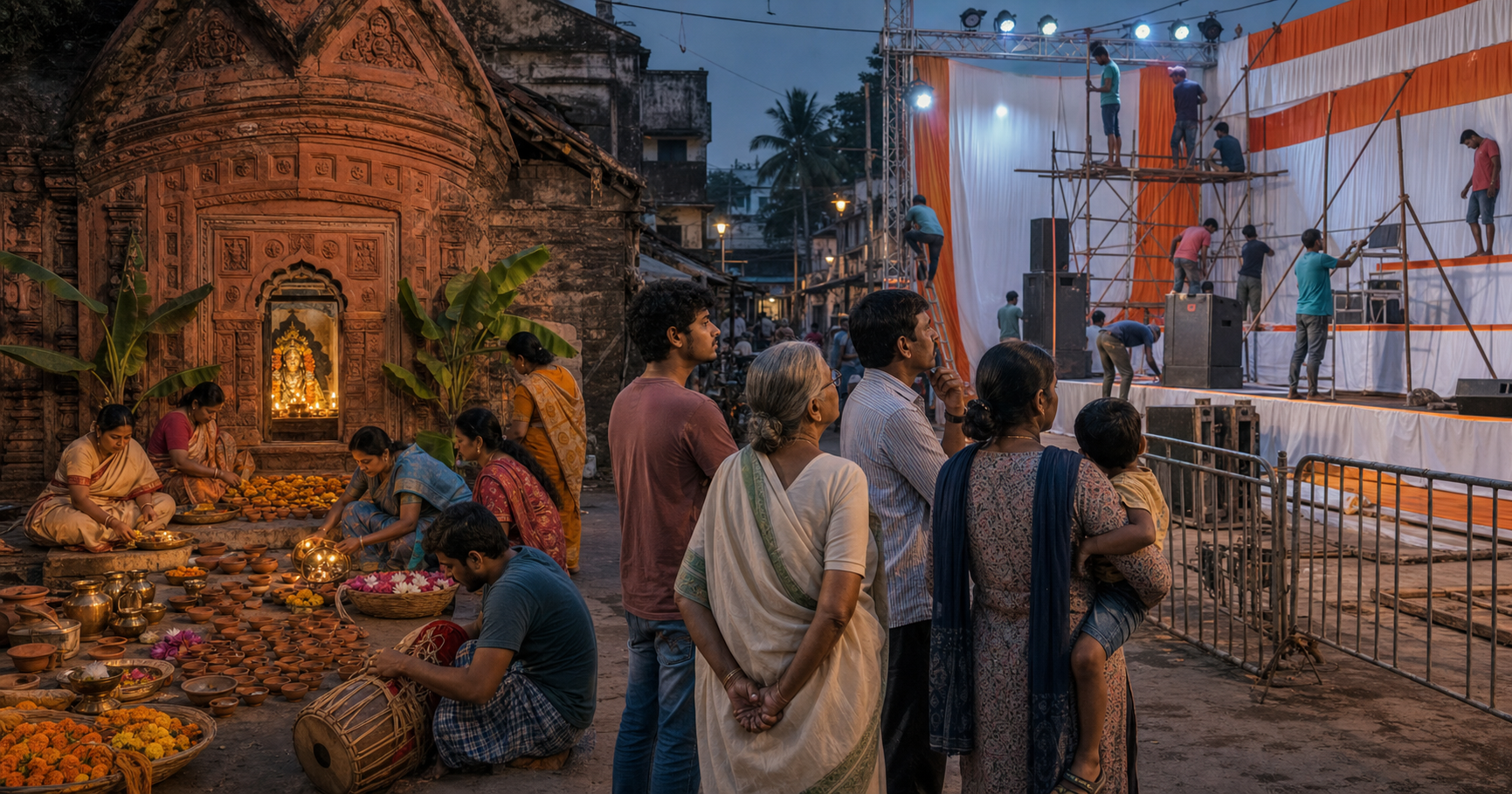
The Ram Mandir era has made Hindu cultural belonging a more explicit part of Bengal’s political competition. Its effect is larger than support for one temple. It has connected religious memory, national pride, political representation, and governance claims in a language that parties can no longer leave entirely to their opponents. The result is a contest over who can speak credibly for Hindu voters while still assembling a broader electoral coalition.
Mamata Banerjee’s invocation of Jai Mahakal, public temple visits, and support for Durga Puja have been read as a calibrated form of "soft Hindutva." That label describes an interpretation of the signalling, not a neutral measurement of its sincerity. The apparent political purpose is to reassure Hindu constituents without abandoning a coalition that includes other religious and Dharmic communities.
The BJP offers a different political conversion. It places greater emphasis on the Ram Mandir, cultural restitution, national pride, organizational outreach, and governance competence. It has also sought to reach distinct caste and community networks rather than assuming that religious identification automatically creates one uniform voting bloc. These are competing strategies on shared cultural terrain, not identical messages distinguished only by intensity.
Your first task, therefore, is to ask what work a symbol is doing. A religious gesture may express genuine respect, defend cultural visibility, prevent an opponent from monopolizing an identity, or distract attention from a weak governing record. It can even perform several of those functions at once. Political strategy and sincere cultural attachment are not mutually exclusive.
This is also why the phrase "the Hindu vote" should make you pause. Bengal’s Hindu citizens do not cease to have different local interests, occupations, caste and community affiliations, economic pressures, or views about the state merely because they share a civilizational identity. Matua and other community networks are courted through combinations of cultural recognition, welfare commitments, and constituency services. Rural and urban voters may also encounter the same political message through very different everyday conditions.
- When someone predicts Hindu consolidation, ask which communities and localities are actually moving.
- When someone claims Hindu fragmentation, ask whether the disagreement concerns identity, local leadership, welfare delivery, livelihoods, or candidate quality.
- When a party claims to represent Hindus, ask whether it has engaged Hindu society in its diversity or merely repeated a general slogan.
- When a commentator treats one election result as a permanent civilizational verdict, separate the long-term cultural shift from the short-term choice among candidates.
Keep three separate ledgers: culture, dignity, and delivery
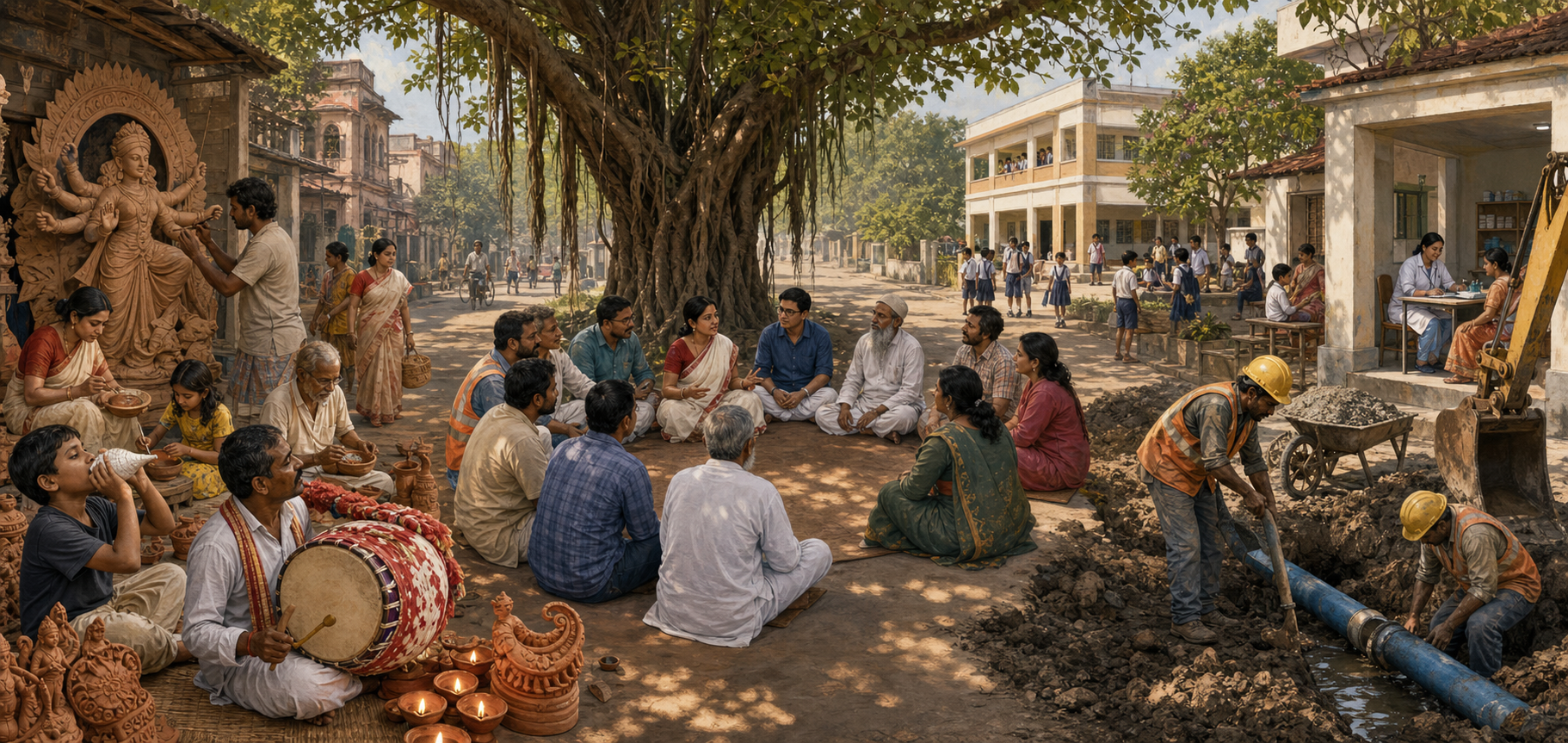
Identity politics becomes difficult to judge when every issue is placed in one emotional basket. A temple visit is treated as proof of good administration. A welfare payment is treated as proof of cultural respect. A grievance about public safety is dismissed as mere campaigning, or amplified as proof of a total civilizational crisis. You will see more clearly if you keep three separate ledgers.
Cultural recognition
This ledger records whether Hindu festivals, temples, sacred language, customary practices, and historical memory receive fair and consistent recognition. Public respect matters. A plural society does not become more equal by requiring Hindus to make their traditions invisible.
But recognition should be assessed across a political cycle, not at the most photogenic moment. Ask whether the party’s conduct is consistent when no major ceremony is dominating public attention. Ask whether cultural commitments produce clear administrative decisions, or remain gestures whose only measurable result is media coverage. A symbol without a policy consequence may still have cultural value, but you should not count it as evidence of governing delivery.
Dignity, safety, and equal citizenship
This ledger concerns whether people can participate in civic and religious life without intimidation, selective protection, collective blame, or partisan dependence. Law and order belongs here, as does the public perception that institutions will treat a person fairly.
Apply one standard. Do not dismiss a Hindu’s concern about safety or dignity merely because a party may exploit it. Do not accept an allegation merely because it confirms your existing political view. Demand a precise account of what happened, where it happened, who is responsible for responding, and what verifiable action followed. Hindu security is too important to reduce to a rumour, and equal citizenship is too important to reduce to a partisan favour.
Material and institutional delivery
This ledger covers jobs, inflation, roads, healthcare, education, welfare delivery, and the quality of local administration. Bengal’s voters routinely consider these questions alongside cultural identity. A party that understands the mood but cannot administer well has recognized only part of the voter’s life. A party that delivers benefits but treats Hindu culture as an embarrassment has also failed a legitimate part of that life.
Do not allow either ledger to cancel the others. Cultural respect does not repair a road, staff a health facility, create employment, or ensure reliable welfare delivery. Material benefits do not purchase permanent silence about cultural dignity. The durable political offer is the one that can join faith, development, safety, and institutional trust without using one as an excuse for failure in another.
A five-part test for every identity-based political claim
When a speech, campaign message, or social-media clip asks for your support in the name of Hindu identity, run it through the same five questions. This works whether the appeal comes from the TMC, the BJP, a smaller organization, or a commentator speaking on a party’s behalf.
- What is the exact claim? Rewrite it as one plain sentence. "We honour Hindu civilization" expresses a disposition, not a deliverable. A claim about festival administration, temple access, public safety, education, welfare, or employment should identify the action being proposed. If you cannot tell whether you are hearing a value, an accusation, or a policy promise, do not treat it as all three.
- Who has the authority to act? Identify whether responsibility lies with a local body, the state government, the Union government, a law-enforcement agency, a party organization, or a community institution. Political messaging often gains force by blaming one actor for a decision controlled by another. If the speaker cannot connect the promise to the responsible office, the promise is not yet operational.
- What is the record of delivery? Look beyond announcements. Ask what changed in administration, public access, safety, services, or opportunity. If the claim concerns a continuing programme, distinguish eligibility rules and actual delivery from ceremonial presentation. If the claim is purely symbolic, judge it honestly as symbolism rather than inflating it into proof of competence.
- Does the rule protect dignity without creating partisan citizenship? A pro-Hindu policy can defend cultural visibility, institutional fairness, and security while still applying public rules consistently. Be wary when access to protection or services appears to depend on political loyalty. Be equally wary when the language of pluralism is used to declare Hindu cultural concerns illegitimate before their merits are examined.
- Can the claim survive verification? Identity-laden messages move quickly because anger and pride both reward immediate sharing. Pause before forwarding. Find the original statement or full recording, establish its location and context, separate visible events from an added caption, and look for a correction if the claim has changed. Transparent communication and fact-checking are not secondary courtesies; they are safeguards against turning a legitimate cultural concern into manufactured hostility.
You can make this test practical by keeping a simple claim card. Record the exact promise, the responsible institution, the evidence offered, the intended beneficiaries, and the result you should be able to observe. This prevents a later substitution in which a party answers a question about delivery with another symbol, or answers a question about cultural dignity with an unrelated benefit.
The test also protects you from false equivalence. Two parties may use Hindu imagery while making substantially different commitments. Conversely, two hostile campaign messages may conceal similar failures of administration. Evaluate each claim on its own content and record. Fairness does not require pretending that every actor is the same.
Dharmic unity must become visible civic conduct
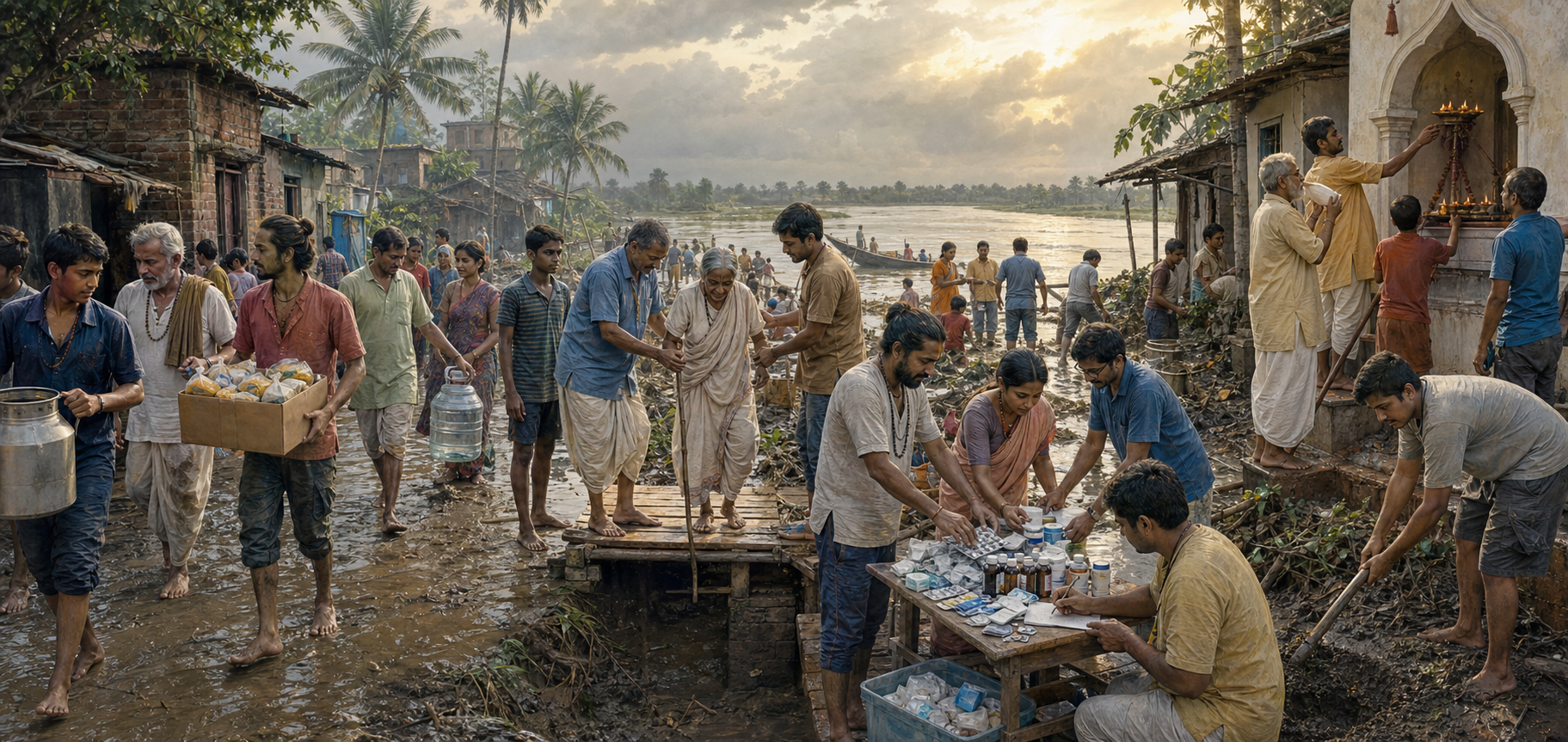
Dharmic unity is not a demand that Hindus, Buddhists, Jains, and Sikhs erase their distinct teachings, institutions, histories, or political concerns. Nor is it a device for manufacturing a single vote. Its political value lies in creating a shared ethical floor beneath legitimate disagreement.
Four principles give that floor practical shape. Ahimsa requires restraint from violence and dehumanization. Satya requires factual speech and a willingness to correct falsehood. Seva turns cultural solidarity into service. Lokasangraha asks whether public action sustains the wider social order instead of rewarding only the loudest faction. These principles make Dharmic solidarity a civic discipline, not merely a campaign slogan.
You can test an organization that invokes Dharmic unity by looking for visible conduct:
- Shared service: Does it bring communities together around a concrete local need, or does cooperation disappear when the rally ends?
- Truthful advocacy: Does it verify claims that favour its own side as rigorously as claims that harm it?
- Internal respect: Does it make room for different Hindu sampradayas and for Buddhist, Jain, and Sikh participants without treating distinct identities as inconveniences?
- Issue-based dialogue: Can participants discuss livelihoods, education, healthcare, safety, and youth opportunity alongside cultural recognition?
- Peaceful accountability: Can it criticize a party it generally supports and acknowledge a useful action by a party it usually opposes?
A useful local initiative does not need to begin with ideological agreement. Representatives of Dharmic institutions can choose one public concern, define one achievable act of service, publish who is responsible, and report what was completed. They can also host a structured forum in which every political representative answers the same questions about culture, safety, services, and youth opportunity. Equal questions produce more information than competing speeches.
This approach refuses a false choice. Hindu assertion does not require permanent social antagonism. Pluralism does not require Hindu self-erasure. The stronger position protects Hindu continuity and public dignity while insisting on truth, nonviolence, competent government, and fair rules.
Key takeaways
- Hindu identity in Bengal is a competitive political field, but Hindu voters are not one undifferentiated bloc.
- TMC’s culturally reassuring signals and the BJP’s identity-forward mobilization should be judged as distinct strategies, not collapsed into a single label.
- Keep separate ledgers for cultural recognition, dignity and safety, and material delivery. Success in one does not erase failure in another.
- Reduce every campaign appeal to an exact claim, identify the institution with authority, and look for an observable result.
- Do not forward identity-charged material until you have checked the original context, place, and claim.
- Dharmic unity becomes credible when it produces truthful advocacy, shared service, internal respect, and peaceful accountability.
At the next political speech or cultural event, choose one claim that matters to you and put it through the five-part test. If it cannot be stated clearly, assigned to a responsible institution, and connected to evidence, treat it as mobilization rather than policy. You can honour the symbol without handing it your judgement.
References
