
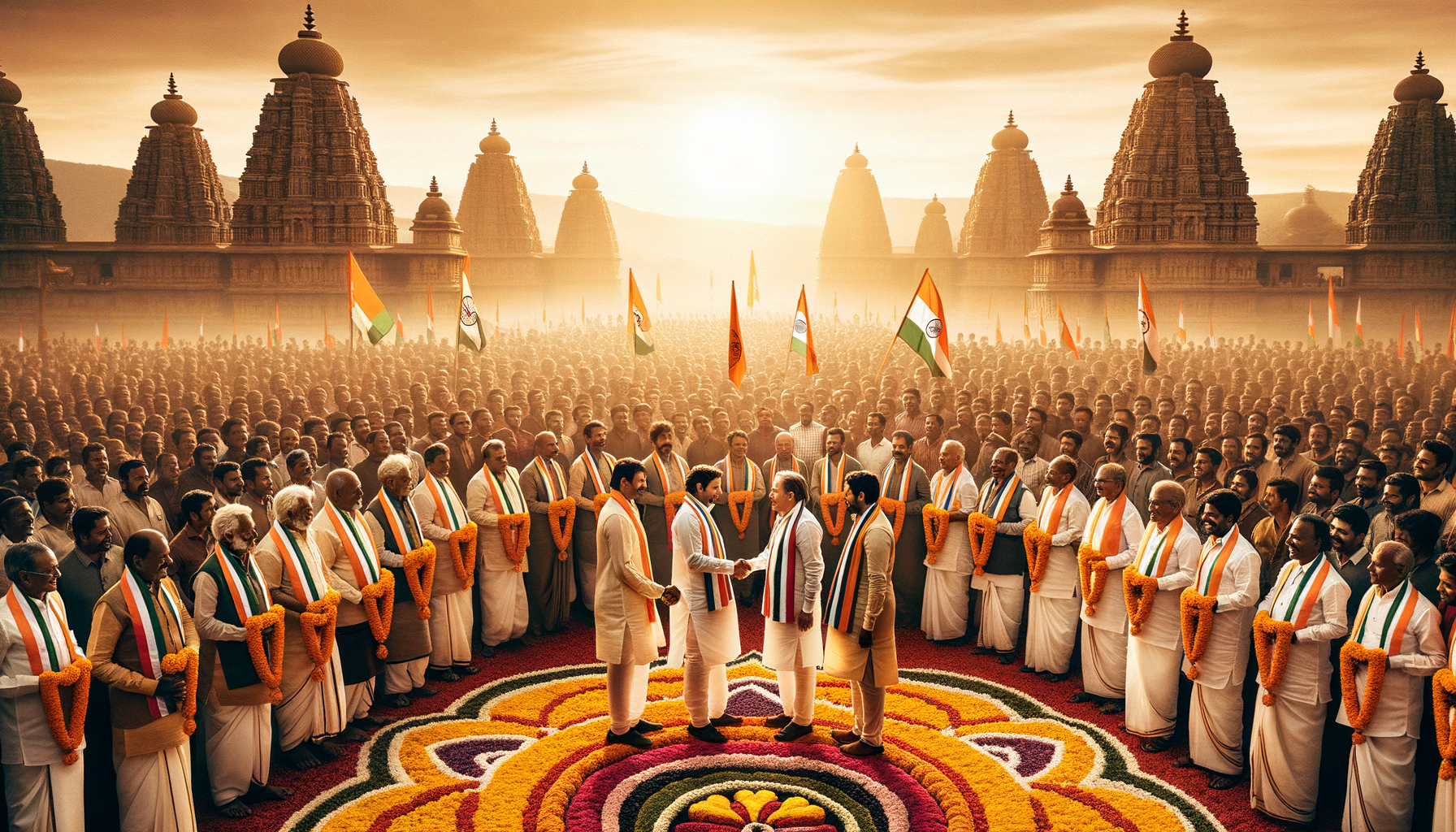
On 9 February 2026 in Kittur, Belagavi district, the Hindu Samajotsava rally drew cross-party participation as Congress leaders stood alongside their BJP counterparts. The shared platform marked an unusual convergence in Karnataka politics, drawing attention precisely because such public alignment across party lines remains rare in contemporary political culture.
The moment mattered beyond optics. Cross-party presence at a large community gathering suggested a willingness to prioritize social cohesion over competitive partisanship, even if briefly. In the context of Belagavi’s diverse civic life, the image of leaders greeting the same audience conveyed an implicit message: cultural observances can serve as common ground where political differences need not eclipse shared civic responsibilities.
Community observers in Kittur noted that Hindu Samajotsava traditions often emphasize service (seva), ethical conduct, and unity in diversityvalues that resonate across the broader dharmic spectrum of Hinduism, Buddhism, Jainism, and Sikhism. Framed this way, the event’s inclusive tone underscored a constructive ideal: cultural celebration as a platform for reinforcing peace, mutual respect, and neighborhood solidarity without politicizing faith.
Analytically, the gathering can be read in two complementary ways. First, as a civil society moment that foregrounds Hindu unity in a plural society; second, as a signal of evolving campaign styles in Karnataka, where leaders sometimes engage in what is described as “soft Hindutva” or culturally anchored outreach. The latter framing should not be conflated with exclusionary narratives; in Belagavi, the prevailing sentiment during the rally centered on community welfare, cultural continuity, and inter-household harmony.
Crucially, the tone in Kittur aligned with constitutional principles of peaceful assembly and freedom of cultural expression. Public messaging at such events carries greatest value when it elevates shared civic dutiesrespect for law, commitment to non-violence, and care for local livelihoodsover adversarial rhetoric. In this sense, the cross-party tableau functioned as a reminder that cultural life can help temper polarization by foregrounding everyday concerns and ethical conduct.
For Belagavi district, the Hindu Samajotsava Rally in Kittur 2026 will likely be remembered as a symbolic bridge: leaders from Congress and BJP on the same stage, signaling that civic rituals and cultural heritage can create room for dialogue. Whether or not this becomes a durable template, the immediate civic benefit was clearshared presence encouraged calm, affirmed communal trust, and highlighted a path where political competition does not preclude cooperation for social good.
More broadly, the episode supports a unifying message across dharmic traditions: diverse practices can coexist within a framework of mutual respect and public-minded service. As Karnataka politics continues to evolve, moments like Kittur’s Hindu Samajotsava demonstrate how cultural spaceswhen approached with responsibilitycan reinforce social harmony, local resilience, and a forward-looking ethic grounded in unity.
Inspired by this post on Struggle for Hindu Existence.
