
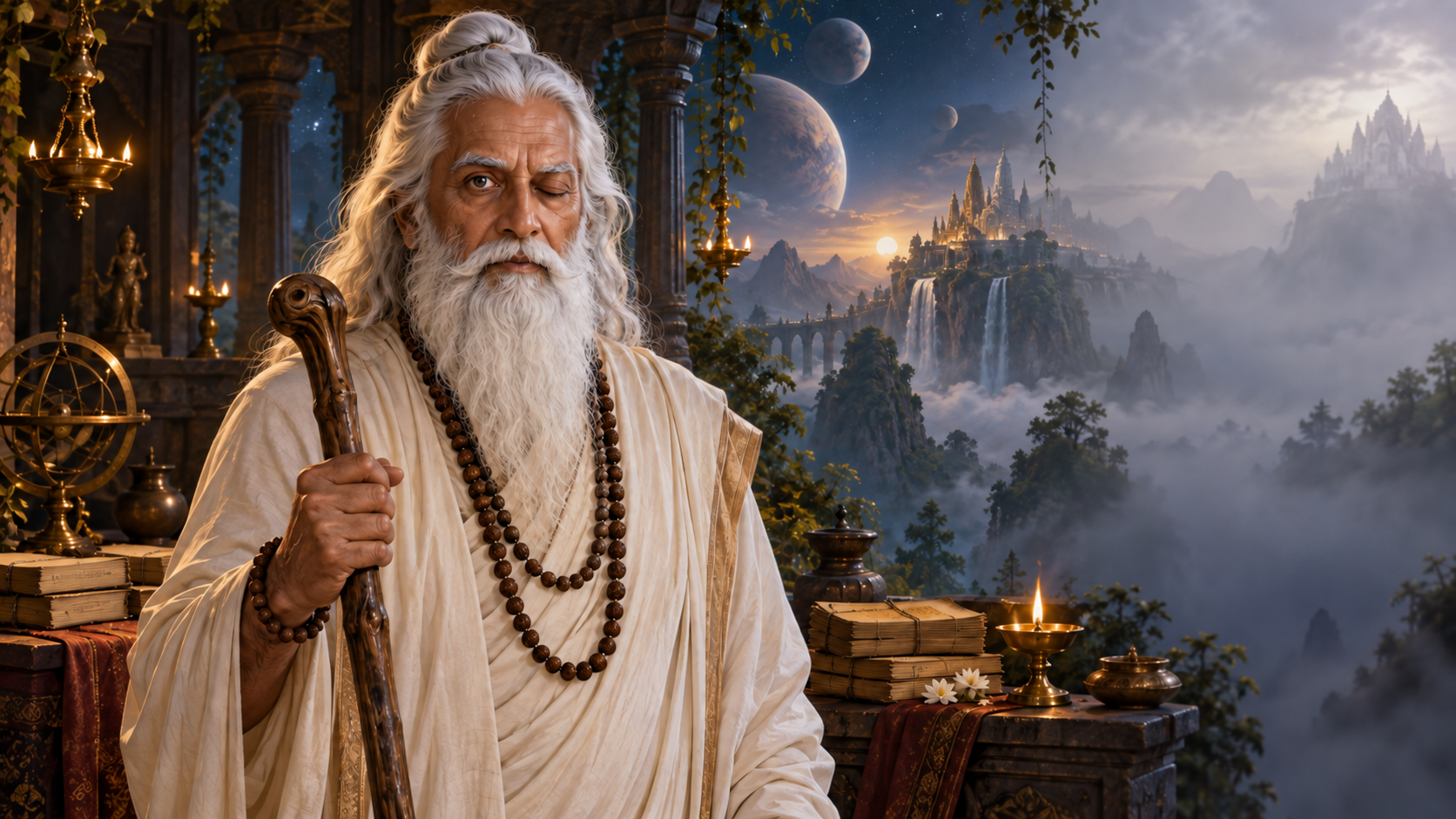
If you have seen Shukracharya represented with one functioning eye, you may wonder whether the mark is merely an injury, a punishment, or a judgment on his character. Treating it as decoration misses the lesson. Treating it as proof that he is simply evil misses it too.
The clearest symbolic reading is that Shukracharya possesses genuine knowledge but not complete vision. He can see, teach, advise, and exercise power, yet something essential remains outside his field of view. His single eye warns you that intelligence can be formidable while judgment remains unbalanced.
The missing eye signifies a limit, not an empty mind

Shukracharya is remembered as a guru, so the symbolism cannot sensibly mean that he knows nothing. A teacher with no insight would present no philosophical tension. The image matters precisely because wisdom and limitation occupy the same face.
One intact eye represents a real capacity to perceive. The absent eye represents what that capacity does not encompass. The result is vision that contains truth without containing the whole truth.
This is not an anatomical claim that a person with one eye literally understands only half of reality. It is visual philosophy. Two eyes ordinarily give depth and a wider field; the single-eye motif converts that ordinary experience into a warning about perspective. What is visible may be accurate, but depth, context, or consequence may still be missing.
Partial truth is often more dangerous than obvious falsehood. You reject a blatant lie when you recognise it. A partial truth arrives with evidence, logic, and perhaps the authority of a learned person. It becomes misleading only when one valid part is presented as the complete moral picture.
Why one eye says something total blindness cannot
Total blindness and single-eyed sight do different symbolic work. Dhritarashtra’s blindness can be read as a refusal to confront the moral decay within his own family. Shukracharya’s remaining eye, by contrast, preserves the fact that he does perceive, understand, and counsel. His problem is not the total absence of knowledge but an imbalance within it.
The difference gives you a more precise way to read the image:
- The functioning eye signifies knowledge, discipline, strategy, and the ability to act effectively.
- The missing eye signifies a blind spot: a person, duty, consequence, or moral dimension left outside the frame.
- The complete face holds both truths together. Shukracharya should not be reduced either to an infallible sage or to a figure with nothing to teach.
Other embodied signs in Dharmic narratives show why this symbolism must be handled carefully. Ashtavakra’s eight bends make crookedness visible within his story, but they do not make Ashtavakra morally crooked. A bodily mark can reveal a conflict surrounding a figure rather than condemn the person who bears it.
That distinction matters beyond storytelling. A physical difference in a living person does not disclose moral worth, spiritual attainment, or past conduct. Shukracharya’s eye is a narrative symbol to examine inwardly, not a licence to interpret another person’s disability as a karmic verdict.
Nor should one interpretation be treated as the only doctrine accepted by every sampradaya, retelling, or artistic tradition. Symbolism helps when it illuminates the moral tension of a figure. It becomes careless when an interpretation is presented as though no other reading could exist.
Knowledge becomes dangerous when it serves only one aim
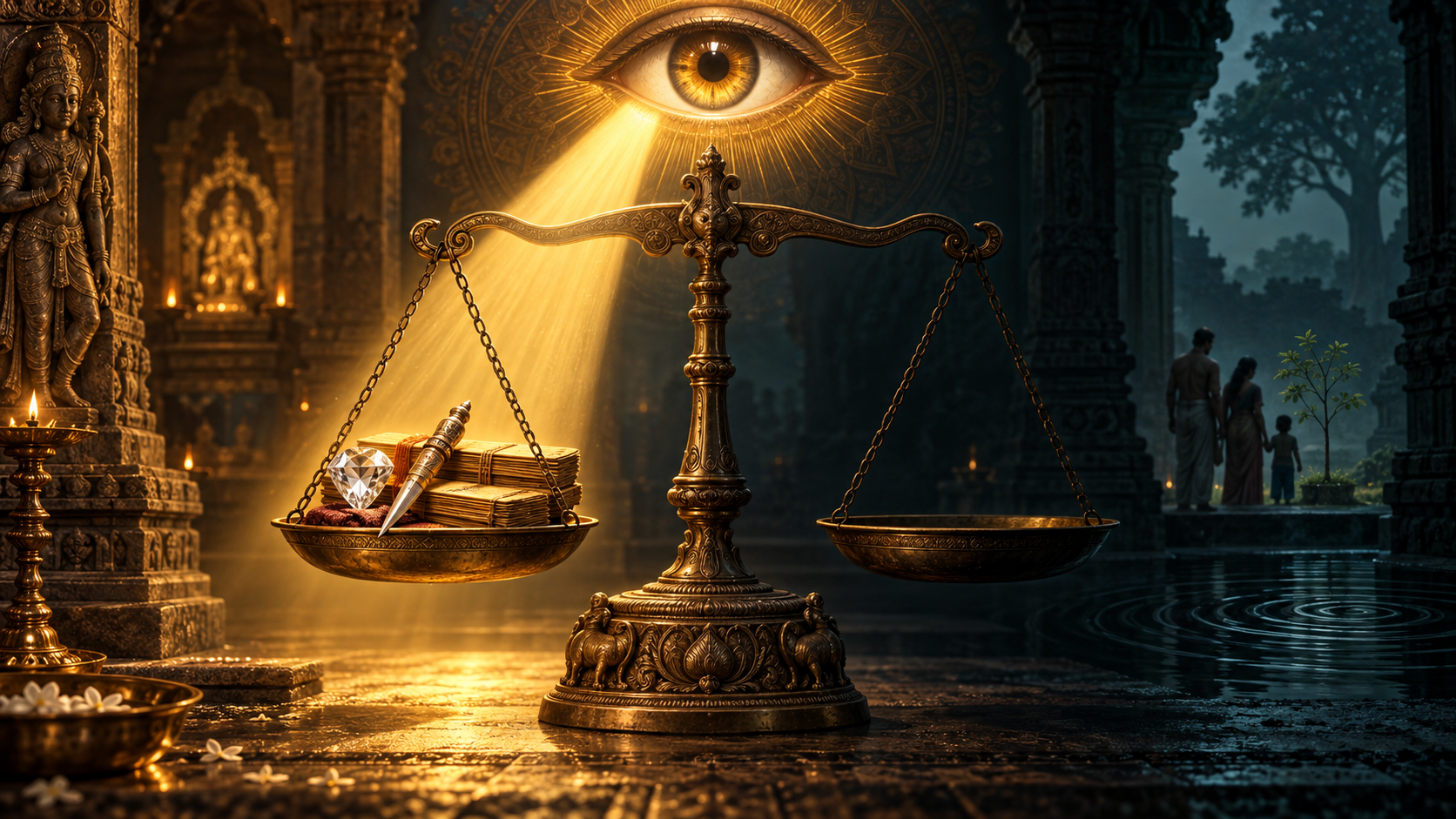
Shukracharya’s single eye becomes especially useful as a symbol of power. Skill answers, “Can this be done?” Strategy asks, “How can we prevail?” Dharma adds questions that power would rather postpone: “Should this be done? Who will bear the cost? What duty remains even if breaking it would produce victory?”
A plan may be tactically excellent and morally incomplete. Loyalty may be admirable while protecting conduct that should be opposed. A true statement may be deployed so selectively that it creates a false impression. Success may prove that a method worked, but it cannot by itself prove that the method was righteous.
You are slipping into single-eyed judgment when:
- You can explain in detail how your side benefits but cannot name who pays the price.
- You invoke a principle against an opponent but excuse the same conduct from an ally.
- You treat the ability to defeat, expose, or humiliate someone as permission to do so.
- You know the immediate result you want but have not considered what habit or precedent the action creates.
- You can state your own strongest argument but only a caricature of the opposing one.
None of these signs proves that your conclusion is wrong. They show that your conclusion has not yet been tested with both eyes. The correction is not indecision. It is fuller perception before decisive action.
Use a four-part test to uncover the missing view

You can turn Shukracharya’s symbolism into a practical discipline whenever a choice involves power, loyalty, conflict, or strong personal interest. Write down your answers rather than merely thinking through them; an omitted consideration is easier to notice on the page.
- Name what the visible eye sees. State the facts you consider reliable, the result you want, and the argument supporting it. Do not weaken your own position for the sake of appearing neutral.
- Name what may be outside the frame. Look separately for an affected person, a competing duty, a delayed consequence, and a fact that would inconvenience your preferred conclusion. If you cannot find any, ask whether loyalty or desire has narrowed the search.
- Separate effectiveness from righteousness. Write two different answers to “Will it work?” and “Is it dharmic?” Test the second answer against truthfulness, non-injury, restraint, fairness, and responsibility. A successful means can still violate a governing duty.
- Invite the corrective eye. State the strongest morally serious objection to your choice. If you cannot express that objection in terms its holder would recognise, you have not yet understood it. Revise the decision only after the neglected concern has been answered rather than dismissed.
Suppose you are preparing to answer a public insult directed at your family or community. One eye sees the falsehood, the need for courage, and the value of a firm response. The corrective eye asks whether an unverified allegation, indiscriminate abuse, or punishment of uninvolved people has entered your reply. Seeing the second set of facts does not require passivity. It helps you defend what is right without copying what was wrong.
The same test applies to private disputes. Before giving advice, ask whether you are protecting the person who consulted you, protecting your own relationship with that person, or protecting dharma. Those aims can overlap, but they are not automatically identical.
Key takeaways
- Shukracharya’s single eye symbolises genuine but incomplete perception, not a complete absence of wisdom.
- The image warns against mistaking one accurate perspective for the whole moral truth.
- Knowledge, loyalty, and strategic skill require balance from consequence, duty, restraint, and fairness.
- The symbolism should be used for self-examination, never to judge the moral worth of people with physical disabilities.
- Before acting, identify what your preferred conclusion sees clearly and what it leaves outside the frame.
Keep one question ready for the moment when every fact seems to favour your side: “What would the other eye see?” Ask it before you advise a family member, defend a group, answer an opponent, or exercise authority. Then the mark on Shukracharya’s face becomes more than an unusual feature. It becomes a discipline of seeing enough to act without mistaking power for wisdom.
References

Leave a Reply
You must be logged in to post a comment.