
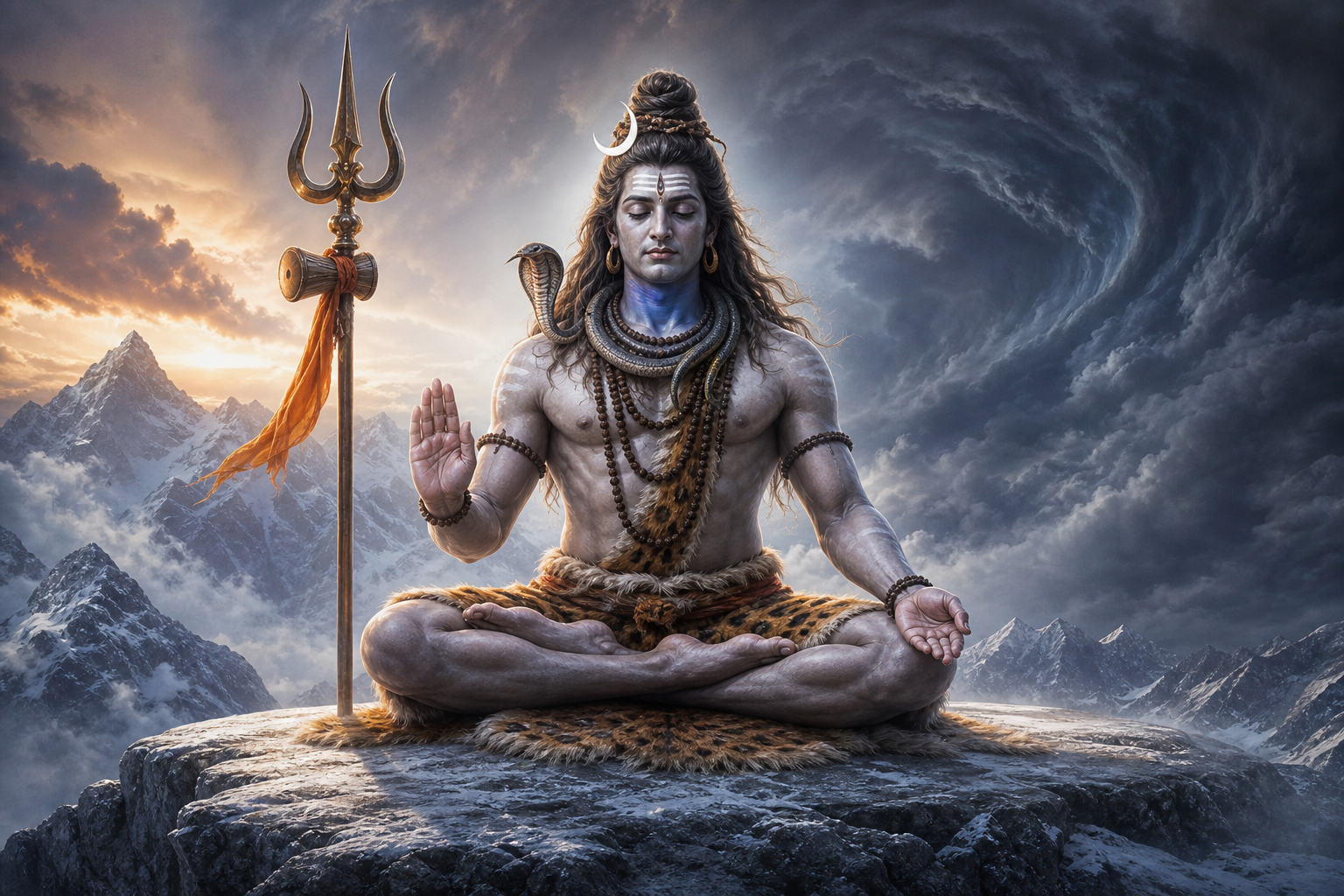
You may look at Shiva and see a contradiction. The ash-covered yogi has renounced comfort, status, and ordinary security, yet devotees also approach him as a guardian who subdues danger, steadies the cosmos, and answers distress.
The contradiction disappears once you read the symbols as a sequence. Shiva can protect because he is not controlled by what usually controls us. His asceticism creates the freedom to face poison without becoming poisonous, wield power without craving domination, and enter places of fear without abandoning awareness.
The ascetic and the guardian are not two different Shivas
If protection meant only defeating an external enemy, Shiva’s ascetic appearance would be difficult to explain. A ruler protects with fortifications, wealth, armies, and institutions. Shiva appears with almost none of these. His body bears ash. His ornaments include serpents and rudraksha. He sits on a mountain or inhabits the cremation ground. Even when armed, he remains composed rather than anxious to display force.
That visual language changes the meaning of protection. Shiva does not first ask, “How do I preserve everything I possess?” He asks what remains true when possession, reputation, beauty, and even the body pass away. Because he has faced that question completely, the threat of loss has less leverage over him. Detachment becomes protective capacity.
This is why the cremation ground is not merely a frightening backdrop. It is where social distinctions, bodily vanity, and the illusion of permanence reach their limit. Shiva’s presence there teaches that the sacred is not confined to places society calls pleasant or auspicious. The highest auspiciousness can meet death, grief, and disorder without being defeated by them.
Do not turn that teaching into a romantic cult of deprivation. Poverty, neglect, and self-punishment are not automatically spiritual, and family life is not the enemy of liberation. Shiva’s bond with Parvati itself prevents such a shallow conclusion. The discipline to imitate is inward: reduce the number of fears and appetites that can purchase your silence, distort your judgment, or provoke you into adharmic action.
A useful test follows. When an attachment is threatened, ask whether you are protecting something entrusted to you or merely defending your self-image. Dharma may require you to protect a person, a promise, a temple, a family, or an institution. It does not require you to preserve every preference or win every contest. Shiva’s austerity helps you distinguish responsibility from possessiveness.
Read each ascetic emblem as a discipline of freedom
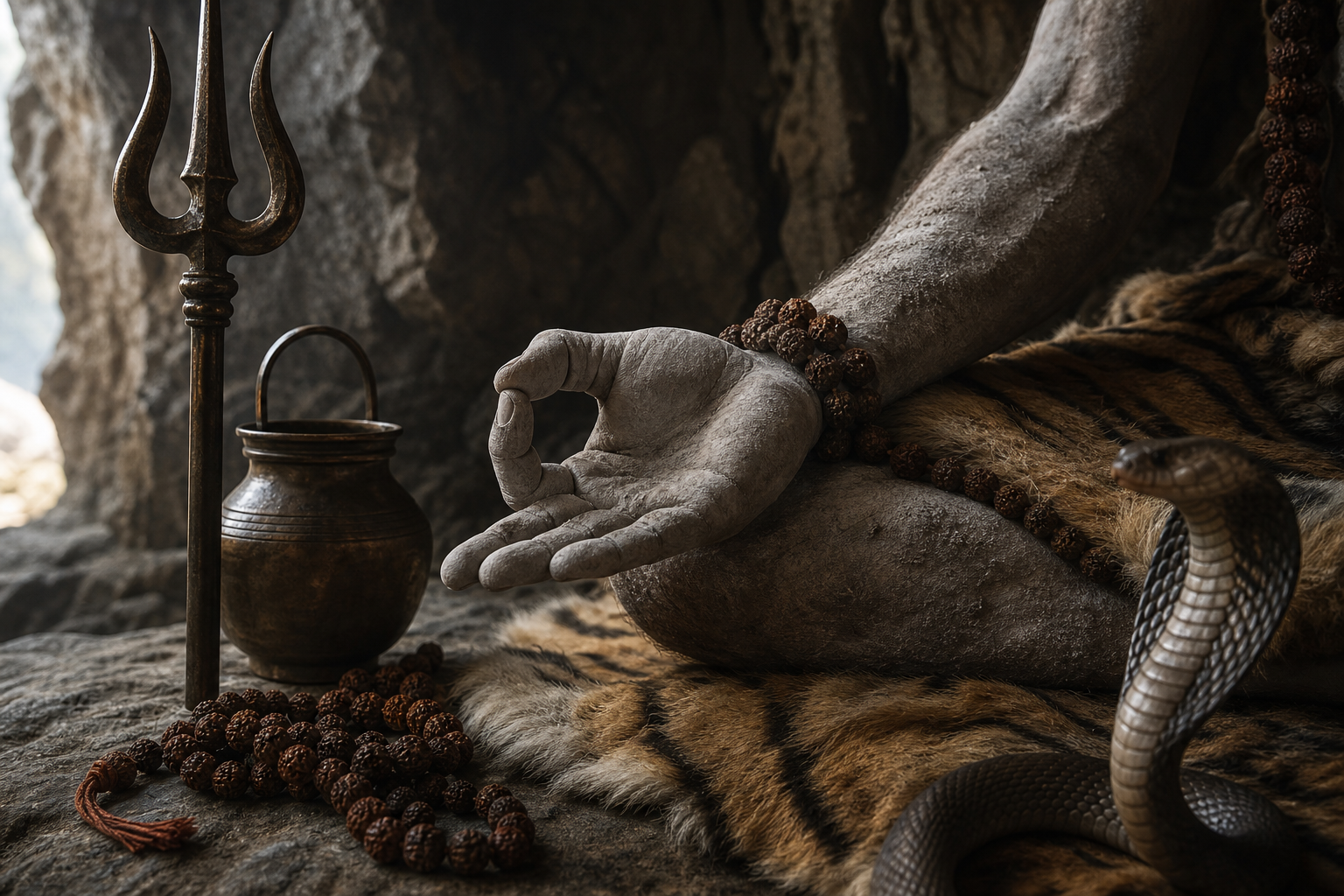
Shaiva images are not collections of exotic accessories. Agamic and artistic traditions use posture, setting, ornaments, weapons, and accompanying figures as a recognisable theological grammar. No short table can exhaust that grammar, but the following readings give you a practical way to begin.
| Emblem | What it places before you | The protective discipline it can train |
|---|---|---|
| Vibhuti, or sacred ash | Every formed thing is perishable; status and the body do not escape change. | Make decisions from duty rather than vanity about how you will appear. |
| Cremation ground | What society avoids is still part of reality. | Face loss and consequence early, before denial makes the danger larger. |
| Tiger skin | Predatory force is present but no longer occupies the seat of command. | Recognise anger and appetite without letting either choose your action. |
| Serpents | Danger can be approached with vigilance rather than panic. | Keep powerful energies close to awareness and under discipline. |
| Rudraksha beads | Freedom is sustained through recollection and repeated practice. | Return to a vow, mantra, or ethical rule when emotion scatters attention. |
| Matted locks bearing Ganga | A tremendous force is received, moderated, and given a beneficial course. | Channel power so that what could overwhelm becomes useful. |
| Crescent moon | Time and changing cycles are present without ruling Shiva’s awareness. | Respect urgency without treating the present crisis as the whole of reality. |
| Nandi’s steady gaze | Strength is aligned through unwavering attention. | Choose the object of your loyalty before pressure chooses it for you. |
| Linga | The divine cannot be reduced to a human personality or a collection of attributes. | Look beneath surface conflict for the consciousness and truth that do not depend on appearance. |
These are working interpretations, not passwords with one fixed meaning. A serpent, trident, or moon can carry several resonances across regions, texts, and forms of Shiva. Context matters: posture, facial expression, accompanying deities, and ritual use may change the emphasis. Be cautious when an infographic claims that every point of the trident or every strand of hair has one universally binding definition.
Absence can also communicate. Shiva is rarely identified by a lotus held prominently in the hand, even though lotus symbolism remains important in yoga and lotus offerings are not inherently excluded from Shaiva worship. The flower commonly evokes purity, flourishing, beauty, and auspicious order. Shiva’s more characteristic ash, stone, hide, and wild landscape direct attention toward the freedom disclosed when familiar forms dissolve.
That distinction need not become a sectarian ranking. The lotus in Hindu, Buddhist, Jain, and Sikh contexts teaches how to remain unstained while living in the world. Shiva’s cremation-ground imagery teaches how to remain awake when the world you knew is passing away. One begins amid flourishing and the other amid dissolution, but each can train non-attachment.
Neelakantha shows that protection begins with containment
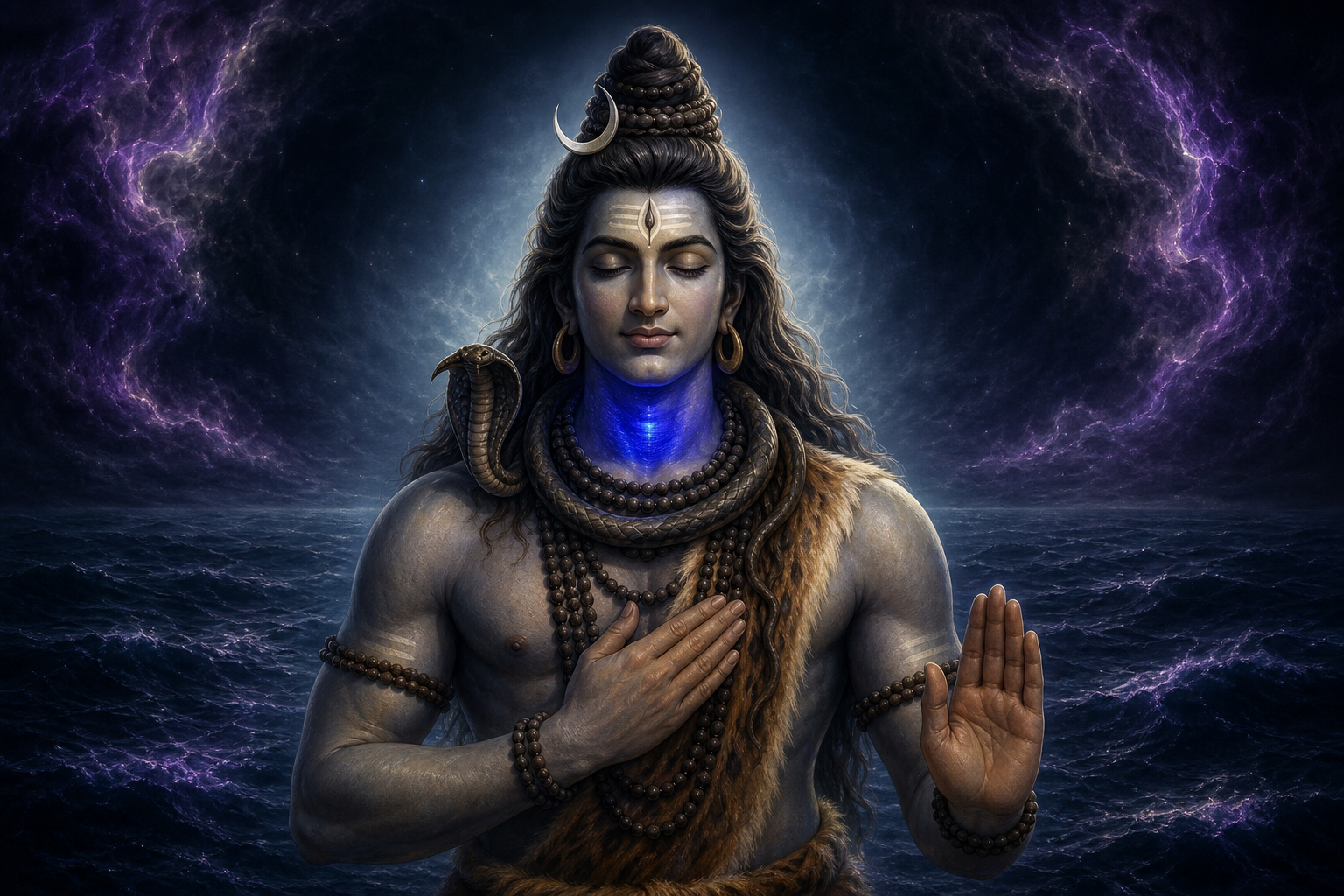
The clearest union of Shiva’s austerity and guardianship appears during Samudra Manthan. Devas and asuras churn the cosmic ocean in search of amrita, but halahala, a poison capable of threatening beings across the worlds, emerges before the auspicious treasures. Shiva receives the toxin and holds it at his throat, becoming Neelakantha, the blue-throated one. In many traditions, Parvati participates in safeguarding that containment. The episode presents a precise model of danger faced without being transmitted.
Notice what the blue throat preserves. Shiva does not pretend that the poison is harmless. He does not allow it to penetrate his deepest being, and he does not cast it back into the world for others to absorb. Its mark remains visible. Protection here is not untouched purity; it is the capacity to make contact with harm while stopping its spread.
- To swallow poison psychologically is to let another person’s hatred, a public insult, or a grave failure become your identity.
- To spit it outward is to pass the injury into gossip, humiliation, vengeance, reckless speech, or punishment of someone uninvolved.
- To contain it is to acknowledge what happened, prevent immediate transmission, and choose a proportionate response aligned with dharma.
The throat matters because reaction often becomes consequence through speech. A rumour is forwarded. An accusation is enlarged. A private wound becomes a public weapon. Reading Neelakantha through the yogic symbolism of vishuddha, the throat centre associated with purification, gives you a concrete discipline: do not let unexamined toxicity cross from feeling into word and action.
Containment is not silence at any price. It does not require you to tolerate abuse, conceal wrongdoing, or remain in immediate danger. If someone is at risk, the protective act may be to leave, warn others, preserve evidence, involve responsible authorities, or seek qualified help. Shiva holds the poison because he has the capacity to hold it; the image does not demand that an unprotected person absorb unlimited harm.
The surrounding emblems clarify what comes next. The third eye asks you to see more than the two-sided quarrel visible on the surface. The trishula represents the capacity for decisive severance when confusion, bondage, or danger must be cut. Ganga in the matted locks shows force regulated before release. The damaru recalls rhythm: after disruption has been contained, order must be re-established. Protection therefore moves through discernment, restraint, decisive action, and restoration. Force is one instrument within that sequence, not its whole meaning.
This also explains why tapas is essential to the protective Shiva. You cannot improvise steadiness only after the poison appears. Repeated discipline creates the inner capacity on which others may later depend. A person who practises truthful speech in ordinary situations is less likely to spread falsehood in a crisis. A person who regularly examines attachment is less likely to disguise wounded pride as righteous defence.
Turn Shiva’s symbolism into a practice you can use

A five-step Neelakantha response
Use this sequence when you meet ordinary conflict, provocation, or disturbing information. It is a discipline for preventing reactive harm, not an emergency procedure.
- Name the halahala. State the problem in one factual sentence without guessing motives. “A confidential message was shared” is clearer than “Everyone here is treacherous.” If you cannot describe the event without exaggeration, you are not yet ready to respond.
- Find your stable base. Stop adding new inputs for the moment. Put down the device, return attention to the body, or use an established practice such as japa, measured breathing, prayer, or silent observation. The aim is not to manufacture pleasant feelings. It is to keep agitation from choosing your next act.
- Guard the throat. Do not send, post, forward, or confront merely to discharge pressure. Draft an unsent response if writing helps. Return to it when you can identify its purpose, the facts it relies on, and the consequence you intend.
- Select the necessary form of protection. Some situations need containment: restrict access or prevent a rumour from spreading. Some need correction: state the truth calmly to the people affected. Some need severance: leave a harmful arrangement, report misconduct, or end participation. Choose the least destructive action that actually protects what dharma requires you to protect.
- Keep the mark as instruction, not identity. Once the immediate danger has passed, identify the practice or safeguard that should remain. That may be a clearer boundary, a verification rule before forwarding claims, a better division of responsibility, or a commitment to more disciplined speech. The lesson should survive even when the emotional charge does not.
If there is immediate danger, skip the reflective exercise and move toward safety. Contact the appropriate emergency, legal, medical, safeguarding, or community support for the actual situation. Spiritual symbolism should sharpen protective judgment, never delay necessary intervention.
When you stand before a murti or image
Instead of trying to decode every attribute at once, choose one focal question. This keeps darshan from becoming either a visual trivia exercise or a vague emotional impression.
- What in this form is completely still, and what is moving?
- Which feared or dangerous thing has been mastered rather than denied?
- What is Shiva releasing, what is he containing, and what is he cutting away?
- Which attachment in your present decision makes clear action harder?
- What single conduct would honour this darshan after you leave?
The last question is decisive. If the serpent leads you to greater vigilance, name where you will verify before reacting. If vibhuti confronts you with impermanence, make the delayed apology or complete the neglected duty. If Nandi’s gaze exposes scattered loyalty, decide which promise deserves your attention. Symbolism becomes sadhana when it changes conduct.
When you perform Shaiva puja
Follow the instructions of your temple, family tradition, guru, or sampradaya before adopting generic symbolic explanations. Shaiva practice is not uniform, and a private interpretation should not be mistaken for a universal ritual rule.
Within that discipline, let the materials focus attention. Water offered in abhishekam can accompany a resolve to cool reactive speech. Vibhuti can recall that pride and possession end in ash. The trifoliate bilva leaf is traditionally read through Shaiva triads, including Shiva’s three eyes and the three lines of tripundra. Its three leaflets can prompt one exact question: what must you see more clearly, restrain more firmly, and offer more completely?
Carry one modest vrata from the shrine into the day. You might resolve not to forward an inflammatory claim before verifying it, not to answer an insult while angry, or not to ignore a duty because it threatens your comfort. One observed vow teaches more than a dozen decorative interpretations.
Key takeaways for reading Shiva well
- Shiva’s asceticism and protection express one principle: freedom from compulsion creates the capacity to guard others without craving control.
- Ash and the cremation ground train fearless recognition of impermanence; they do not glorify neglect or suffering.
- Serpents, tiger skin, matted locks, and the crescent show dangerous or changing forces brought under awareness rather than denied.
- Neelakantha represents conscious containment: recognise poison, stop its transmission, and respond without making it your identity.
- The trishula and third eye place discernment before force. Protective action must be proportionate to what actually needs protection.
- Iconography becomes practice when one symbol produces one observable change in your speech, boundaries, loyalty, or conduct.
The next time you encounter Shiva’s image, do not ask only what each object means. Ask what kind of person could wear danger as an ornament, hold poison without spreading it, and remain still enough to act without hatred. Then choose one small discipline that moves you in that direction. That is where the ascetic symbol begins to protect the world around you.
References
- DharmaRenaissance Blog — Why Halahala Emerged First: Profound Life Lessons and Dharma Insights from Samudra Manthan
- DharmaRenaissance Blog — Why Shiva Rarely Holds the Lotus: Decoding Shaiva Iconography, Vairagya, and Dharmic Harmony
