
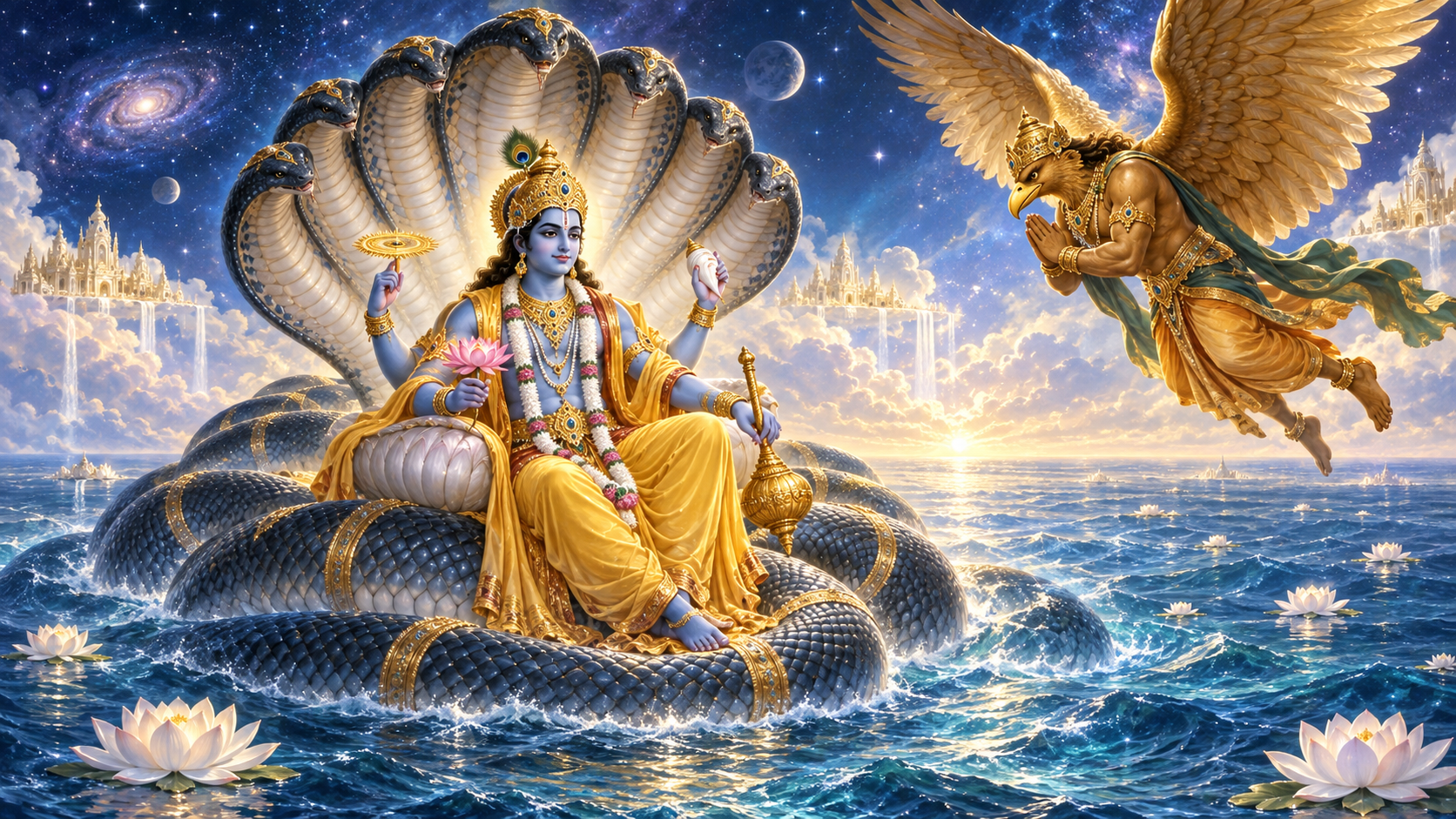
You may have seen Garuda overpowering a naga, then noticed that Vishnu is served by both Garuda and the great serpent Ananta Shesha. If one creature represents good and the other evil, the imagery appears contradictory. That contradiction disappears when you begin with their kinship rather than their combat.
The serpent and eagle lineages share a father because Hindu cosmology does not place them in two unrelated moral universes. They express contrasting possibilities within one creation: concealment and vision, containment and movement, entanglement and release. Their rivalry matters, but it is not a simple war between absolute evil and absolute good.
Begin with the family tree, not the battlefield
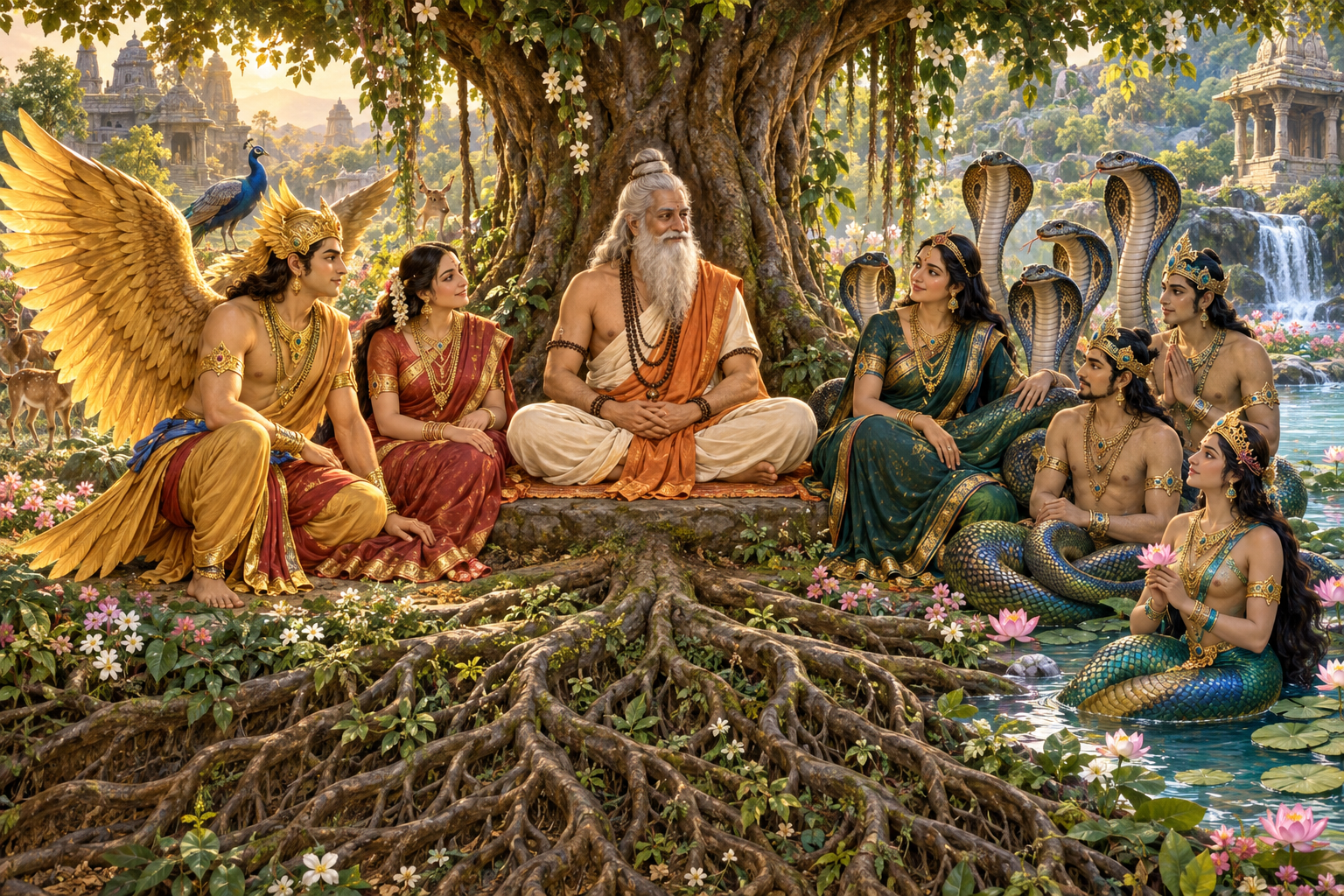
In the familiar Puranic genealogy, Brahma stands at the head of an unfolding creation. The Prajapatis extend its many forms of life, and the sage Kashyapa belongs to this generative order. Kashyapa fathers Garuda through Vinata and the nagas through Kadru. The traditional adversaries are therefore half-siblings: the serpent and eagle lineages have the same paternal origin.
This genealogy changes how you should read their conflict. An enemy who comes from an entirely separate source can be dismissed as alien to the order of creation. A rival born within the same family cannot. The opposition has to be understood as a tension inside the cosmos, and by extension inside embodied life, society, and the human mind.
Hindu genealogies often do more than answer who descended from whom. They place astonishing diversity inside a connected sacred order. Birds, serpents, devas, human beings, and other classes of beings may display different dispositions, yet none has an independent creator competing against Brahma. Difference is real; separation is not ultimate.
That is the first practical rule for reading this symbolism: do not begin by assigning one lineage to the side of God and the other to a rival power outside creation. Begin with shared origin. Only then examine why the relatives oppose one another.
The serpent is not simply a villain, and Garuda is not simply a saint
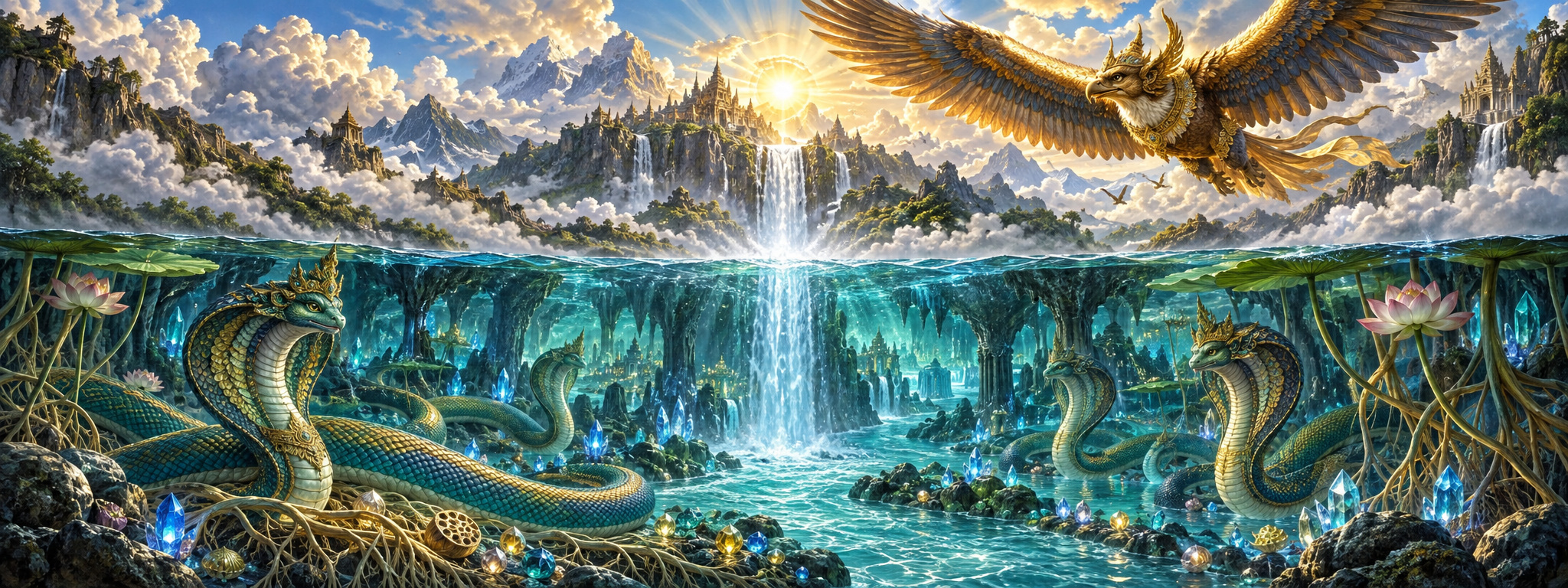
A symbol in Hindu tradition does not behave like a word with one fixed dictionary definition. Its meaning depends on its posture, location, relationship, and role in a particular scene. A naga supporting a deity, a serpent worn as an ornament, and a snake being subdued do not communicate the same thing.
What serpent imagery asks you to notice
The serpent stays near the earth, disappears into hidden places, coils upon itself, and can strike with little warning. Those qualities make it a fitting image for concealed power, concentrated potential, protection, danger, continuity, and attachment. Its shedding of skin also permits associations with renewal. None of these possibilities cancels the others.
This is why calling every Hindu serpent evil is untenable. Ananta Shesha can serve as the ordered support on which Vishnu reclines. A serpent can appear under control, at rest, guarding a threshold, or participating in divine iconography. Its power may be beneficial, threatening, or transformed according to the relationship shown.
It is equally misleading to label every serpent Kundalini. Kundalini is an important yogic use of coiled-serpent imagery, but it is not a universal key that unlocks every naga narrative, temple sculpture, or divine attribute. Use that interpretation only when the yogic context actually supports it.
What Garuda imagery asks you to notice
Garuda is a divine, eagle-like being rather than merely a zoological eagle. His wings, speed, height, and power of sight naturally direct attention toward movement, vigilance, expanded perspective, and freedom from what constricts. Where a serpent coils and contains, Garuda opens his wings and crosses distance.
Yet height alone does not make Garuda morally perfect. His deepest significance comes through relationship and service, especially as Vishnu’s vahana. He is not simply the creature that defeats snakes; he is immense power directed toward a divine purpose. That distinction matters. Victory without dharma is not what makes the image sacred.
You can therefore use several paired questions when examining serpent-and-Garuda imagery: Is the scene contrasting hidden depth with far-seeing vision? Stored power with swift action? Binding conditions with release? Stillness with movement? These are interpretive questions, not rigid equations. The scene itself must decide which contrast is active.
Vishnu’s iconography holds the apparent opposites together
Vishnu’s relationship with both lineages prevents an easy good-versus-evil reading. He reclines upon Ananta Shesha and travels upon Garuda. The serpent provides a stable cosmic support; the great bird enables purposeful movement. Rest and action belong to the same divine order.
Look closely at the functions. Ananta Shesha is not shown as a defeated enemy when he supports Vishnu. Garuda is not shown as an uncontrolled predator when he carries Vishnu. Each power has been placed in right relationship to the divine. The symbolism is therefore less about erasing one side than about ordering different capacities through dharma.
This offers a useful spiritual reading without pretending that it is the only reading. Human life requires depth, endurance, memory, and the ability to hold power in reserve. It also requires clarity, movement, courage, and the ability to rise above a binding situation. Serpent-like concentration becomes harmful when it hardens into possessiveness or entanglement. Garuda-like movement becomes harmful when speed loses purpose. Neither capacity is sufficient by itself.
The relationship also corrects a common assumption about harmony. Hindu cosmology does not always depict unity as the disappearance of difference. Garuda remains Garuda, and Shesha remains Shesha. Their distinct natures are not erased. Harmony appears when distinct powers occupy their proper places within a larger order.
How to read a serpent-and-eagle image without flattening it
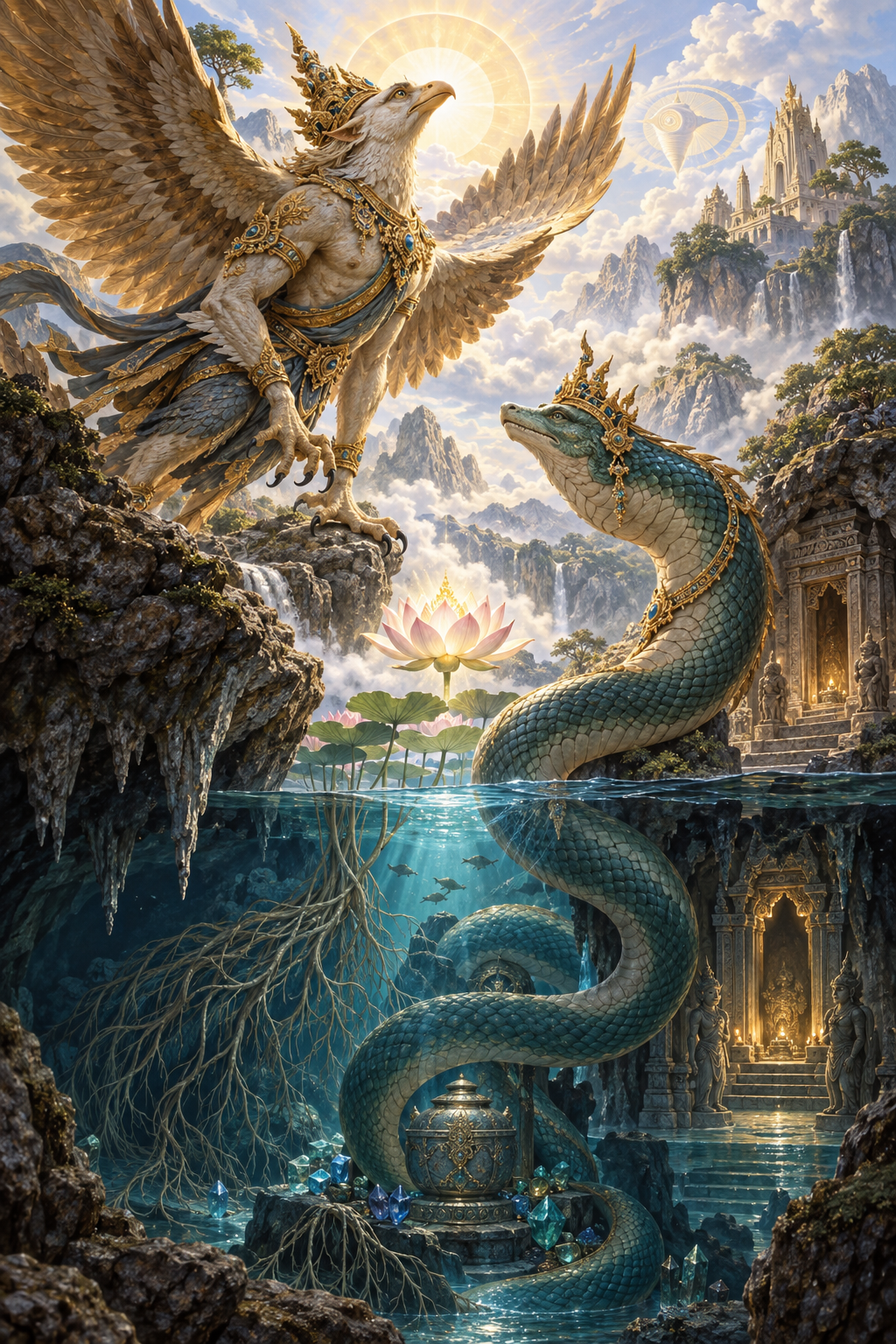
When you encounter these figures in a temple, manuscript, story, or modern artwork, use a sequence that keeps the Hindu context intact.
- Identify the beings precisely. Determine whether the bird is Garuda and whether the serpent is a named naga, a naga lineage, or a more general serpent figure. Do not assume that any eagle and snake automatically reproduce the Puranic relationship.
- Observe the action before assigning a meaning. Is the serpent supporting, sheltering, encircling, threatening, guarding, or being subdued? Is Garuda carrying a deity, flying independently, kneeling in devotion, or confronting a naga? Posture and action often carry more meaning than species.
- Identify the central relationship. If Vishnu is present, ask how each figure serves him. If another deity or a local temple tradition is involved, let that setting govern the reading. The same creature can perform a different symbolic function in a different composition.
- Separate cosmic symbolism from moral caricature. Opposition may indicate conflicting tendencies, domains, or modes of power. It does not automatically turn every naga into an embodiment of sin or every winged figure into an emblem of faultless virtue.
- Consult the narrative attached to the image. A temple’s sthala-purana, the relevant scriptural episode, or the figure’s traditional name may settle questions that visual resemblance alone cannot. Iconography is read through inherited relationships, not shape-matching alone.
Two imported shortcuts are especially unhelpful. The first is treating the serpent exclusively through the Biblical image of Eden. The second is treating the eagle primarily as a modern national or imperial emblem. Comparisons across cultures can be illuminating after the Hindu image has been understood on its own terms. Used at the beginning, they replace the tradition’s grammar with someone else’s.
You should also resist turning a mythic relationship into an instruction about biological animals. Garuda and the nagas belong to sacred narrative and cosmology. Their enmity is not a mandate to mistreat snakes, birds, or any community that later uses either image as an emblem.
Key takeaways
- Garuda and the nagas are half-siblings through Kashyapa, so their rivalry occurs within one cosmic family.
- The shared father points toward unity of origin without denying real differences in nature, function, or disposition.
- Serpent imagery can express hidden or concentrated power, support, protection, danger, renewal, or entanglement; context determines which meaning is active.
- Garuda imagery can express vision, speed, ascent, release, and power placed in divine service.
- Vishnu’s association with both Ananta Shesha and Garuda shows that stable depth and purposeful movement can belong to the same sacred order.
- Neither the Western serpent-versus-saviour pattern nor an eagle-equals-good formula adequately explains Hindu iconography.
The next time you encounter Garuda and a naga, pause before deciding who represents good and who represents evil. Name the figures, notice what each is doing, and find the divine relationship organizing the scene. That small discipline will reveal far more than a ready-made symbolic label.
References

Leave a Reply
You must be logged in to post a comment.