
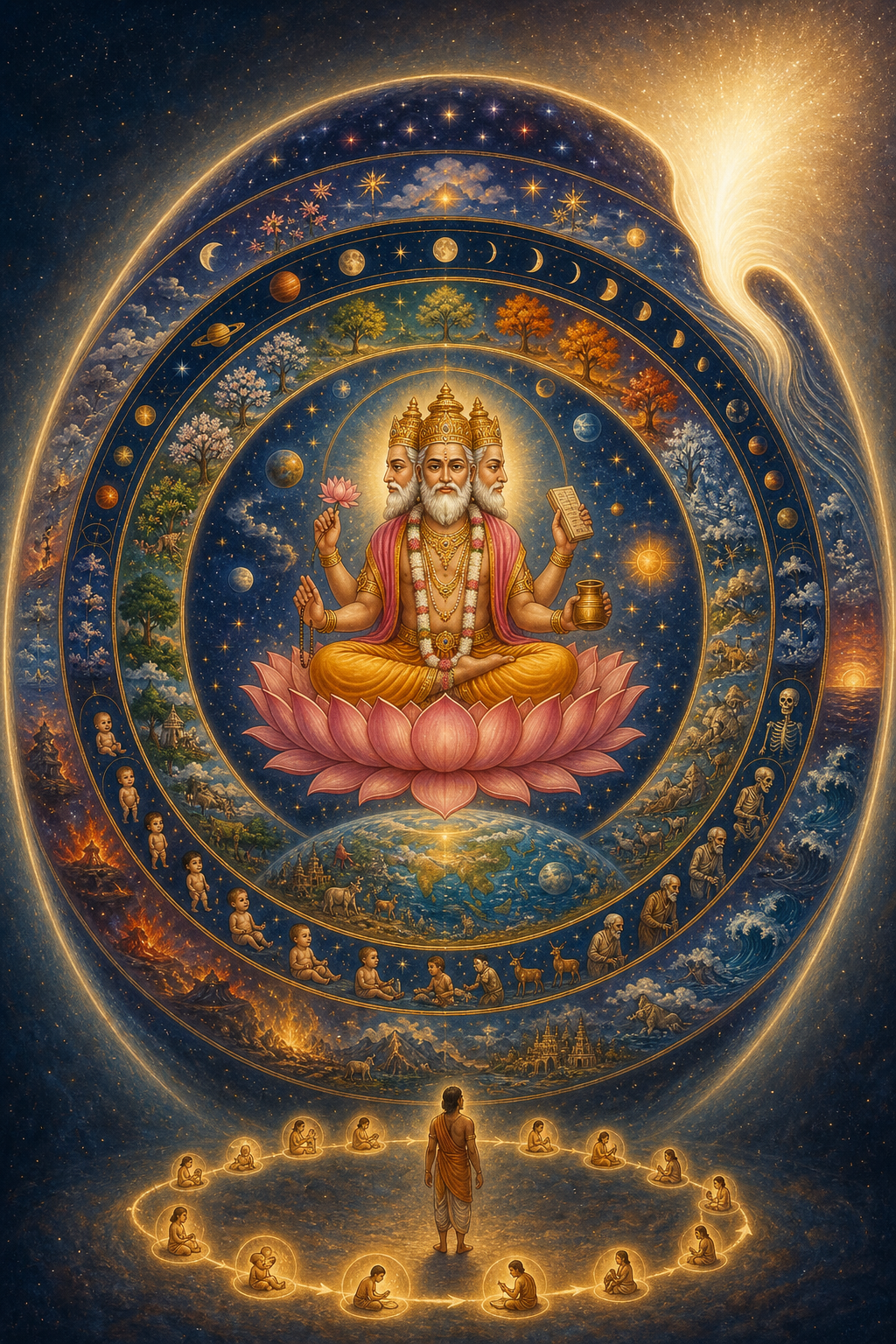
You may have heard the story of Hiranyakashipu and wondered why he did not simply ask Brahma for immortality. If a deity can grant extraordinary protection, why stop at an elaborate set of conditions?
The answer changes how you read the entire story. A boon can extend life or protect a body within creation, but it cannot turn that body into something beyond time. That distinction also explains why moksha is not an infinitely prolonged life. It is freedom from the bondage that makes repeated embodiment necessary.
First separate three promises that sound like immortality
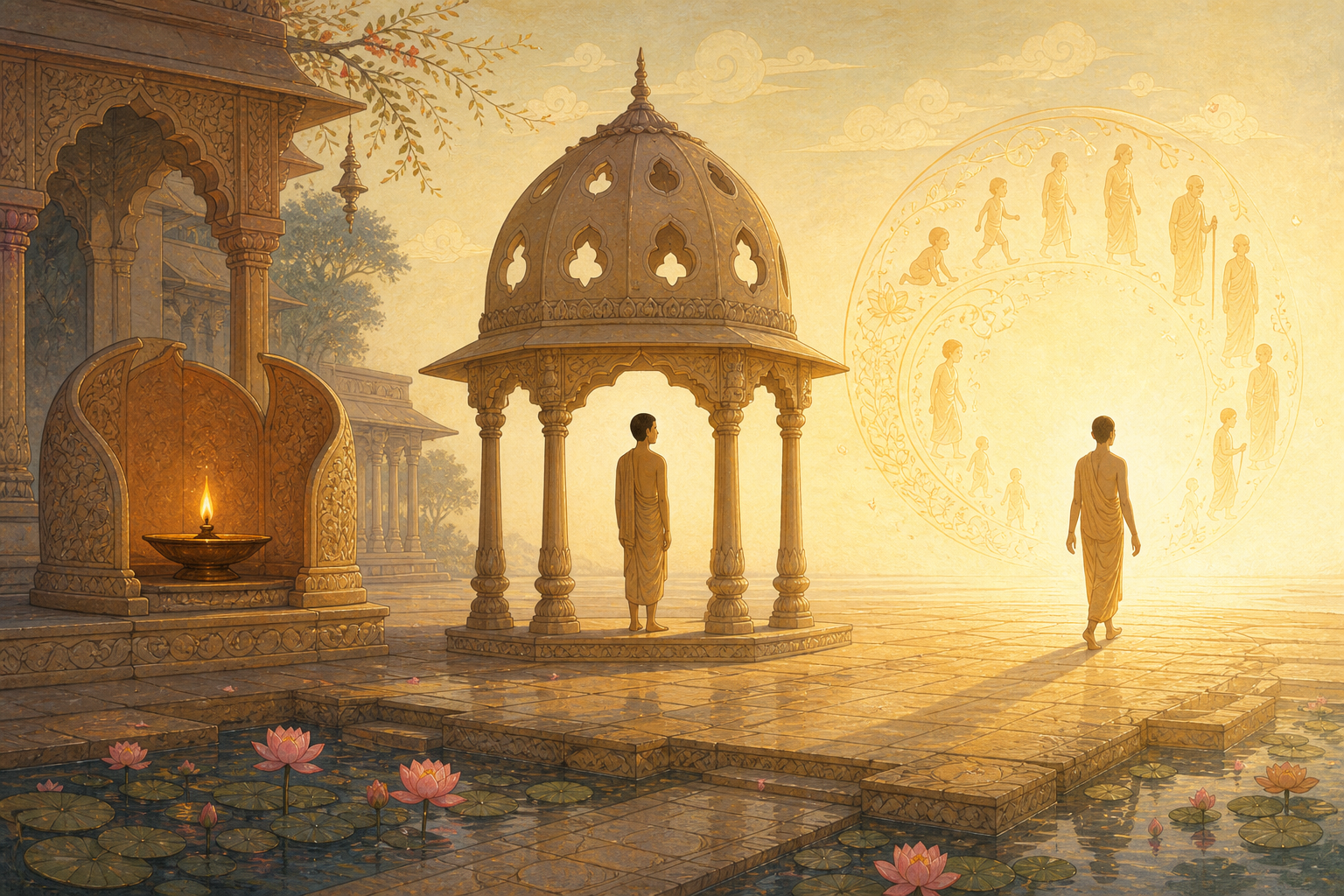
Much of the confusion disappears when you stop using one word for three different possibilities:
- Longevity gives an embodied being more time. However immense that span may be, it still has a beginning, passes through change, and eventually ends.
- Conditional protection prevents death through specified agents, places, circumstances, or means. It narrows vulnerability without abolishing it.
- Moksha ends bondage to karma and samsara. It does not preserve the present body forever; it releases the being from compulsory birth, death, and rebirth.
The first two possibilities belong to the world of causes and conditions. The third concerns freedom from bondage to that world. Treating them as interchangeable is like confusing a stronger prison cell with release from prison.
An embodied life has a form, a location, a history, and relationships with other changing things. Adding protective clauses does not remove those conditions. It only changes the circumstances under which the body can be harmed. A useful test is simple: if a boon must be expressed through conditions, it still operates within samsara.
This is why the number or ingenuity of a boon’s protections is not the decisive issue. A fortress may have many guarded entrances, but it remains a fortress situated within a larger territory. In the same way, conditional invulnerability remains inside the field of time, karma, and change.
Brahma administers creation; he does not stand outside its law
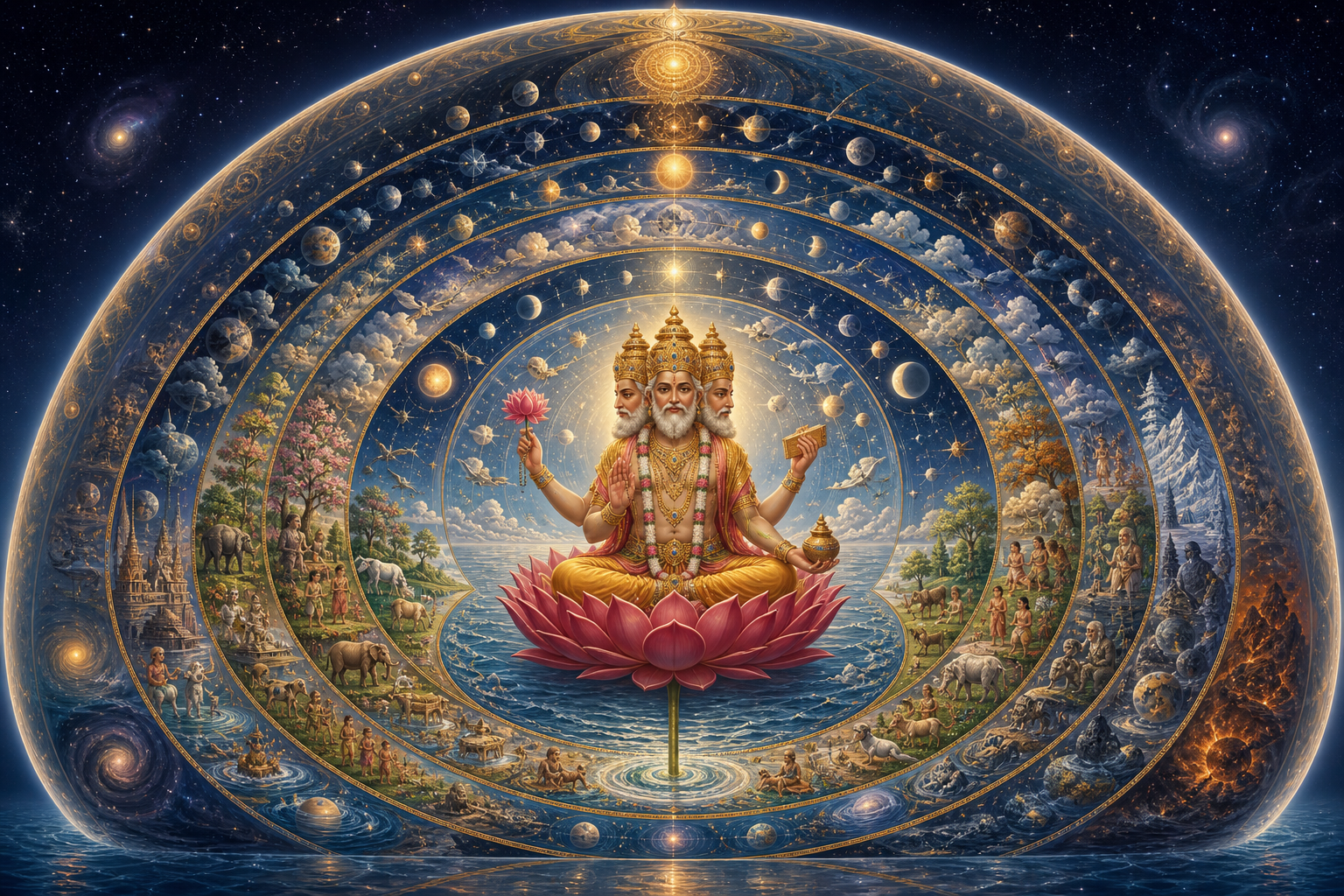
Within the familiar Trimurti framework, Brahma creates, Vishnu preserves, and Shiva transforms. These roles are not rival powers pulling the cosmos in different directions. They express complementary movements within one ordered reality.
Brahma therefore does not grant boons as an authority who can discard the structure of existence whenever a petitioner asks. Brahma himself remains within cosmic time, with a lifespan measured in kalpas. That lifespan is almost inconceivably vast from a human perspective, yet vast duration is still duration. Creation eventually reaches dissolution, or pralaya, and manifest forms are reabsorbed.
This is not best understood as a weakness in Brahma. It is a limit of category. A creator acting within manifestation can produce, arrange, empower, and prolong manifested beings. He cannot make a conditioned body unconditioned while leaving it a conditioned body. The request contradicts itself.
Karma supplies the moral side of the same principle. Actions have consequences, and embodied beings remain accountable within that causal order. If one embodied ruler could acquire absolute exemption from death and consequence, power could become permanently detached from responsibility. Adharma would no longer contain the conditions of its own correction.
Cosmic law here is not a bureaucratic rule imposed on reality from outside. It is the coherence that allows creation, moral consequence, dissolution, and renewal to belong to the same cosmos. A boon works through that coherence; it does not cancel it.
Hindu sampradayas do not all describe Brahma, divine supremacy, or liberation in identical theological language. You need not force every tradition into a single formula. The narrower principle is enough for reading the boon narratives: no power granted within manifestation can convert a perishable form into the timeless absolute.
Narasimha is not a lesson in tricking the fine print
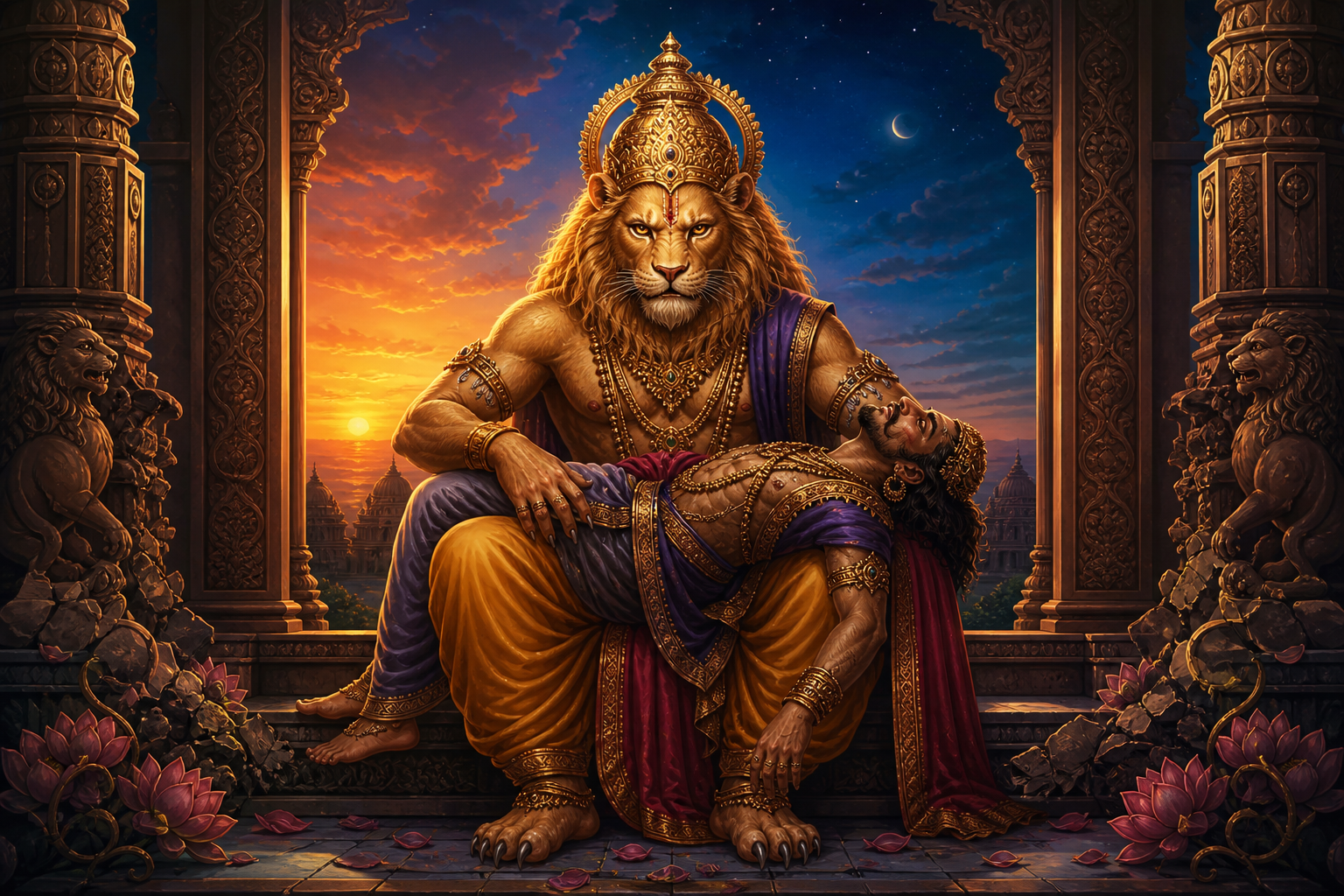
Hiranyakashipu’s strategy was to approach immortality indirectly. Once an unconditional request was unavailable, protection was expressed through a carefully constructed set of qualifications. The strategy mistook coverage under many conditions for transcendence of all conditions.
That mistake is the heart of the narrative. Hiranyakashipu did not merely want time in which to fulfil dharma. He treated acquired protection as permission to place his will above the moral order. The boon increased his capacity, but it did not transform adharma into dharma.
Narasimha’s appearance is sometimes reduced to divine legal cleverness: Hiranyakashipu drafted a contract, and Vishnu found a loophole. That reading is too shallow. The conditions always marked the boundary of the granted power. They never amounted to a promise that adharma had become untouchable.
Vishnu’s intervention shows that preservation includes restoring balance when protected power is turned against dharma. Narasimha acts without converting the conditional boon into absolute immortality. The outcome preserves both the integrity of the boon and the deeper order within which it was granted.
You can use three questions to read other stories of divine gifts and extraordinary powers:
- What was actually granted? Separate long life, protection, knowledge, status, or capacity from claims of absolute immortality.
- How was the gift used? A capacity acquired through effort does not carry automatic moral approval for every later action.
- What restores accountability? Notice how the narrative prevents power from becoming a permanent exemption from dharma and karma.
This approach keeps you from turning Puranic accounts into puzzles about wording alone. Their sharper concern is ethical: what happens when a being mistakes exceptional power for sovereignty over truth?
Moksha answers a different question from bodily survival
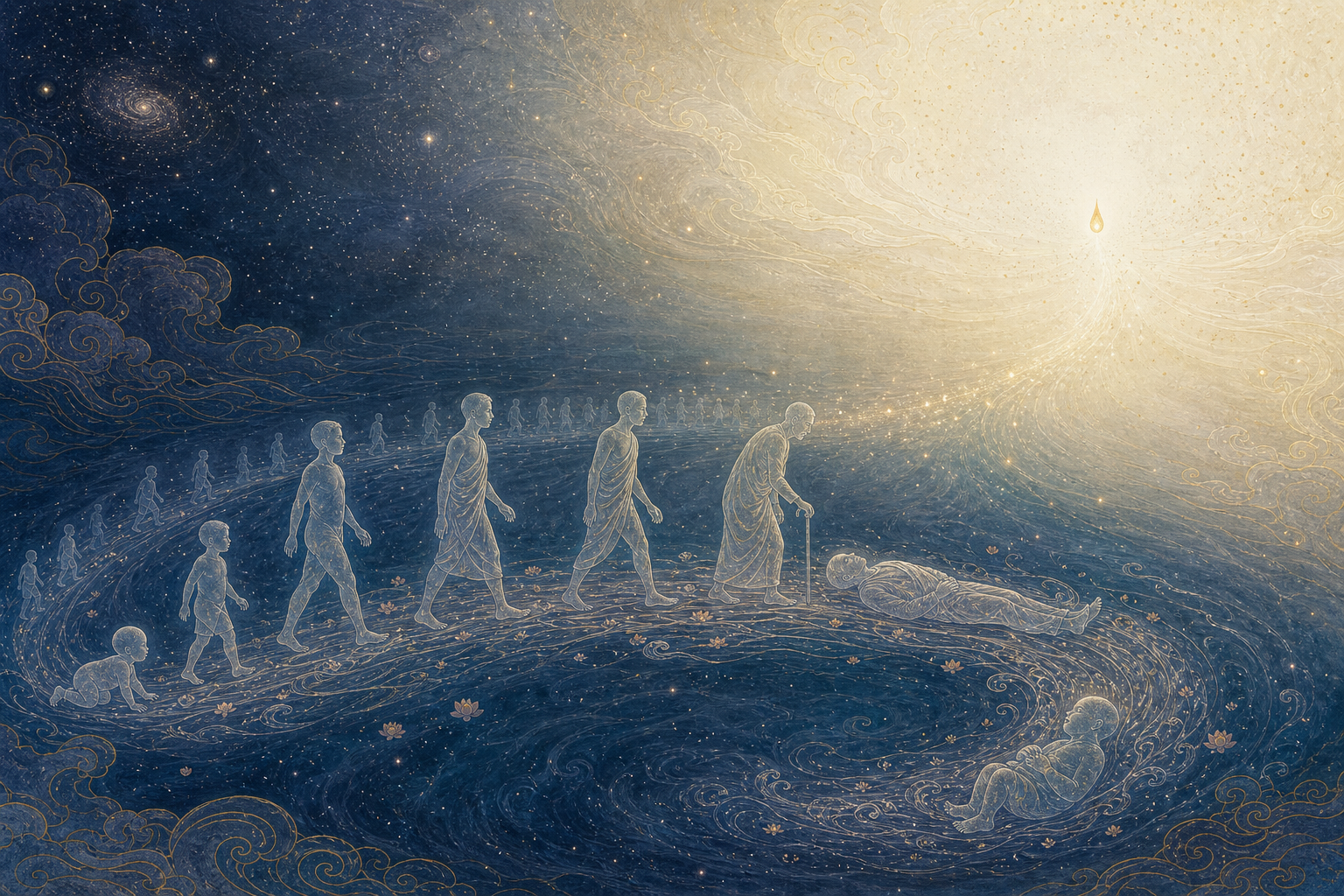
Physical immortality asks, “How can this embodiment continue without end?” Moksha asks, “Why am I bound to embodiment, action, consequence, and rebirth in the first place?” One seeks endless continuation inside samsara. The other seeks freedom from samsara.
Death by itself is not moksha. Within a karmic account of rebirth, the ending of one body does not necessarily end the causes of further embodiment. Nor would an indestructible body solve the problem. It could simply provide an indefinite field for attachment, domination, craving, and further action.
Vedantic language makes another essential distinction. The atman is not the everyday ego, social identity, memory, or personality demanding perpetual continuation. The eternal is not manufactured by a boon. It is realized through knowledge that the deepest Self is not reducible to the changing body. In Advaita Vedanta, this realization is expressed through the non-duality of atman and Brahman; other Hindu schools articulate the relation between the self and the ultimate differently.
The Bhagavad-Gita, Mahabharata, and Puranic traditions repeatedly direct attention away from clinging to perishable form and toward right action, self-knowledge, devotion, and liberation. The practical correction is important: wanting your present ego to last forever is not the same as realizing the eternal.
A related reorientation appears across the wider Dharmic family, though the traditions must not be collapsed into one metaphysical doctrine:
- Hindu paths pursue moksha through disciplines that may emphasize knowledge, devotion, meditation, selfless action, or combinations of these. The body is a field for sadhana, not the final object of preservation.
- Buddhism emphasizes anitya, or impermanence, and directs practice toward nirvana. It would be misleading to translate this into the Vedantic claim of an eternal atman; the shared point here is the refusal to make permanent embodiment the goal.
- Jainism seeks freedom from karmic accumulation and associates liberation with kevala-jnana. Prolonging embodied existence is not equivalent to ending karmic bondage.
- Sikhism directs the seeker toward Naam, life in hukam, and the loosening of ego. Clinging to bodily permanence moves in the opposite direction from alignment with the divine order.
The common practical movement is from possession to freedom: not “How can I keep this form forever?” but “What ignorance, attachment, or ego keeps binding action to further bondage?” The answers differ among traditions, but none makes an endlessly defended body the highest attainment.
Turn the immortality question back toward the life you have
The wish for immortality often contains a more immediate demand. You may want enough time to complete a duty, control over what can be taken from you, relief from fear, or assurance that your life will matter. Naming that demand is more useful than debating an imaginary indestructible body.
When the question arises in your own practice, work through it in this order:
- Name what you are trying to preserve. Is it the body, a relationship, reputation, authority, accumulated wealth, memory, or a particular image of yourself? “Everything” is too vague to examine.
- Separate duty from control. You can perform a duty with care, but you cannot make every result permanent. Ask what dharma requires even if the outcome remains uncertain.
- Inspect the hidden bargain. Notice whether you are treating worship, knowledge, austerity, or good conduct as a transaction that should exempt you from loss. Spiritual discipline may transform your relation to change; it does not make change disappear.
- Choose a practice that weakens bondage. Depending on your path, that may mean self-inquiry, meditation, remembrance of Naam, devotion, seva, restraint, or more exact ethical conduct. Choose the discipline that confronts your attachment rather than decorating it.
- Judge power by its use. Knowledge, position, health, and longevity enlarge your field of action. Ask whether that larger field produces service and accountability or merely gives ahankara more room.
A short set of questions can keep this reflection concrete:
- What am I demanding must never change?
- Which present duty am I postponing while imagining that I need unlimited time?
- Would the power I desire make me more accountable or help me escape accountability?
- Is my practice making me more truthful, less possessive, and more capable of seva?
These questions also guard against a spiritualized version of Hiranyakashipu’s error. Sadhana itself can be recruited by the ego as a search for invulnerability, superiority, or control. If a practice strengthens the conviction that ordinary moral limits no longer apply to you, the problem is not lack of spiritual power. It is the direction in which that power is being used.
The traditions instead point toward dharma, self-knowledge, meditation, seva, and ethical living. These do not promise that the body will escape time. They prepare you to live within time without mistaking the temporary for the absolute.
Key takeaways
- Brahma can grant long life and conditional protection, but not an absolutely immortal body outside time and causality.
- A boon operates within cosmic law; it does not erase karma, dharma, change, or eventual dissolution.
- Hiranyakashipu confused comprehensive protection with transcendence and then treated power as exemption from moral accountability.
- Narasimha restores dharma without turning a conditional boon into a meaningless promise.
- Moksha is release from karmic bondage and samsara, not perpetual continuation of the present body and ego.
- Hinduism, Buddhism, Jainism, and Sikhism describe liberation differently, but each redirects the seeker away from clinging to bodily permanence.
The next time you hear a story about an extraordinary boon, do not begin by hunting for a cleverer immortality clause. Ask what remains conditioned, how power affects accountability, and whether the seeker wants longer bondage or genuine freedom. Then bring the same test to one attachment in your own life: identify the duty it obscures and perform that duty without demanding a permanent result.
References
