

You take the first sip of tea, hear the opening phrase of a beloved raga, or step into cool air after a difficult day. Relief appears to come from the taste, sound, or touch. Yet the same tea can become uninteresting after another cup, and the same melody can irritate you when your mind is elsewhere. If pleasure were stored inside the object, why would its effect change so easily?
Vishayananda gives you a precise way to investigate that question. It does not ask you to distrust enjoyment. It asks you to notice what happens in the mind at the exact moment enjoyment appears. That shift in attention can turn an ordinary pleasure from an occasion for grasping into a lesson about the source of ananda.
Pleasure begins where craving briefly ends
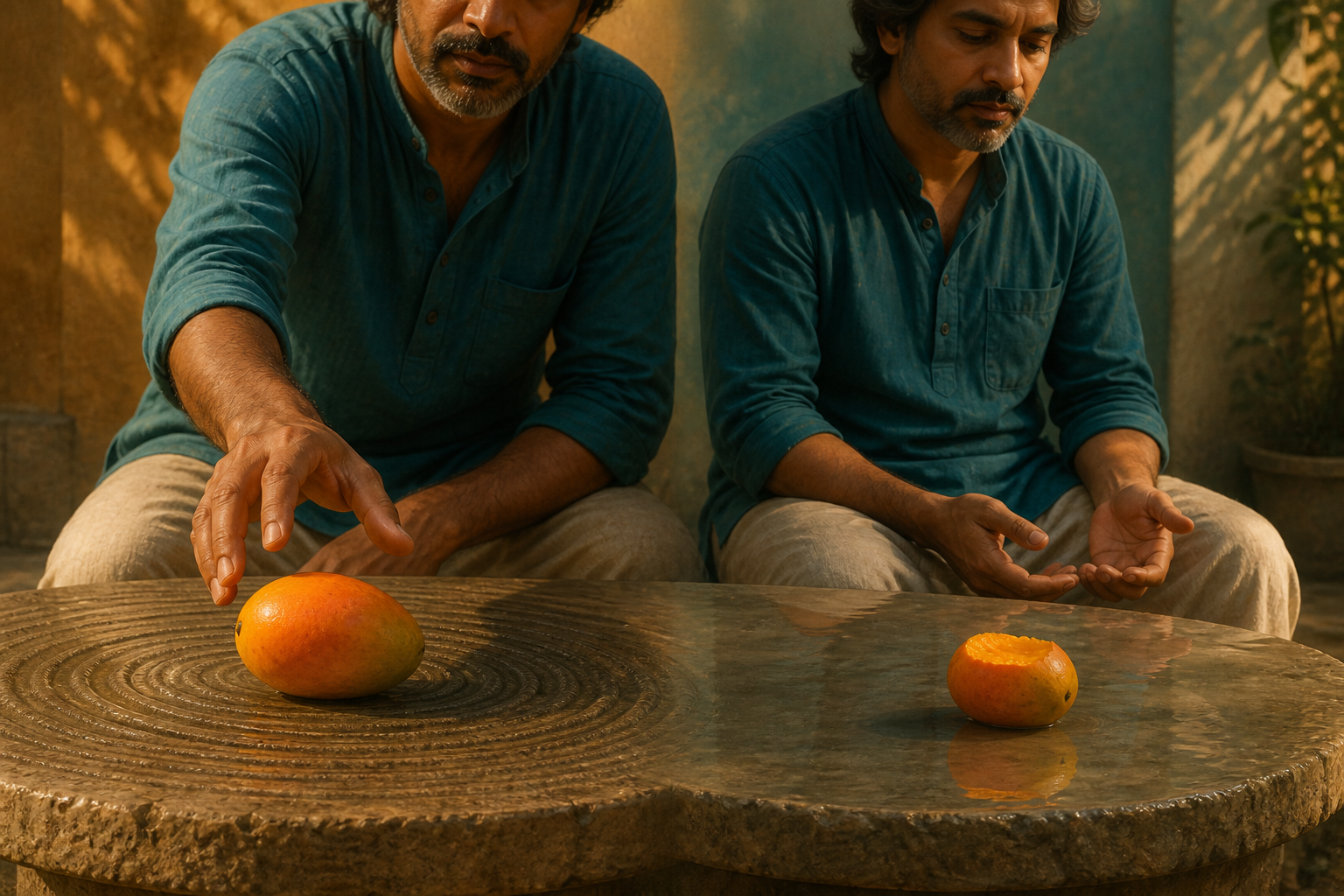
Before you obtain something you want, the mind is divided. Part of it attends to the present, while another part reaches toward the imagined experience. The unspoken message is simple: “I will be complete when I get that.” This movement may be mild, as with wanting a particular taste, or insistent, as with repeatedly checking for stimulation.
When the desired object arrives, that particular demand briefly stops. The senses and mind become aligned with one experience. For an instant, the agitation of wanting is absent. Advaita identifies the pleasure revealed in this interval as vishayananda: ananda associated with contact between the senses and their objects.
The crucial word is “revealed.” The object helps bring the search to a temporary halt, but it does not manufacture bliss. As mental disturbance settles, the happiness belonging to the Self becomes perceptible in the composed mind. A mirror does not create sunlight when its surface catches the sun; it makes already-present light visible under the right conditions. In the same way, the quietened mind reflects ananda without producing it.
This explains why pleasure often feels like relief. Something has indeed changed, but the deepest change is not that happiness has travelled from the object into you. The change is that the mind has stopped insisting, however briefly, that happiness lies somewhere else.
The object is a condition, not the owner of happiness

It would be an overcorrection to say that objects have no role at all. A pleasing melody and a jarring noise do not create identical mental conditions. Fresh food and spoiled food are not interchangeable. At the practical level, the object, the senses, your condition, your attention, and your desire all shape the experience.
Advaita makes a narrower and more important claim: the object does not contain happiness as one of its inherent properties. It is an occasion under which a particular mental disturbance may subside. You can test that distinction instead of accepting it as an abstract doctrine.
- Compare different people. An object that delights you may leave another person unmoved. If happiness belonged to the object in the same way that heat belongs to fire, the response would not depend so heavily on the experiencer.
- Compare different moments. The taste you eagerly anticipate when hungry may become unwanted after satisfaction. The object may be substantially unchanged while your experience of it changes with the condition of the mind and body.
- Watch what repetition does. The first contact can end a vivid want. Immediate repetition often lacks the same force because the original want has already subsided. More contact cannot repeatedly end a desire that is, for the moment, absent.
- Notice object-free composure. Meditation, prayer, quiet remembrance, or simple inward collectedness can disclose ease without the acquisition of a new sensory object. This does not prove every Advaitic conclusion by itself, but it does show that peace need not wait for consumption.
These observations expose a common error in memory. The sequence is “object obtained, desire quieted, pleasure known,” so the mind compresses it into “the object gave me happiness.” That shortened account hides the decisive middle event: the cessation of craving.
This is also the distinction between vishayananda and Brahmananda. Vishayananda is conditional, reflected, and brief because it depends on a suitable object-mind-sense arrangement. Brahmananda is not one more intense experience competing with lesser pleasures. It is the limitless ananda of Brahman, the ground from which every reflected glimpse borrows its apparent radiance. Confusing the glimpse with its occasion keeps the search moving outward.
A practice for tracing pleasure back to awareness

Use a small, ordinary pleasure for this inquiry. Tea, fruit, rainfall, music, a fragrance, or dawn light is more suitable than something around which you already feel strong compulsion. The aim is not to generate an extraordinary state. You are examining a familiar transition closely enough to stop misreading it.
- Pause before contact. Notice the mind leaning toward the experience. Name the promise without judging it: “I expect this taste to satisfy me,” or “I want this sound to change how I feel.”
- Receive the experience without adding another task. Let the senses meet the object directly. If you eat while scrolling or listen while planning, several wants remain active and the transition is harder to see.
- Catch the end of wanting. Attend to the instant when anticipation gives way to enoughness. The important event is not merely the taste or sound; it is the disappearance of the demand that preceded it.
- Turn attention toward the quiet. Ask, “What is absent now?” Often the clearest answer is not a new possession but a temporary lack of striving, comparison, or incompleteness.
- Do not rush to repeat the stimulus. Rest for a moment without trying to prolong pleasure through more contact. See whether the ease can be known directly when attention is no longer fixed on the object.
- Observe the next movement. When another desire appears, notice how the mind again locates fulfilment in a future event. You have now seen the cycle rather than merely being carried by it.
If the exercise makes you tense, you are probably trying to seize the quiet as another object. Return to a neutral experience and soften the analysis. Vishayananda is disclosed when agitation diminishes; aggressive self-monitoring merely introduces a new form of agitation.
Regular abhyasa makes the pattern easier to recognize. Pratyahara helps by loosening the reflex to follow every sensory invitation. Dhyana allows attention to remain steady after a desire has fallen silent. A sattvic way of living supports both by reducing avoidable disturbance. None of these requires hostility toward the senses. The senses continue to perform their proper work while losing their authority to dictate where fulfilment must be found.
Enjoyment without indulgence or self-denial

Vishayananda can be misread in two opposite directions. The first error is hedonistic: if sensory pleasure reflects Brahman, then collecting more pleasures must be spiritual. But multiplying objects usually multiplies anticipation, comparison, and fear of loss. The flashes remain brief while the machinery of craving grows busier.
The second error is to declare the senses enemies. Forced denial can leave the mind inwardly occupied with the very object it outwardly refuses. Renunciation then becomes another kind of attachment, organized around avoidance rather than possession.
The wiser course is disciplined proportion, close to the Gita’s counsel of balanced living, or yukta-ahara-vihara. Accept a legitimate enjoyment without asking it to provide permanent completion. Let satisfaction end the encounter instead of automatically arranging its repetition. Before following a desire, ask:
- Am I choosing this experience, or merely obeying restlessness?
- Will I recognize when the present want has ended?
- Can I enjoy what is here without immediately planning how to recover it?
- Does obtaining it require me to disregard dharma, duty, another person’s welfare, or my own clarity?
That last question matters. The claim that happiness comes from the Self does not make conduct irrelevant. It removes the excuse for treating any finite object as indispensable. Once you stop demanding absolute fulfilment from food, entertainment, possessions, status, or another person, it becomes easier to keep enjoyment within ethical limits.
This insight also helps you understand resonances across Dharmic paths without flattening their differences. Buddhist discipline closely examines craving and the ease disclosed when it calms. Jain Samayik cultivates equanimity rather than dependence on changing circumstances. Sikh practice knows Anand through remembrance in Naam Simran. These traditions do not become doctrinally identical, and their distinct teachings should be respected. Their practical convergence lies in refusing to make restless acquisition the final measure of happiness.
Within Advaita, the conclusion remains specific: happiness belongs to Atman rather than to the object. Viveka distinguishes the temporary condition from the ever-present ground. Vairagya then develops without bitterness. You do not have to pretend that pleasant things are unpleasant; you simply stop asking a passing arrangement to deliver the limitless.
Key takeaways
- Vishayananda is sensory pleasure experienced when contact with a desired object briefly quiets the wanting mind.
- The object is a practical condition for the experience, but it does not possess or manufacture happiness.
- The decisive transition is from craving to temporary composure; that composed mind reflects the ananda of the Self.
- Vishayananda is finite and conditional, while Brahmananda is the unconditional ground from which reflected pleasure draws its light.
- Neither indulgence nor hostility toward the senses produces freedom. Viveka, vairagya, pratyahara, dhyana, and balanced living loosen dependence without denying ordinary enjoyment.
At your next ordinary pleasure, do not ask only, “How good is this object?” Notice the instant at which wanting stops, and remain with the quiet before reaching for more. Repeated honestly, that small inquiry teaches the senses their proper place: useful instruments that can point you inward, but cannot own the ananda they reveal.
References
