
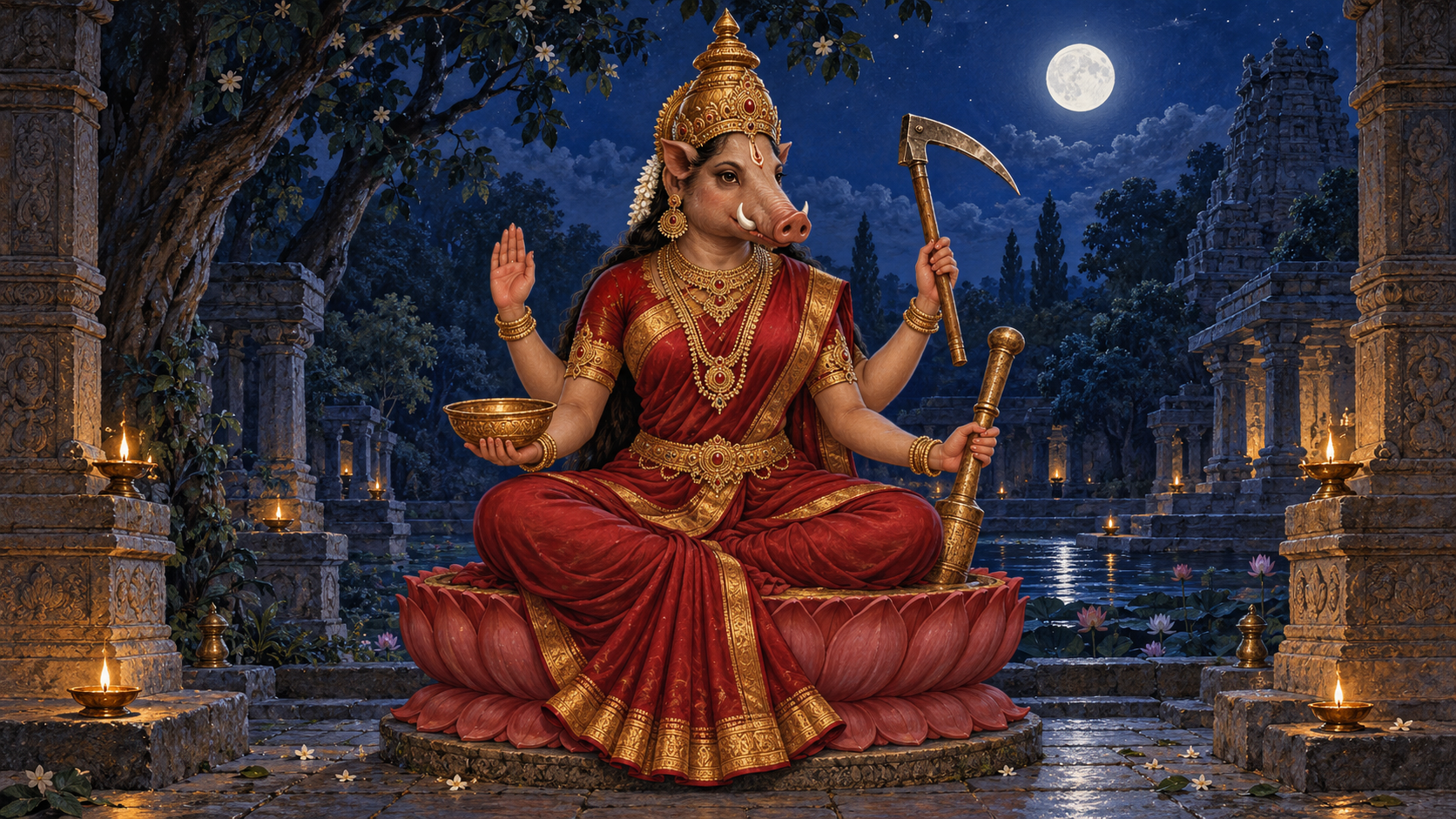
If you have encountered Varahi as Ratri Devata, you may be wondering whether “Goddess of Night” simply identifies an hour of worship, or whether darkness makes her a sinister deity. Both readings are too narrow.
Her nocturnal identity becomes clearer when you hold together her place among the Saptamatrikas, her relationship to Varaha, and her fierce boar-headed form. Night is the setting in which ordinary visibility recedes. Varahi represents the power to remain discerning, protected and capable when familiar forms of certainty are no longer available.
Key takeaways
- Ratri Devata means a deity of night, but “night” can be understood as both an outer condition and an inner symbol.
- Night should not be treated as a synonym for moral evil. It can signify uncertainty, concealment, inward attention and truths that daylight consciousness avoids.
- Varahi must be read through three identities at once: divine mother, shakti of Varaha and fierce boar-headed power.
- Her fierceness is not the opposite of motherhood. It expresses the protective, boundary-setting and uncompromising dimensions of the maternal.
- Reflecting on this symbolism is not the same as undertaking formal Shakta or Tantric sadhana. Specific ritual practice should be learned within a qualified tradition.
Night changes how you know, not what is true

The world does not disappear after sunset. What changes is your ability to see it in the usual way. Familiar outlines become uncertain, peripheral movement attracts attention, and hearing matters more. You can no longer behave as though sight gives you complete command of your surroundings.
That physical fact gives night its spiritual usefulness. In a symbolic reading, ratri is the condition in which your usual confidence thins out. It includes the unexamined fear, unresolved conflict or inconvenient truth that remains present even when you cannot—or will not—name it clearly. Darkness does not create these things. It reveals the limits of the awareness with which you meet them.
Varahi belongs here because her form does not promise that every spiritual reality will arrive in a gentle, familiar shape. Her presence asks whether you can recognise divine power when it unsettles your preferences. The question is not, “How do I make the darkness disappear?” It is, “How do I remain aligned with dharma when I cannot see the entire path?”
This distinction also prevents a common misreading. Fierce does not mean wicked, and dark does not automatically mean impure. If an interpretation turns Varahi into an embodiment of evil merely because she is associated with night, it has imported a moral equation that her maternal and divine identities do not support.
Read the mother, the shakti and the boar form together
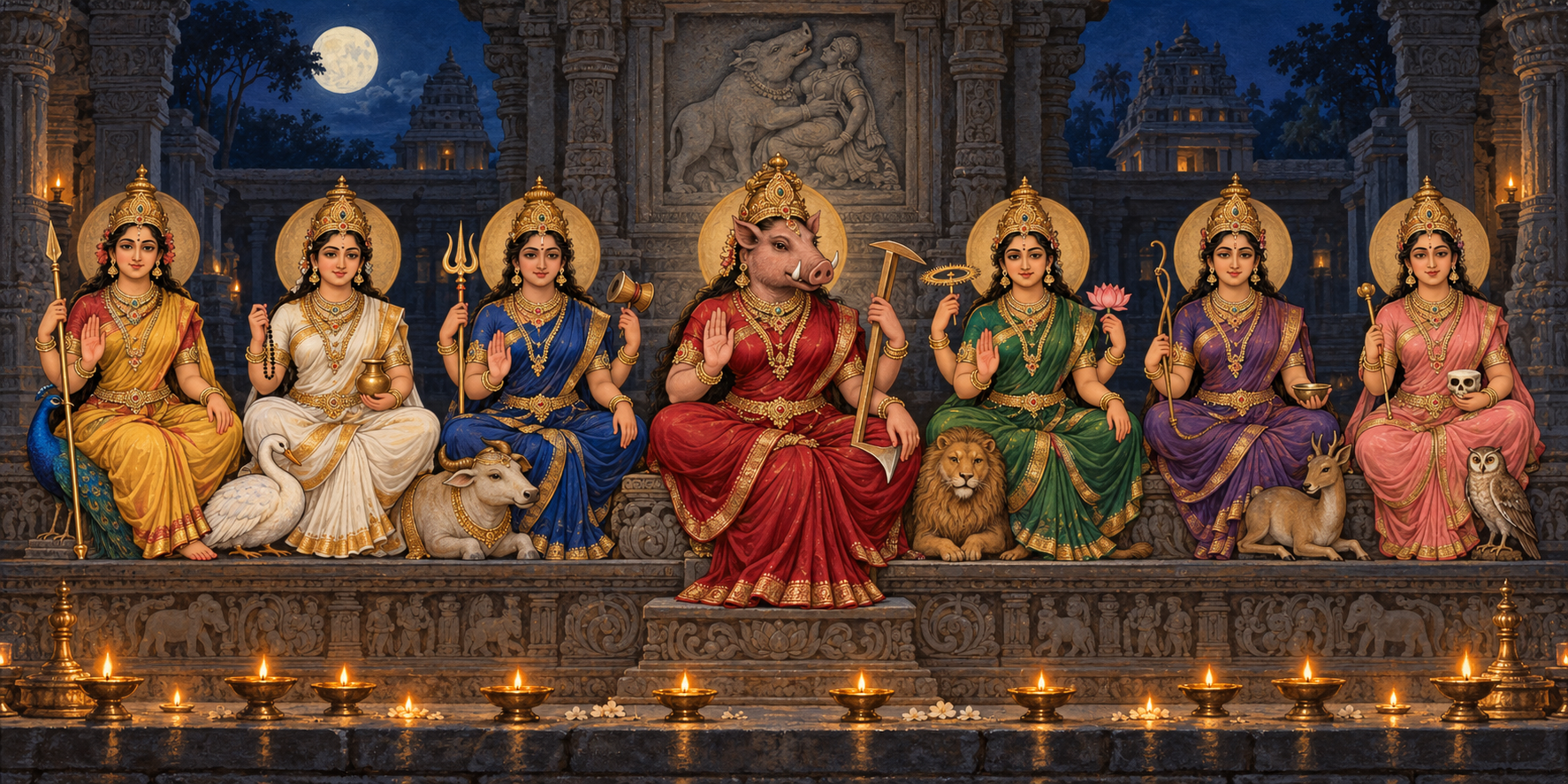
Varahi’s identity has three inseparable dimensions. Removing any one of them produces a thinner—and often distorted—picture.
- She is one of the Saptamatrikas. Her fierceness therefore appears within the sacred field of the divine mothers. Motherhood here is not reduced to softness. It also includes defence, correction, endurance and the refusal to surrender what must be protected.
- She is the shakti of Varaha. Varaha is the boar incarnation of Bhagavan Vishnu. Shakti, in this context, identifies living divine power rather than a decorative female counterpart. Varahi’s relationship with Varaha places her fierce form within a wider Dharmic theology of preservation and divine action.
- She bears the boar head and embodies primal energy. “Primal” need not mean chaotic, immoral or mindless. It points to power operating beneath social polish: instinctive recognition, tenacity and the capacity to act when elegant language is no longer enough.
Use these dimensions as a check whenever you encounter a depiction or explanation of Varahi. Does it remember that she is a mother? Does it retain her relation to Varaha? Does it take her fierce form seriously without turning ferocity into cruelty? A reading that cannot hold all three is probably emphasising spectacle over meaning.
This is also why Varahi cannot be understood by translating her into a generic “warrior goddess.” That label captures force but loses the theological relationships that direct it. Her power is not aggression for its own sake. It is force situated within divine motherhood and shakti.
Her fierceness exposes the limits of spiritual comfort
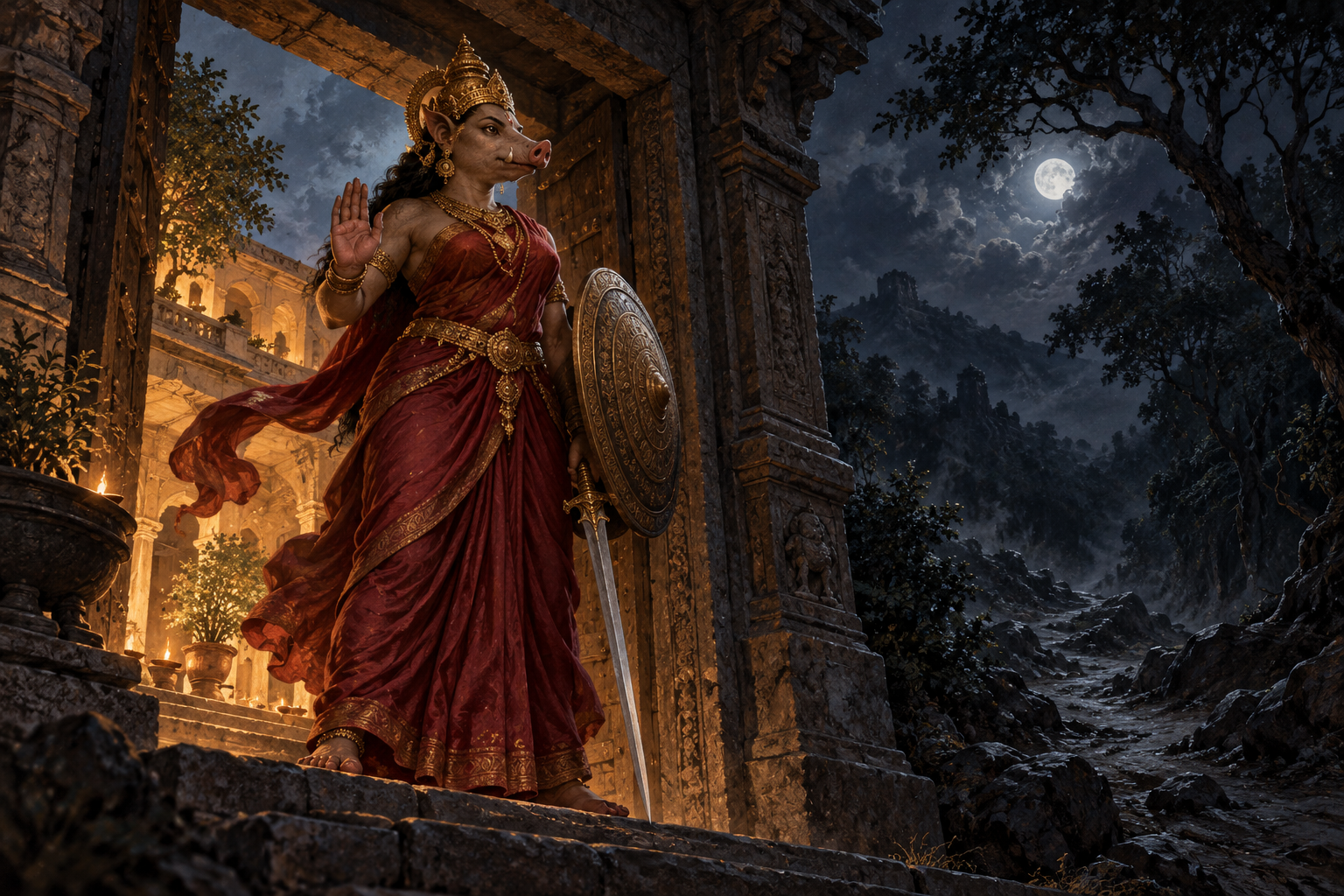
Many people are comfortable with the Divine as long as divinity remains consoling. Varahi confronts that condition. A mother who only soothes but never protects, corrects or establishes a boundary is an incomplete image of maternal care. In the same way, a spirituality that values peace but cannot face danger, deception or fear may become avoidance dressed in sacred language.
Night sharpens this lesson because uncertainty makes your habits visible. You may rush toward an answer because not knowing feels intolerable. You may postpone a necessary decision while calling the delay patience. You may also mistake fear for intuition, or impulsiveness for divine prompting. Varahi’s symbolism does not justify any of those reactions. It asks for courage joined to discrimination.
You can make that distinction practical by examining a difficult situation through these questions:
- What fact am I avoiding because accepting it would disrupt a comfortable self-image?
- What necessary boundary have I postponed while waiting to feel completely certain?
- Am I calling my fear “discernment,” or calling my anger “strength”?
- What would protection look like here if it were firm without becoming vindictive?
- What is the smallest ethical action I can take without pretending to know more than I do?
These questions keep the symbolism accountable. If contemplating a fierce deity merely makes you feel grand, invulnerable or entitled to dominate someone else, something has gone wrong. A Dharmic encounter with power should deepen responsibility, not inflate the ego that claims to possess it.
Contemplate Varahi without inventing a ritual
Varahi is worshipped within Shakta and Tantric traditions. That context matters. Reading her symbolism is open to any sincere reader; assembling a formal practice from fragments found online is a different matter. You do not need to improvise mantras, offerings or ritual claims in order to learn from her identity as Ratri Devata.
A restrained contemplation can proceed without presenting itself as traditional Varahi sadhana:
- Begin with her established identities. Recall the Saptamatrika, the shakti of Varaha and the fierce boar-headed mother. Do not begin with a fantasy of what you want a dark goddess to be.
- Name the night you are actually facing. Write down the uncertainty, fear or avoided truth in plain language. Keep it concrete rather than turning it into a dramatic story about destiny.
- Separate what is known from what is imagined. List the facts available to you, then identify the conclusions you have added. This is especially important when anxiety makes every ambiguity feel like a sign.
- Choose a bounded Dharmic response. Prefer an action that is ethical, proportionate and reversible: tell the truth, keep a necessary boundary, fulfil an obligation or seek sound counsel.
- Release the demand for total visibility. Responsible action does not require omniscience. It requires enough clarity to take the next honest step without pretending that the entire path has been revealed.
This reflection can be done in a quiet evening if the symbolism of night helps you attend, but darkness is not a requirement and should not be romanticised. Nor should a dream, coincidence or surge of emotion be treated automatically as a command from the deity. Test impressions against dharma, ordinary evidence and mature counsel.
If you want formal Varahi worship, seek instruction from a qualified teacher rooted in a living Shakta or Tantric lineage. The point is not secrecy for its own sake. Context tells you what a practice means, how its elements fit together and which instructions cannot be safely or faithfully separated from the tradition that carries them.
The next time you meet Varahi as the Goddess of Night, do not stop at the darkness around her. Notice the quality of awareness she demands within it. Name what you cannot yet see, refuse the temptation to invent certainty, and take the next action that is both courageous and Dharmic.
References

Leave a Reply
You must be logged in to post a comment.