
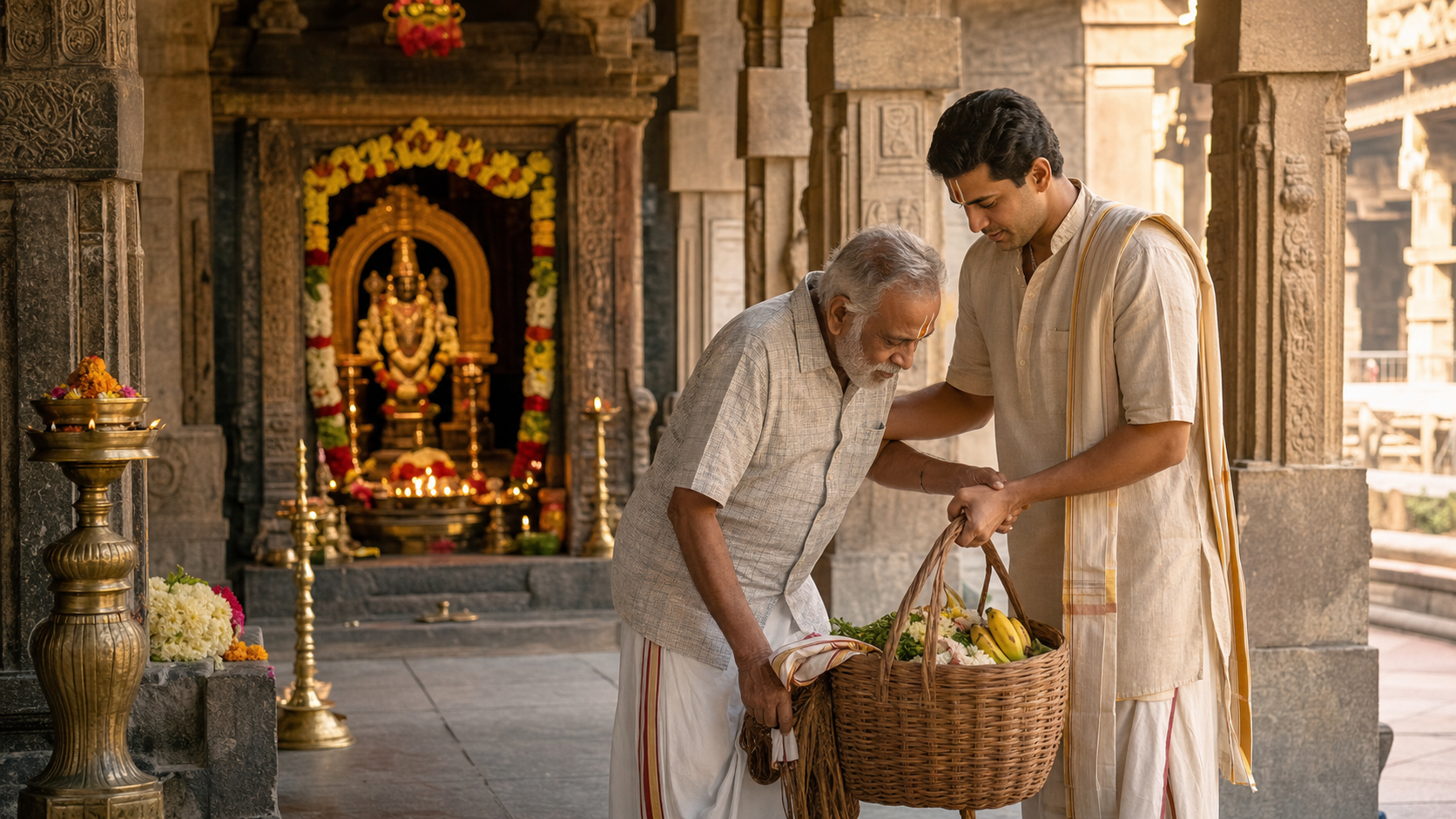
Your puja may be regular, your theology sound, and your affection for Vishnu sincere. Yet the decisive question often appears after worship: are you more patient with the person who interrupts you, more dependable in an ordinary duty, and more willing to help someone who cannot repay you?
Sri Vaishnava and Gaudiya traditions speak in distinct theological registers, and their differences should not be blurred. Both, however, confront you with a demanding practical principle: love of Bhagavan must become humility, responsibility, and compassionate service. Bhakti is not an escape from relationships. It changes how you inhabit them.
Begin with relationship, not private self-improvement
A spiritual routine can quietly become another self-improvement project: your peace, your purity, your learning, your liberation. Vaishnava philosophy interrupts that self-centered frame by placing the individual within a reality of enduring relationships.
In Sri Vaishnavism, Vishishtadvaita affirms the real relationship among the individual self, the world, and the Supreme. The jiva is real, jagat is real, and Ishvara is supreme. Difference is not dismissed as an illusion that makes duty irrelevant. A practical implication follows: the people, places, and responsibilities around you are not merely interruptions on the way to spiritual life.
Notice three distortions that can enter devotion:
- Treating the jiva as proprietor: you begin to regard time, ability, family, or position as private possessions whose purpose is to satisfy you.
- Treating jagat as disposable: material life becomes an excuse for neglecting ordinary care, because only explicitly religious activity appears worthy.
- Treating Ishvara as an instrument: prayer becomes bargaining for control, recognition, protection, or a preferred outcome.
Correct these distortions with a relationship audit. Choose one recurring duty that you resist. Ask who depends on its completion, what has been entrusted to you, and what response would honor Bhagavan rather than protect your convenience. Then do that duty without waiting for devotional emotion to appear.
This is where philosophy becomes immediately useful. It gives you a way to notice when the ego has converted religion into a private possession. If your practice makes you more absorbed in your spiritual status but less attentive to those who rely on you, the relationship between doctrine and conduct has broken.
Let surrender remove self-importance, not responsibility

Prapatti, or surrender, is central to Sri Vaishnava practice. Divine grace is understood through Vishnu in unity with Sri, or Lakshmi, while loving devotion and surrender provide paths of spiritual realization. This grace-centered vision joins disciplined practice to trust in Bhagavan.
Surrender is easy to misread as passive waiting. The practical distinction is simple: you relinquish the claim to control every result, but you do not abandon the action that dharma requires. Grace releases you from self-importance; it does not turn negligence into holiness.
- Name what you cannot command. Another person’s response, public recognition, and the final outcome are not yours to dictate.
- Name the action that remains yours. You may need to keep a promise, complete an overlooked duty, apologize without qualification, repair avoidable harm, or offer help.
- Offer the result before you act. Let the action be an offering to Bhagavan rather than a referendum on your worth.
- Act fully and examine the residue. Resentment, wounded pride, and hunger for praise reveal where surrender is still only verbal.
This test is especially useful when religious language begins protecting you from accountability. If your version of surrender leaves another person carrying a duty you neglected, it is avoidance. If it helps you act conscientiously without demanding control of the result, it is moving toward prapatti.
The same distinction applies to service. Do not wait to feel pure, inspired, or perfectly selfless. Begin with the responsibility already present. The ego often prefers a dramatic act of generosity because an ordinary obligation offers less recognition.
Make worship feed a repeatable circuit of service
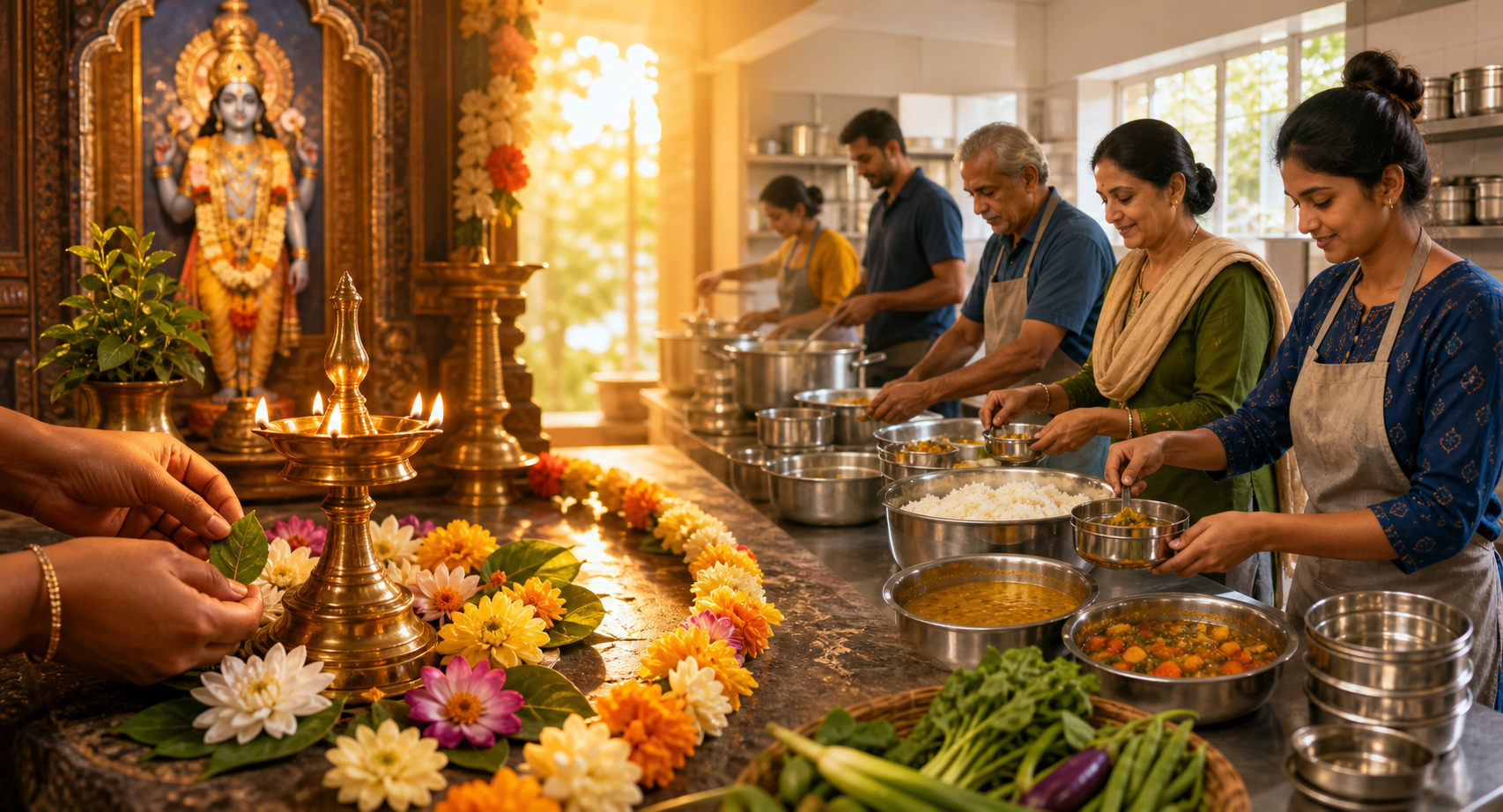
Sri Vaishnavism brings philosophical study, devotional poetry, temple worship, household practice, and ethical conduct into one rhythm. The hymns of the Alvars make divine intimacy singable, while the acharya tradition gives that devotion intellectual structure. Home recitation of the Bhagavad Gita and Divya Prabandham extends the same rhythm beyond the temple. Temple service, household worship, liturgy, and compassion belong to an integrated devotional life.
You can build that integration around a simple circuit: receive, remember, serve, and review.
- Receive: recite or study a manageable passage from the Bhagavad Gita, the Divya Prabandham, or the text followed in your sampradaya. Stay with enough material to understand and remember it; accumulation is not the goal.
- Remember: carry one phrase or teaching into the next ordinary part of your day. The point is to prevent sacred reading from becoming isolated from conduct.
- Serve: identify one concrete kainkarya already within reach. Prepare an offering, clean a shared space, complete a household responsibility, assist with a temple task, welcome a newcomer, or help someone who is struggling.
- Review: before the day closes, ask where service remained joyful, where it became bargaining, and where you avoided it because nobody would notice.
Kainkarya is more than generic helpfulness. It is service performed within a devotional relationship. That orientation changes the inner question from “What do I gain?” to “What response is fitting?” The external act may look ordinary, but its center has shifted away from possession and toward offering.
Keep the circuit small enough to repeat. A demanding routine that collapses quickly may feed guilt more than devotion. A modest practice that consistently reaches another person is more revealing. Before ending worship, name the next service it should produce. If you cannot name one, look first at the duty you have been postponing.
Temple participation benefits from the same clarity. Ask what service is actually needed instead of assuming the most visible role is the most valuable. Established ritual traditions such as Pancharatra and Vaikhanasa remind the devotee that reverence has form, discipline, and continuity. Humility includes learning that form rather than redesigning communal practice around personal preference.
Practice compassion without turning it into conquest
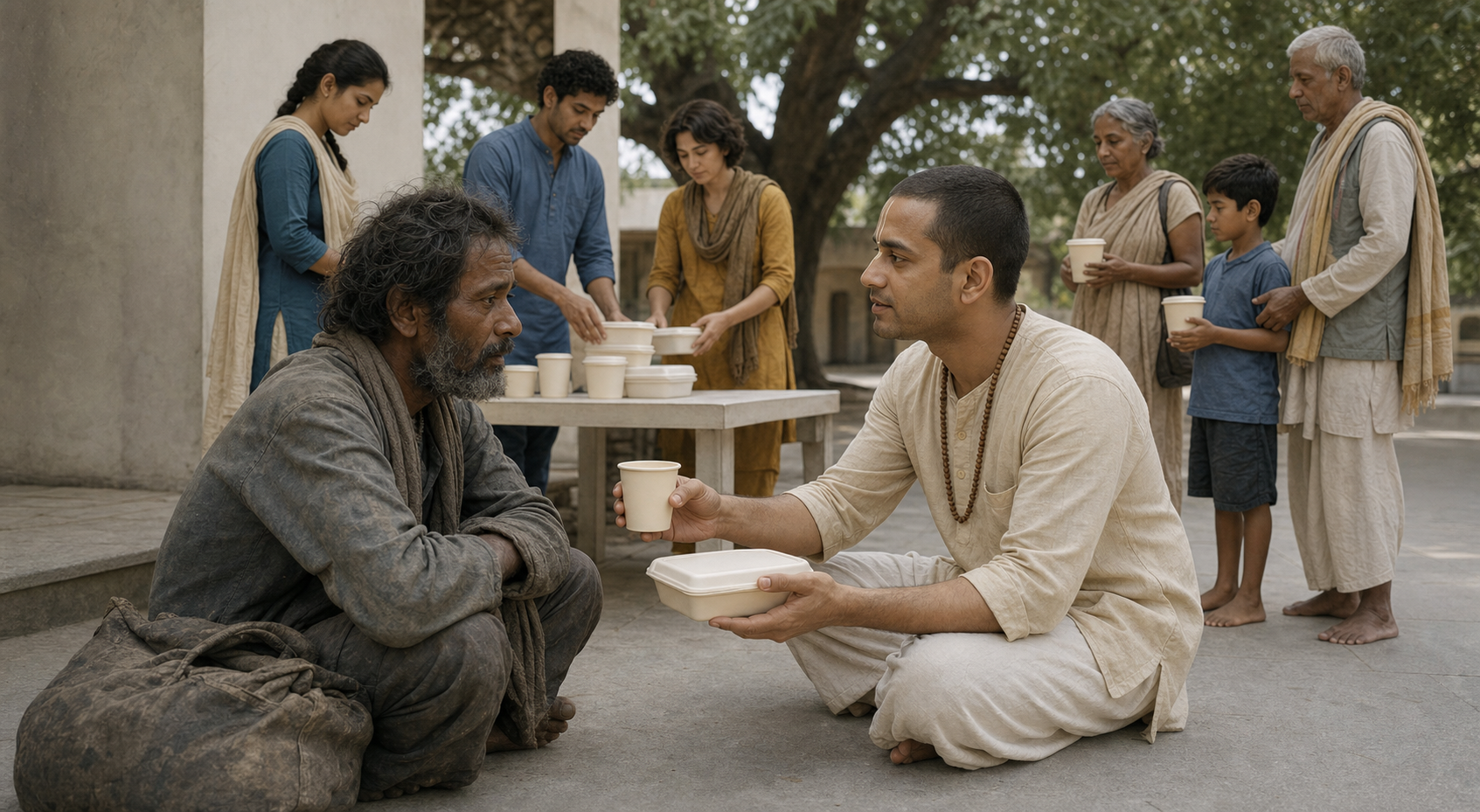
Compassion becomes difficult when the person before you is indifferent, socially distant, resistant, or unable to reward your effort. The life of Lord Nityananda offers a precise image for this moment: he traveled from household to household with folded palms, inviting people to receive the mercy of Caitanya Mahaprabhu. In that humble approach, the messenger lowered himself rather than lowering the dignity of the person being addressed.
This is not merely a courteous style of preaching. It is a discipline for exposing domination disguised as concern. Use four checks when you serve or share dharma:
- Check your posture before your message. If you need the other person to feel inferior, your ego has occupied the place of compassion.
- Offer rather than coerce. A person should be able to decline an invitation without being humiliated, threatened, or treated as spiritually disposable.
- Remove the eligibility test. Do not reserve courtesy and help only for people who already use your vocabulary, belong to your circle, or can enhance your reputation.
- Follow through concretely. A warm greeting that leaves a newcomer isolated, or a lofty appeal that ignores an obvious need, has not yet matured into service.
Compassion does not require approval of harmful conduct, abandonment of truth, or the erasure of boundaries. You can refuse wrongdoing and still refuse to humiliate the wrongdoer. You can defend dharma without enjoying another person’s degradation. The folded-palms test concerns the moral posture from which strength is exercised.
It also gives Dharmic communities a sound basis for cooperation. Vaishnava compassion can recognize resonances with karuna in Buddhism, daya and ahimsa in Jainism, and seva in Sikhism without claiming that all doctrines are interchangeable. Compassion, humility, and service can create practical solidarity across distinct Dharmic paths. Unity is stronger when it is built around honest cooperation rather than theological blur.
When working across communities, begin with a shared task: welcoming families, caring for a sacred place, feeding people, supporting elders, or preserving cultural continuity. State the common moral purpose plainly. Let each tradition explain its own theological reasons in its own voice. This preserves both fellowship and integrity.
Key takeaways
- Vaishnava devotion is tested in relationships and responsibilities, not only in the intensity of private religious feeling.
- Vishishtadvaita’s real relationship among jiva, jagat, and Ishvara helps you see the world of duty as spiritually significant.
- Prapatti releases the demand to control results while leaving dharmic action fully in your hands.
- A durable daily practice connects study or recitation to remembrance, kainkarya, and honest self-review.
- Compassion preserves another person’s dignity. It invites without coercion, serves without an eligibility test, and maintains truthful boundaries.
At your next worship, bring to mind the person you find hardest to serve without recognition. Choose one concrete act that genuinely falls within your duty, offer its result to Bhagavan, and complete it before adding another chant, book, or event to your schedule. That act will show you where philosophy has become devotion, and where devotion still needs to become service.
References
- DharmaRenaissance Blog – Sri Vaishnavism Unveiled: Devotion, Vedanta, and the Heart of Vishnu Worship
- Dandavats – Lord Nityananda’s Appearance Day: Radiant Compassion, Bhakti Joy, and Dharmic Unity
