
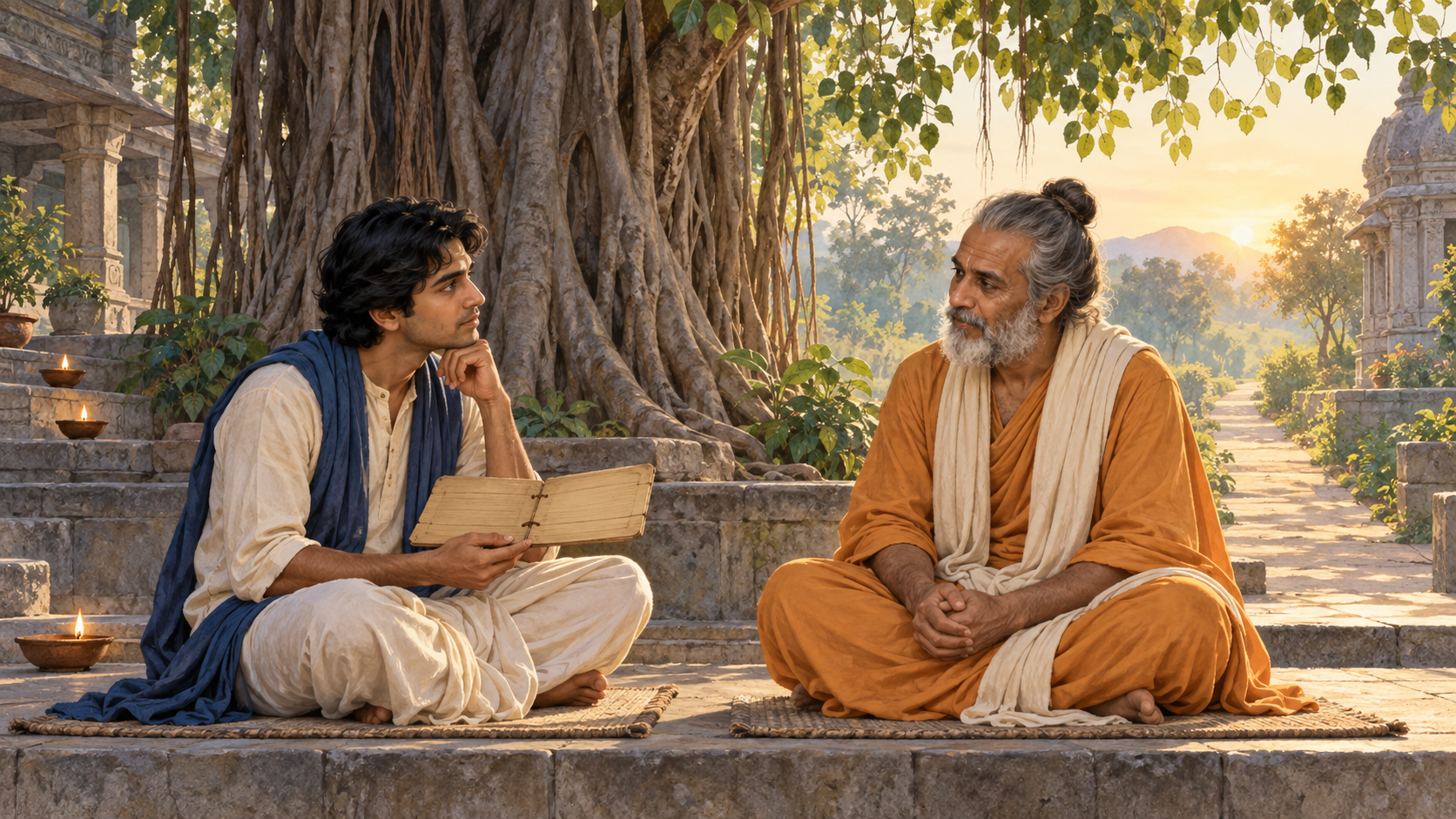
If you are looking for a guru, or wondering whether someone you already follow deserves that name, the difficult question is not how impressive the teaching sounds. The question is what the relationship is doing to you.
Hindu tradition gives the guru the highest reverence, but it does not require you to grant that status indiscriminately. A genuine guru helps uncover your own divinity, disciplines your potential and allows you to develop beyond the teacher’s personal limitations. That gives you a practical standard for deciding whom to trust and how deeply.
Not every teacher is a guru

The word “guru” is often applied to any expert, instructor or influential personality. That usage obscures an important distinction. Someone can teach you a subject, transmit a skill or explain a scripture without necessarily becoming your guru.
An ordinary teacher works primarily with what you know and can do. A guru works at the level of what prevents you from seeing and realizing your deeper capacity. Information may be part of that work, but information alone is not enough.
Sanatan Dharma traditionally places the mother first among one’s gurus, the father second and the spiritual guru after them. This ordering directs your attention to formation rather than celebrity. Your earliest guides shape how you see, choose and conduct yourself long before you can discuss philosophy. The title therefore concerns transformative responsibility, not public recognition.
You can preserve this distinction without diminishing anyone. Respect a capable instructor as an instructor. Honour a learned teacher for learning. Reserve the word “guru” for the person whose guidance reaches beneath accumulated information and changes how clearly, truthfully and fully you live.
Judge a guru by what the guidance develops in you

One useful image is a lamp. The flame represents the divinity already present within you. The lamp’s covering has become dark or opaque through confusion, habit and limitation, so the light cannot shine freely. The guru does not manufacture the flame or replace it with another one. The guru helps remove what obstructs it.
This image protects you from two common mistakes. The first is assuming that spiritual worth must be bestowed by another person. The second is assuming that whatever a powerful personality impresses upon you must be spiritual growth. The real work is neither flattery nor imprinting. It is uncovering, testing and strengthening what is already waiting to be expressed.
- The guru reveals the obstruction. After receiving guidance, you should be able to identify something you previously failed to see: a limitation, confusion or pattern that was restricting your development.
- The guru disciplines and tests you. Encouragement alone cannot uncover your full capacity. Practice, correction and testing show whether an insight has become part of your conduct.
- The guru responds to the actual student. A guide must be more than a lecturer. The work calls for an example worth following, the judgment of a coach and an understanding of the student’s mind and capacity.
- The guru amplifies rather than duplicates. You are not meant to become a tinted copy of the teacher. Guidance should release your distinctive potential instead of confining it within the teacher’s preferences and limitations.
- The guru permits the student to grow beyond the guru. A mature teacher is not threatened when a student becomes more capable or potent. Such growth can be evidence that the teaching has fulfilled its purpose.
These functions give you a better test than appearance, fluency or personal magnetism. Before accepting someone as your guru, observe the relationship long enough to answer concrete questions:
- What inner obstruction has this person helped you recognise?
- What discipline has turned that recognition into a change in conduct?
- Does correction enlarge your capacity, or merely make you imitate the teacher?
- Is your temperament understood, or is every student pressed into the same mould?
- Are you becoming clearer and more capable, or merely more attached to the teacher’s identity?
- Would this teacher welcome your development even if you eventually exceeded the teacher’s own reach?
Do not force an answer after one moving encounter. Inspiration can begin a relationship, but a pattern of transformation is what justifies the title. If you can describe the teacher’s personality in detail but cannot name what the teaching is helping you see, practise or overcome, continue learning without rushing to declare discipleship.
Reverence and guru dakshina follow discernment

The traditional language used for the guru is deliberately elevated:
गुरूर्ब्रह्मा गुरूर्विष्णुः गुरूर्देवो महेश्वरः ।
Traditional guru verse
गुरूर्साक्षात परब्रह्म तस्मै श्री गुरवे नमः ।।
The verse identifies the guru with Brahma, Vishnu and Maheshwara, and ultimately with Param Brahma. Read through the actual work of a guru, this language has an intelligible depth. The guru helps bring forth what is latent, sustains its development and destroys what obstructs its expression.
This is not a ceremonial promotion automatically granted to every person who adopts the title. The greater the reverence attached to the word, the more carefully you must discern who qualifies for it. Someone who merely colours students with personal opinions, keeps them confined within the teacher’s limitations or prevents their fuller development has not met the standard described by the verse.
Discernment therefore comes before extraordinary reverence. That order is not disrespectful. It protects the meaning of respect. Once a teacher has genuinely helped remove your obstructions, tested your capacity and allowed your own light to grow, profound gratitude becomes a fitting response rather than a demand imposed in advance.
Guru dakshina expresses this relationship of teaching and gratitude. It is a contribution or fee shaped by both what the student can offer and what the teacher asks. Capacity matters. A request that ignores what the student can reasonably give neglects one of the relationship’s own traditional measures.
Money alone also cannot define the bond. A legitimate teacher may receive payment for teaching, while a student may offer dakshina through an appropriate gift, service or other contribution. Yet payment does not convert instruction into transformation. Nor can an expensive offering compensate for neglected practice. The most faithful response to guidance is to do the work for which the guidance was given.
Guru Purnima turns gratitude into a yearly examination

Guru Purnima falls on the full-moon day of the Hindu month of Ashadha. It marks the birthday of Krishna Dwaipayan, better known as Maharishi Ved Vyas, and is dedicated to gurus more broadly.
Ved Vyas occupies this place because his labour continues to guide Sanatan Dharma. He composed the vast Mahabharata, within which the Bhagavad Gita appears, and collected, classified and documented the Vedic literature available to him. His commentaries, explanations and analytical works helped make a civilizational inheritance available to later generations.
A traditional account remembers Lord Ganesha serving as the scribe while Vyas composed the Mahabharata at great speed in a cave at Mana Village in Uttarakhand. The image captures an essential feature of the occasion: Guru Purnima honours not only spiritual affection but the disciplined transmission of knowledge.
You can therefore observe Guru Purnima as more than a greeting or public tribute. Use it to examine the living chain of formation in your own life:
- Name what your mother and father first taught you through instruction or example.
- Identify the teachers who gave you knowledge, even if they did not occupy the fuller role of guru.
- Write down one obstruction that a genuine guide helped you see and one discipline that helped you work through it.
- Ask whether your current spiritual relationships are developing your capacity or merely strengthening imitation.
- Express gratitude in a form suited to the relationship and within your means.
- Renew one neglected practice received from a worthy teacher. This makes gratitude visible in conduct.
This examination also prevents gratitude from becoming indiscriminate. You may discover that one person taught you a valuable subject, another corrected your conduct and another awakened a deeper spiritual possibility. Honour each contribution accurately. Precision does not reduce gratitude; it keeps the word “guru” meaningful.
Key takeaways
- Not every knowledgeable or inspiring teacher is a guru; the distinction rests on transformation, not status.
- A genuine guru helps remove what obscures your inner divinity, then disciplines and tests the capacity that emerges.
- The decisive test is whether guidance develops your own potential rather than turning you into a copy of the teacher.
- A true guru can allow a student to become more powerful or capable than the guru.
- Exceptional reverence should follow careful discernment, while guru dakshina should respect both the student’s capacity and the teacher’s request.
- Guru Purnima, observed on Ashadha Purnima, honours Maharishi Ved Vyas and offers a yearly occasion to examine, practise and repay worthy guidance.
If you are deciding whether to accept someone as your guru, make the decision concrete. Write down the obstruction that person is helping you remove, the discipline being developed and the evidence that you are becoming more capable in your own form. If you can record only charisma, claims or borrowed identity, keep learning but withhold the title. If the guidance steadily uncovers your inner light and helps it burn more freely, you may have found a relationship worthy of both gratitude and the name guru.
References
- DharmaRenaissance Blog — Who is a Guru?
