

You can finish a demanding book, complete a course, and fill pages with notes, only to discover that you cannot explain the central idea when it matters. The usual failure occurs before forgetting: you mistake recognition for understanding. Familiar words feel mastered because they are easy to reread, while the harder tests – recall, reasoning, transfer, and action – remain untouched.
Across their real differences, Hindu, Buddhist, Jain, and Sikh pedagogies set a more demanding standard. Knowledge must be observed carefully, questioned, tested, assimilated, and lived. This movement from information to lived wisdom can become a practical system for anything you want to learn, whether your subject is scripture, history, technology, a profession, or your own conduct.
Key takeaways
- Begin with a live question, not a pile of material. A question tells attention what to notice and gives you a standard for judging an answer.
- Move repeatedly through sravana, manana, nididhyasana, and nishtha or seva: careful study, reasoned reflection, contemplative assimilation, and responsible application.
- Test what you think you know through direct observation, inference, analogy, trustworthy testimony, competing perspectives, and honest dialogue.
- Use retrieval, spaced revisiting, explanation, and application to expose gaps that rereading conceals.
- Judge learning by what you can explain, transfer, correct, and enact – not by pages consumed, notes collected, or certificates earned.
Start with a live question and a mind quiet enough to see

Write the question before collecting answers
Jigyasa is not casual curiosity or the restless collection of interesting facts. It is an inquiry that presses toward clarity. Nachiketa’s persistence in the Katha Upanishad and Satyakama Jabala’s commitment to truthfulness illustrate the disposition it requires: the learner must care more about truth than convenience, approval, or the appearance of knowing.
Before opening a book, video, lecture, or scripture, write a question at the top of the page. Make it narrow enough to investigate and important enough to use. Replace a subject such as Buddhism with a question such as: What distinction does this teaching make between observing a feeling and obeying it? Replace project management with: Which assumption is causing this handoff to fail?
Then add the tests your answer must survive:
- What exactly am I trying to understand or decide?
- What observation, argument, or testimony would support an answer?
- What evidence would make me revise it?
- Where will I apply the answer so that its limits become visible?
This prevents a common form of unproductive study: collecting information without deciding what problem the information is meant to solve. A practical neti neti check can sharpen the inquiry further. Ask which attractive answer is inadequate, what it fails to explain, and which hidden assumption must be removed before you proceed.
Prepare attention as part of learning
Attention is not a decorative spiritual addition to study. It determines what enters the learning process in the first place. If your mind is rehearsing an argument, switching between notifications, or defending a preferred conclusion, more material will usually produce more noise rather than more understanding.
Begin a serious learning session with five to ten minutes of simple attentional practice. Put the phone out of reach, sit steadily, and follow the natural breath. When attention wanders, notice the wandering and return. At the end, name the condition of the mind plainly: hurried, dull, defensive, scattered, or clear. That observation is useful data, not a verdict about your character.
Yoga gives this training a durable structure. Abhyasa is sustained practice; vairagya loosens the need to cling to every distraction, reaction, or early conclusion. Pratyahara regulates competing sensory input, dharana steadies attention on an object, and dhyana develops continuity. Buddhist mindfulness adds a closely observed field of body, feeling, mind, and phenomena. These methods should not be collapsed into one doctrine, but each trains you to notice distortion before building an argument on top of it.
Do not use quiet practice to avoid difficult reading or disagreement. Its purpose here is to make inquiry more exact. The useful question after contemplation is not whether you felt peaceful. It is whether you can now see the claim, your reaction to it, and the difference between them.
Use the four-stage cycle instead of stopping at study

A dependable Dharmic learning practice can be organised around four recurring movements. They are a cycle, not a ladder you climb once. Application produces feedback; feedback reveals a new question; the new question sends you back to careful study.
- Sravana – receive carefully. Read, listen, or observe systematically. Preserve the actual claim before reacting to it. Record the key terms, the reasoning offered, the context, and the evidence. Shabda, or trustworthy testimony, is not permission for blind acceptance; it requires care about the competence, integrity, and relevance of the person or tradition being heard.
- Manana – reconstruct and test. Close the material and explain the idea in your own words. State why it should be true, identify its assumptions, find a counterexample, and compare it with a related idea. If you cannot reconstruct the reasoning without looking, you have found the boundary of your present understanding.
- Nididhyasana – assimilate deeply. Hold the central insight in steady attention. Notice where it conflicts with your habitual perception, desire, or conduct. This is not another round of verbal analysis. It is the stage at which an idea stops being merely external and begins to reorganise how you see.
- Nishtha and seva – enact and refine. Put the insight into a real decision, task, relationship, or act of service. Observe the result, including unintended effects. Then return to study and reflection with evidence from life rather than with an unchanged abstraction.
Modern learning techniques fit naturally inside this cycle when they serve understanding rather than becoming ends in themselves. Active retrieval, spaced repetition, interleaving, elaboration, and concept mapping make the learner produce or connect knowledge instead of merely recognising it. Retrieval belongs in manana. Spaced revisiting renews reflection after familiarity has faded. Interleaving forces you to distinguish neighbouring concepts. Concept maps expose relationships that isolated flashcards can hide.
The cycle also diagnoses why learning has stalled. If you can repeat a teaching but cannot defend it, return to manana. If you can defend it but it never affects a choice, strengthen nididhyasana and nishtha. If enthusiasm has carried you beyond the evidence, return to sravana and check what was actually said. If an application creates consequences you did not anticipate, widen the perspectives you consult before trying again.
Suppose you are studying ahimsa and satya in the context of a recurring disagreement. Sravana means learning what the principles actually require rather than relying on a slogan. Manana examines the apparent tension between avoiding harm and speaking truth. Nididhyasana asks you to observe your fear, anger, and wish to appear righteous. Nishtha means entering the next conversation with a specific practice: state the disagreement truthfully without attacking the other person, then record what happened. The outcome becomes material for the next round of inquiry.
Test conviction with evidence, rival views, and dialogue
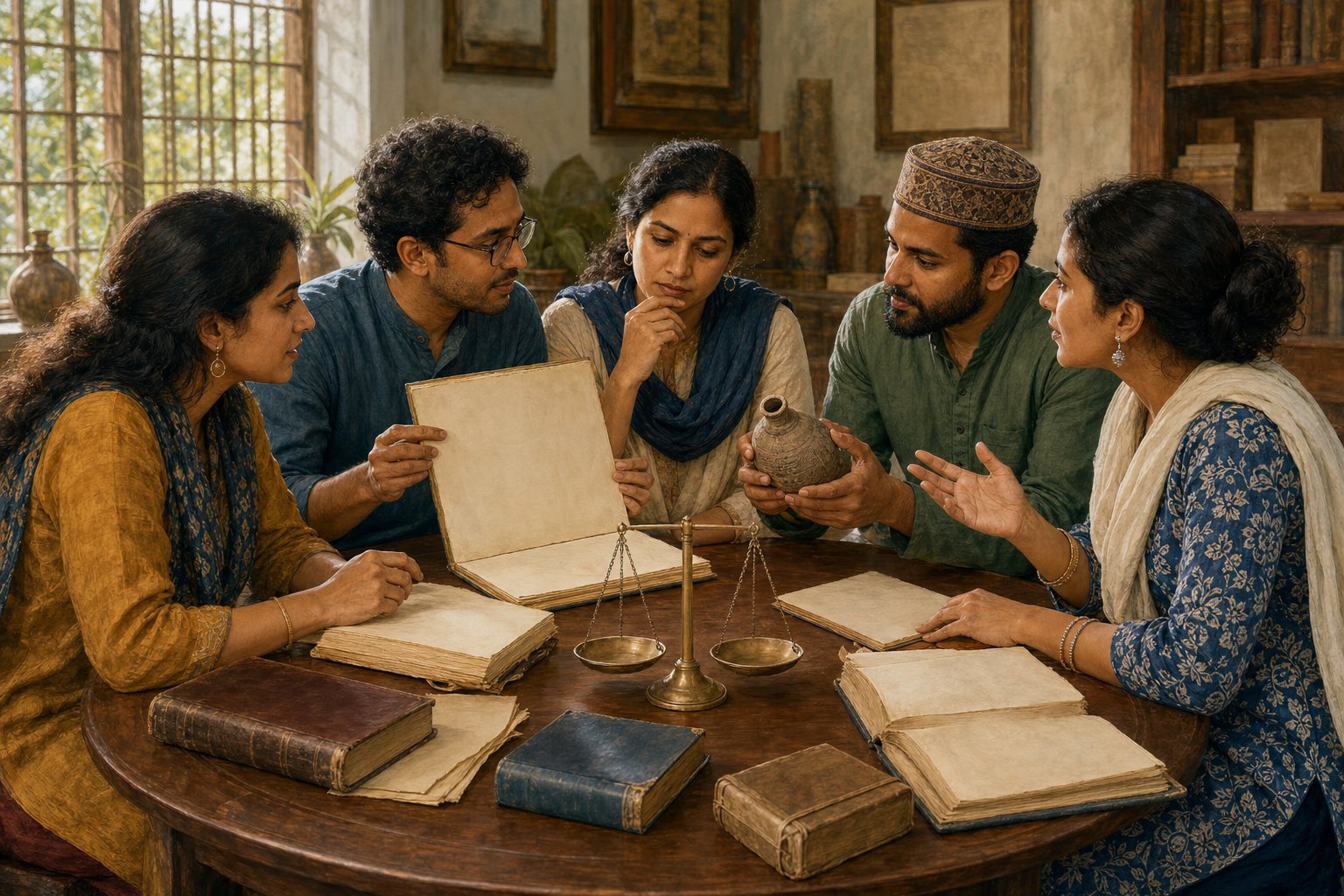
A strong feeling of certainty is not a pramana. Hindu darshanas, Buddhist epistemology, Jain perspectival reasoning, and Sikh vichar provide distinct ways to detect error. The following inquiry card combines several of those tools for practical use; it is not a claim that every tradition accepts one identical list.
| Lens | Question to ask | What to record |
|---|---|---|
| Pratyaksha: direct perception | What did I directly observe, before interpretation? | Concrete words, events, sensations, or results. |
| Anumana: inference | What conclusion am I drawing, and which assumption connects it to the observation? | The reasoning chain and its weakest link. |
| Upamana: analogy | What comparison helps me understand this, and where does the comparison break? | The relevant similarity and the limiting difference. |
| Shabda: trustworthy testimony | Why is this testimony credible and relevant to this question? | The speaker’s competence, context, and actual claim. |
| Anekantavada: many-sided examination | How does the matter appear from another valid standpoint? | The strongest rival description and the conditions under which it holds. |
| Vichar in sangat: communal reflection | What can another disciplined learner see that I cannot? | The correction, objection, or consequence revealed through dialogue. |
The separation between observation and inference is especially important. If a colleague rejects your proposal, the rejection is observable; the belief that the colleague dislikes you is an inference. If your body tightens and an unpleasant feeling arises, those can be observed; the story that you must immediately retaliate is something added. Buddhist analysis of body, feeling, mind, and phenomena gives you a disciplined way to notice those layers before treating a reaction as knowledge.
Put every important claim under friendly pressure
Nyaya offers a compact architecture for reasoning. You can turn it into an argument card whenever a claim matters:
- Prashna: Write the exact question or point at issue.
- Pratijna: State your claim in one clear sentence.
- Hetu: Give the reason that supports it.
- Drstanta: Supply an example in which the reason can be examined.
- Tarka: Stress-test the reasoning with objections, counterexamples, and unwanted consequences.
Mimamsa adds a necessary reading discipline. Before quoting a line as support, examine its context, purpose, wording, and relation to the surrounding passage. Ask whether you are preserving a distinction made by the text or importing the conclusion you hoped to find. This check is valuable in scripture, law, policy, history, and any setting where a sentence can be detached from the argument that gives it meaning.
Jain anekantavada is often weakened when it is treated as the claim that every opinion is equally true. Its practical force is more rigorous: a complex reality may admit valid descriptions from different standpoints, so your first description should not pretend to exhaust the whole. Syadvada encourages conditional formulation. Instead of saying that a policy simply works or fails, state for whom it works, under which conditions, in what respect, and at what cost. The rival view must still face evidence; intellectual humility is not indifference to truth.
Dialogue completes the test. Sikh vichar in the sangat makes understanding communal, while the guru-shishya relationship places learning under lived example and personalised correction. Bring a mentor or serious peer a written question, claim, reason, and objection. Ask the person to identify your hidden assumption. Restate the correction in your own words before defending yourself. The purpose is not to borrow another person’s certainty but to expose what solitary reflection could not see.
A good debate therefore leaves you with a more precise claim, a better question, or a recognised error. If it leaves only a winner and a loser, it has trained status-seeking rather than learning.
Build a routine that leaves evidence of learning

Pages read and hours logged measure exposure. They do not tell you whether knowledge is available when the book is closed or whether it improves judgment. Your routine needs to produce visible evidence: an explanation, an argument, an application, feedback, and a revised understanding.
Use this sequence for a serious learning session
- Sharpen attention. Spend five to ten minutes settling the mind and noticing distraction without following it.
- Frame the inquiry. Write the question, the reason it matters, and what could change your present view.
- Study and retrieve. Work through a bounded portion of material, close it, and reconstruct the central claim and reasoning from memory.
- Test and widen. Use the pramana checklist, the Nyaya argument card, a competing perspective, or dialogue with a serious peer.
- Assimilate. Sit quietly with the most important distinction and notice where your habits resist it.
- Enact and refine. Choose a modest application, observe its consequences, seek feedback, and write the next question.
The sequence can fit the time available. When the window is narrow, reduce the amount of material rather than removing retrieval and application. Covering less while completing the learning cycle is more useful than covering more while leaving the knowledge inert.
Keep a learning log with stable fields: Question; Direct observation; Testimony or material studied; My inference; Strongest objection; Application; Feedback; Revision; Next question. The log prevents later confidence from rewriting what you originally observed. It also lets a mentor inspect your reasoning rather than merely react to your conclusion.
Audit transfer, judgment, and conduct
At the end of a week, review what the practice produced. Do not reread the notes first. Ask:
- Can I explain the central idea accurately without looking?
- Can I use it in a new case rather than repeat the original example?
- Can I name the strongest objection and the condition under which it succeeds?
- Can I distinguish what I observed from what I inferred?
- What changed in my decision, habit, or service?
- What did another person correct that I could not see alone?
- Which question must now return to sravana?
Your answers point to the missing discipline. Heavy consumption with weak recall calls for retrieval and manana. Fluent explanation without a changed decision calls for nididhyasana and nishtha. Rising certainty accompanied by weaker engagement with objections calls for anekantavada and sangat. Repeated distraction calls for renewed abhyasa and sensory regulation. Well-meant service that ignores its effects calls for direct observation and better feedback.
Ethics belongs inside the audit because capability without discernment is incomplete learning. The yamas and niyamas can be treated as behavioural tests rather than decorative ideals. Satya asks whether you represented the evidence honestly. Ahimsa asks who might be harmed by your application. Aparigraha asks whether attachment to status, ownership, or being right is distorting judgment. Tapas asks whether you continued the discipline after novelty faded. Svadhyaya turns examination toward your own motives and habits.
Seva supplies a particularly demanding test because real people answer abstractions with needs, constraints, and consequences. Begin with a modest, responsible application in a sphere where you already have standing to act. Listen before assuming what would help. If your action affects others, invite their feedback before expanding it. Service is not proof that your original idea was correct; it is where the idea becomes answerable to life.
Choose one question already pressing on your work, family, study, or sadhana. Write it at the top of a page and run your next learning session through the full cycle. Before closing the page, name the action in which you will test your answer and the person from whom you will seek correction. When the answer fails, preserve the failure as evidence and turn it into the next prashna. That is how learning remains alive for a lifetime.
References
