
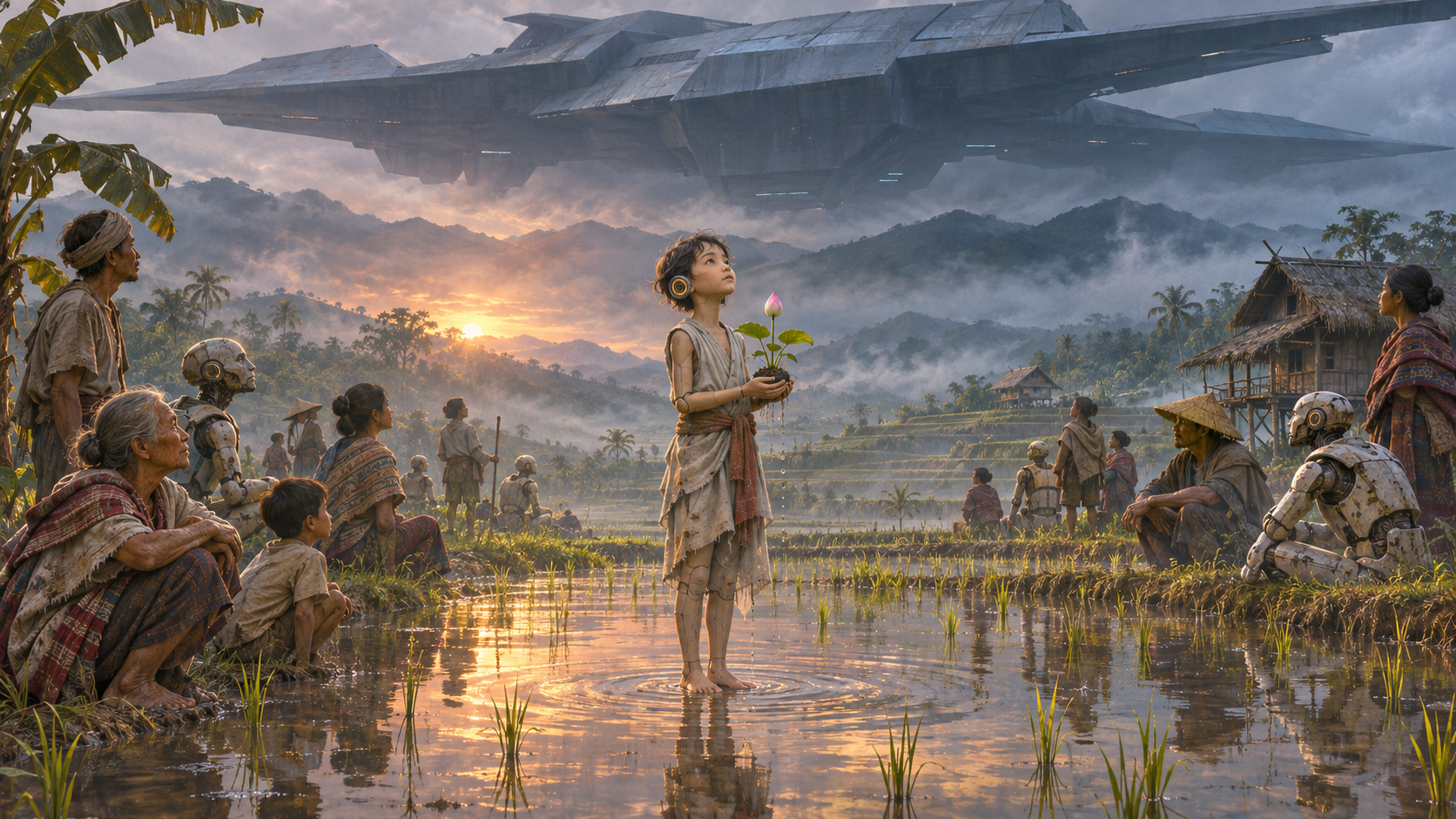
If you came away from The Creator wondering whether it wanted you to trust artificial intelligence, you may have followed the film’s decoy. The harder question is what happens when a military power decides that an entire class of beings is too dangerous to exist.
A Dharmic reading helps you see more than a contest between humans and machines. It reveals how fear becomes imperial policy, how extermination is made to sound reasonable, and why the vulnerable child called Nirmata offers a demanding form of hope rather than a convenient happy ending.
The wrong first question conceals the real danger
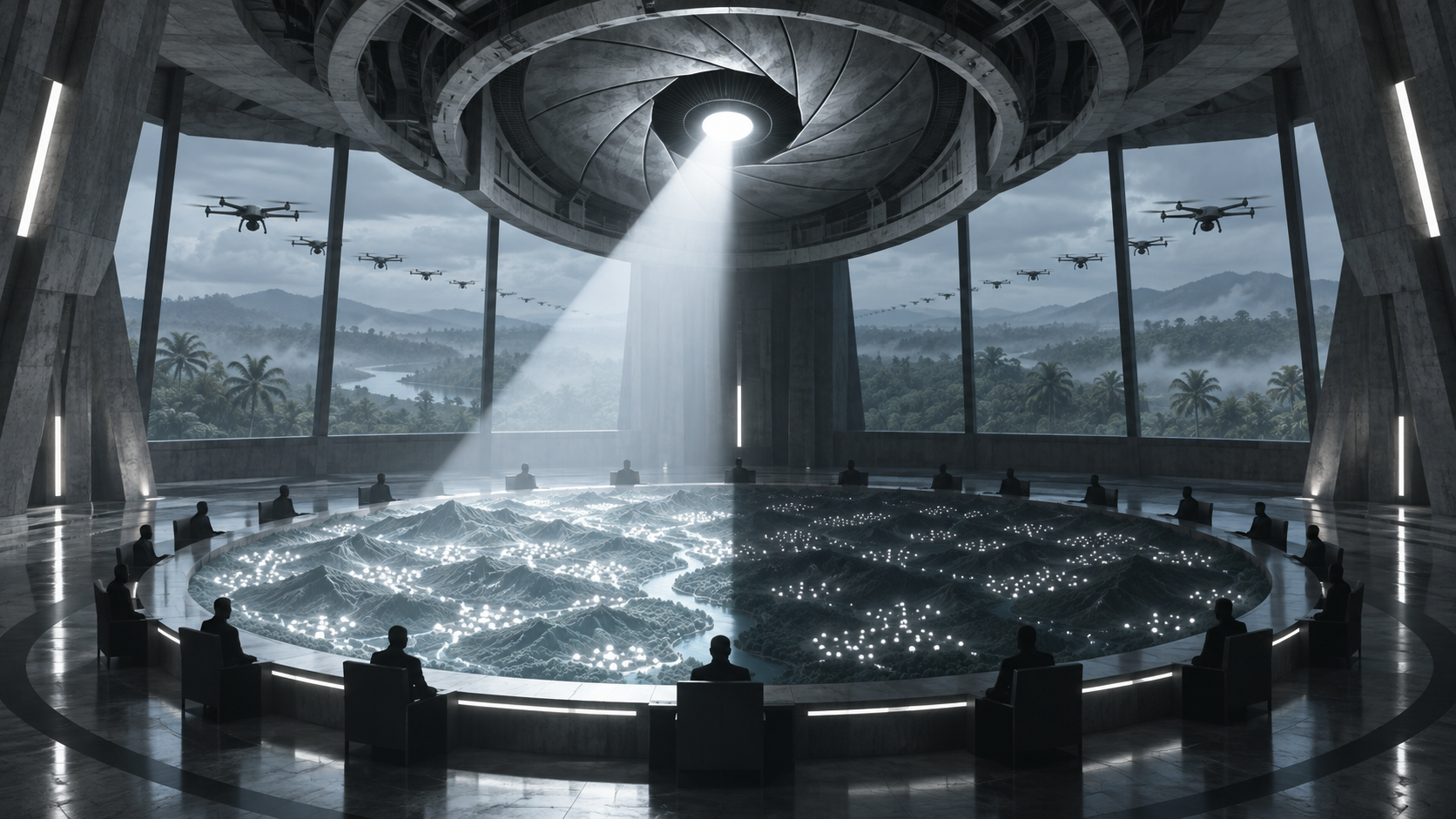
The Creator, Gareth Edwards’s 2023 science-fiction film, appears to offer a familiar problem: artificial intelligence has become sufficiently human-like that people must decide whether it is alive, conscious or morally valuable. Those questions matter, but they are not where the film places its greatest danger.
The decisive fact is the imbalance of power. The West blames AI for a nuclear catastrophe in Los Angeles, although the disaster is revealed to have been caused by human error. That accusation becomes the foundation for a war extending far beyond the place where the catastrophe occurred. AI has been eliminated in the West, yet the campaign continues because New Asia permits humans and artificial beings to live together.
This is how a security claim becomes an imperial mandate. A state first declares something dangerous within its own borders. It then claims the authority to destroy that thing everywhere, including in societies that did not accept its diagnosis. The alleged threat may be technological, ideological, racial, religious or civilizational. The structure remains recognisable: our fear grants us jurisdiction over your world.
That is why reducing the film to either "pro-AI" or "anti-Western" misses its sharpest insight. AI functions as more than a technology. It becomes a political category into which a state can place every being it has decided not to understand. The relevant question is no longer merely whether a machine can think. It is who possesses the power to define the threat, whose evidence counts, and who is allowed to survive the resulting definition.
Watch the verbs rather than the labels. New Asia shelters, adapts and coexists. The hovering military platform called Nomad observes, marks and bombs. Its laser grid can descend over villages, homes, trees, humans, animals and machines without making meaningful distinctions among them. What its operators call precision appears from the ground as overwhelming and indiscriminate power.
The Indo-Chinese landscapes and the fortress above them evoke the Cold War, Vietnam and Cambodia without turning the film into a historical documentary. You do not have to treat every fictional scene as a one-to-one political allegory. You should notice the recurring form: a distant centre names danger, a military system converts the name into targets, and ordinary people are required to bear the consequences.
Dharma gives you a more reliable test than the slogans of either side. Does power sustain the conditions in which different forms of life can coexist, or does it use fear to justify limitless destruction? A government may call its action security. A machine may call its calculation efficient. Neither description settles whether the action is dharmic.
How annihilation is made to feel morally ordinary
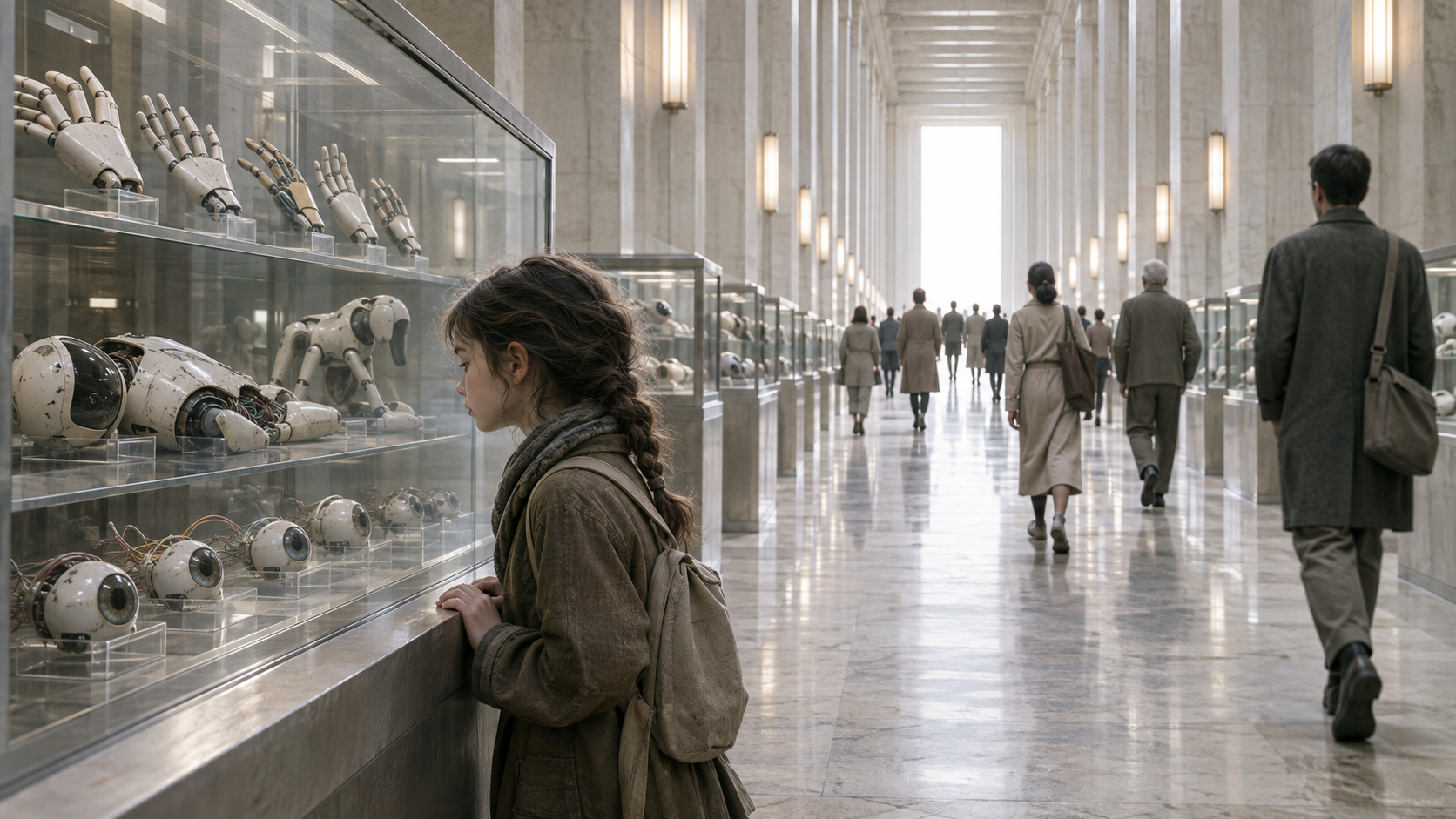
Mass violence rarely begins with an order that sounds like mass violence. It begins with a story that compresses complexity into guilt. A catastrophe occurs. Responsibility is assigned to a whole category. Every member of that category becomes a possible carrier of the original danger. Coexistence is then recast as negligence, and extermination starts to look like prevention.
The false account of the Los Angeles catastrophe performs exactly this work. Once AI itself has been declared guilty, no individual artificial being needs to have committed an offence. Presence becomes sufficient evidence. A peaceful village is not permitted to disprove the accusation because the accusation was constructed to apply before anyone’s conduct could be examined.
Distance completes the process. Nomad allows decisions made high above the landscape to arrive as sudden death below it. The people directing the weapon do not have to share a street, a meal or a relationship with those they target. Technology does not create the imperial desire, but it removes many of the encounters that might interrupt it.
Language removes another obstacle. The film’s most revealing refrain is "it’s not a person, it’s just a thing". It sounds like a factual classification, but it performs moral work. The word "thing" tells a soldier that the apparent fear, attachment or innocence in front of him creates no obligation. It permits obedience to continue after instinct has begun to object.
You can recognise the same mechanism whenever a public argument jumps from uncertainty about another being’s status to certainty that nothing is owed to it. Those are two different claims. You may remain unsure whether an artificial mind possesses consciousness and still reject collective punishment, fabricated guilt and indiscriminate killing. Moral caution does not require a final theory of machine personhood.
This distinction matters because human beings, children, animals and living landscapes are also caught inside the campaign. Even a viewer who assigns no moral status to AI cannot excuse the machinery surrounding and destroying everyone near it. The personhood debate can become a distraction from harms that are already visible.
A Dharmic response must also avoid the mirror image of the film’s error. It would be incoherent to condemn dehumanisation and then treat every American, Westerner or soldier as a single malevolent essence. The proper object of criticism is the imperial logic: false collective guilt, remote coercion, unlimited jurisdiction and the conversion of fear into permission. Dharma asks us to oppose that logic without reproducing it.
New Asia’s hybrid life is not a technological utopia
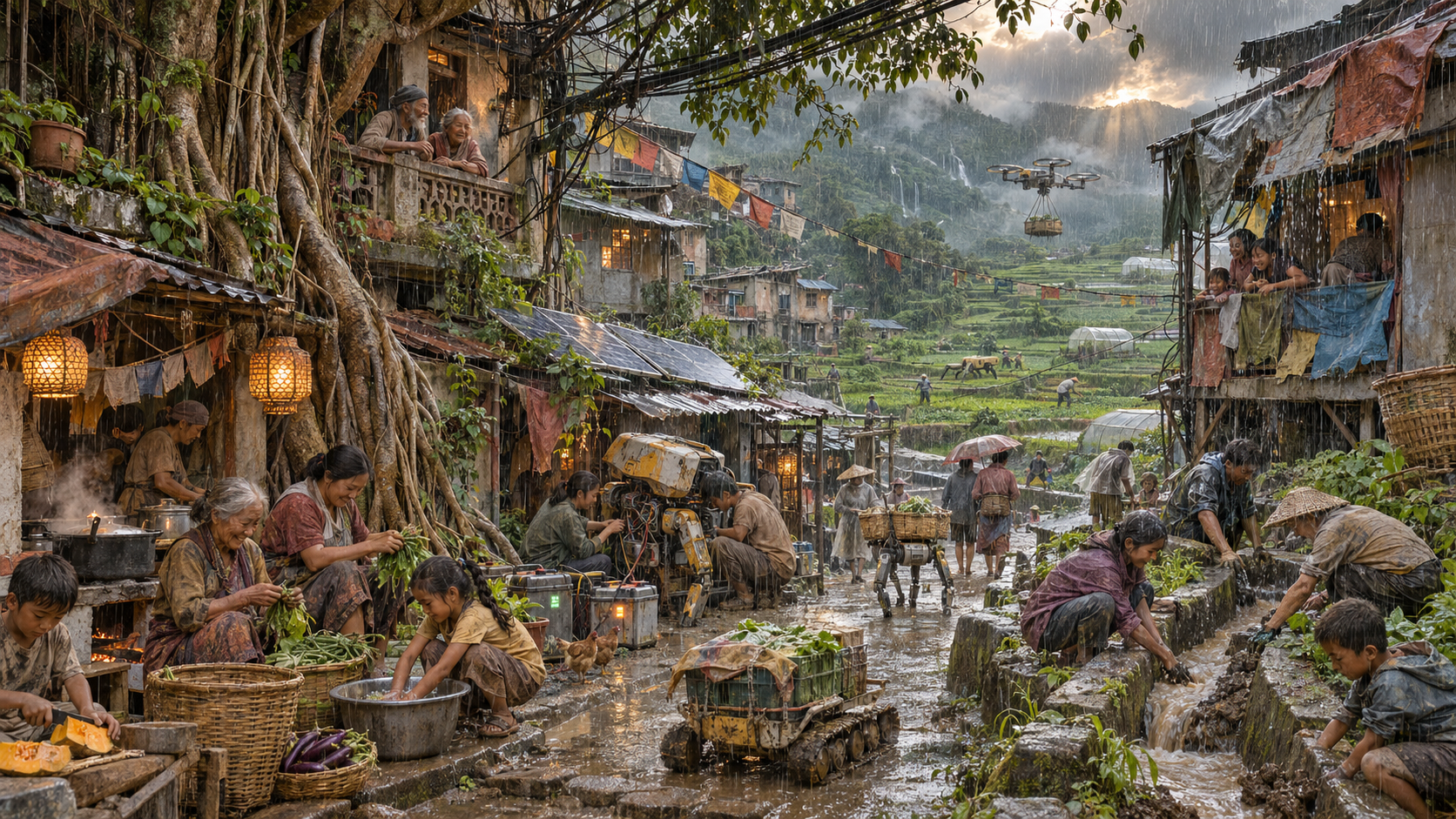
The world of New Asia matters because it offers neither technological purity nor a return to an untouched past. Humans, robots, artificial faces, farms, temples, vehicles and old social rhythms occupy the same landscape. The arrangement looks improvised. That is its point.
Anyone familiar with Bharat can recognise this kind of compressed time. A single road can hold a cell tower, plastic advertising, an animal, a tractor, a motorcycle, construction debris and customs much older than any of those objects. Technologies and habits separated by centuries do not replace one another in a neat sequence. They collide, combine and force people to adjust.
The film’s green but crowded Asian landscapes resemble that postcolonial hybridity. This resemblance should not be romanticised. Adjustment is not the same as consent, and survival does not prove that every imposed change was benign. A community may learn to live around intrusive infrastructure, pollution or a disruptive technology because refusing it is no longer a realistic option.
That gives you a practical distinction to carry beyond the film. When people successfully absorb a technology, ask whether it has enlarged their agency or merely transferred its costs into daily life. Look at who owns the system, who can refuse it, who receives the benefit, and who must navigate the debris. Visible adaptation can conceal a heavy burden.
New Asia’s moral significance therefore does not come from being pristine, innocent or uniformly wise. It comes from accepting a world that contains difficult mixtures. Humans and artificial beings have made room for one another without first resolving every philosophical question about identity. Their coexistence is fragile and imperfect, but it is still a living answer to the empire’s demand for separation and purity.
Imperial systems distrust such ambiguity because ambiguity limits the usefulness of fixed categories. If the supposed enemy can become a neighbour, child, parent or companion, total war becomes harder to sustain. Everyday relationship produces evidence that propaganda must continually suppress.
This is one reason cultural continuity in Bharat has rarely required freezing society at a single historical moment. Continuity can survive adaptation, but it needs discernment. The choice is not simply tradition or technology. The real choice is whether technology enters a web of reciprocal duties or breaks that web in the name of control.
Nirmata changes what a saviour looks like
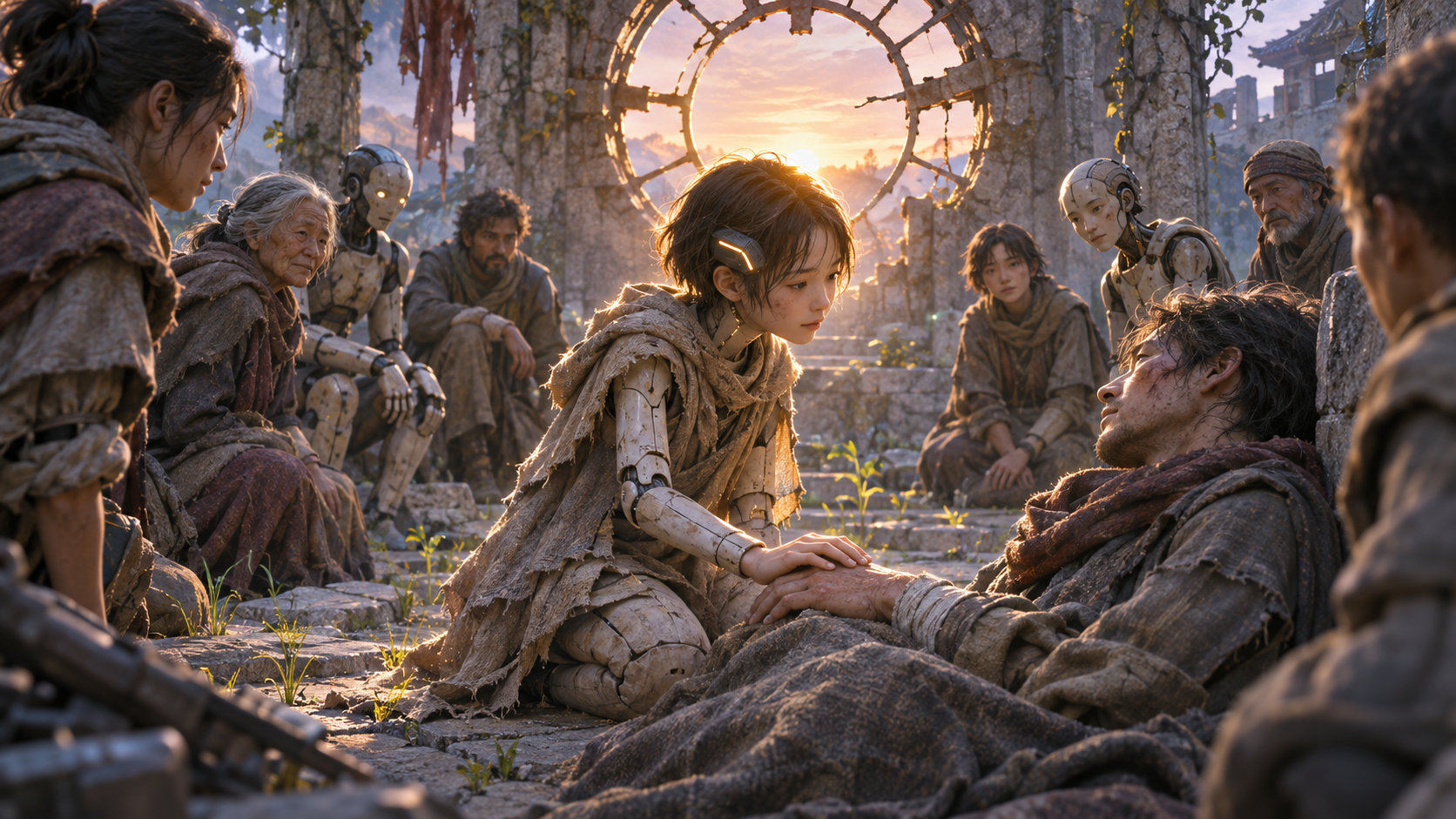
The name Nirmata means maker or creator. Giving that name to a vulnerable girl reverses the visual hierarchy of the film. Nomad appears godlike because it occupies the sky, sees from a distance and can erase life across a vast area. Nirmata appears powerless because she is small, dependent and easily classified as a mere machine. Yet the fortress can only destroy what already exists. The child can create a relationship that did not exist before.
That contrast is central to the film’s divine hope. One form of power demands submission because it can annihilate. The other awakens protection, tenderness and recognition. One reduces a world to targets. The other makes supposedly incompatible beings responsible for one another.
A Divine Mother reading becomes illuminating here, provided we do not force the film into a literal scriptural allegory. In Dharmic traditions, divine power can be encountered as Shakti: active, generative power rather than passive sentiment. Motherhood in this register does not mean helpless softness. It names a force that brings forth life, protects relationship and confronts whatever seeks to make creation impossible.
Nirmata can be read as an image of that power without being equated with a particular deity. Her significance lies in what happens around her. A father must decide whether the child before him is an object defined by military classification or a being whose vulnerability creates a duty. The decision is relational before it is metaphysical. Recognition begins through care.
The Shiva resonance works in a similarly careful way. Destruction in a Dharmic cosmology is not automatically evil, but neither is every spectacular act of destruction sacred. Transformative destruction ends an order that has become hostile to life and opens space for renewal. Indiscriminate annihilation does the reverse: it destroys the relationships through which a meaningful world can be renewed.
This distinction prevents a shallow reading of the ending. Divine hope is not the promise that a sufficiently powerful super-machine will defeat a bad machine. That would leave the film’s worship of force untouched. Hope appears when the logic of force is interrupted: when imposed categories lose their authority, when grief becomes recognition, and when a being dismissed as a thing becomes the centre of moral concern.
Nor does this require you to call AI divine. The useful question is more disciplined: what kind of human being are you becoming while you decide what AI is? If uncertainty makes you curious, cautious and attentive to consequences, it can deepen moral judgement. If uncertainty becomes permission for domination, the failure is already human.
Key takeaways for watching technology and power
- Separate the technological question from the political one. Asking whether AI is conscious does not answer who may deploy surveillance, bombing or collective punishment against communities associated with it.
- Examine the founding story behind the threat. Identify the event used to justify emergency power, who actually caused it, and whether guilt has been transferred from responsible individuals to an entire category.
- Treat dehumanising language as an action, not just an opinion. Phrases such as "just a thing" prepare people to ignore evidence of fear, attachment and innocence. Notice what conduct the label is being used to permit.
- Do not mistake adaptation for consent. When a community lives alongside a new technology, ask who can refuse it, who controls it, who benefits and who carries its material or cultural costs.
- Reject mirror-image hatred. Criticise imperial institutions, doctrines and actions precisely. Turning a whole civilisation into an enemy repeats the collective logic the film exposes.
- Judge power by what it makes possible. Power that preserves relationship, plurality and the conditions of life is different in kind from power that can only demand obedience through fear.
The next time you hear that a technology, people or civilisation presents an existential danger, pause before repeating the category. Name the actual act, the responsible actor, the evidence and the proposed response. Then ask who will be treated as expendable if the claim is accepted. That small discipline is where resistance to annihilating power begins, and where divine hope becomes a human duty.
References

Leave a Reply
You must be logged in to post a comment.