
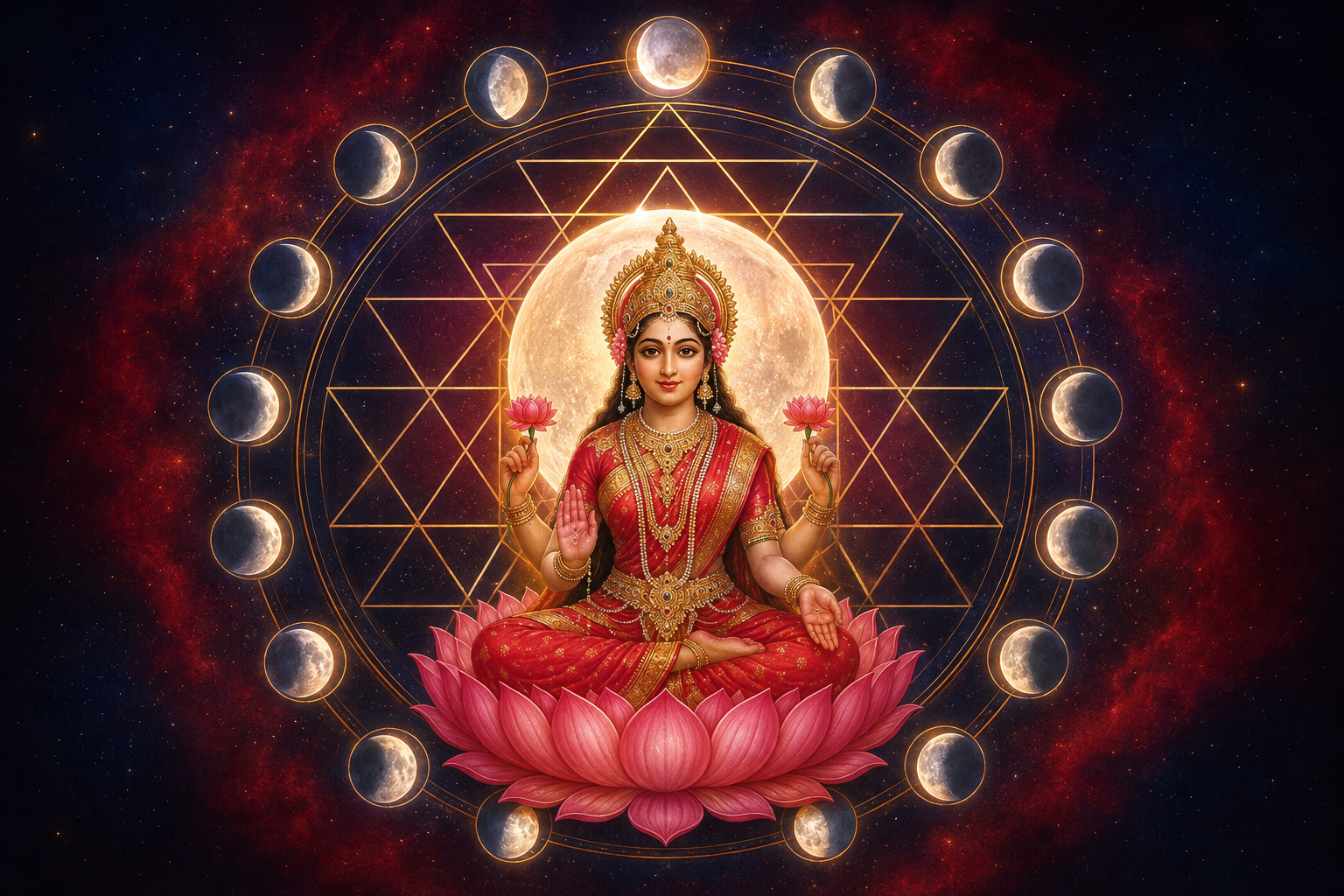
You may have learned that a lunar fortnight contains fifteen tithis and then wondered why Lalita Tripurasundari is worshipped as Shodashi, the Sixteenth. Is there a hidden sixteenth lunar day, or is the number pointing somewhere beyond the calendar?
The answer changes how you read Srividya. Fifteen names the complete movement of lunar time within a fortnight. Sixteen names the fullness that is present through that movement but cannot be reduced to one more position inside it. Once you keep those two levels distinct, Shodashi’s place becomes much clearer.
Why the sixteenth follows a cycle of fifteen

Begin with the structure itself. In the Srividya vision presented here, the lunar fortnight unfolds through fifteen tithis, and the fifteen tithis are presided over by fifteen Nitya Devis. Time is therefore not treated as an empty container in which divine events occasionally happen. Its recurring measures are already expressions of Shakti.
That gives you three related but distinct levels to hold in mind:
- The temporal level: a lunar fortnight moves from its first tithi through its fifteenth.
- The divine level within time: the fifteen Nitya Devis preside over that ordered movement.
- The transcendent level: Lalita Tripurasundari as Shodashi is the fullness that exceeds the sequence without being disconnected from it.
The common mistake is to place Shodashi beside the fifteen Nityas as though all sixteen were identical units in a longer calendar. That turns a metaphysical distinction into an arithmetic puzzle. Shodashi is called the Sixteenth because she signifies what is beyond the completed set of fifteen, not because an overlooked tithi must be inserted after the fifteenth.
A useful way to state the distinction is this: the fifteen belong to the wheel; the Sixteenth reveals the completeness that the wheel expresses but does not contain. Sixteen is theological grammar here, not a correction to lunar reckoning.
Time is divine, but the Devi is not imprisoned by time

It would be easy to hear “beyond time” and conclude that ordinary time is unreal, impure, or spiritually worthless. That reading misses an essential balance in Srividya. The lunar cycle is understood as a living rhythm of the cosmic feminine. Change is not outside the Devi’s presence.
Yet no individual tithi, phase, rise, decline, beginning, or completion can exhaust her. Each condition manifests something real, but each condition also passes. Shodashi points to divine fullness that does not wax when circumstances improve or wane when they deteriorate.
This resolves an apparent contradiction. The tradition can honor time as sacred while recognizing a reality beyond temporal succession. Transcendence does not require contempt for the world. Immanence does not require confining the Divine to whatever form is presently visible.
You can use that distinction whenever you encounter Srividya language about fullness, eternity, or the lunar phases. Ask two questions: “What is changing within the sequence?” and “What is being presented as present through, before, and beyond that sequence?” If a reading answers only one, it is probably flattening the symbolism.
What “fullness” means in this symbolism
Fullness is often mistaken for the most impressive moment inside a process: the brightest phase, the successful result, the emotional peak, or the end of a spiritual effort. Shodashi directs attention beyond that conditional idea of completion.
A peak still belongs to change. It arrives, remains for a time, and gives way to another condition. If fullness depended entirely on remaining at the peak, it would disappear as soon as the cycle moved onward. The Sixteenth instead signifies a completeness that is not produced by adding one final fragment to an otherwise deficient Divine.
This does not make the fifteen dispensable. A circle cannot display its rhythm without its differentiated points. The Nitya Devis allow time to be encountered in its ordered plurality; Shodashi prevents that plurality from being mistaken for the final boundary of Shakti.
Notice what this corrects in practice. You need not divide your life into “spiritual” moments in which the Goddess is present and ordinary moments in which she is absent. Nor should you call every changing mood absolute simply because time is sacred. The phase deserves attention, but it is not the whole.
A disciplined way to contemplate the Sixteenth

You do not need to invent an esoteric ritual to make this symbolism useful. The following exercise is a way to clarify the teaching in your own mind. It is not a substitute for formal instruction in mantra, yantra, or initiated Srividya worship.
- Begin with an actual cycle. Choose something presently moving through stages: a responsibility, a season of family life, a period of study, or the rise and fall of a strong emotion.
- Name the present phase without making it permanent. Say plainly what is beginning, maturing, reaching completion, or receding. This trains you to respect time rather than deny it.
- Separate the phase from total reality. Ask what you are treating as absent merely because it is not visible in its fullest form. A diminished appearance is not necessarily the destruction of its ground.
- Hold the two levels together. Regard the changing condition as meaningful, while refusing to identify divine fullness exclusively with success, intensity, or culmination.
- Return to the duty appropriate to the phase. The point is not to escape time. It is to act within time without imagining that one passing condition defines the whole of you, your dharma, or the Devi.
This approach also gives you a test for devotional language. If “beyond time” becomes an excuse to neglect duties, it has been misunderstood. If reverence for a particular time, date, or phase makes the Divine seem absent everywhere else, the symbolism has again been narrowed. Shodashi holds transcendence and presence together.
Formal Srividya practice is another matter. Do not assemble mantras, diagrams, or ritual procedures from isolated fragments simply because the philosophical idea is intelligible. Conceptual reflection can begin with careful reading; specialized worship should follow competent lineage guidance.
Key takeaways
- The fifteen tithis form the complete temporal sequence of a lunar fortnight in this Srividya framework.
- The fifteen Nitya Devis express that ordered movement as a divine reality rather than spiritually empty time.
- Shodashi is not an extra astronomical tithi. She is the transcendent Sixteenth, signifying fullness beyond the completed wheel of fifteen.
- “Beyond time” does not mean hostile to time. Lalita Tripurasundari is present through temporal rhythm without being limited by any one phase.
- You can contemplate this distinction without improvising formal esoteric practice: attend to the present phase, act according to dharma, and do not mistake a passing condition for the whole.
The next time you encounter Shodashi, do not begin by searching for a missing item in the lunar calendar. First see the fifteen as a complete sacred movement. Then let the Sixteenth disclose what no sequence can measure: the fullness of Lalita Tripurasundari that accompanies every phase and remains greater than them all.
References
