

If you have stood before a Shivalinga and wondered why Shiva’s emblem looks like a weapon, the useful answer is not simply that Shiva destroys. The hand holding the Trishul matters as much as its points. What appears dangerous is held in perfect stillness, under complete command.
The Trishul is both a divine weapon and a map of spiritual mastery. Its three prongs carry several related meanings: the gunas, the worlds, the divisions of time, the states of consciousness, and the forms of suffering. You do not have to choose one as the only correct explanation. Each reveals a different field in which Shiva is present but never bound.
The origin story turns overwhelming radiance into ordered power
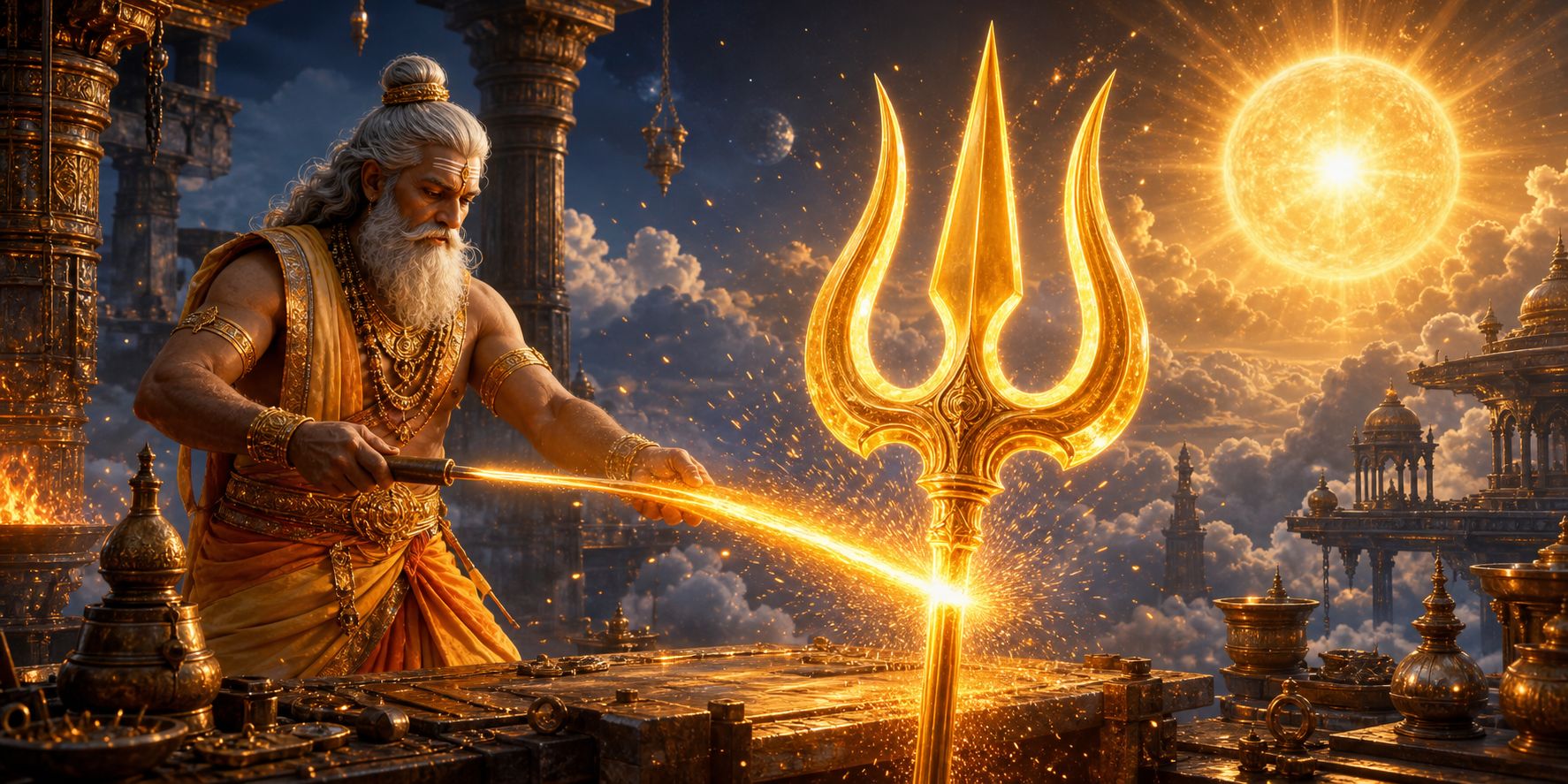
The Vishnu Purana preserves a sacred account of the Trishul’s origin. Surya Dev was married to Sanjana, the daughter of Vishvakarma, the divine architect. Unable to bear Surya’s full brilliance, Sanjana sought her father’s help. Vishvakarma reduced that radiance by one-eighth, and the removed energy descended as blazing sacred light.
Vishvakarma did not discard the excess radiance. He fashioned it into three extraordinary forms: Shiva’s Trishul, Vishnu’s Sudarshana Chakra, and the Pushpaka Vimana. Within this narrative, the Trishul is therefore not an ordinary metal spear. Its material is solar splendour shaped for divine purpose.
That detail gives you a useful way to approach the symbol. The problem in the story is not energy itself. The problem is intensity without a form that embodied life can bear. Once measured and shaped, the same force becomes an instrument of cosmic order. When anger, desire, ambition, or grief feels overwhelming, the Trishul does not ask you to pretend the energy is absent. It asks whether that energy has acquired discipline, direction, and a dharmic purpose.
This also corrects a common misreading. Power in Shiva’s hand is not uncontrolled force. The Trishul begins as radiance, becomes ordered through Vishvakarma’s skill, and rests with the great yogi who is not ruled by what he holds. Its authority comes from mastery, not display.
Why the three prongs can carry several meanings
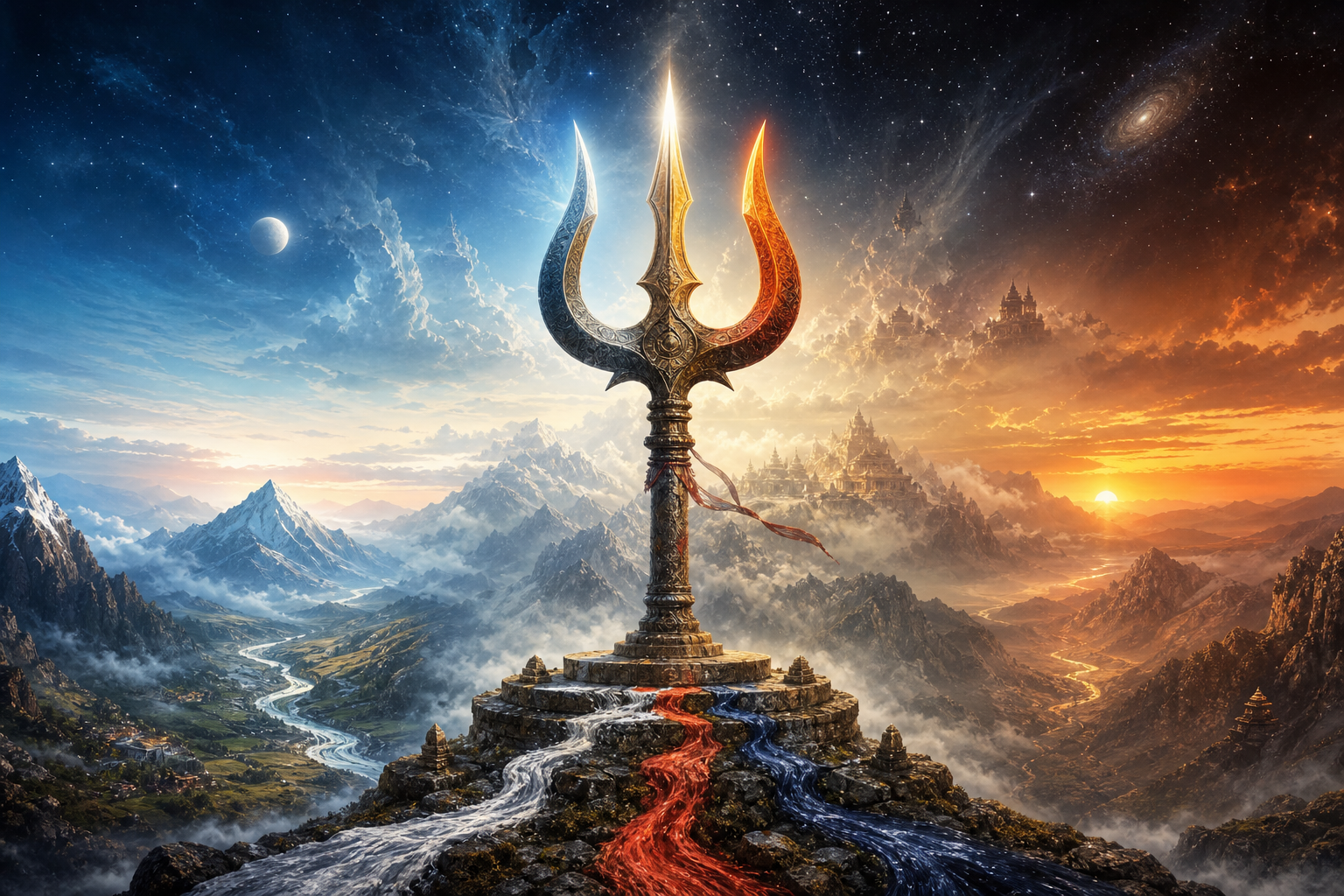
A sacred symbol can hold several teachings without becoming vague. The recurring structure here is precise: three forces or conditions encompass a field of experience, while Shiva remains sovereign across that field. The meanings reinforce one another because each applies the same spiritual principle at a different scale.
| Interpretive lens | The three aspects | What Shiva’s mastery signifies | A question for your reflection |
|---|---|---|---|
| The three gunas | Sattva: clarity, purity, wisdom, and balance; Rajas: desire, action, energy, and movement; Tamas: darkness, stillness, ignorance, and dissolution | All three qualities operate in creation, but none governs Shiva | Which quality is steering your present decision? |
| The three worlds | Swarga Loka, the celestial realm; Bhu Loka, the earthly realm; Patala Loka, the lower or nether realm | Shiva’s presence and authority are not confined to one plane of existence | Are you attending to your earthly duty while remembering a reality larger than immediate appearances? |
| The three divisions of time | Bhuta, the past; Vartamana, the present; Aagami, the future | Shiva as Trikalagya knows all three and is not imprisoned by time | Are memory or anticipation preventing the action that belongs to the present? |
| The three ordinary states of consciousness | Jagrat, waking; Swapna, dreaming; Sushupti, deep sleep | Shiva is present through these changing states and beyond them in Turiya, pure awareness | What in your identity remains worth examining when experience continually changes? |
The gunas are especially easy to misuse. They are not permanent personality labels with which to rank people. Sattva, rajas, and tamas are qualities that influence embodied life. You can notice which one is dominant in a particular moment without declaring that it is your fixed identity. Restless activity may reveal rajas; confusion or resistant inertia may reveal tamas; calm discernment may reveal sattva. Shiva’s Trishul then adds the decisive point: even sattva is held, not clung to as a new ego.
The time symbolism is similarly practical. A difficult decision often becomes tangled because three different things are being treated as one: what happened, what must be done now, and what might happen later. Separate them. Let the past supply facts rather than chains, give the present its duty, and treat the future as something to prepare for without pretending to control it. The Trishul holds all three together without confusing their roles.
The consciousness symbolism requires one important distinction. Sushupti, deep sleep, is one of the three states represented by the prongs; it is not itself Turiya. Turiya lies beyond waking, dream, and deep sleep as pure awareness. The Trishul therefore does not glorify unconsciousness. It points past all three changing conditions toward the awareness with which Shiva is identified.
The weapon is aimed at three kinds of suffering
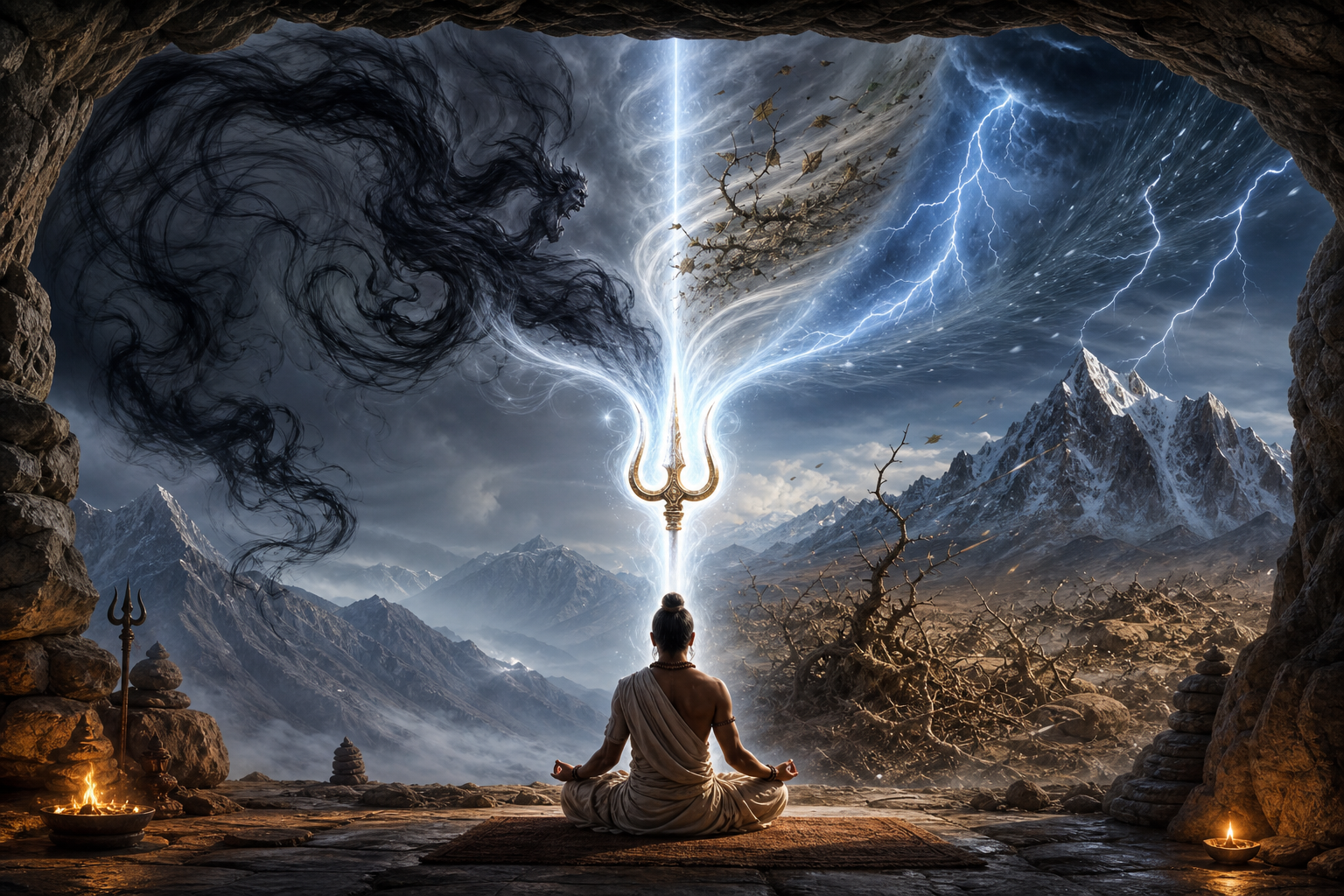
The Trishul’s character as a weapon should not be erased. Yet its deepest target is not a human opponent. It represents the destruction of attachment, ignorance, bondage, and the three forms of suffering that affect human life.
- Adhyatmika is suffering experienced from within, including bodily illness, emotional pain, grief, and mental struggle.
- Adhibhautika is suffering caused by other living beings.
- Adhidaivika is suffering associated with nature, destiny, or conditions beyond immediate human control.
This classification is useful because different forms of suffering call for different responses. If another person is causing harm, introspection alone may not establish the boundary or protection you need. If the turmoil is being sustained internally, blaming the outer world may leave the governing habit untouched. If the cause is genuinely beyond your control, a fantasy of total control adds a second burden to the first.
A single difficulty can also involve more than one category. Grief may be inwardly experienced, connected to another being, and intensified by events nobody could prevent. Do not force a neat label onto a complex reality. Instead, use the threefold distinction to find the part that is yours to address.
- Name where the suffering is entering your life. Is the immediate pressure arising within, through another living being, or through a condition outside your control?
- Choose a response at the same level. Work on the inner habit, take the needed interpersonal action, or prepare for the external condition as the situation requires.
- Separate responsibility from possession. Act fully where you have agency, then stop claiming ownership over every possible outcome.
This is why Shiva can be understood as a compassionate destroyer. Destruction is compassionate when it removes what keeps a being bound. If an interpretation of the Trishul merely sanctifies rage, domination, or revenge, it has missed the yogic image directly in front of it: tremendous force governed by stillness and awareness.
The Damaru prevents a one-sided reading of destruction
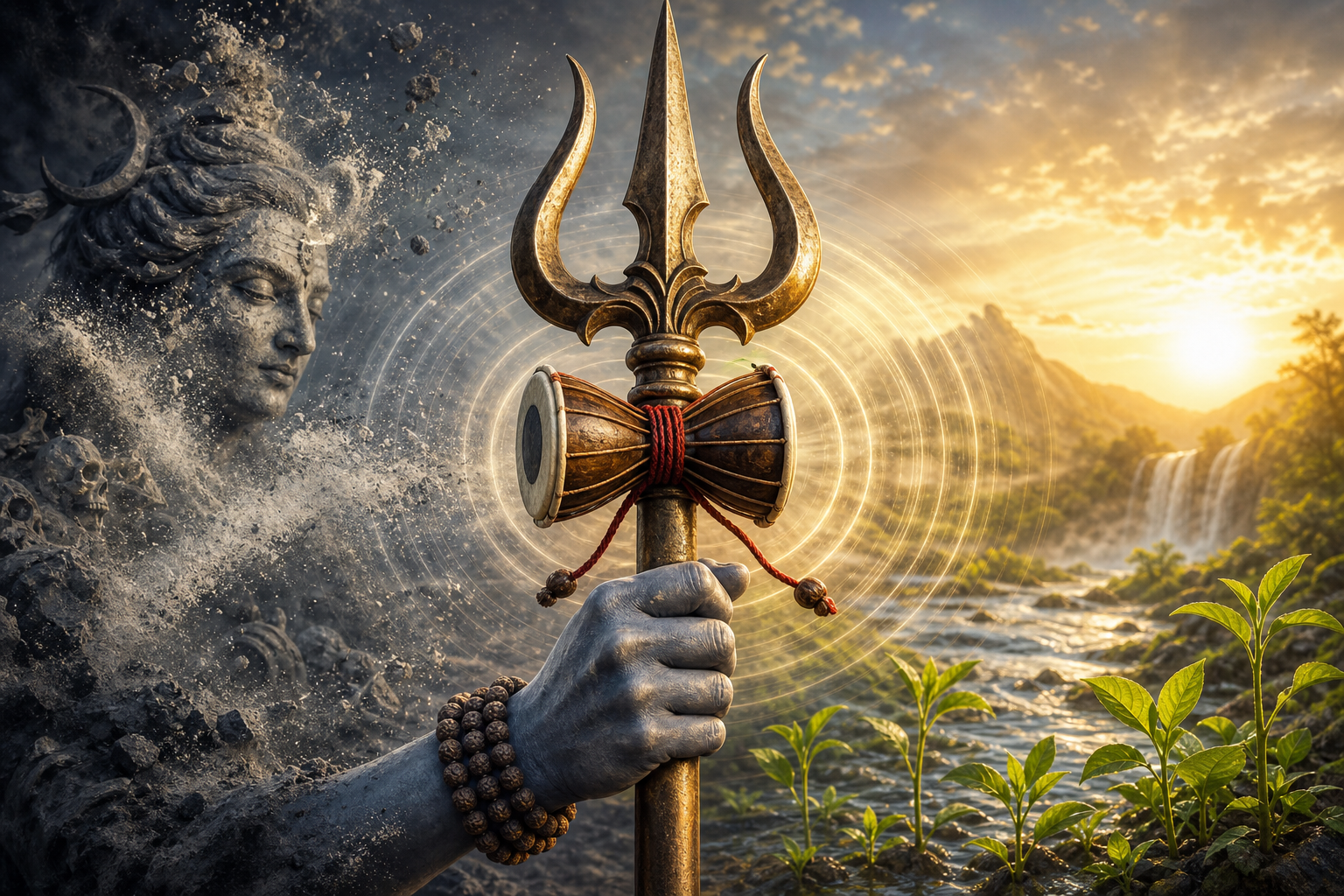
Shiva’s Trishul is often accompanied by the Damaru, the small two-sided drum. The pairing completes the teaching. The Trishul signifies dissolution, while the Damaru signifies creation. Its sound is associated with the rhythm of manifestation and, in tradition, with the emergence of Sanskrit sounds. In Shiva’s Nataraja form, that rhythm becomes a cosmic dance in which movement and balance belong to one continuous order.
The two emblems together show why dissolution is not the same as nihilism. Something ends so that another movement can begin. A binding attachment is cut so that freedom becomes possible. Ignorance is removed so that discernment can operate. A harmful pattern is interrupted so that a dharmic pattern can take its place. The Trishul without the Damaru could be mistaken for mere negation; the Damaru without the Trishul could be mistaken for creation without necessary endings.
You can apply this pairing whenever you are trying to change a habit or repair a part of life. First ask the Trishul question: what must end? Then ask the Damaru question: what rhythm will replace it? Ending reactive speech, for example, becomes more durable when you establish a new practice of pausing and answering deliberately. Dissolution clears the space; creation gives that space a worthy form.
There is also a test for claims made in the name of Shiva’s destructive power. Ask what bondage is being removed and what more truthful order is being made possible. If the only result is that anger has found a sacred costume, the Trishul’s symbolism has been reversed. Shiva does not lose control in order to overcome disorder.
How to make the symbolism part of your practice
You do not need to contemplate every meaning at once. In fact, trying to map all the triads simultaneously can turn a spiritual symbol into an exercise in cleverness. Choose the lens that corresponds to the question actually before you.
For a decision, use the gunas. Identify whether your present impulse is clear and balanced, agitated by desire, or obscured by inertia and confusion. Do not condemn the energy. Decide what would place it under wiser direction.
For regret or anxiety, use the divisions of time. Write one sentence for the fact belonging to the past, one for the duty available in the present, and one for the future possibility you cannot yet know. Then act on the present sentence.
For distress, use the three forms of suffering. Locate the part arising within, through another being, or through circumstances beyond your control. This keeps spiritual reflection from becoming either self-blame or blame of everyone else.
For meditation, use the states of consciousness. Notice that waking experience, dreams, and deep sleep all change. Let the Trishul remind you that Shiva is not reduced to any one passing state. The contemplative direction is toward awareness, not toward collecting unusual experiences.
For change, pair the Trishul with the Damaru. Name one pattern to dissolve and one constructive rhythm to begin. Make the new rhythm concrete enough to perform, because an empty space is easily reclaimed by the habit that previously occupied it.
Devotees also offer a Trishul at Shiva temples as an expression of surrender, trust, and a wish for divine protection. The inner offering is the central one: ego, fear, desire, and unresolved struggle are placed before Mahadev rather than polished into a religious identity. A physical offering is not a bargain guaranteeing a particular outcome. It gives visible form to the devotee’s willingness to release control and accept divine order.
If you intend to bring or place a physical Trishul at a mandir, ask the temple or pujari about its custom first. Sacred space has an order of its own, and surrender includes respecting it. You can still make the inward offering wherever you are: name what you must relinquish, identify the duty that remains yours, and take that action without demanding control over the result.
Key takeaways
- Shiva’s Trishul represents power held under complete spiritual command, not uncontrolled aggression.
- Its three prongs can signify the gunas, the worlds, the divisions of time, the ordinary states of consciousness, and the forms of suffering.
- The repeated teaching is mastery without bondage: Shiva acts through these fields while remaining beyond their control.
- The Trishul destroys what binds; the Damaru represents the creative rhythm that follows dissolution.
- For practical reflection, choose one threefold lens, identify what is governing the situation, and take one corresponding dharmic action.
- Offering a Trishul is best understood as surrender of ego, fear, desire, and inner struggle rather than a transaction for a guaranteed result.
The next time you see the Trishul beside a Shivalinga, look first at Shiva’s stillness and then at the three points. Choose the prong that names what is controlling you, remember the hand that holds all three, and make one decision from that steadier place.
References
