
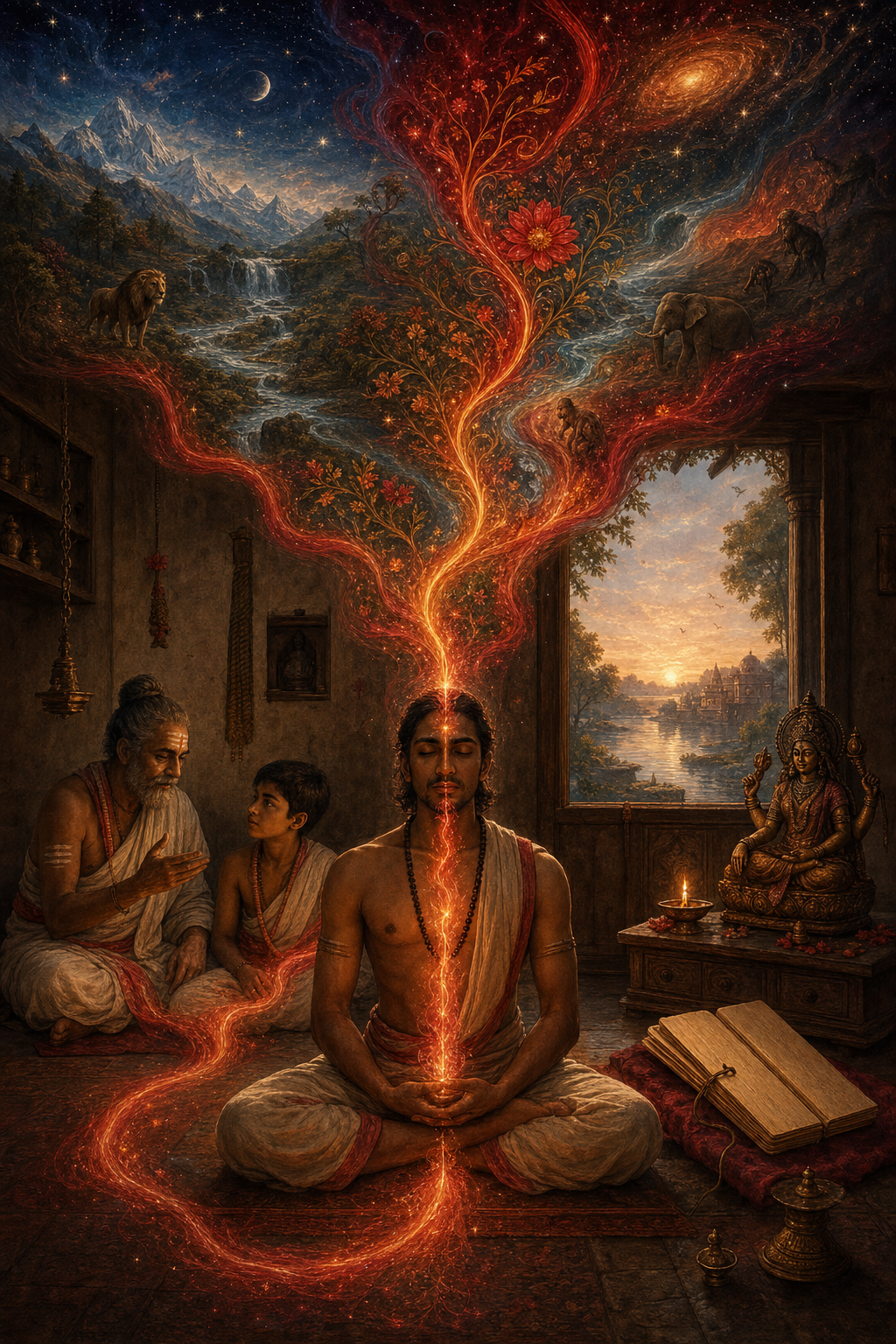
Shakta traditions connect three questions that modern discussions often separate: What is divine power, how is it encountered through the body, and how does a community preserve access to it? Read together, the source articles present Shakti as supreme reality, embodied presence, and a current sustained through practice rather than abstract belief alone.
This synthesis clarifies how theology becomes bodily discipline, why different chakra maps can remain internally valid, and how households, initiatory lineages, sacred art, and even fragmentary texts participate in transmission.
Shakti is reality in action, not a secondary divine attribute

The theological foundation is decisive. The article on the living current of Shakti reports that many Shakta schools understand Devi not merely as the companion or power of a male deity but as the supreme reality from which the cosmos emerges, by which it continues, and into which it is reabsorbed. Consciousness and its power are consequently presented as inseparable.
This view changes the meaning of embodiment. If Shakti is active as life, perception, memory, thought, nature, and spiritual awakening, the body cannot be treated simply as an obstacle to transcendence. It becomes one field in which divine activity can be recognized, disciplined, and interpreted. The account of the Saptachakra Yoginis develops this implication through subtle-body practice: matter, breath, sound, consciousness, and divine power meet within a contemplative model of the person.
The two accounts therefore illuminate different scales of the same theology. One describes Shakti cosmically and relationally, including her continuity through worship and lineage. The other shows how divine power is mapped within embodied awareness through lotuses, syllables, geometric forms, deities, and Yoginis. Neither approach reduces Shakti to a vague synonym for energy. She is understood theologically as divine agency and encountered ritually through specific forms.
The subtle body makes theology contemplatively usable

According to the Saptachakra account, chakras belong to the subtle body rather than to modern anatomical description. Prana, nadi, mantra, bindu, tattva, and Kundalini form an interconnected contemplative vocabulary. Comparisons with nerves, glands, or the spinal cord may function as modern metaphors, but the source cautions against presenting them as literal equivalences.
The chakra lotus is consequently more than an illustration. Petals marked by Sanskrit phonemes relate the body to sacred sound; geometric figures organize elemental and energetic associations; seed syllables concentrate these relationships into recitable form. Yoginis personify the active powers that guard, animate, nourish, and transform each level. Their gestures, implements, faces, and sometimes fierce features communicate capacities that an abstract chart cannot convey as vividly.
This iconography also expands the meaning of sacred embodiment. The source reports that some Srividya descriptions associate chakra Yoginis with constituents such as skin, blood, flesh, fat, bone, and marrow. These associations belong to ritual physiology, not medical diagnosis. Their contemplative force lies in refusing to place ordinary embodiment outside the possible presence of Shakti.
Historical variation is essential to that interpretation. The source emphasizes that Hindu Tantra contains no single universally binding chakra chart. Systems may differ in the number of centers, their correspondences, and their presiding powers because diagrams operate within particular texts, initiations, deities, and ritual purposes. Two sequences discussed in the article demonstrate the point:
| Reported framework | Yogini sequence from lower to higher centers | Structural emphasis |
|---|---|---|
| Satcakranirupana-related presentation | Dakini, Rakini, Lakini, Kakini, Sakini, Hakini | Six centers from Muladhara through Ajna, with Sahasrara as the culmination rather than always receiving a Yogini in the same manner |
| Srividya sequence reflected in the Lalitasahasranama | Sakini, Kakini, Lakini, Rakini, Dakini, Hakini, Yakini | Sevenfold allocation extending through Sahasrara |
The contrast is not best resolved by selecting one table as authentic and dismissing the other. It shows that transmission includes the preservation of a coherent symbolic grammar. A practitioner or reader must therefore ask which text or lineage governs a set of correspondences before combining it with another.
Sacred transmission moves through bodies, relationships, and texts
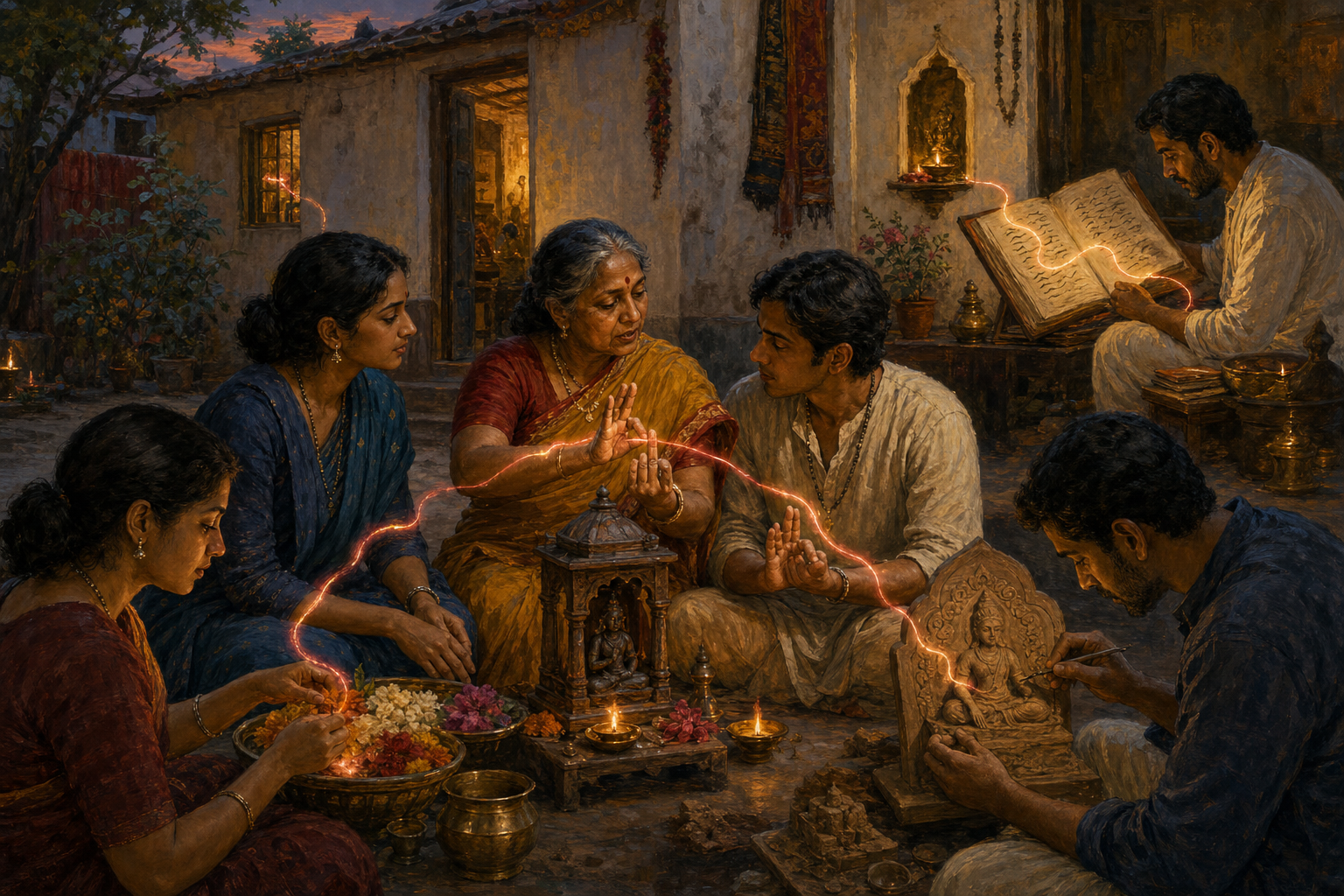
The lineage article presents transmission as a layered process. A household may preserve hymns, festival observances, offerings, ritual objects, stories, and a relationship with a family deity. A child watching an elder approach a shrine also absorbs posture, cadence, fragrance, sound, timing, and emotional orientation. In this setting, religious knowledge is carried through repeated bodily participation as well as verbal explanation.
Guru-parampara adds another form of continuity. Family inheritance can establish familiarity and formative impressions, but the source does not equate ancestry with realization or ritual authority. Initiatory traditions may require qualified guidance, mantra transmission, discipline, and practices specific to a lineage. Household continuity and formal initiation can support one another, yet they are not interchangeable credentials.
The account of the lost Nandi Purana introduces a third channel: transmission through quotation and reuse. It reports that no complete manuscript securely corresponding to the early work is available in the standard scholarly account, although hundreds of attributed verses survive in later compilations. Medieval authors preserved passages relevant to charity, education, ritual conduct, devotion, public welfare, and other concerns, thereby acting as indirect witnesses to a work they did not transmit intact.
This textual case reveals an important feature of living traditions: preservation is selective. Later compilers retained material useful to their questions, while narrative transitions, chapter divisions, and unrelated teachings could disappear. The surviving fragments therefore indicate some contents and patterns of authority without permitting confident reconstruction of the whole. The same principle, in a different medium, applies to domestic and initiatory memory: transmission carries forward what communities repeatedly enact, teach, copy, and value.
The Nandi Purana account also reports a remembered chain in which Karttikeya declared the teaching to Nandin, who transmitted it onward. Whether expressed through a scriptural frame, a teacher-disciple succession, or instruction at a household shrine, authority is represented relationally. Knowledge survives because it passes between persons, not because information remains untouched by history.
Embodiment requires discipline, context, and ethical testing

Sacred embodiment does not mean that every bodily sensation is automatically a revelation. Chakra practice belongs to a structured ritual and contemplative setting, just as inherited worship depends on interpretation and care. A family object without practice, a diagram detached from its symbolic system, or a fragment removed from its textual attribution can retain fascination while losing much of its organizing context.
The sources also establish several necessary limits. The lineage article cautions against treating Shakti as a scientifically measurable substance transmitted through DNA. It distinguishes theological and experiential claims from historical, psychological, and anthropological explanations without requiring one perspective to erase the others. The chakra article draws a parallel boundary by distinguishing subtle anatomy from laboratory anatomy.
Ethics provide another test of continuity. The lineage account argues that ritual inheritance is weakened when it fails to deepen honesty, hospitality, reverence, and concern for vulnerable people. It also warns that theological honor given to the Goddess does not by itself prove social equality for women. Mothers, grandmothers, aunts, female gurus, renunciants, and ritual specialists may perform crucial work of preservation even when formal histories understate their contribution.
These cautions sharpen rather than diminish Shakta claims. They prevent sacred embodiment from becoming pseudo-anatomy, ancestry from becoming automatic authority, textual fragments from being mistaken for complete books, and Goddess theology from serving as a substitute for ethical conduct.
Key takeaways
- Shakta theology links supreme reality with active divine power, making embodied life a potential field of recognition and practice.
- Chakras and Yoginis belong to lineage-specific contemplative systems; differences among their sequences are meaningful and should be identified rather than flattened.
- Sacred transmission occurs through household memory, embodied ritual, ethical formation, guru-parampara, sacred art, manuscripts, and later textual quotation.
- Inheritance can open a path but does not automatically confer realization, initiation, authority, or moral excellence.
- Traditional subtle anatomy, devotional accounts of Shakti, and modern scientific explanation address different kinds of questions and should not be casually conflated.
Future engagement with these traditions will be strongest when practitioners, families, artists, and scholars preserve not only visible forms but also the textual affiliations, disciplined relationships, and ethical purposes that make those forms intelligible.
References
- DharmaRenaissance Blog – Saptachakra Yoginis Revealed: A Powerful Map of Inner Awakening and Sacred Art
- DharmaRenaissance Blog – The Lost Nandi Purana Revealed: Its Contents, History, and Enduring Importance
- DharmaRenaissance Blog – The Living Current of Shakti: How Sacred Power Flows Through Family and Lineage