

You may care deeply about rivers, trees, animals, and climate, yet still wonder what sacred ecology asks of you on an ordinary day. Is it meditation outdoors, restraint in consumption, protection of habitat, or ritual care? In a Dharmic life, these belong to one sequence: notice relationship, reduce harm, offer service, and return often enough for the habit to become character.
The practical test is simple. Does your reverence change both how you attend to a place and what you take from it after you leave? If contemplation never alters conduct, it remains a pleasant mood. If ecological work has no inward discipline, urgency can harden into anger or exhaustion. Sacred ecology joins clear perception to responsible action.
Begin with relationship, not scenery
Nature spirituality is easily reduced to liking green spaces. Dharmic sacred ecology makes a stronger demand: a river, tree, animal, or patch of soil is not merely attractive scenery arranged around the human observer. It participates in a field of relationships that existed before you arrived and will continue after you depart.
Hindu traditions express this through several complementary lenses. The Isha Upanishad affirms the Divine presence throughout existence, while the distinction between Prakriti and Purusha trains attention on nature and consciousness without treating the material world as spiritually empty. Bhagavad Gita 7.4-7.5 describes layered Prakriti through gross elements and subtler principles. The implication for practice is not that every natural object should be handled identically, but that nothing should be approached as spiritually meaningless.
Buddhist dependent arising, or pratityasamutpada, gives you another practical lens: no being or event stands alone. Food depends on soil, water, weather, seed, labor, transport, and innumerable lives. Jain ahimsa asks you to notice the injury hidden inside ordinary convenience. Sikh remembrance of Ik Onkar refuses a fragmented world, while the verse Pavan Guru, Pani Pita, Mata Dharat Mahat presents air, water, and earth as guide, progenitor, and great mother. These traditions do not collapse into one metaphysical system. They do converge on disciplined attention, restraint, gratitude, and care.
Before entering a grove, harvesting a sacred leaf, beginning a cleanup, or buying something extracted from the earth, pause over three questions:
- What relationships sustain what is before me? Look for water, soil, shade, pollinators, human labor, seasonal change, and the lives that depend on this place.
- What can remain undisturbed? Sacred conduct includes knowing when not to pluck, move, feed, photograph, enter, or possess.
- What can I return? The answer may be protection, reduced consumption, careful maintenance, financial support, physical seva, or simply leaving the place cleaner and quieter.
Use those questions before choosing a spiritual technique. They prevent a common inversion in which nature becomes another consumable experience: a background for meditation, a photograph, or a feeling of purity. A sacred relationship includes duties even when the place is muddy, damaged, inconvenient, or visually unimpressive.
Use the five elements as instructions for attention

The Pancha Mahabhutas – earth, water, fire, air, and space – provide a practical map for meeting a landscape. They are contemplative categories, not substitutes for modern chemistry or ecology. Their value lies in teaching you to notice qualities that are simultaneously present in the world and in embodied experience: stability, flow, transformation, movement, and openness.
One complete elemental sit
Choose a place you can visit safely and lawfully. It may be a temple garden, courtyard tree, balcony, micro-park, riverside path, or open window. Move through the elements in order:
- Earth: feel the points where your body meets the ground, chair, or wall. Notice weight, texture, firmness, and the support you usually ignore. Ask what material conditions are holding you up at this moment.
- Water: attend to visible water, moisture in the air, the movement of sap or clouds, or the water within your own mouth and breath. Notice that life depends on flow rather than possession. Let this prompt one concrete question about how you use or protect water.
- Fire: feel warmth, light, digestion, or the contrast between sun and shade. Treat fire as transformation and energy, not merely flame. Never stare at the sun, and do not introduce an open flame where weather, vegetation, or local rules make it unsafe.
- Air: take five unforced breaths. Feel the exchange rather than imagining breath as a private possession: the body receives, changes, and releases air continuously. Lengthen the exhalation only if it remains easy. If you become dizzy or strained, return immediately to natural breathing.
- Space: widen attention beyond a single object. Include near and distant sounds, gaps between branches, the sky, and the space around bodily sensations. The aim is not to become blank. It is to notice how many events can arise without your having to seize any one of them.
The practice becomes more useful when you finish with one sentence of observation and one material response. You might record, for example, that the soil around a familiar tree is compacted and then ask its caretaker whether mulching or another form of care is appropriate. The observation keeps spirituality honest; the response prevents awareness from ending at sensation.
Pancha Kosha Viveka can deepen this inquiry by helping you distinguish bodily sensation, vital movement, mental activity, discernment, and subtler experience. Use those layers to examine what is occurring, not to make grand claims about a momentary feeling. A quiet nervous system can support insight, but calmness alone is not proof of spiritual realization.
There are reasonable scientific grounds for expecting natural settings to help attention and physiological settling. The biophilia hypothesis proposes an innate human affinity for living systems, while Attention Restoration Theory explains how gently engaging natural patterns can replenish directed attention. Clinical work involving forest bathing has reported changes in cortisol, blood pressure, heart-rate variability, and parasympathetic activity. These findings support modest claims about restoration; they do not establish a forest walk as a treatment for hypertension, anxiety, trauma, or any other medical condition.
Keep pranayama equally modest. Slow, comfortable breathing is enough for this practice. Do not add kumbhaka, or breath retention, merely because strain feels more advanced. If retention belongs to an established practice you have been taught, follow that guidance and your own health limitations. Nature meditation should make attention clearer, not turn endurance into a spiritual contest.
The Bilva test: can devotion leave a tree healthier?
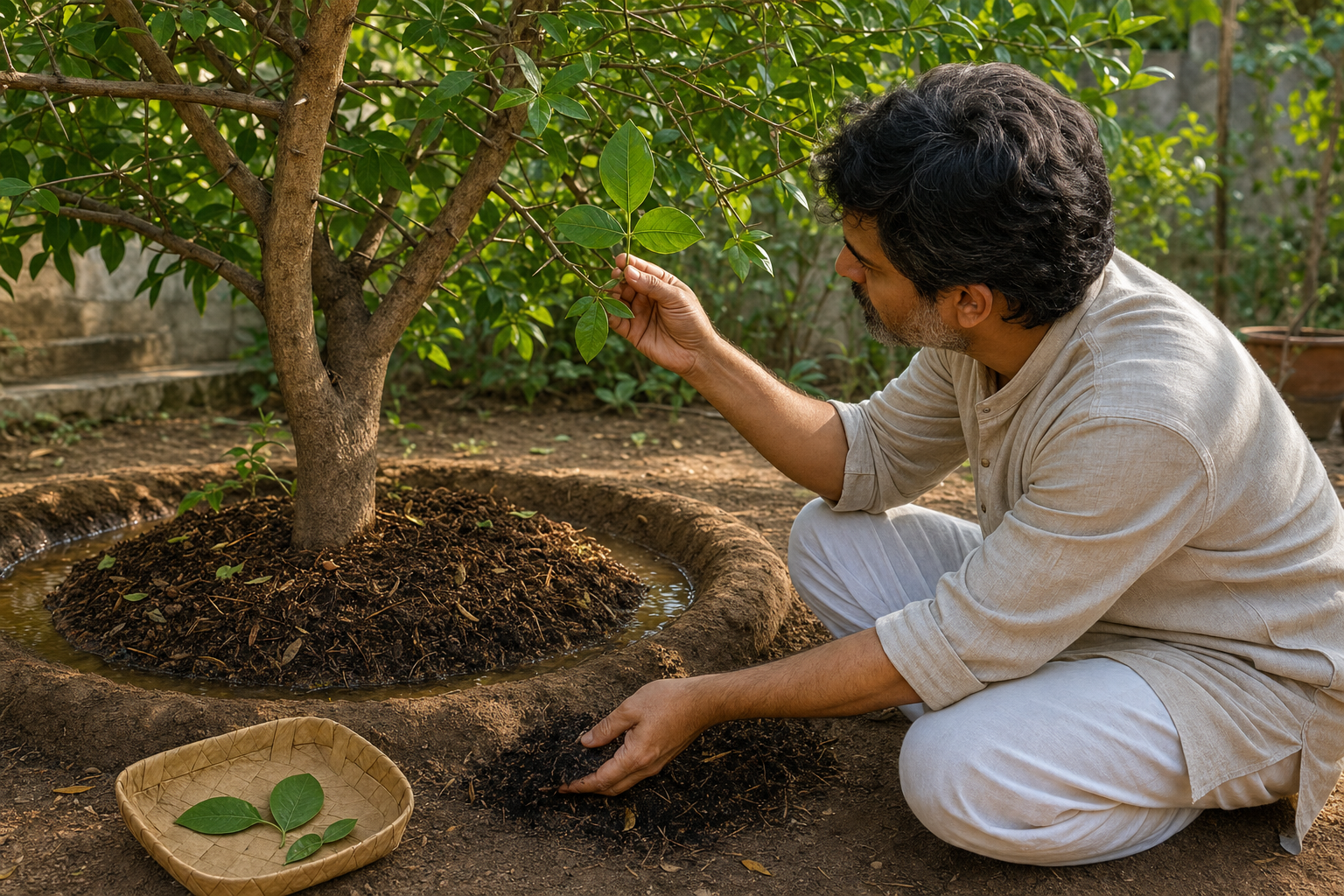
The Bilva tree makes sacred ecology tangible because its leaves are both living tissue and a cherished Shaiva offering. The Skanda Purana connects the emergence of Bilva with Goddess Parvati on Mount Mandara, presenting the tree as an embodiment of Shakti and a beloved offering to Shiva. The trifoliate leaf is often contemplated through Shaiva triads: Shiva’s three eyes, the Trishula, the three gunas, and the powers of will, knowledge, and action.
Those meanings matter only if they alter the devotee’s behavior toward the living tree. A sacred leaf is not made more sacred by stripping a branch. Ritual precision and ecological restraint belong together.
When gathering Bilva leaves, use the following discipline:
- Learn the temple, household, or sampradaya custom before collecting. Traditions differ on the orientation of the leaflet and stalk, so a local instruction should not be promoted as the only universal rule.
- Seek permission from the tree’s caretaker or landholder. Sacred intention does not cancel ownership, temple management, conservation rules, or the needs of other devotees.
- Inspect the tree before touching it. If foliage is sparse or a branch has already been heavily harvested, leave it alone and obtain leaves from a cultivated source.
- Take only what the vrata or puja requires. Counts such as 11, 21, and 108 are used in devotional settings, but an auspicious number is never a license for careless harvesting.
- Prefer careful pruning to stripping when that is the established local practice and the caretaker permits it. Do not break branches to obtain visually perfect trifoliate leaves.
- Respect rules concerning fallen leaves. Some formal offerings call for freshly and reverently gathered, intact leaves. That ritual rule should not be converted into a reason to remove every fallen leaf from the ecology around a tree.
- If your household or temple uses Bilva regularly, support propagation and long-term care. Repeated taking creates a corresponding duty to cultivate, water, protect, and renew.
Bilva, or Aegle marmelos, is a hardy, drought-tolerant member of the Rutaceae family adapted to semi-arid and tropical conditions in the Indian subcontinent. It can provide habitat for insects and birds and contribute shade in temple or urban precincts. Hardiness does not mean suitability everywhere. If your climate or local ecology cannot support Bilva responsibly, caring for an appropriate local tree is better than planting a sacred species where it will fail or become an ecological burden.
This is the Bilva test for every form of nature devotion: after the worship is complete, is the living being healthier, equally secure, or diminished? The answer reveals whether sacred symbolism has matured into sacred conduct.
Translate reverence into vows you can audit

A moving meditation can change your mood for an afternoon. A vow changes what you repeatedly permit yourself to do. Dharmic ethics therefore gives nature spirituality a structure that survives after the pleasant feeling has passed.
A four-vow ecological audit
- Ahimsa: identify one recurring, avoidable disturbance. It may be overharvesting sacred leaves, leaving waste after a gathering, walking through a protected patch, or buying something whose use you do not need. Stop the specific harm rather than merely affirming non-violence in general.
- Aparigraha: choose one category in which enough can actually mean enough. Before acquiring a devotional, household, or festival item, ask whether you can borrow it, repair it, reuse it, share it, or go without it.
- Satya: measure what you are tempted to describe vaguely. Look at the waste produced by a celebration, the water used in a repeated ritual, or the survival of saplings after a planting drive. Honest observation protects seva from flattering stories.
- Seva: adopt a place or task you can revisit. Riverbank cleaning, soil care, tree protection, biodiversity work, and maintenance of a temple garden become spiritually formative through continuity, not through a single dramatic event.
For communal work, define responsibility before the event. A planting effort needs suitable species, permission, a watering arrangement, and someone who will notice whether the saplings survive. A cleanup needs safe handling and lawful disposal, not a pile of collected waste left for somebody else. Maintenance is not the dull work after seva; it is part of the seva.
You do not need access to wilderness. Balcony gardens, windowsill herbs, campus grounds, neighborhood trees, and micro-parks can all train sustained attention. A windowsill plant is not a substitute for ecosystem restoration, but caring for it can expose your habits: whether you remember water, notice stress, learn seasonal limits, and accept growth that does not obey your schedule.
Watch for four distortions. Romanticizing nature ignores decay, predation, disease, and ecological conflict. Spiritual bypassing uses serenity to avoid grief, anger, or responsibility. Performative virtue values the photograph more than the follow-through. Cultural appropriation lifts an attractive practice from its lineage while ignoring its discipline and meaning. The corrective is the same in each case: study humbly, practice consistently, tell the truth about results, and serve a living place.
Inter-traditional respect also requires discernment. You do not need to blend every Dharmic method into one session. A Hindu practitioner may use japa and bhuta contemplation; a Buddhist practitioner may remain with Anapanasati and metta; a Jain practitioner may ground the day in samayik and careful non-harm; a Sikh practitioner may walk with simran and remembrance of Ik Onkar. Shared ecological responsibility does not require erasing distinct paths.
Build a seven-day rhythm that joins practice and repair
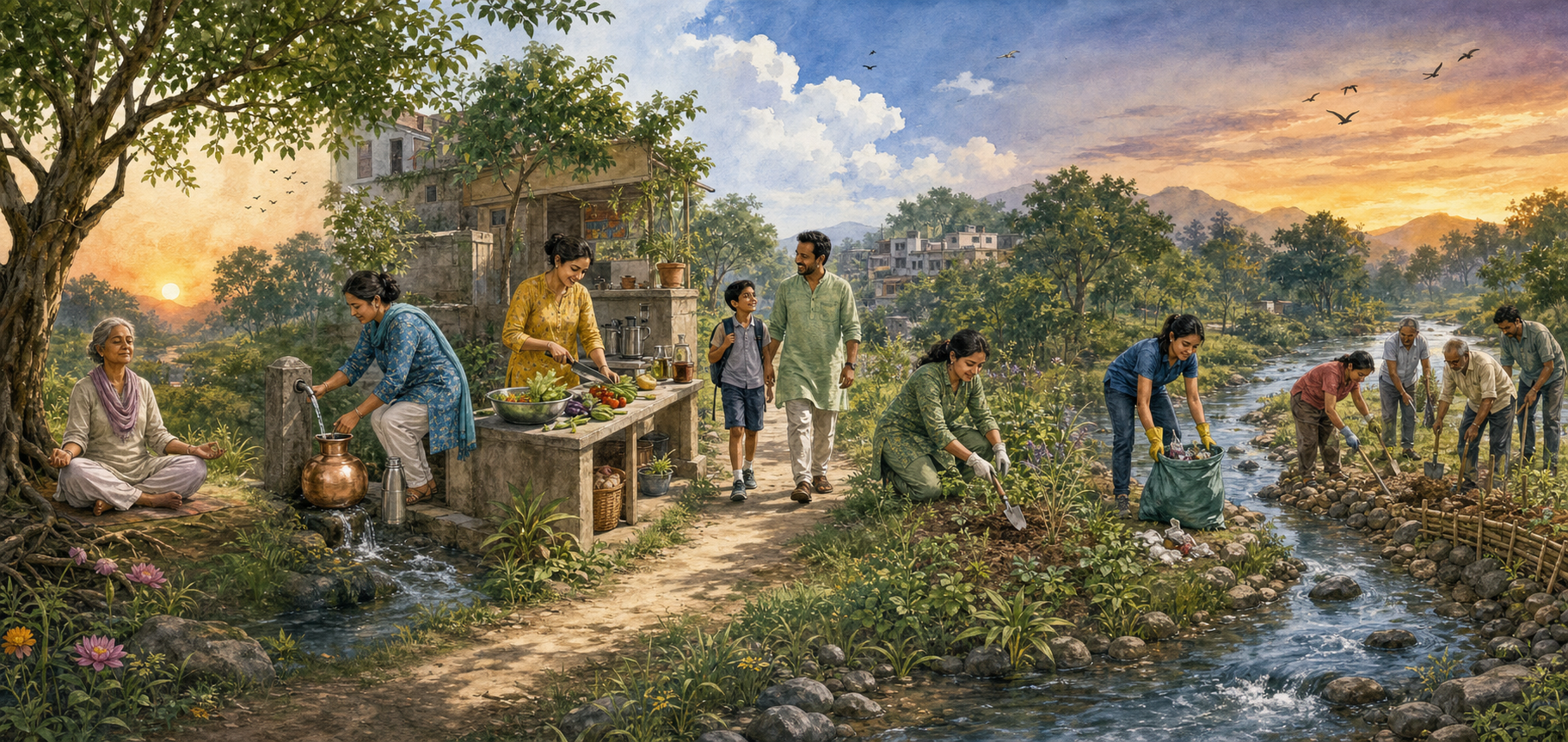
Consistency is easier when each day has one clear emphasis. Use the same nearby place when possible; repetition lets you notice changes that novelty hides.
- Day one – earth: walk slowly and feel each point of contact with the ground. Notice soil condition, roots, litter, erosion, or compaction without trying to fix everything immediately.
- Day two – air and sacred sound: take five easy breaths, then continue with japa, simran, or silent breath awareness according to your lineage. Let sound settle into the place rather than using volume to dominate it.
- Day three – other lives: practice metta, samayik, or another established contemplation of non-harm. Include visible and unseen beings, then identify one convenience of yours that affects them.
- Day four – space: sit beneath an open sky or near a window and widen attention. Notice how quickly the mind labels, selects, and excludes. Return to panoramic awareness whenever one thought takes over.
- Day five – stillness: complete the five-element contemplation without rushing. End by writing one sensory fact, one emotional response, and one obligation you can realistically accept.
- Day six – seva: act on something you observed. Join an authorized cleanup, care for a plant, reduce a repeated waste, help maintain a sacred precinct, or support people already doing competent ecological work.
- Day seven – reflection: review mood, sleep, focus, and reactivity across the week. Also ask the harder question: what changed outside your mind because you practiced?
Do not expect every day to feel peaceful. The practice may make damage more visible and responsibility less avoidable. That is not failure. Equanimity is not indifference; it is the capacity to see clearly and respond without being ruled by panic, vanity, or despair.
A journal is usually enough to track the pattern. If you already monitor heart-rate variability or blood pressure for health reasons, treat the readings as limited indicators and follow the method given by your clinician. Do not use a favorable reading to certify spiritual progress, and do not alter medical care because an outdoor practice feels calming.
Key takeaways
- Sacred ecology begins when you meet nature as a network of relationships rather than an inventory of useful objects.
- The five elements work best as a disciplined map of attention, not as a replacement for ecological science.
- Ahimsa restrains harm, aparigraha restrains acquisition, satya tests flattering assumptions, and seva repairs what carelessness has damaged.
- Bilva worship becomes ecologically credible when harvesting protects the tree and regular use is matched by cultivation.
- Practice within a lineage while cooperating across traditions on the shared work of protecting life.
Choose one living place you can revisit: a courtyard tree, temple garden, river edge, neighborhood park, or balcony plant. On your next visit, take five unforced breaths, name one relationship sustaining that place, identify one harm you can stop, and choose one act of care you will complete. Then return. Sacred ecology becomes real through the quality of that return.
References
- DharmaRenaissance Blog – Spirituality of Nature: Sacred Dharmic Wisdom, Science-Backed Healing, Inner Resilience
- DharmaRenaissance Blog – Parvati and the Sacred Bilva in Skanda Purana: Symbolism, Ritual Science, and Ecology
