

You usually know when something has reached its limit before you are ready to admit it. A role, habit, relationship to status, or long-defended plan no longer serves its purpose. The difficult question is not simply whether to let go. It is what must end, what must be protected, and how to act without turning clarity into anger.
Rudra and Kalabhairava offer two complementary disciplines for that threshold. Rudra reveals the transformative force awakened by clear seeing. Kalabhairava confronts you with time, consequence, and the boundary beyond which postponement becomes disorder. Neither asks you to romanticize loss. They teach you to make necessary change answerable to Dharma.
When time becomes a spiritual problem
Change becomes a spiritual problem when reality has moved but your conduct has not. You continue maintaining a form after its purpose has disappeared. You repeat a promise that your actions no longer support. Or you call delay patience because acknowledging the truth would disturb a familiar identity.
Kala is not merely time measured by a clock. In the symbolism of Kalabhairava, time is also the force that reveals limits and carries every condition toward dissolution. A beginning creates possibilities, but it also creates a sequence. Choices mature into consequences. Opportunities pass. Bodies, institutions, arrangements, and identities cannot remain fixed simply because we are attached to them.
Kalabhairava therefore does not represent pessimism. His fierceness removes the fantasy that postponement can suspend consequence. Time may be uncompromising, but your response to time can still be truthful, disciplined, and protective.
Rudra addresses the other half of the problem: the obscuration that prevents timely action. In the Devi Bhagavata Purana’s cosmological narrative, Rudra emerges from Brahma’s brow at the point where intensified vision becomes transformative energy. The third eye, or jnana-chakshu, represents discernment capable of burning through concealment. The force that follows is not destruction for entertainment or rage without measure. It clears what obstructs order and renewal.
When you face a difficult transition, begin with three diagnostic questions:
- What continues only because you keep postponing a decision?
- What duty or value remains alive even though its present form is failing?
- What fact have you admitted privately but refused to express through action?
The distinction between form and purpose matters. Ending an ineffective form need not mean abandoning the Dharma it was meant to serve. Sometimes preservation requires transformation. Sometimes loyalty to a purpose requires releasing the arrangement that once carried it.
Rudra transforms; Kalabhairava guards the threshold
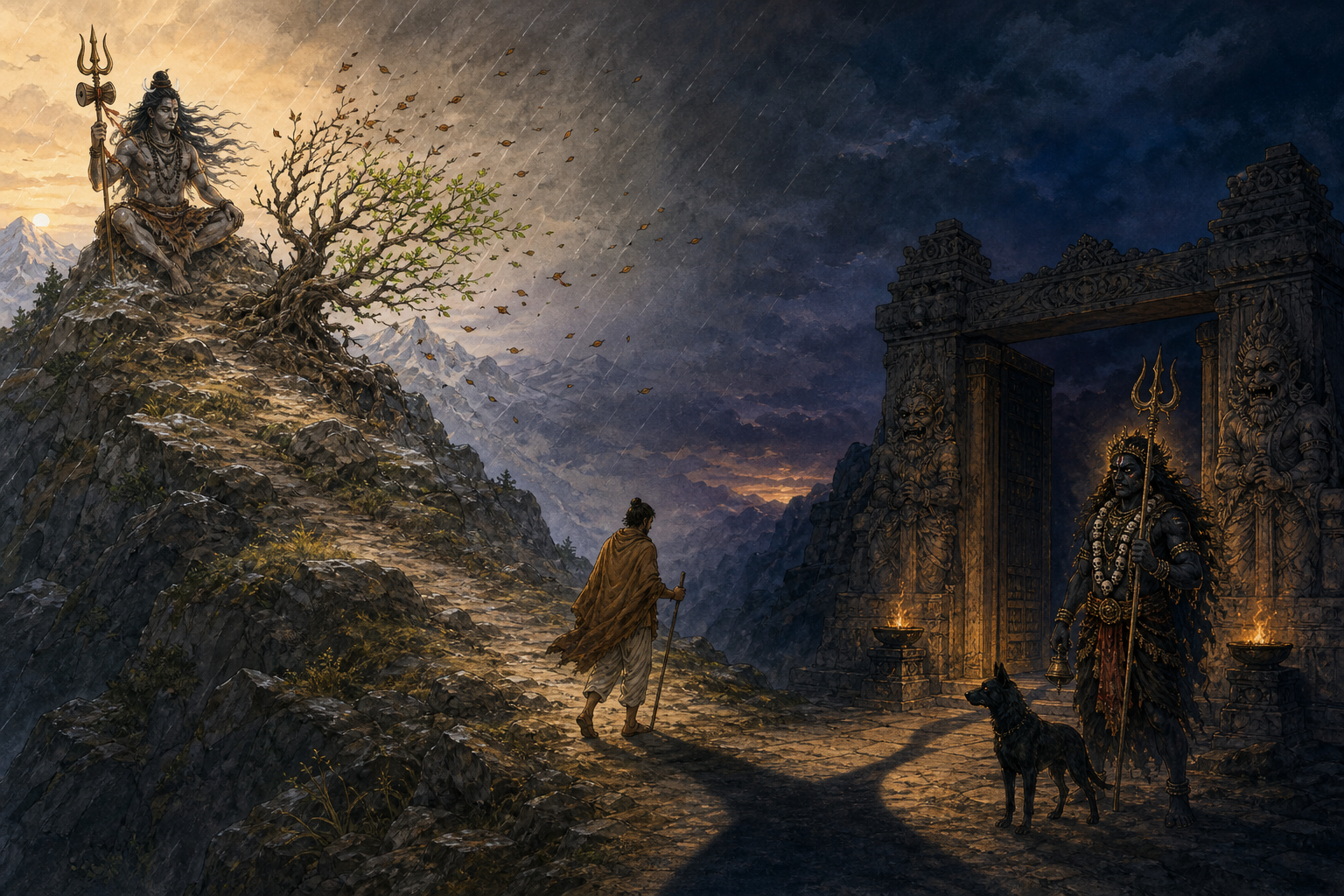
Rudra and Kalabhairava should not be flattened into interchangeable emblems of destruction. Both belong to the theological world of Shiva, but each brings a different aspect of change into focus. Rudra makes obscured truth active. Kalabhairava gives that truth a boundary in time and places it under ethical guard.
| Lens | Rudra | Kalabhairava |
|---|---|---|
| Primary emphasis | Purification and transformation through awakened discernment | Time, dissolution, justice, and guardianship |
| Central image | The third eye and purifying fire | The fierce keeper of boundaries and sacred space |
| Question for you | What truth must be seen without concealment? | What limit must now be acknowledged and guarded? |
| Failure corrected | Confusion, stagnation, and action clouded by ego | Endless delay, weak boundaries, and evasion of consequence |
| Dharmic movement | Remove what obstructs renewal | Protect what should cross the threshold and stop what should not |
Rudra’s emergence within Brahma’s own field of awareness carries a precise implication: transformation is not an alien power attacking creation from outside. It is already present within the creative process. The five great elements may be assembled into worlds and forms, but those forms remain dynamic. Without purification and return, creation would harden into stagnation.
Kalabhairava sharpens this insight by standing as Kshetrapala, guardian of the sacred field. He is the embodiment of time and its dissolution as well as a protector of thresholds, including the sacred geography of Kashi. A threshold is where discernment becomes responsibility. You must decide what may enter, what must leave, and what you are obligated to defend.
A useful sequence follows: see clearly, end what has expired, and protect what remains worthy. If you act before seeing clearly, fierceness becomes impulse. If you see clearly but refuse to set a boundary, insight becomes decorative. If you try to protect every existing form, preservation decays into attachment.
This is why the Trimurti framework remains practical rather than merely cosmological. Brahma’s generative movement, Vishnu’s sustaining equilibrium, and Rudra-Shiva’s transformative return are not competing claims about which function matters most. A dharmic decision asks all three questions: What should begin? What should continue? What must end so that order can be restored?
Read the fierce image as a discipline, not a threat
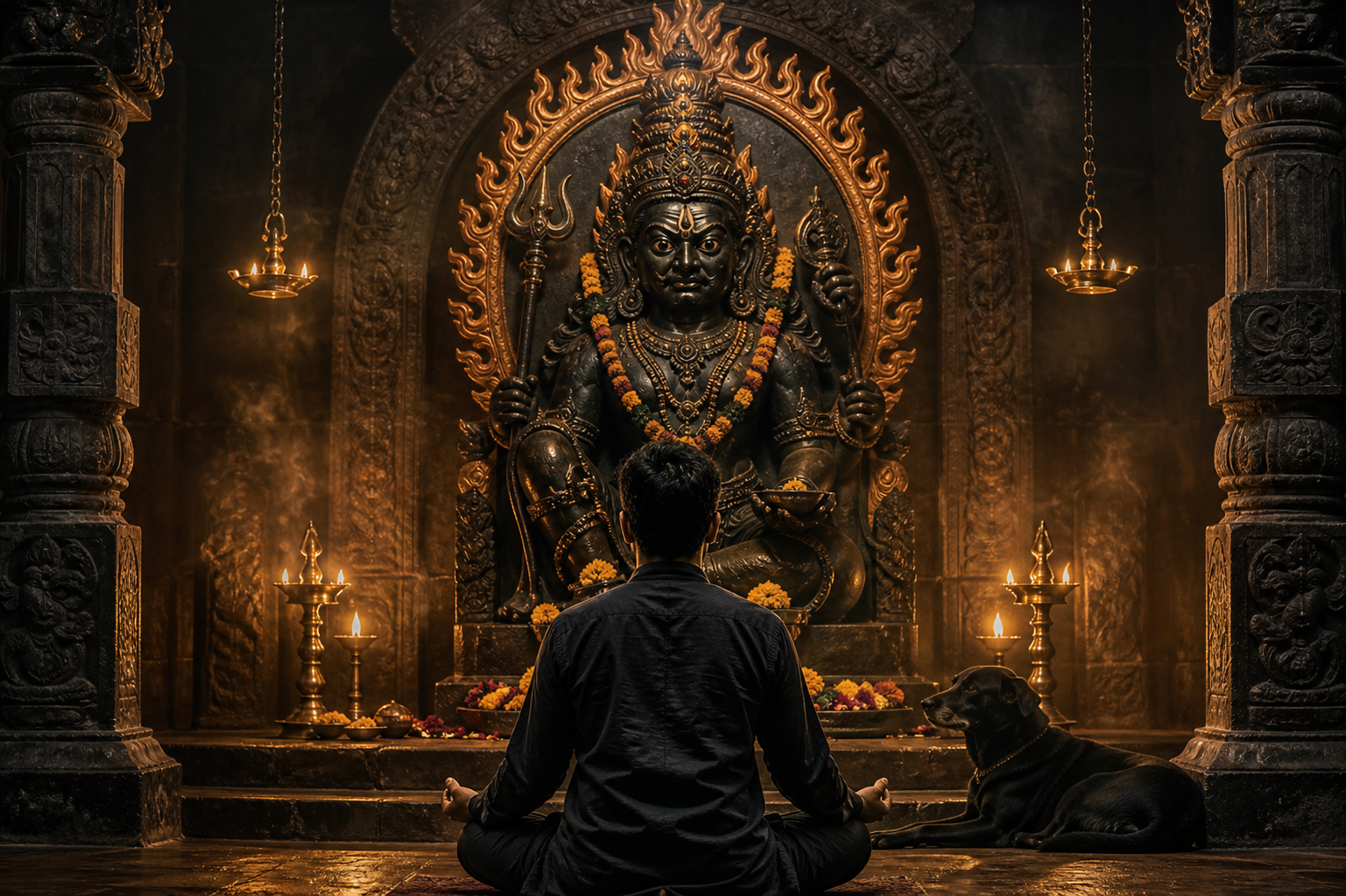
Kalabhairava’s dark or ash-covered body, fiery hair, skulls, serpents, weapons, and canine vahana can be unsettling. That response is part of the encounter. The image refuses to decorate impermanence. Yet its fierceness must not be mistaken for cruelty, occult spectacle, or permission to indulge anger.
Iconographic details vary across Agamic, Tantric, Shilpa Shastra, and regional traditions, including forms with four or eight arms. The recurring attributes can nevertheless serve as exact contemplative prompts:
- The third eye: Write down the truth you keep softening when you explain the situation to yourself. Remove excuses, accusations, and predictions. Keep only what you can honestly say is known.
- The trishula: Compare thought, speech, and action. If you believe a commitment has ended but continue speaking and behaving as though it remains intact, mark that contradiction.
- The damaru: Identify the rhythm that has been lost. Is the problem one of beginning, sustaining, pausing, or ending? A missed rhythm often reveals where discipline has failed.
- The sword: Cut one delusion, not one person. Name the false assumption that keeps the problem alive, such as “changing course means failure” or “setting a boundary means disloyalty.”
- The kapala and garland of skulls: Ask which identity is demanding preservation. You may be defending the appearance of being indispensable, victorious, agreeable, learned, or spiritually advanced.
- The noose and goad: Pair restraint with direction. State what must stop, then state the next legitimate action. A prohibition without a path forward can become sterile severity.
- The dog: Decide what requires vigilance after the immediate choice. Boundaries fail when they are announced once but never watched.
Rudra’s fire should be read with the same care. Fire can illuminate and purify, but uncontrolled fire consumes without discrimination. The third eye comes before the transformative act because discernment must govern force. If your proposed action depends on humiliation, revenge, or the pleasure of domination, you are no longer using fierce symbolism to discipline the ego. You are using sacred language to excuse it.
A test for dharmic fierceness
Before calling a hard decision necessary, test it with four questions:
- Truth: Can you describe the actual condition without exaggeration or concealment?
- Proportion: Does the response match the problem, or are you using a real grievance to justify excessive force?
- Protection: Which duty, person, community, or sacred boundary will the action genuinely protect?
- Accountability: Are you willing to be judged by the same standard you are applying to others?
These questions separate compassionate severity from anger wearing religious vocabulary. Kalabhairava guards sacred order; he does not sanctify every impulse that feels intense. Justice becomes compassionate when it restrains harm, protects the vulnerable, and maintains a boundary without turning cruelty into a virtue.
The broader Dharmic family offers resonant disciplines of impermanence, restraint, vigilance, courage, and ethical action. Hindu, Buddhist, Jain, and Sikh traditions do not thereby become identical, and related fierce-protector motifs should not be used to erase their theological differences. When discussing these resonances, compare the virtues being cultivated rather than declaring distinct deities, doctrines, or rituals to be the same.
A five-step practice for a real turning point
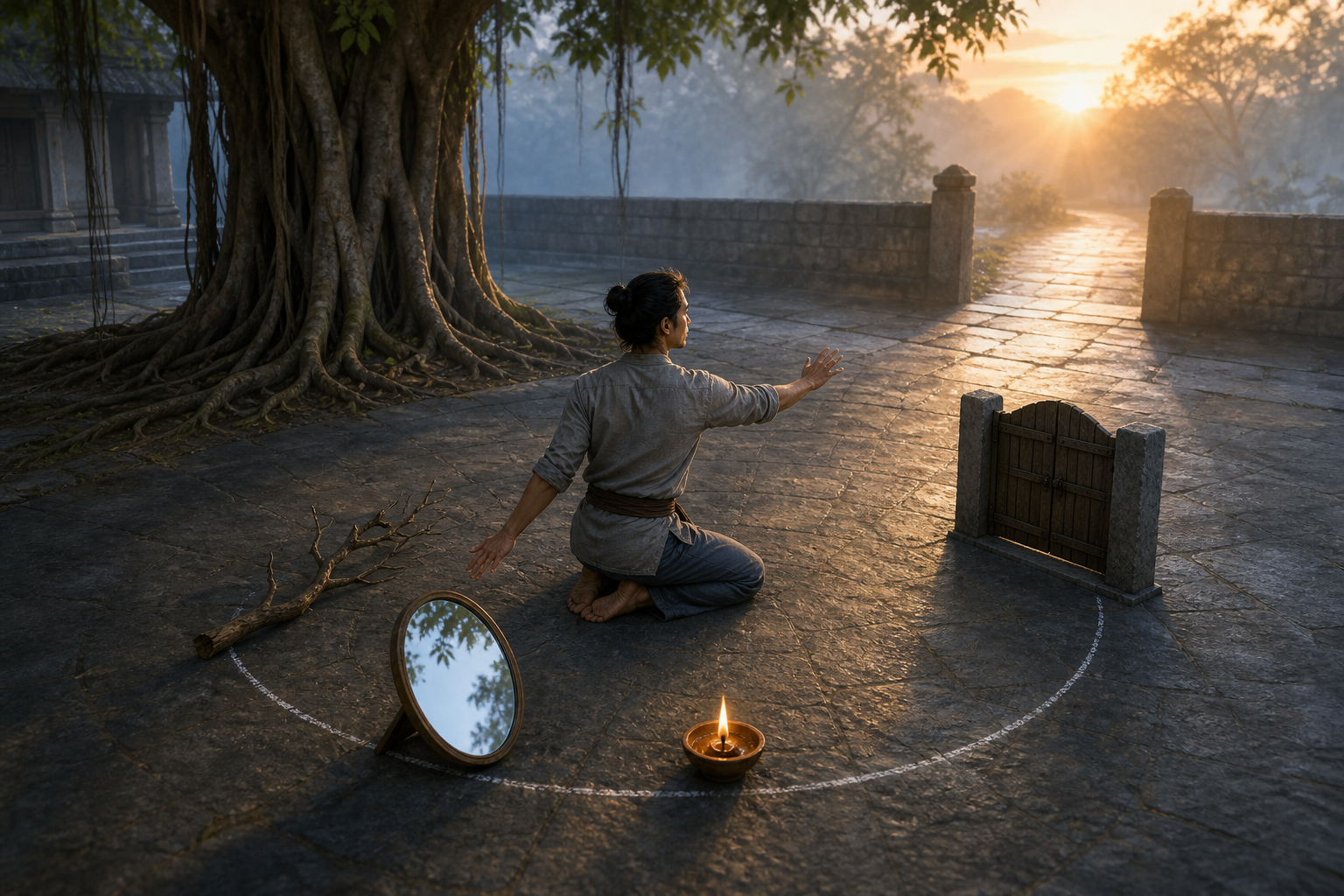
The following is a modern contemplative exercise drawn from the symbolism, not a ritual prescription from an Agama or Tantra. If you follow instructions received from a guru, lineage, or temple tradition, retain those instructions. Use this exercise to clarify conduct, not to replace established sadhana or ask an image to make a decision for you.
- Name the threshold. Complete this sentence: “This phase has reached its limit because…” Give an observable reason. “I feel strange” describes a mood; “I have repeatedly been unable to fulfil the duty I accepted” identifies a condition that can be examined.
- Open the Rudra lens. Make three short lists headed “What I know,” “What I assume,” and “What I avoid.” Do not promote an assumption into a fact. Pay closest attention to the third list, because avoided knowledge often supplies the energy behind confusion.
- Identify what Dharma requires you to preserve. Name the duty, relationship, dignity, truth, or communal good that should survive the transition. This prevents transformation from becoming indiscriminate destruction. You are not asking only what to remove; you are deciding what the removal must serve.
- Set the Kalabhairava boundary. Specify one limit, one action, and one time. A workable statement sounds like: “I will communicate the decision at the agreed meeting, complete the handover, and accept no new obligations in this role afterward.” A vague intention such as “I should step back sometime” leaves the threshold unguarded.
- Offer the ego, then act. Name the self-image that the old arrangement protected. Release the demand to appear indispensable, blameless, or unchanged. Take the first concrete action, then review whether your conduct protected the value named in step three.
Imagine, for example, that you remain in a community service role even though you can no longer discharge its responsibilities reliably. The Rudra question may reveal that the role itself has become tied to your identity. The preserving question may show that the community still needs continuity, accurate records, and a dignified handover. The Kalabhairava boundary then gives the transition a definite date and prevents you from accepting fresh duties that recreate the same problem.
In that case, abrupt disappearance would not be transformation aligned with Dharma; it would abandon the value that needs protection. Endless delay would not be compassion; it would transfer the cost of your indecision to others. The disciplined path is to acknowledge the ending, preserve the service through a responsible transition, and surrender the identity that made departure feel impossible.
If the facts remain unclear after the exercise, do not manufacture certainty merely to feel fierce. Continue observing, ask the necessary questions, and postpone irreversible action while gathering what is missing. Rudra represents clarity becoming force, not force pretending to be clarity.
Key takeaways
- Rudra represents transformation governed by intensified awareness, not anger released without measure.
- Kalabhairava embodies time, dissolution, justice, and guardianship, making delay and boundaries matters of ethical responsibility.
- Transformation is inherent within creation. Ending an exhausted form can preserve the purpose it was meant to serve.
- Fierce iconography becomes useful when each symbol is translated into a discipline: clear seeing, ego-release, restraint, direction, and vigilance.
- A sound threshold decision sees the facts, protects a dharmic value, sets a definite boundary, and accepts accountability for the result.
Choose one threshold you have delayed and write a single truthful sentence about it. If the sentence exposes only irritation, wait and look again. If it reveals a clear limit, name what must be preserved and set the next boundary. The work begins when insight becomes conduct.
References
- DharmaRenaissance Blog – Rudra from Brahma’s Third Eye: Profound Symbolism and Cosmic Balance in the Devi Bhagavata Purana
- DharmaRenaissance Blog – Kalabhairava Unveiled: Decoding Shiva’s Fierce Iconography of Time, Justice, and Protection
