
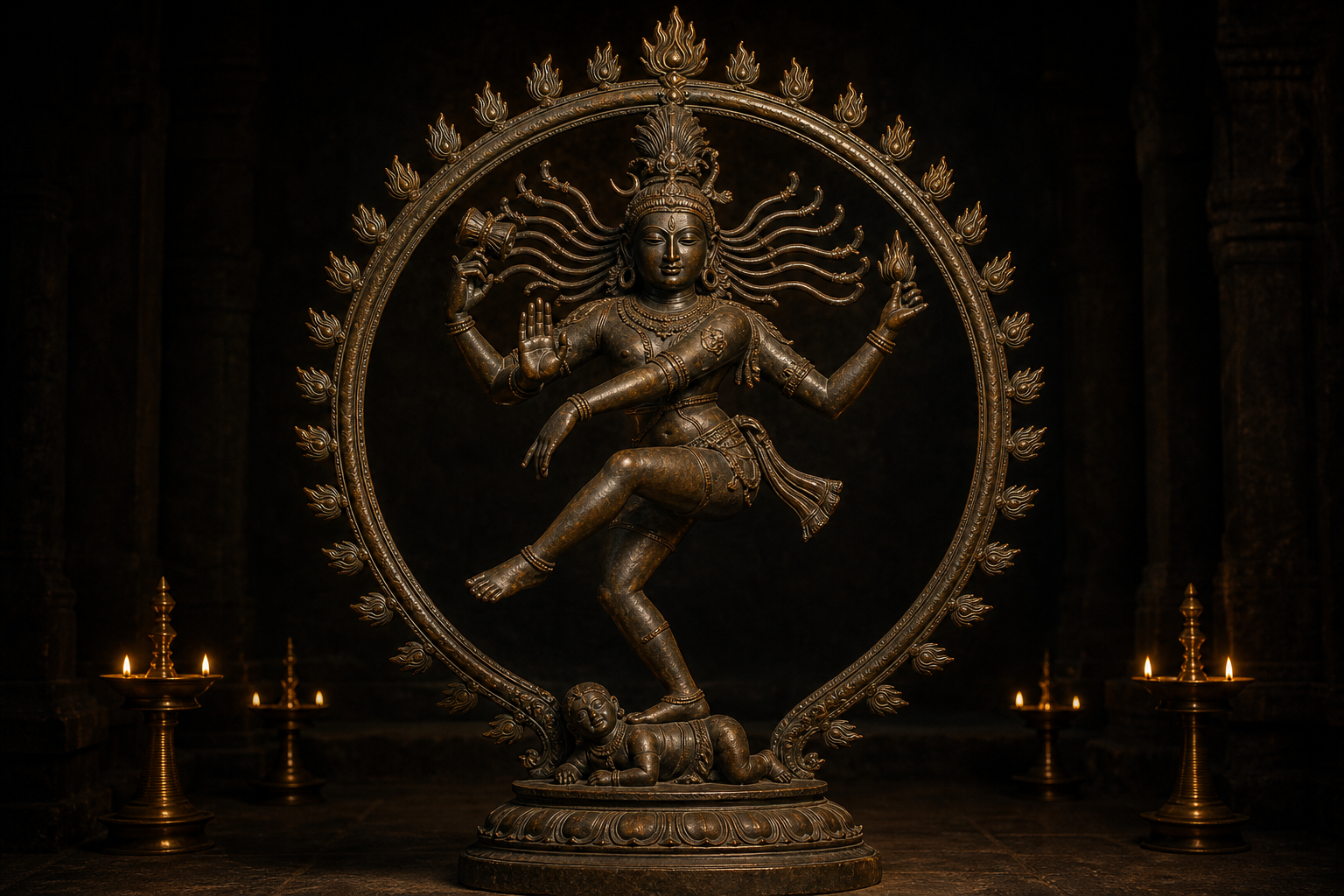
You may recognize Shiva Nataraja immediately yet still wonder how to read the image. Why does one hand carry a drum while another holds fire? Why is one foot planted on a small figure and the other lifted? And why is this vigorous movement called a dance of bliss?
The image becomes coherent when you stop treating its details as separate ornaments. Nataraja is a visual grammar: movement surrounds a composed center, destruction accompanies creation, and ignorance lies beneath a gesture of refuge. Read in the right order, Ananda Tandava becomes both a map of the cosmos and a discipline for meeting change without losing clarity.
Key takeaways
- Ananda in Ananda Tandava means unconditioned fullness, not a passing mood of excitement.
- Nataraja’s body holds five divine acts at once: creation, preservation, dissolution, concealment, and grace.
- The planted foot subdues forgetfulness and constricted awareness; the raised foot offers release.
- Shaiva Siddhanta, Advaita Vedanta, and Kashmir Shaivism use the same image within distinct philosophical frameworks.
- You can contemplate the icon by following a deliberate route from drum to fire, from fearlessness to the raised foot.
Begin with the stillness inside the movement
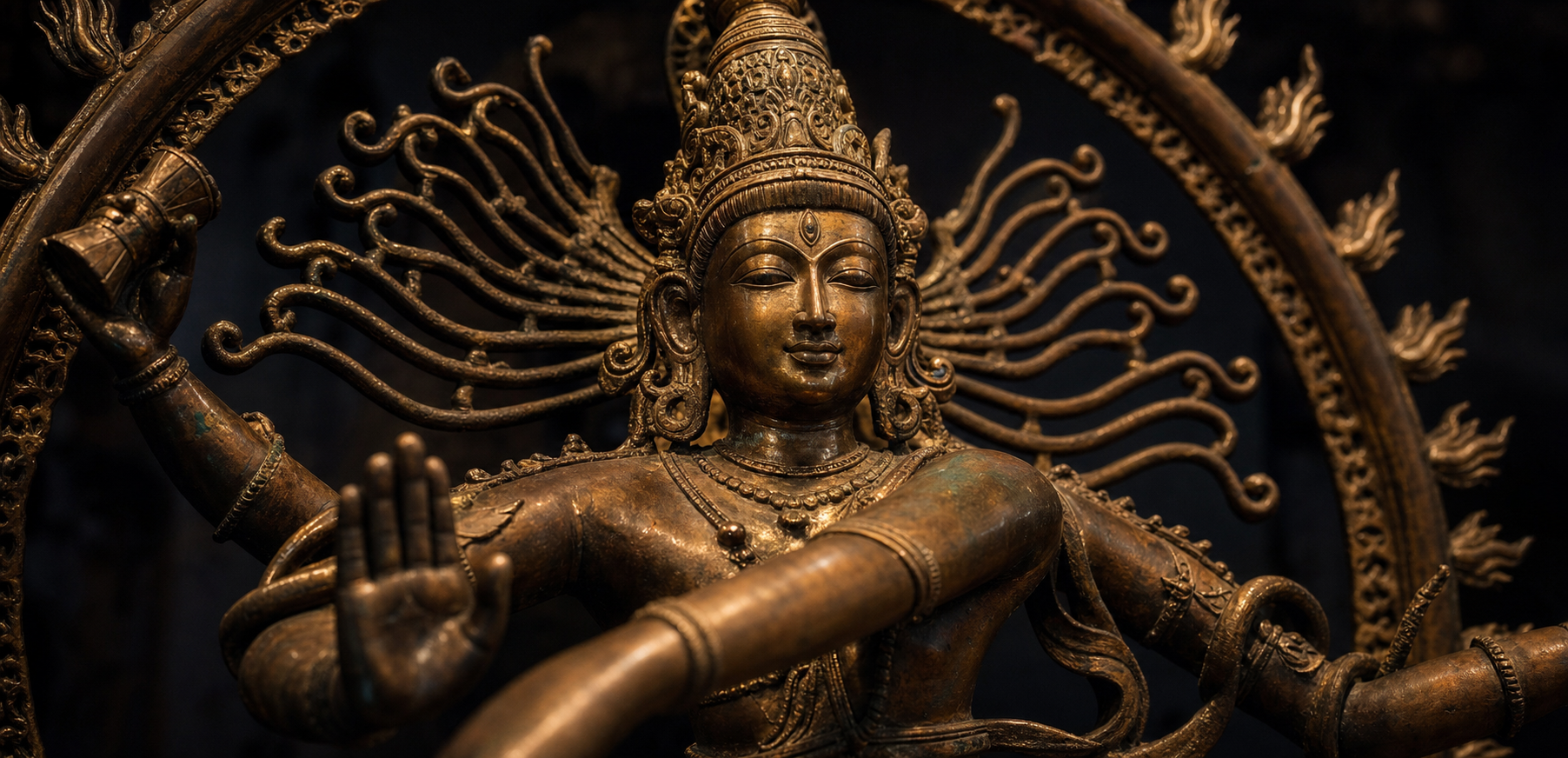
Nataraja means Shiva as Lord of Dance, but the central point is not movement for its own sake. The streaming hair, curving limbs, flames, drum, and fire all convey ceaseless activity. Shiva’s composure provides the counterpoint. The world changes; the awareness in which change is known does not have to be thrown into confusion by every change.
This is why Ananda Tandava should not be reduced to Shiva feeling happy. Ananda is bliss as fullness of being, not pleasure produced by favorable circumstances. Tandava names the vigorous divine dance through which reality moves. In this form, bliss is not a reward waiting at the end of cosmic activity. It is the inexhaustible ground from which the activity proceeds.
The distinction also prevents Ananda Tandava from being confused with more ferocious forms such as Rudra Tandava. Fire and dissolution remain present, but they belong to a dance ordered toward renewal and liberation. Transformation is not excluded from compassion. It is one of compassion’s necessary forms when an exhausted form must make way for another.
Try one simple act of looking before memorizing any terminology. Trace the outer ring, the flying locks, and the extended limbs. Then return your gaze to Shiva’s center. Notice that dynamism and composure are not arranged as enemies. The image asks you to recognize both at once. That is the first practical lesson: steadiness is not the absence of movement but the capacity to remain lucid within it.
The mature form seen in Chola-period Nataraja bronzes makes this insight tangible. Their balance is not merely an achievement of metalwork. The poised body turns a philosophical claim into something you can see: reality is rhythmic rather than static, yet its movement is held within consciousness rather than abandoned to disorder.
The five acts turn the statue into a map of reality
The most reliable key to the icon is pañcakṛtya, the five interlocking acts of Shiva. These are sṛṣṭi, creation; sthiti, maintenance; saṃhāra, dissolution or transformation; tirobhāva, concealment; and anugraha, grace. Each answers a different question about experience: How does a form arise? What allows it to endure? Why does it end? Why is reality misperceived? How does liberation become possible?
| Divine act | Visible cue | What you should notice |
|---|---|---|
| Sṛṣṭi — creation | The ḍamaru in the upper right hand | The beat signifies the arising of sound, time, space, and differentiated form. |
| Sthiti — maintenance | The lower right hand in abhaya | Existence is not only brought forth; it is protected and given enough continuity to unfold. |
| Saṃhāra — dissolution | Agni in the upper left hand | Forms are transformed and returned. Dissolution is not the destruction of reality itself. |
| Tirobhāva — concealment | The constricted awareness represented by Apasmara beneath the planted foot | Reality can be present while habit, karma, and limited cognition prevent it from being recognized clearly. |
| Anugraha — grace | The raised left foot, indicated by the crossing lower arm | Release is built into the cosmic order rather than added as an afterthought. |
Do not force the five acts into a single timeline that happened once in a distant mythic past. Nataraja holds all of them in one body. At any moment, some patterns are arising, others are being sustained, and others are dissolving. Something may also remain hidden from you while another possibility appears through insight, devotion, instruction, or grace.
This changes how you understand the fire. If creation alone were sacred, every ending would look like divine failure. Nataraja places the drum and flame in the same dance. A form may deserve protection for a time and transformation when its time is complete. The icon therefore gives you a better question than whether change is simply good or bad: which cosmic function is operating, and what response does dharma require from you now?
Concealment deserves equal attention because it is the act most easily missed. Ignorance does not mean that reality has vanished. It means your way of seeing has contracted. A prejudice, compulsive reaction, inherited assumption, or attachment can conceal what is already present. The problem is not solved by producing a new reality but by loosening the limitation that prevents recognition.
Grace completes the sequence without cancelling effort. The raised foot offers refuge, but the devotee still has to look where the lower left arm directs attention. That combination matters. Discipline prepares attention; grace releases the bondage that effort alone cannot master.
Read the icon from the ring of fire to the raised foot
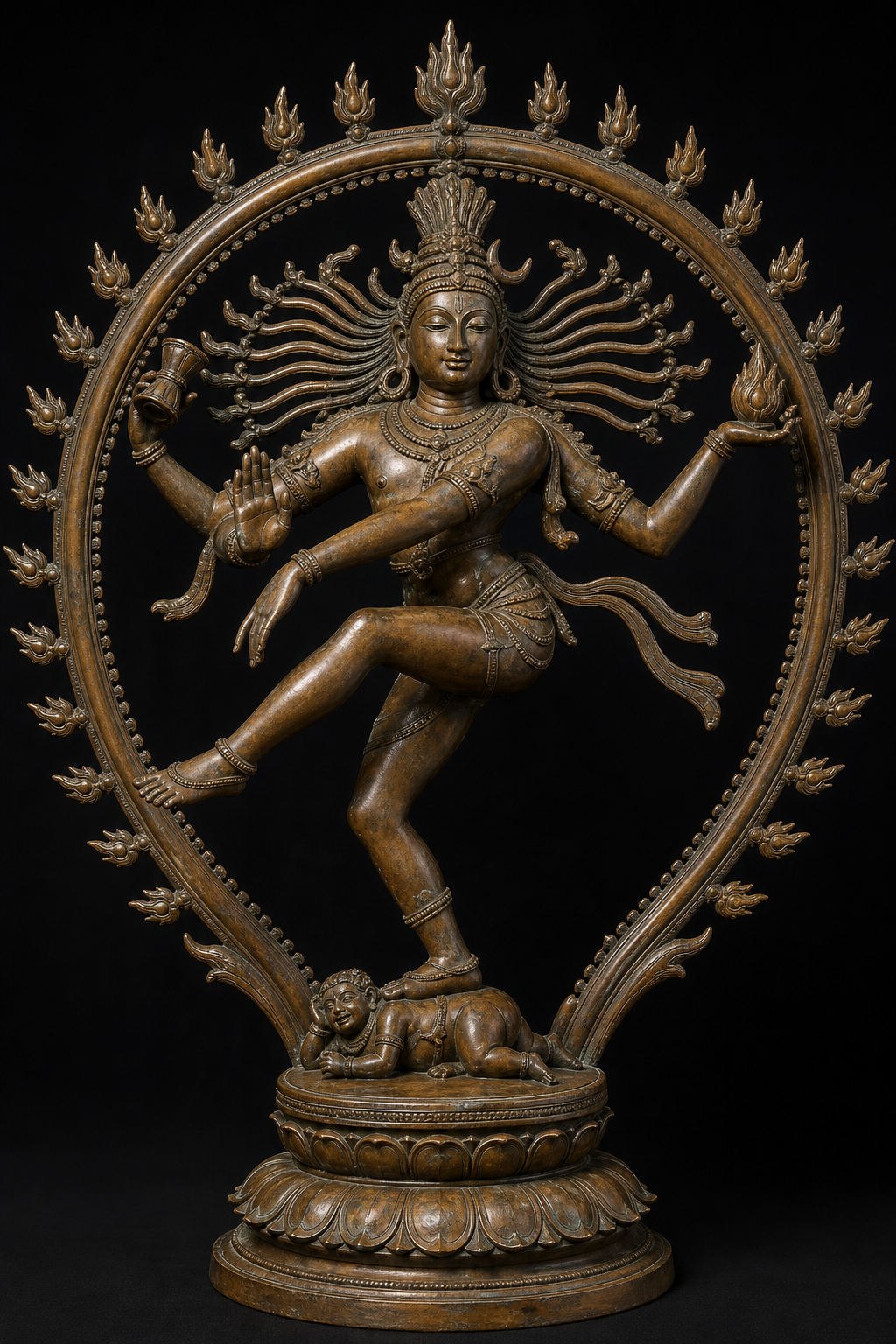
If you encounter Nataraja in a temple, a museum, a dance performance, or a home shrine, use the following route. It prevents the eye from stopping at the most dramatic detail while missing the relationships that give the form its meaning.
- Start with the ring of flames. The prabhāmaṇḍala represents the dynamic field of the cosmos, time, and Śakti. It is not merely a decorative halo placed behind an otherwise separate deity. Shiva dances within the energy through which phenomena arise and disappear.
- Compare the two upper hands. The upper right hand carries the ḍamaru, whose beat signifies emergence through primordial sound. The upper left hand carries agni, the power by which forms are transformed. Read the hands together: becoming and dissolution belong to one rhythm.
- Move to the two lower arms. The open lower right palm gives abhaya, the assurance of fearlessness and protection. The lower left arm crosses the torso in gajahasta and directs your gaze toward the lifted foot. One gesture steadies you; the other tells you where liberation is found.
- Look at both feet, not only the small figure below. The right foot subdues Apasmara, also called Muyalakan in Tamil tradition, who represents forgetfulness, inertia, and spiritual ignorance. The raised left foot signifies refuge and liberating grace. Bondage and release are deliberately shown together.
- Return through the hair, ornaments, and posture. The flying matted locks carry Gaṅgā and the crescent moon, joining sacred flow with cosmic cycles. Serpentine ornaments evoke life-force and protection. The curving tribhaṅga posture expresses balance that is alive rather than rigid.
Apasmara is especially vulnerable to misuse. He should not be turned into a symbol for a disliked community, opponent, or human being. The figure represents a condition of consciousness that can appear within anyone. The right foot therefore depicts mastery of ignorance, not permission to dehumanize an external enemy. When you read the symbol inwardly, it becomes a demand for vigilance against your own forgetfulness.
The lifted foot is equally easy to underread. It does not merely make the pose more dramatic. The crossing arm actively directs attention toward it, making grace the icon’s visual destination. Fire is conspicuous, but refuge receives the final emphasis. Ananda Tandava is therefore not a spectacle of divine power with liberation tucked into a corner. Its composition leads the eye from cosmic activity toward release.
Classical dance gives this visual language a living body. The Nāṭyaśāstra distinguishes dance modes and preserves 108 karaṇas, a vocabulary of movement also encountered in temple art. A dancer does more than reproduce the silhouette of a bronze. Posture, breath, gesture, and disciplined technique must open into rasa, the experienced flavor of the performance. This helps any viewer notice that Nataraja is not a frozen pose. The bronze is arrested movement that continually implies what came before and what will follow.
Different Shaiva schools illuminate different dimensions
Nataraja is widely shared, but Hindu philosophical traditions do not all explain the relation among Shiva, the soul, and the world in identical terms. If you read a commentary or hear a discourse, identify its school before treating every technical term as interchangeable. The icon unites the conversation without erasing real metaphysical distinctions.
Shaiva Siddhanta: the Lord releases the bound soul
Shaiva Siddhanta approaches the dance through the triad of Pati, the Lord; paśu, the bound soul; and pāśa, the bonds. Karma and mala, the obscuring impurity or limitation, help explain tirobhāva. The soul does not see clearly while these bonds operate. Anugraha is Shiva’s liberating action, made visible in the raised foot.
Within this framework, do not flatten grace into a technique by which the isolated ego saves itself. Practice, devotion, knowledge, and ethical discipline matter, but the icon’s upward opening remains a gift of the Lord. The planted foot shows bondage restrained; the lifted foot shows the soul’s destination beyond it.
Advaita Vedanta: multiplicity moves within non-dual reality
An Advaitic reading sees the dance as the līlā, or play, of Brahman. Shiva and Śakti express awareness and its power of manifestation. Multiplicity appears without diminishing the fullness of non-dual reality. The drum and fire mark changes in name and form, while the underlying reality remains complete.
This brings sat-cit-ananda — being, consciousness, and bliss — into view. Bliss is not a sensation manufactured by dancing. It belongs to reality’s own fullness. For the seeker, the practical shift is from chasing an extraordinary mood to recognizing the awareness in which both pleasant and unpleasant states appear.
Kashmir Shaivism: the dance is consciousness recognizing itself
Kashmir Shaivism emphasizes spanda, the subtle pulse of consciousness; prakāśa, its self-luminous nature; and vimarśa, its capacity for self-awareness. The five acts express Paramaśiva’s freedom, or svātantrya, rather than a mechanical process imposed from outside.
Here Apasmara can be understood as contracted cognition. Liberation is pratyabhijñā, recognition of what consciousness truly is. The movement from bondage to freedom is therefore not travel to a different universe. It is an expansion from limited identification into recognition of the consciousness already illuminating experience.
These readings overlap in their attention to ignorance, transformation, and liberation, but they should not be collapsed into a vague claim that every school teaches precisely the same metaphysics. Let each framework answer its own central question. Shaiva Siddhanta clarifies Lord, soul, bonds, and grace. Advaita asks how multiplicity appears in non-dual reality. Kashmir Shaivism examines consciousness as dynamic self-manifestation and recognition.
Chidambaram places form beside sacred openness
The Chidambaram Nataraja Temple gives this philosophy an architectural home. It is associated with ākāśa, space, among the Pañcha Bhūta Sthalas. Within the Citsabhā, the Chidambara Rahasya places the manifest form of Nataraja beside a revelation represented through sanctified openness. The apparent emptiness is not treated as a barren void. It points toward formless consciousness, which cannot be confined to an object even while it is approached through a sacred form.
If you visit, do not rush from the bronze once you have inspected its attributes. Attend to the space around the form. Form and formlessness are part of the same teaching: Shiva graciously becomes available to sight and worship, yet ultimate reality exceeds every visible boundary.
Chidambaram also belongs to a wider Tamil Shaiva geography of five dance halls. Its Kanaka Sabha is the Golden Hall; Madurai is associated with the Rajata or Silver Hall; Thiruvalangadu with the Ratna or Ruby Hall; Tirunelveli with the Tamra or Copper Hall; and Kutralam with the Chitra Sabha, the Hall of Paintings. These are not merely five copies of one setting. Together they preserve a sacred landscape in which Shiva’s dance is remembered through distinct places and traditions.
Arudra Darshan, also called Thiruvathirai and observed in the Tamil month of Mārgaḻi, is the major liturgical occasion for Nataraja worship. Abhiṣeka, vibhūti, bilva, and the singing of Tēvāram hymns place the image inside living devotion. That setting corrects a museum-only reading: Nataraja is not simply an artistic representation carrying philosophical ideas. He is Shiva encountered through worship, festival, sound, fragrance, movement, and darśana.
Turn the image into a disciplined contemplation
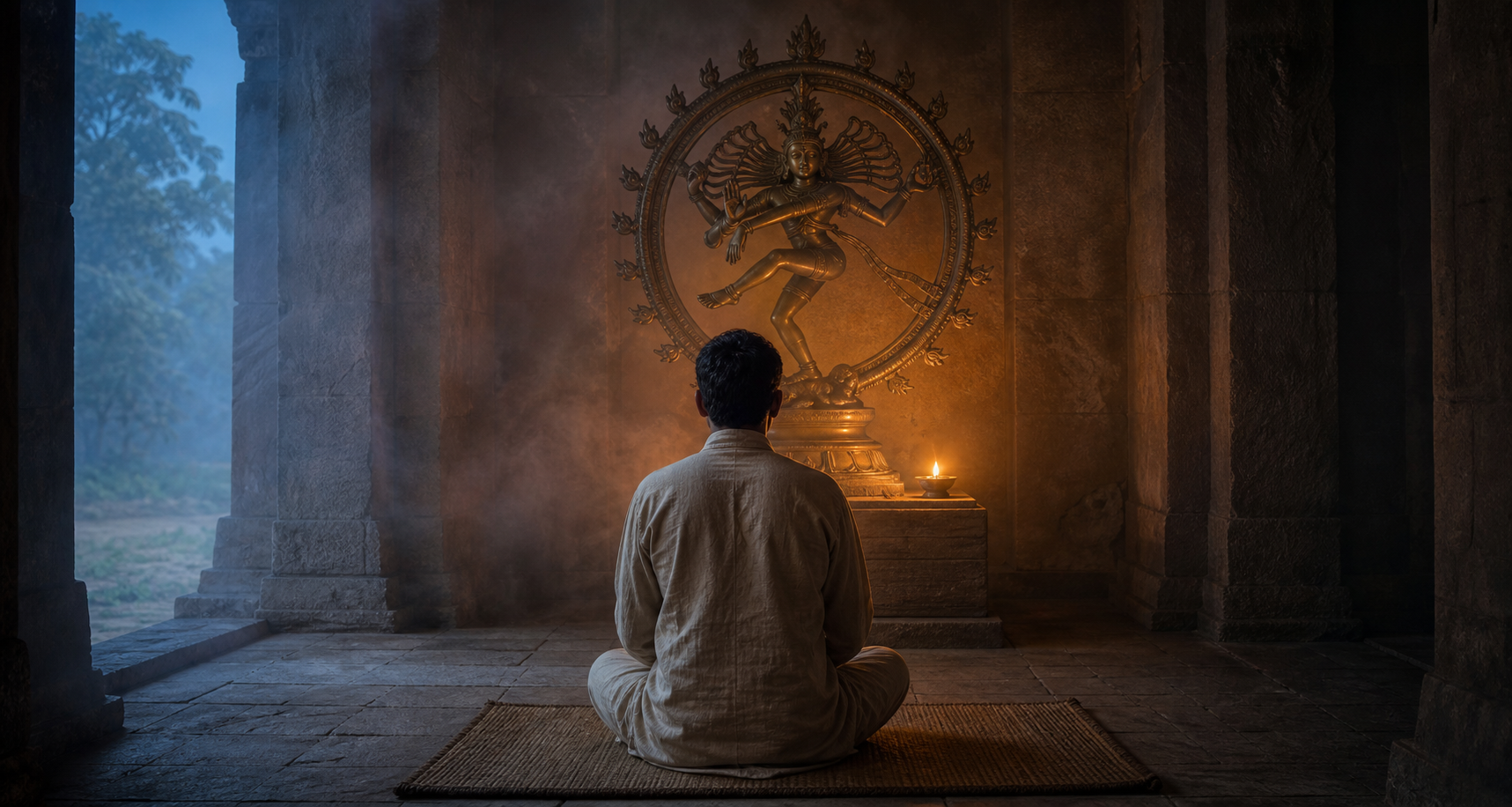
You do not need to convert Nataraja into a generic wellness symbol to make the image relevant to daily life. Its practical force comes from remaining recognizably Hindu: Shiva is worshipped, the mantra is sacred, and grace cannot be reduced to a productivity device. If you belong to a lineage with specific ritual or mantra instructions, follow that discipline. For a simple visual contemplation, use the icon’s own sequence.
- Settle before the whole form. Let your breathing become even without forcing it. See the ring, body, gestures, feet, and figure below as one composition.
- Recognize the field. Treat the ring of flames as the field of your present experience. Sensations, thoughts, duties, relationships, memories, and changes all arise within that field.
- Follow the drum and fire. Ask what is beginning and what is ending. Do not assume that the new must be good or the ending must be bad. Identify the dharmic responsibility attached to each.
- Name your Apasmara. Choose one form of forgetfulness currently narrowing your vision: inertia, automatic anger, compulsive distraction, or attachment to a fixed conclusion. Name the condition without transferring it onto another person.
- Rest attention on abhaya and the raised foot. Receive fearlessness as permission to see clearly, then let the lifted foot remind you that release is possible. Silently recite Oṃ Namaḥ Śivāya if that belongs to your practice.
You can then use the five acts as a concise examination of the day. Write five headings: create, sustain, transform, uncover, and receive. Under each, place one honest observation. What needs to be started? What deserves protection? What has completed its purpose? What habit is concealing reality? Where are you being asked to accept help, instruction, insight, or grace?
This examination keeps the symbolism from becoming vague. It also prevents you from using dissolution as an excuse for carelessness or grace as an excuse for passivity. Each act corrects the excesses of the others. Creation without preservation becomes restlessness. Preservation without transformation becomes stagnation. Dissolution without compassion becomes cruelty. Effort without grace becomes spiritual pride.
If you study Bharatanatyam or another classical form, apply the same discipline to performance. Do not stop after approximating Nataraja’s outline. Ask whether the posture communicates the relationship among emergence, fearlessness, transformation, ignorance, and release. Technique shapes the vessel; abhinaya, attention, and rasa allow the philosophical meaning to become perceptible rather than merely announced.
The next time you stand before Nataraja, do not begin by testing how many symbols you can recall. Follow the movement from drum to fire, from the abhaya hand to Apasmara, and finally to the raised foot. Then identify one thing in your own field of experience being created, sustained, transformed, concealed, or opened by grace. That is how looking begins to become darśana.