
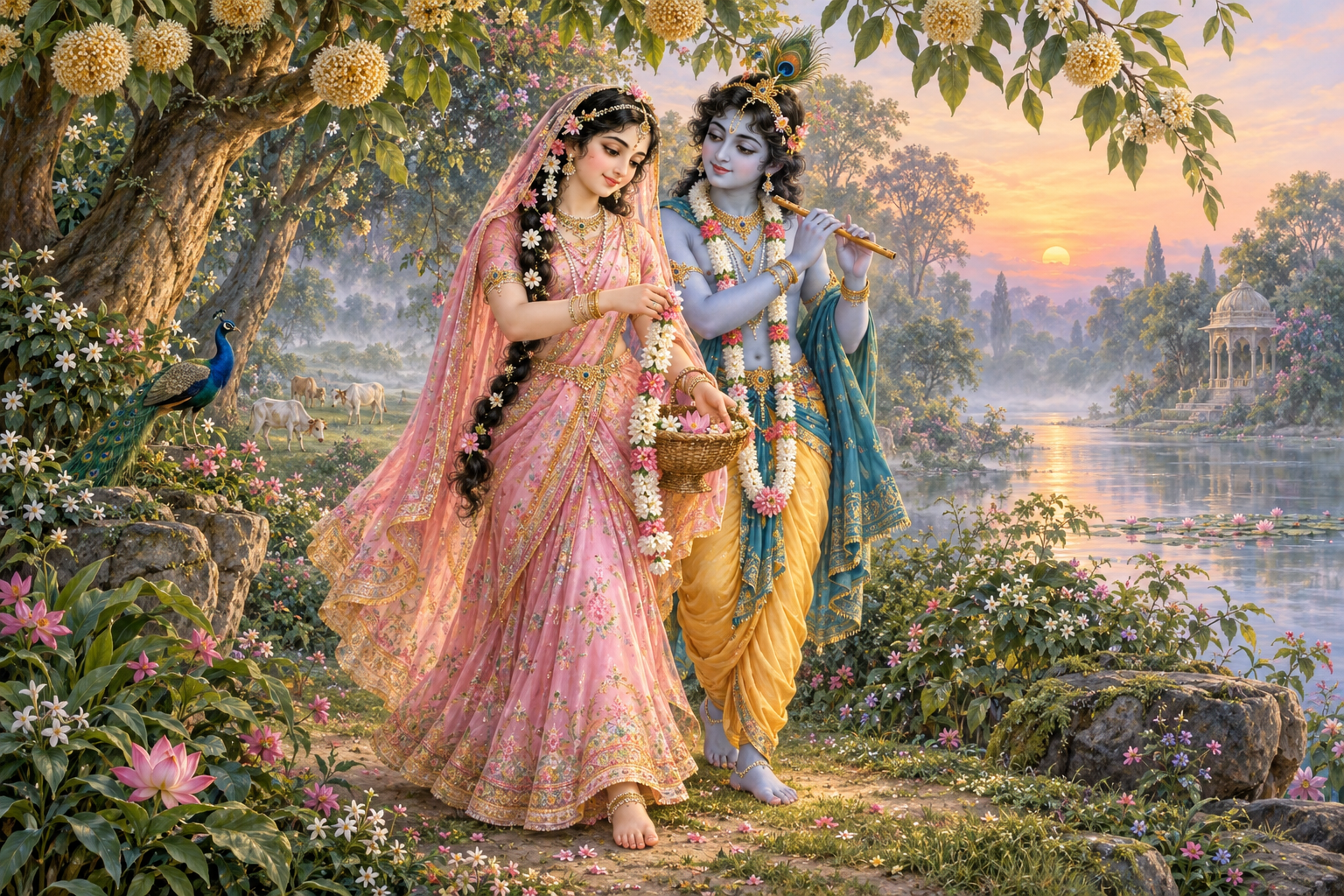
If you have heard that Srimati Radharani is the heart of Gaudiya devotion while your teacher places special emphasis on the Gopal mantra, you may wonder whether the two point in different directions. They do not. Radharani reveals the love and service at the center of Vraja bhakti; the Gopal mantra directs the practitioner toward Krishna in his intimate identity as Gopala.
The distinction still matters. Radharani is not merely a devotional theme, and a mantra is not simply a line of Sanskrit to collect from the internet. Understanding what each represents will help you honor the mantra, avoid premature imitation, and keep your daily practice centered on service rather than technique.
Radharani is the key to understanding Krishna as Gopala
In Gaudiya Vaishnava theology, Srimati Radharani is Krishna’s eternal consort, his divine potency, and the supreme exemplar of devotion to him. She is commonly understood as the complete embodiment of his hladini-shakti: the potency through which divine bliss and love are experienced and shared. This does not reduce Radha to an impersonal energy. She is worshipped as a fully personal divine reality whose love for Krishna is unsurpassed.
This is an expression of acintya-bheda-abheda, the Gaudiya teaching of inconceivable oneness and difference. Radha and Krishna are inseparable as potency and the possessor of potency, yet they remain eternally distinct persons who exchange love. The theology protects two truths at once: their unity is not erased by their relationship, and their relationship is not erased by their unity.
Radharani’s appearance and its observance as Radhashtami bring this central place into view. Devotees do not honor her only because she is associated with Krishna. They approach her as the highest guide to loving Krishna, the one whose service gives Gaudiya devotion its characteristic direction.
Gopala means Krishna as the cowherd of Vraja. The name does more than identify a youthful form. It places Krishna within a world of personal relationships: cows and pastures, friends and elders, affection and intimate service. The Gopal mantra therefore does not direct you toward an isolated or abstract deity. It directs worship toward Krishna as he is known within the relational life of Vraja.
This resolves a common doubt. If an audible form of a Gopal mantra does not include Radha’s name, that does not make Radharani irrelevant or absent from Gaudiya worship of Gopala. Krishna’s Vraja identity cannot be separated from his divine potency and devotees. At the same time, you should not invent a hidden decoding of every syllable. The precise way Radha is contemplated in relation to a mantra belongs to the teaching received through your lineage.
The useful question, then, is not whether you should choose Radha or Krishna. Ask how your worship of Krishna can mature into service shaped by Radharani’s devotion. That question turns theology into practice.
What the potency of the Gopal mantra actually means

A mantra is sacred sound addressed to, or identifying, divine reality. Gaudiya Vaishnavas do not treat such sound as a merely symbolic label for an absent God. Yet the mantra’s potency should not be confused with an impersonal acoustic force that produces spiritual attainment automatically.
The traditional concern with the potency of the Gopal mantra belongs within a living relationship of revelation, reception, remembrance, and service. The mantra matters in its exact form, but so do the sambandha, or spiritual relationship, it discloses and the devotional intention with which it is practiced.
- The mantra is not a personal affirmation. Its purpose is not to persuade you that you possess a desired quality. It turns attention toward Krishna and your relationship of service to him.
- Correct sound matters, but sound is not a mechanical trick. Learn the words and pronunciation faithfully. Do not conclude that technically accurate repetition can replace humility, attention, or devotional conduct.
- Transmission supplies context. A qualified teacher explains not only what to repeat but how the mantra fits within guru, sadhu, scripture, nama, worship, and daily service.
- Potency is received, not possessed. Mantra practice is not a claim of private spiritual power. Its fruit is associated with grace and the gradual purification of intention.
- Practice should deepen service. If mantra repetition feeds superiority, fascination with secrecy, or contempt for other devotees, its purpose has been misunderstood.
Mechanical chanting and careless improvisation are opposite errors. In the first, a practitioner preserves the syllables while forgetting the person being served. In the second, personal enthusiasm overrides the received form. Faithful practice holds form and intention together.
You can use a simple test. After chanting, notice the direction in which your mind and conduct move. Are you becoming more willing to hear, serve, correct a fault, and respect other Vaishnavas? Or are you mainly preoccupied with having access to something advanced? This is not a way to measure mystical attainment. It is a practical check on whether your understanding of potency is becoming devotional or self-centered.
Keep diksha-mantra, the maha-mantra, and Radha-seva distinct

Confusion often begins when every sacred utterance is placed in one undifferentiated category. Gaudiya practice gives different forms of chanting related but distinct functions.
- The Hare Krishna maha-mantra is chanted publicly in sankirtana and personally in japa. A newcomer does not need to wait for formal initiation before beginning to chant the holy names.
- The Gopal mantra commonly functions as a diksha-mantra transmitted within a guru-disciple relationship. Its precise form, pronunciation, meditation, daily discipline, and degree of confidentiality may be handled differently across Gaudiya lineages.
- Prayers and service to Radharani cultivate shelter, gratitude, and the aspiration to serve Radha-Krishna. They illuminate the inner direction of Gaudiya bhakti, but they do not authorize you to alter an initiated mantra or replace the practice assigned by your guru.
This distinction prevents two avoidable mistakes. The first is postponing nama-bhajana because you have not received a diksha-mantra. Public chanting of Krishna’s names remains open to you. The second is treating a diksha-mantra found online as though seeing its text were equivalent to receiving it with instruction and responsibility.
If you encounter several versions of a mantra, do not splice them together or decide that the longest must be the most advanced. Variations can reflect lineage, liturgical purpose, transliteration, or teaching context. For an initiated practitioner, the authoritative form is the one actually received from the initiating guru, together with that lineage’s instructions.
Confidentiality should also be handled without theatre. Do not publish or casually forward a mantra that your tradition treats as restricted. But secrecy is not evidence that a mantra grants elite status. Its purpose is to protect reverence, careful transmission, and the personal responsibility created by initiation.
Radharani’s place must likewise remain theological and devotional, not sentimental. The language of divine intimacy in Vraja is not permission to project ordinary romantic desire onto Radha and Krishna. A beginner does not need to manufacture elaborate inner scenes. Nama, hearing, service, ethical discipline, and instruction provide the stable ground on which deeper remembrance may develop.
A practical path for seekers and initiated practitioners

If you have not received the Gopal mantra
Do not self-initiate from a printed or online version. You can build a substantial Gaudiya practice without pretending to have received what you have not received. Keep publicly accessible nama-bhajana central, learn the basic theology of Radha-Krishna, associate with serious practitioners, and observe whether a prospective teacher’s conduct supports the teaching being given.
Before accepting diksha, ask concrete questions. Clear answers now will prevent uncertainty later:
- Is the Gopal mantra part of this lineage’s diksha, and what commitments accompany receiving it?
- Will the mantra be taught orally, in writing, or in both forms?
- How will pronunciation be checked?
- What meaning and devotional relationship should be remembered while chanting?
- Is there an assigned count, time, place, or order within daily worship?
- Which details are confidential, and with whom may questions be discussed?
- What should a disciple do after forgetting a word, missing an assigned practice, or becoming uncertain about an instruction?
- How does this mantra practice relate to daily maha-mantra japa and congregational kirtana?
A teacher who expects a commitment should be able to explain the commitment. You do not need every advanced theological answer before initiation, but you should know what you are agreeing to practice and where you can seek correction.
If you have already received the mantra
Your task is not to assemble a more impressive version from books, recordings, or other lineages. Deepen the practice you actually received.
- Confirm the exact received form. If you are unsure about a syllable or pronunciation, ask your guru or an authorized senior practitioner. Do not crowdsource a reconstruction.
- Follow the discipline you were given. Keep the assigned count, timing, sequence, and conditions rather than substituting a routine invented elsewhere. If circumstances make the instruction impossible, seek guidance instead of silently rewriting it.
- Recall the relationship before beginning. Bring to mind that you are approaching Krishna as Gopala for service, not using sound to acquire control, prestige, or an unusual experience.
- Chant one complete repetition at a time. When attention wanders, return to the mantra without turning distraction into a drama about your spiritual worth.
- Use only the meditation you were taught. If no detailed visualization was assigned, keep the intention modest: hear attentively, remember the object of worship, and pray for a service disposition.
- Let the practice enter conduct. Carry its orientation into service, speech, dealings with devotees, and ordinary duties. A daily mantra period should not become an isolated spiritual compartment.
- Bring persistent difficulties back into the teaching relationship. Questions about pronunciation, missed practice, inner meditation, or apparent dryness deserve specific guidance. Do not compensate by adding self-appointed austerities or collecting new mantras.
You may pass through periods in which chanting feels concentrated and periods in which it feels dry. Sensation is not a reliable daily scoreboard. Fidelity, attentive return, and willingness to be instructed give you a steadier basis for practice than chasing an emotional state.
Key takeaways
- Radharani and the Gopal mantra are not rival centers of worship. Sri Radha embodies the love and service through which Gaudiya Vaishnavas approach Krishna in Vraja.
- The mantra’s potency is devotional and relational, not a mechanical effect that can be separated from grace, instruction, attention, and conduct.
- The maha-mantra is openly chanted, while the Gopal mantra is commonly received as a diksha-mantra with lineage-specific instructions.
- An uninitiated seeker should not copy a mantra from the internet; an initiated practitioner should preserve the exact form and discipline received.
- Authentic practice should make service more central and spiritual status less interesting.
Your next step can be very small and very clear. If you are uninitiated, keep Krishna-nama central and take your unanswered questions to a trustworthy Gaudiya teacher. If you are initiated, identify the one part of your received practice about which you remain uncertain and ask for correction. Reverence becomes useful when it leads to faithful hearing and concrete service.
References
- Dandavats — Appearance of Srimati Radharani | Radhashtami Explained
- Dandavats — September 13, 2026 – Chisinau, Moldova – Lecture – The Potency of the Gopal Mantra

Leave a Reply
You must be logged in to post a comment.