
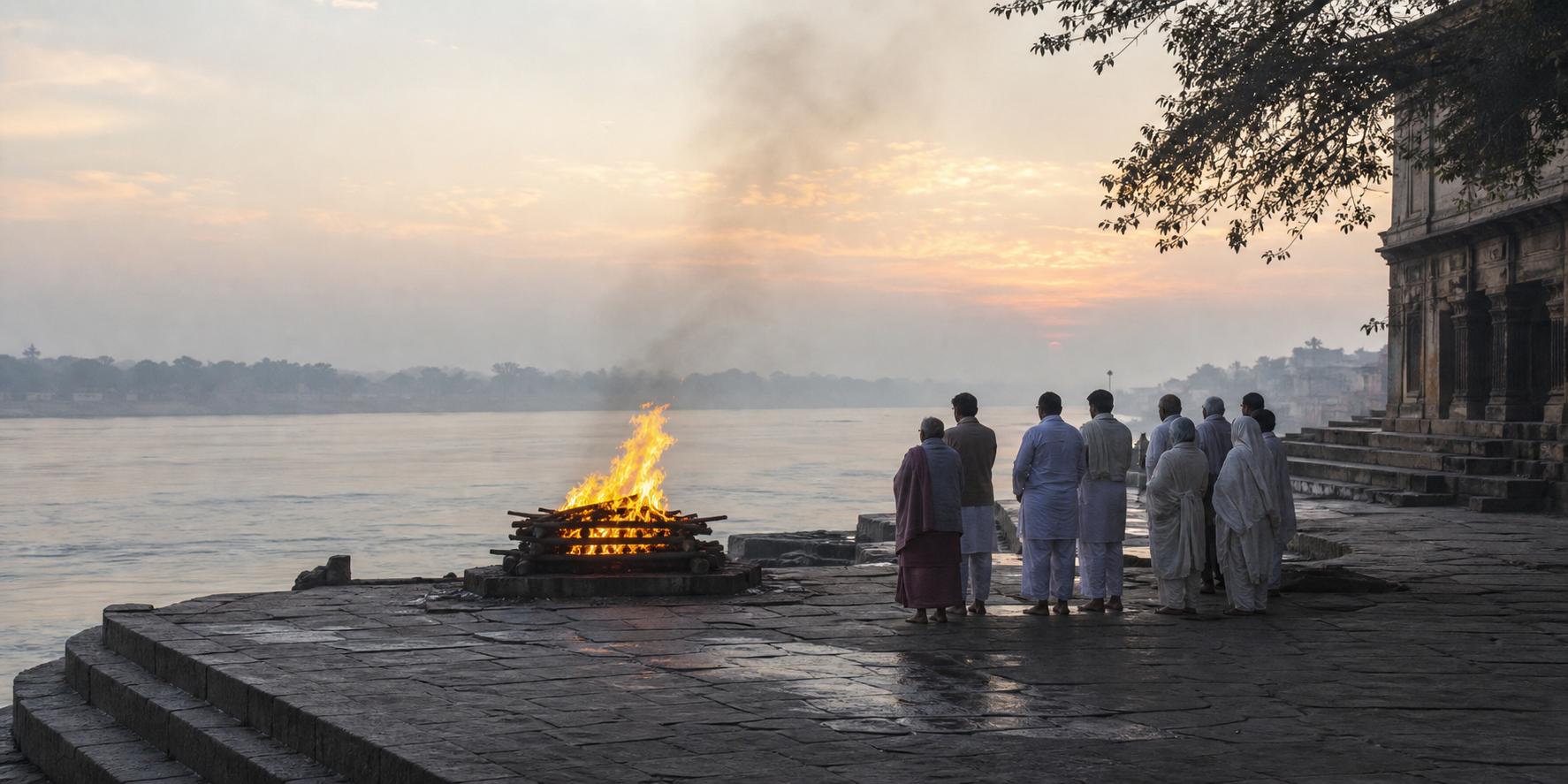
If you are preparing for a Hindu funeral, or trying to understand one you attended, two questions often arrive together: What exactly has left the body, and why is the body given to fire? Hindu traditions answer these questions through connected but distinct ideas. Prana concerns the vitality that sustains embodied life. Pitrmedha concerns the family’s sacred duty toward the deceased and the ancestral line.
Keeping those ideas separate prevents several common mistakes. Breath is not the whole of prana. Prana is not simply another name for atman. Cremation is not the disposal of something that has become worthless. Once those distinctions are clear, the rite becomes easier to approach with both intelligence and reverence.
Keep prana, physical breath, and atman distinct
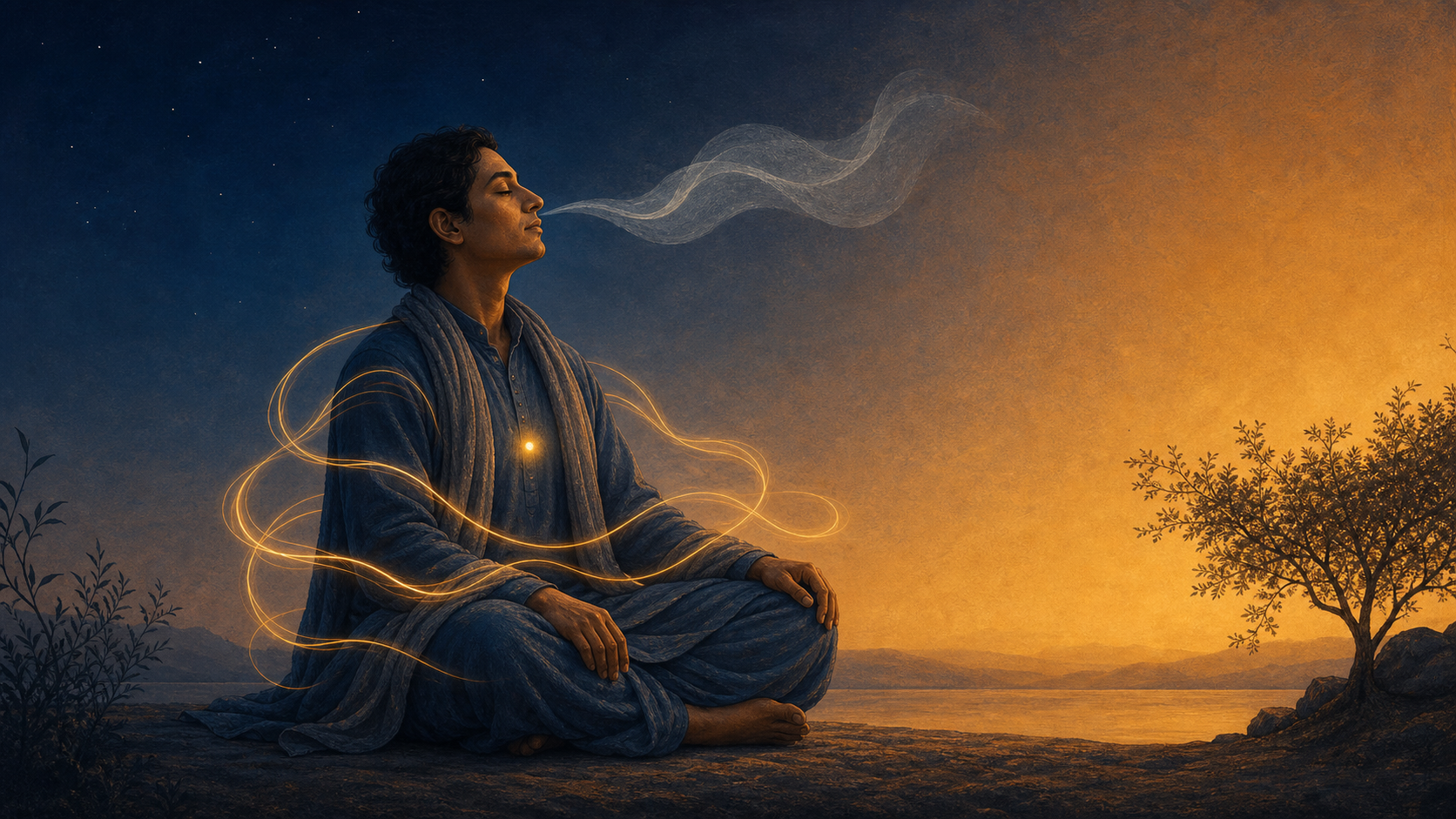
Prana is commonly translated as life force, vital energy, or vital breath. Each translation is useful, but each can also mislead. Prana is not merely the air entering the lungs. Nor is it a gas or anatomical substance waiting to be located by an instrument. It is a traditional way of understanding the ordered vitality through which a living being breathes, receives nourishment, digests, moves, speaks, eliminates, and acts as an integrated organism.
Breathing is one of the clearest outward expressions of life, so the language of breath naturally carries a wider meaning. Yet the traditional account of prana extends across the Vedas, Upanishads, Yoga, and Ayurveda. It describes the activity of embodied life more broadly than respiration alone.
There is another complication: the word prana can name the whole field of vital power, but it can also name one particular current within the fivefold scheme of Pancha Pranas. Context decides which meaning is intended. When someone says that prana has departed at death, the word usually carries the broader sense. When a yogic explanation contrasts prana with apana, it is naming one current among several.
Atman belongs to a different level of discussion. It does not mean one more bodily current. Hindu schools differ in how they explain the individual self, the ultimate reality, and the relation between them, so no single sentence can settle every philosophical question. The practical distinction is still firm: prana describes the vitality of embodied existence, while atman concerns the deeper question of the self. Equating the two turns a subtle teaching into a slogan.
This distinction also protects against a dangerous misapplication. Philosophical language about prana does not establish whether a person has medically died. If a death may have just occurred, follow emergency, medical, and legal procedures in your location. Do not treat absent breath, stillness, or a ritual explanation as a substitute for professional determination of death.
The five pranas form a map of coordinated life
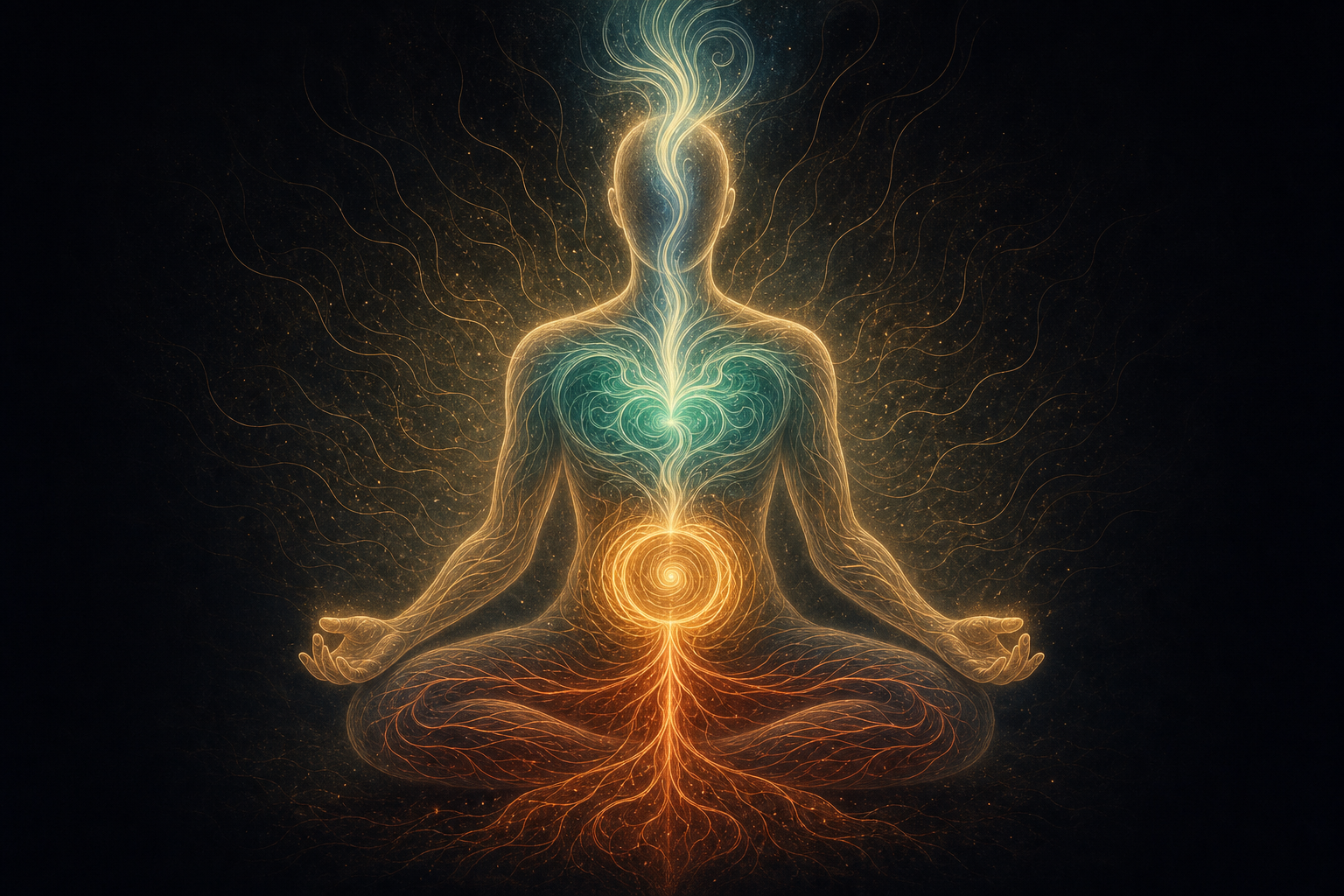
Pancha Pranas means the five vital airs or currents. The number does not imply five detachable substances. It organizes several directions and functions of living activity into a coherent map. Their names are prana, apana, samana, vyana, and udana.
| Vital current | Traditional emphasis | How to read it |
|---|---|---|
| Prana | Inward and receiving movement, especially breathing and intake | One current named prana within the wider field also called prana |
| Apana | Downward and outward movement, including elimination | The body’s capacity to release and move downward |
| Samana | Gathering, balancing, digestion, and assimilation | The transformation of what has been received into usable nourishment |
| Vyana | Diffusion and distribution throughout the body | The coordination that extends vitality through the whole organism |
| Udana | Upward movement, expression, speech, effort, and departure | The current often emphasized when explaining upward movement and the transition at death |
The directional words are interpretive clues. Upward, downward, inward, and pervasive movement make bodily life intelligible as a coordinated process. They should not be forced into a one-to-one identification with modern organs, chemicals, or diagnostic measurements. The categories arose within philosophical, yogic, and Ayurvedic ways of observing life.
The map is especially useful because life is more than one isolated function. A breath can be present while other capacities are impaired. Digestion, movement, speech, perception, and elimination also belong to embodied vitality. Pancha Pranas therefore directs your attention to coordination: a living body is not a collection of unrelated mechanisms but an ordered whole.
At death, that coordinated living presence is no longer expressed through the body. This does not require imagining five invisible objects making five separately timed exits. Ritual and philosophical descriptions are explaining the end of embodied integration, not offering a clinical sequence for observers to measure.
When you encounter the phrase prana has left, ask one clarifying question: Is prana being used for vitality as a whole, or for the particular current associated with intake and breathing? That small distinction resolves much of the apparent contradiction in discussions of life force.
Pitrmedha treats cremation as yajna, not disposal
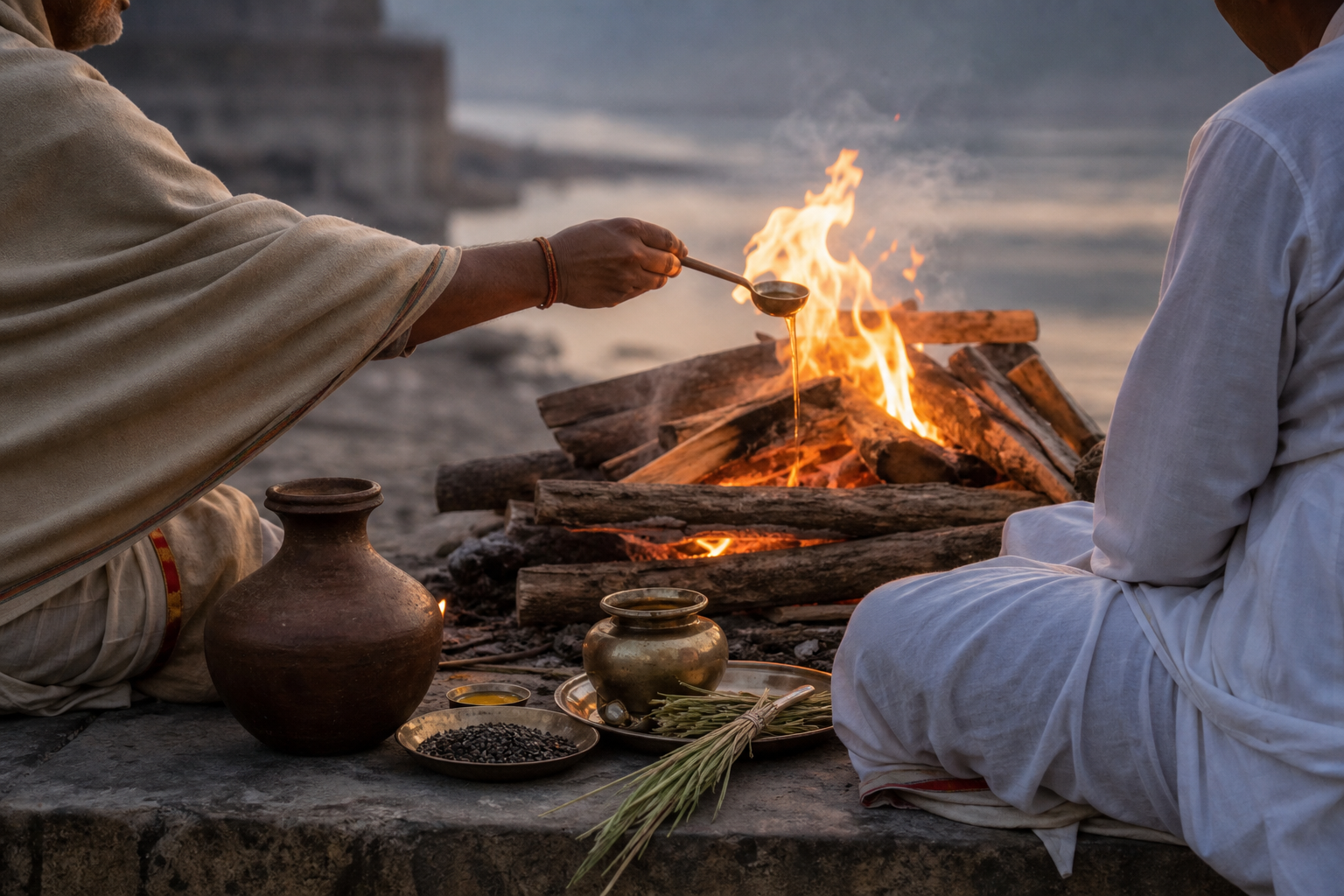
The ritual response to death is expressed powerfully in the term Pitrmedha, also written Pitru Medha. Pitr refers to a forebear or ancestor, while medha carries the sense of sacrifice. The name therefore presents the consignment of an ancestor’s body to sacred fire as a form of yajna.
That language changes the moral meaning of the act. Disposal is concerned only with removing remains. Yajna is an offering made with order, responsibility, and relinquishment. In Pitrmedha, the family does not behave as if the body never mattered. The body is treated with care precisely because it bore a human life, relationships, duties, and a place within the family.
Agni is therefore more than a convenient means of reducing the body. Sacred fire occupies the ritual position of receiving and transforming an offering. The family entrusts the body to that fire rather than clinging to the bodily form as though embodied life could be restored through possession of it.
This is why the outer action and inner intention cannot be separated. Externally, cremation brings the body’s physical form to an irreversible end. Ritually, it acknowledges that the relationship between the living, the departed, and the ancestral line has changed. The rite gives the family a disciplined action at the point where ordinary acts of care can no longer sustain the person physically.
Pitrmedha does not require you to confuse the deceased with the corpse. Within its ritual logic, the body deserves reverence without being treated as the totality of the person. Nor does the word medha imply a sacrifice performed on a living ancestor. It names the funerary offering after death.
Cremation by itself does not settle every question about what follows death. Hindu traditions use concepts such as atman, jiva, karma, rebirth, liberation, and the ancestors within different philosophical frameworks. The shared ritual pattern should not be made to prove one school’s complete metaphysics. What it establishes in practice is a duty: the dead body must be treated as sacred, the transition must be acknowledged, and the living must begin to release their bodily claim on the departed.
Approach an actual funeral through the family’s living tradition
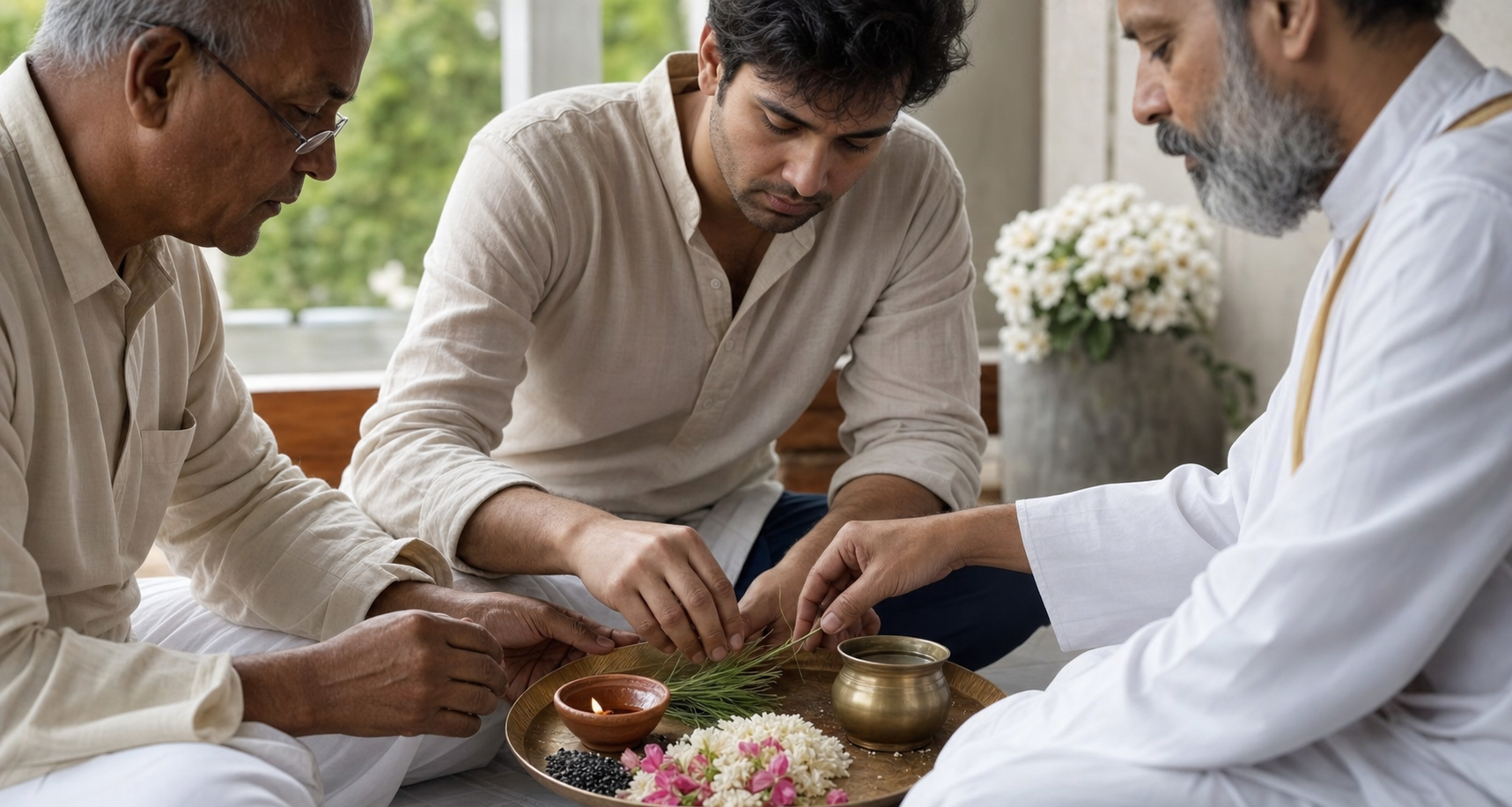
A shared ritual meaning does not produce one universal Hindu funeral script. Regional practice, family lineage, sect, community, available facilities, and local law can all affect what is done. An internet checklist may describe a valid custom and still be wrong for the family in front of you.
If you are helping arrange the rites, work in this order:
- Complete the required medical and legal steps before treating the death as a ritual matter. Local authorities determine what documentation and practical procedures are necessary.
- Identify the tradition actually being followed. Ask which regional, familial, or sampradaya custom governs the funeral rather than asking only for a generic Hindu procedure.
- Confirm who will guide and lead the rites. The family elder, priest, or other designated ritual authority should clarify the chief mourner’s role and the participation expected from relatives.
- Separate essential acts from local adaptations. Crematorium rules, travel, and family circumstances may affect form, so ask the officiant what must be preserved and what can be adjusted.
Ask concrete questions before the ceremony: Who is expected to perform the principal offerings? Which actions occur before cremation? What may other relatives or guests do? What obligations continue afterward? Those questions are more useful than debating abstract doctrine while practical decisions are waiting.
If you are attending as a guest, let the family’s practice lead. Dress modestly, silence your phone, and ask before photographing, recording, touching the body, or handling offerings. You do not need to imitate every gesture or recite words you do not know. Quiet presence is preferable to confident improvisation.
Listen for what the ritual is doing at each stage. Care for the body expresses gratitude and duty. The movement toward the fire marks separation. The offering to Agni enacts relinquishment. Later remembrance places the departed within an ancestral relationship rather than leaving the family with only the image of a corpse. The exact ceremonies may differ, but this sequence of meanings helps you follow what is happening.
Do not use the language of prana to police another family’s grief. A mourner may speak of the person as present, departed, resting, reborn, or with the ancestors. Ritual vocabulary provides a framework; it is not a test that bereaved people must pass. Your practical task is to support the rite being observed without flattening Hindu diversity or turning the occasion into a philosophical argument.
Key takeaways
- Prana means more than physical breath. It describes the ordered vitality of embodied life.
- Pancha Pranas names five functional currents: prana, apana, samana, vyana, and udana. They are a traditional map, not five anatomical substances.
- Prana and atman should not be treated as synonyms. One concerns embodied vitality; the other belongs to the philosophical inquiry into the self.
- Pitrmedha understands cremation as yajna: the reverent offering of an ancestor’s body to sacred fire, not the disposal of worthless remains.
- Hindu funeral customs vary. Follow the family’s lineage and ritual authority while also satisfying medical, legal, and crematorium requirements.
If you are preparing for a rite now, write down the name of the family elder or officiant who can answer three things: which custom governs, who leads, and what must happen next. That one step will serve the deceased better than assembling a supposedly universal ritual from disconnected instructions.