
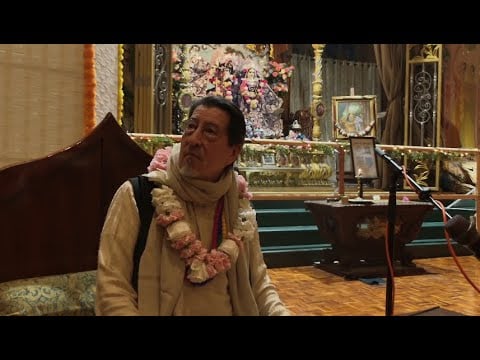
Śrīmad-Bhāgavatam (ŚB) 4.13.8–9 describes a seeker whose deepening knowledge of the Supreme Brahman leads to liberation from the bondage of the body. This state of liberation, termed nirvāṇa, is portrayed not as an endpoint but as a living, ever-expanding condition of transcendental bliss sustained through disciplined bhakti-yoga.
The portrayal of liberation as freedom from bodily identification aligns with a wider dharmic vocabulary: moksha in Hindu traditions, nirvāṇa in Buddhism, kevala jñāna in Jainism, and union with the Divine (Naam/Ik Oankar) in Sikh thought. Each emphasizes release from ignorance, the quieting of afflictions, and the flowering of enduring peace. This shared emphasis suggests a unifying vision across dharmic paths in which spiritual realization manifests as clarity, compassion, and stable joy.
Bhakti-yoga, presented here as continual practice, integrates knowledge and devotion into a transformative sādhana. Through steady remembrance, contemplative study, and selfless service, practitioners cultivate qualities that make transcendental bliss increasingly accessible in ordinary life. Rather than a momentary experience, this bliss is described as cumulative and expansive, deepening with consistent practice and ethical refinement.
Accounts from practitioners across dharmic communities frequently echo these dynamics: as devotion matures, patience strengthens, distractions lessen, and compassion becomes spontaneous. Daily routineswork, family, and community engagementare gradually infused with equanimity and purpose. Such lived markers of progress mirror the text’s assertion that liberation is both realized inwardly and expressed outwardly through conduct.
In this light, ŚB 4.13.8–9 offers a practical roadmap that resonates across Hinduism, Buddhism, Jainism, and Sikhism: deepen true knowledge, embody devotion, and allow disciplined practice to unfold into sustained peace. This synthesis underscores a shared dharmic aspirationunity in spiritual diversitywhere multiple methods converge toward freedom from suffering and the expansion of enduring, transcendental bliss.
Inspired by this post on Dandavats.
