

You have found a ritual, retreat, teacher, or online course that calls itself Tantric. The presentation is polished. Sanskrit words appear in the description. The experience promises intimacy, energy, healing, power, awakening, or some mixture of them. Your practical question is simpler: is this recognisably Tantra, or is Tantra merely the label being used to sell it?
You do not need to become a historian before making that decision. You need a disciplined way to examine the practice’s purpose, context, demands, and ethical boundaries. The test below is aimed specifically at rituals presented through Hindu Shaiva or Shakta language; it is not a universal ruling on every tradition that has been called Tantric.
Authenticity is a relationship, not an ancient appearance
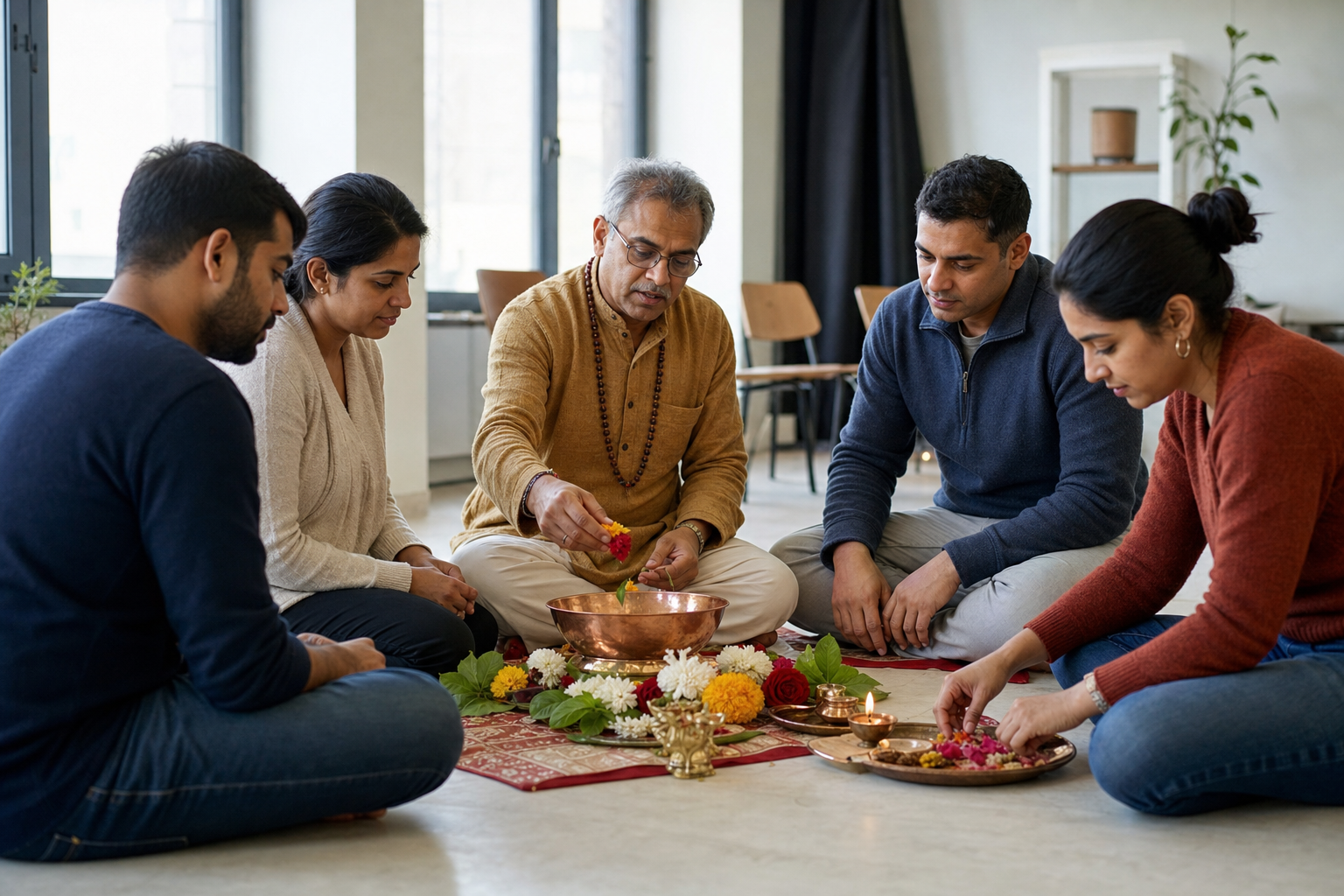
A ritual does not become authentic because the room contains lamps, yantras, red cloth, incense, skull imagery, or Sanskrit syllables. Those things may belong in a legitimate ritual context, but appearance alone cannot tell you what holds the practice together.
Ritual authenticity is best understood as a faithful relationship among purpose, form, transmission, and practitioner. Ask four separate questions:
- Purpose: What transformation is the ritual actually meant to serve?
- Form: Do its deity, mantra, visualisation, gesture, offering, and explanation belong to a coherent ritual world, or have attractive fragments simply been assembled?
- Transmission: Can the teacher explain where the practice comes from and what has been changed?
- Fitness: Is this practice appropriate for you, or does it traditionally depend on preparation, initiation, supervision, or obligations you have not undertaken?
These questions prevent two opposite mistakes. One is accepting anything that looks exotic. The other is declaring every modern adaptation false merely because it is modern. A living tradition may translate, abbreviate, or adapt a ritual. What matters is whether that change is acknowledged and whether the practice still serves a recognisably Tantric aim.
That aim cannot be separated from the expansion and liberation of consciousness. Pleasure, beauty, vitality, intimacy, and emotional intensity may occur within embodied spiritual life. They do not, by themselves, establish that a practice is Tantric. If liberation has disappeared and stimulation has become the final product, the governing purpose has changed.
When sacred union is reduced to an encounter between bodies

The word union creates much of the modern confusion. It is easy to turn a spiritual symbol into a promise of unusual physical experience. It is harder to ask what the symbol demands of consciousness.
Shaiva and Shakta traditions do not all explain reality in one identical way. Yet their language of Shiva and Shakti cannot responsibly be reduced to a technique for improving sexual pleasure. It points beyond an ordinary opposition between subject and object, stillness and dynamism, consciousness and its power. A bodily act cannot manufacture that realisation merely by being called sacred.
This distinction gives you an immediate diagnostic question: after hearing the ritual explained, can you say what is meant to change in your awareness, conduct, or relation to reality? If the explanation ends with stronger sensation, attraction, performance, or chemistry, you have been given an experience claim, not a sufficient account of Tantric sadhana.
Embodiment is not the problem. Treating the body as impure would also miss an important feature of Tantric religious life. The problem is reduction: taking a system of spiritual discipline and presenting one possible symbol, sensation, or ritual element as though it were the whole path.
Do not let someone use non-duality to erase ordinary moral distinctions. Sacred language does not cancel consent, personal boundaries, honesty, or responsibility. A teacher who claims that your hesitation proves spiritual immaturity is not demonstrating transcendence. The teacher is pressuring you. You never owe sexual access, secrecy, money, or obedience to prove that you are open to Tantra.
Use this six-part test before accepting a ritual

No checklist can certify spiritual attainment, but a good checklist can expose incoherence and deception. Ask these questions before paying, participating, or incorporating the ritual into your daily practice.
- Ask for the ritual’s final purpose. A serious answer should identify more than an immediate feeling. Listen for the relationship between the rite and sadhana: purification, worship, disciplined transformation, insight, or liberation. Then ask how the claimed result follows from the actions being prescribed. If every question returns to pleasure, charisma, wealth, attraction, or instant power, the word Tantra is doing more work than the practice.
- Ask where the practice belongs. If it is presented as Shaiva or Shakta Tantra, ask how it relates to a sampradaya, teaching lineage, or the Agamic and Shaiva-Shakta setting from which such ritual systems arise. You are not demanding restricted teachings. You are asking whether the person can locate the ritual within a recognisable tradition. A vague appeal to ancient India is not a lineage.
- Ask how the elements fit together. A coherent ritual has an internal grammar. Its deity, words, images, offerings, contemplative meaning, and intended fruit should not feel like independent decorations. Ask why each major element is present. A trustworthy guide may not disclose everything publicly, but should be able to distinguish symbolic meaning from theatrical effect.
- Ask what preparation and boundaries apply. Find out whether the rite is public devotional practice, a teacher’s modern adaptation, or a practice normally given after initiation. Ask who should not perform it, what commitments accompany it, and whether it is meant for unsupervised home use. A claim that every powerful rite is suitable for every curious person should make you cautious.
- Ask exactly what was modernised. Translation, shortened duration, substituted materials, online instruction, and removal from a temple setting are not the same kind of change. Request a plain account: what was retained, what was altered, and why? The more heavily a practice is adapted, the more important this explanation becomes.
- Examine conduct, not only credentials. A lineage name, Sanskrit title, or photograph with a guru is not self-validating. Notice whether questions are welcomed, fees and expectations are stated clearly, consent can be withdrawn without humiliation, and uncertainty is admitted. Ritual authority that depends on fear, coercion, financial manipulation, sexual pressure, or immunity from criticism is not trustworthy authority.
You are not trying to force the teacher to reveal what a tradition treats as restricted. A reasonable answer may be, “That detail is explained only after initiation.” What matters is whether the boundary itself is intelligible and consistent. Secrecy can protect a graded discipline; it must never be used to conceal abuse, prevent informed consent, or forbid you from seeking help.
Do not confuse precision with authenticity either. Someone can memorise technical vocabulary and still misrepresent a ritual. Conversely, a sincere teacher may use simple language. The decisive issue is whether the explanation remains coherent when you ask about purpose, provenance, prerequisites, adaptation, and conduct together.
Honest adaptation is different from hidden substitution

Modernity is not, by itself, the disqualifying feature. Traditions live in changing languages, places, technologies, and household conditions. The problem begins when a new creation borrows the authority of an older tradition while concealing how far it has departed from that tradition.
For your own evaluation, place a practice under one of three practical labels. These are not classical categories; they are a way to demand honest description:
- Received practice: The teacher presents it as a transmitted ritual and can identify its traditional setting, eligibility rules, and obligations.
- Adapted practice: The teacher identifies a traditional basis but openly explains the changes made for a different language, audience, place, or mode of instruction.
- Tantra-inspired practice: The creator uses Tantric images or ideas but does not claim that the resulting exercise is a transmitted rite.
All three labels can describe something meaningful. They do not make identical claims. Calling an inspired workshop a received initiation is misleading. Calling an adaptation unchanged is also misleading. Clear naming lets you decide whether the offering matches what you seek.
Be especially careful when a teacher mixes elements from several traditions while claiming that all paths secretly teach the same technique. Shared Dharmic ideas do not make every mantra, deity, vow, or ritual sequence interchangeable. Respect for a common civilisational family should sharpen our attention to each tradition’s integrity, not erase its distinctions.
If you cannot verify the status of a supposedly esoteric ritual, do not reconstruct it from fragments. Choose a public form of worship or contemplative practice recognised within your own tradition while you learn more. Simplicity is not spiritual inferiority. A practice you understand and can perform responsibly is a stronger foundation than an impressive rite whose purpose and boundaries remain obscure.
Key takeaways and your next practical step
- An old appearance does not authenticate a ritual; examine its purpose, coherence, transmission, suitability, and ethical setting.
- The Tantric horizon is liberation rather than the enhancement of physical pleasure.
- Embodied symbolism is not the same as reducing spiritual union to a sexual technique.
- A modern adaptation can be honest when its changes and limits are stated plainly.
- A lineage claim or Sanskrit vocabulary cannot excuse coercion, manipulation, or evasive answers.
- When the purpose, origin, prerequisites, or boundaries remain unclear, do not proceed merely because the ritual is described as secret.
Before your next course, retreat, or initiation, make a one-page ritual audit. Write six headings: purpose, tradition, internal logic, prerequisites, adaptations, and teacher conduct. Record the actual answers you receive, not the atmosphere created around them. If the purpose is merely stimulation, the traditional context cannot be named, or the personal boundaries are evasive, you already have enough information to step back.
Then begin with the smallest practice whose meaning, authority, and obligations you can explain. Genuine depth does not depend on accumulating exotic components. It grows when disciplined practice remains aligned with a liberating purpose.
References
