

You may have arrived here after hearing one of two confident claims: modern physics has proved the soul, or Buddhism anticipated modern science by denying a permanent self. Neither claim is careful enough. The useful question is narrower: what can physics tell you about unseen reality, and what must still be investigated through philosophy, contemplation, and conduct?
Once you keep those questions distinct, the comparison becomes more fruitful. Physics can sharpen the way you reason about evidence, causes, and things that cannot be seen directly. Dharmic traditions can sharpen the way you examine awareness, identity, intention, and suffering. They can illuminate one another without being forced into a single theory.
Start with the claim physics can actually support
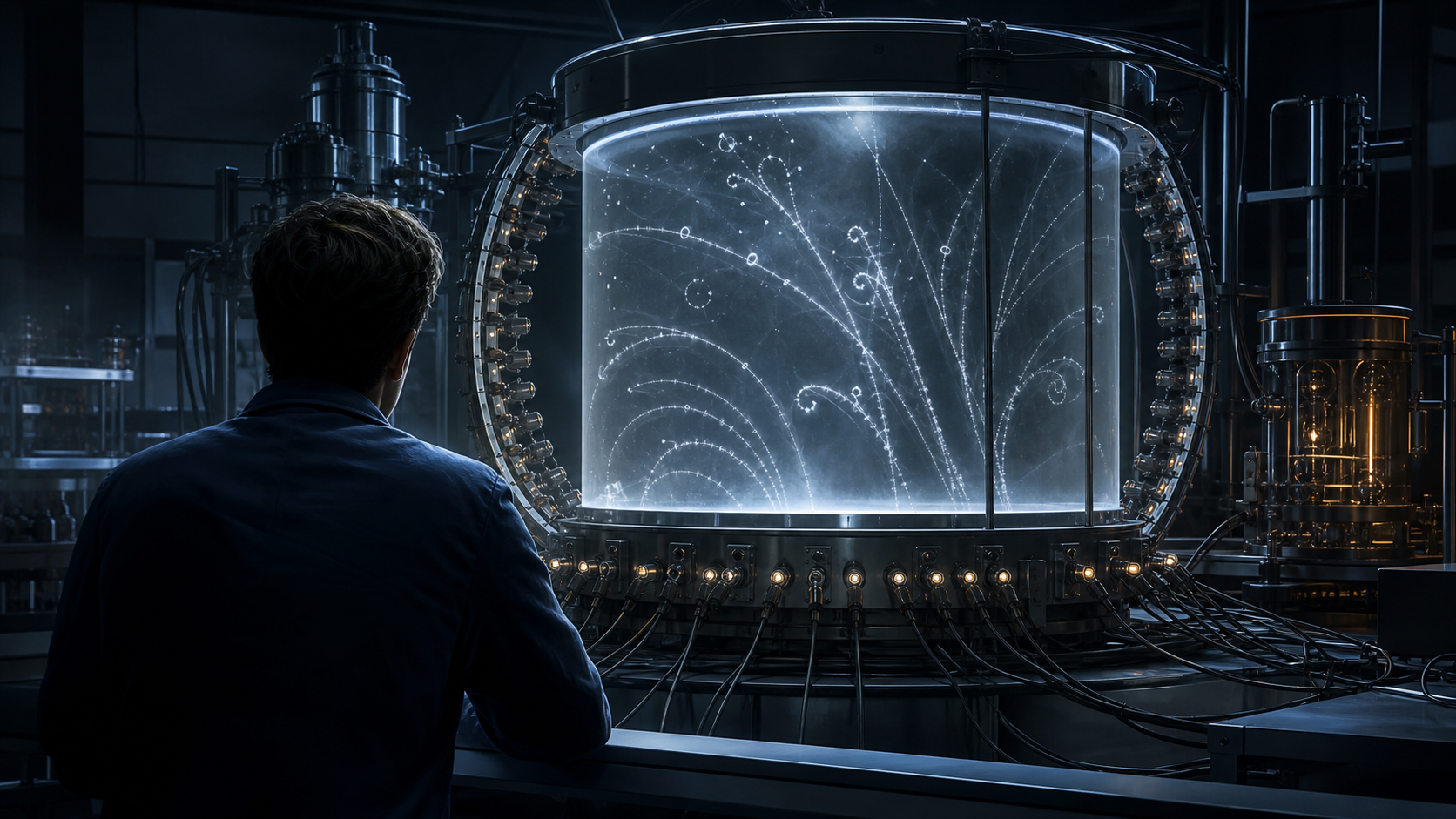
A particle accelerator makes the central distinction vivid: unseen structures become legible through traces and interactions, not through a declaration that whatever is invisible must exist. A detector registers effects. Investigators compare those effects with predictions, rule out alternatives, and revise the model when the evidence fails to fit.
This establishes an important but limited principle: invisibility is not the same as unreality. Something can be known indirectly when its effects are identifiable and the inference connecting effect to cause is disciplined.
It does not follow that because physical particles are inferred from effects, atma has therefore been scientifically demonstrated. That argument moves from one kind of unseen reality to another without supplying the necessary bridge. Particle evidence supports a physical model. A claim about the self requires its own definition, observations, arguments, and standards of evaluation.
When you encounter a physics-and-dharma claim, ask four questions before accepting it:
- What kind of claim is being made? Is it about a physical event, a feature of experience, a metaphysical reality, or an ethical consequence?
- What is the instrument? Is the claim being examined through a detector, trained attention, logical reasoning, textual interpretation, or some combination of these?
- What is the trace? What observable effect is supposed to support the conclusion?
- What else could explain that trace? A strong inference must survive plausible alternatives rather than merely resemble a cherished doctrine.
Be especially cautious when words such as energy, field, observer, information, and vibration appear. Each can have a precise scientific use and a broader spiritual use. Shared vocabulary does not prove shared meaning. Ask whether the speaker intends a measurable quantity, a philosophical concept, or a metaphor. If the meaning changes halfway through the argument, the conclusion has not been earned.
The Dharmic traditions do not teach one theory of self

“The Dharmic view” is convenient shorthand, but it can hide the most important part of this discussion. Hindu, Buddhist, Jain, and Sikh traditions share commitments to disciplined inquiry, causality, ethical formation, and liberation from ignorance. They do not resolve the nature of self in the same way.
| Tradition | Focus of inquiry | Mistake to avoid |
|---|---|---|
| Hindu and Vedantic traditions | Atma is approached through introspection, reason, contemplative discipline, and differing accounts of consciousness and ultimate reality. | Do not turn atma into a tiny physical object or treat one Vedantic school’s account as the whole of Hindu thought. |
| Buddhist traditions | Impermanence and anatta direct attention to changing processes without positing a fixed, independent self. | Do not reduce anatta to the observation that physical things change, or casually equate it with materialism. |
| Jain traditions | Jiva and karmic matter connect consciousness, action, consequence, and liberation in a distinctly ethical account of causality. | Do not assume that the word “matter” makes karma a particle that a laboratory detector should be able to register. |
| Sikh thought | Ik Onkar and hukam place the person within a unifying order that grounds and governs multiplicity. | Do not simply rename Ik Onkar as a physical field; resemblance to unity in physics is not identity. |
These differences are not decorative variations around a single hidden doctrine. Atma and anatta cannot be made identical merely by translating both as “consciousness.” Jiva carries a specific Jain account of bondage and ethical causality. Ik Onkar and hukam cannot be reduced to an impersonal scientific mechanism without losing their religious meaning.
This gives you a quick test for exaggerated claims. If one physics result is said to prove atma, anatta, jiva, and Ik Onkar equally well, it probably proves none of them. The result may inspire several analogies, but mutually distinct teachings require more than the same evocative comparison.
Where the comparison genuinely helps, and where it stops
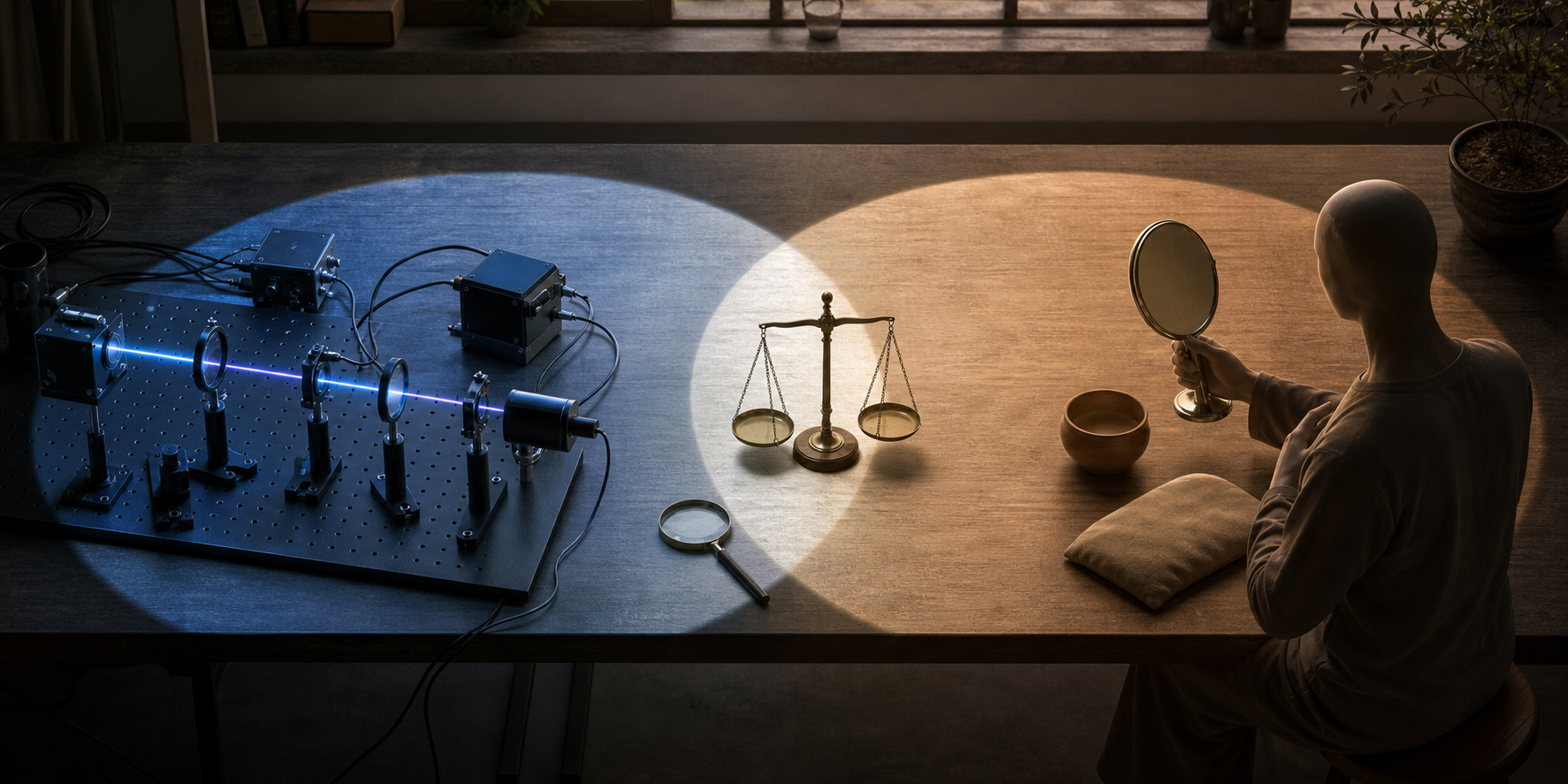
Unseen does not mean unknowable
You do not see causality, consciousness, or a subatomic structure in the same way you see a chair. You approach them through effects, patterns, and disciplined inference. This is the strongest point of contact between modern physics and Dharmic inquiry.
The contact is methodological, not a proof of identical objects. Physics asks which physical model accounts for measurable interactions. Dharmic inquiry asks what careful examination reveals about awareness, intention, identity, bondage, and freedom. Both can reject the crude rule that only what is visible is real. Each must still justify its own conclusions.
A refined instrument changes what can be noticed
An accelerator and detector must be calibrated. In contemplative inquiry, attention is the instrument, and ethics is part of its calibration. Agitation, attachment, fear, and the desire to confirm a preferred doctrine can distort inward observation just as a poorly understood instrument can distort an experiment.
This does not make meditation a particle detector inside the skull. It means that casual introspection and disciplined contemplation should not be treated as equivalent. A passing feeling of unity is not sufficient evidence for a complete metaphysics. A moment in which the ordinary sense of self weakens does not automatically prove either atma or anatta. You still have to distinguish the experience, its interpretation, and the doctrine used to explain it.
Dharmic practice also tests understanding through consequences. Greater clarity, compassion, restraint, and discernment matter because a theory of self is meant to transform how you live. Those consequences are meaningful evidence within a spiritual discipline, but they are not the same kind of evidence as a publicly measured physical interaction.
Different methods answer different questions
Modern physics normally seeks publicly examinable relationships among physical events. Dharmic traditions include first-person observation, philosophical argument, inherited teachings, ethical practice, and communal interpretation. The standards overlap in their demand for discipline, but they are not interchangeable.
A measurement of a particle does not, by itself, establish or eliminate a metaphysical self. Conversely, a contemplative realization does not determine the properties of a physical particle. If a religious teaching makes a specific physical claim, physical evidence remains relevant to it. If physics leaves a question unanswered, that gap is not positive evidence for whichever spiritual doctrine someone prefers.
Complementarity therefore means letting each method do the work for which it is suited. It does not mean using spiritual language to decorate science or scientific language to grant instant authority to theology.
A practical test for physics-and-dharma claims

You can use the following sequence whenever a lecture, video, book, or conversation claims that modern physics confirms a Dharmic teaching.
- Write the exact proposition. Replace “physics and Vedanta are connected” with a sentence precise enough to assess. Is the speaker claiming a useful analogy, historical anticipation, logical compatibility, or experimental proof?
- Classify its domain. Mark the proposition as physical, phenomenological, metaphysical, ethical, or interpretive. A claim can cross domains, but every crossing needs an argument.
- Name the evidence. Identify the measurement, observed experience, logical premise, textual teaching, or practical consequence carrying the claim. “Science has shown” and “ancient wisdom knew” are not evidence.
- Inspect the bridge. State the missing premise connecting evidence to conclusion. If that premise is only a similarity of words or images, you have an analogy rather than a demonstration.
- Restore the tradition’s actual question. Ask what atma, anatta, jiva, Ik Onkar, or hukam is doing within its own path. A concept concerned with identity, bondage, conduct, or liberation should not be detached from that purpose merely to make it sound scientific.
- Check what would change your mind. If no possible observation, argument, or interpretive difficulty could weaken the claim, it is being protected as a conviction rather than offered as a testable scientific conclusion.
Consider the argument, “Particles are unseen but real, so atma exists.” Its premise defeats only the naive objection that an unseen thing cannot be real. It supplies no positive evidence for atma. A more defensible statement is: “Direct visibility is not the only route to knowledge, so claims about atma should be assessed through their own evidence and arguments rather than dismissed merely because atma cannot be seen.”
The claim “physics proves anatta because everything changes” has a similar problem. Change in physical systems does not automatically settle the Buddhist analysis of personal identity, grasping, and experience. The physical observation may provide an analogy for impermanence, but the Buddhist conclusion still depends on a disciplined examination of what we call the self.
You can also apply the method inwardly. Before a quiet contemplative period, write one proposition you want to examine, such as “an unchanged witness stands behind my thoughts” or “what I call myself is a changing process.” During the practice, attend to what appears: sensations, thoughts, intentions, continuity, change, and awareness. Afterwards, make two separate lists. Put what you directly noticed in the first and what you inferred from it in the second.
Do not rush to turn the exercise into proof. Its purpose is to expose the point where observation becomes interpretation. Then examine the ethical result. If your conclusion makes you more vain, careless, or dismissive of other paths, sophisticated vocabulary has probably concealed a failure of discernment. If it produces steadier attention, responsibility, compassion, and openness to correction, the inquiry is beginning to do the work Dharma requires.
Key takeaways
- Modern physics shows that unseen physical structures can be inferred from disciplined observation of their effects; it does not thereby prove atma, anatta, jiva, or any other metaphysical teaching.
- Hindu, Buddhist, Jain, and Sikh traditions must be compared without erasing their real disagreements about self, consciousness, causality, and ultimate order.
- A shared word such as “field,” “energy,” or “observer” is not evidence that a scientific concept and a spiritual concept are identical.
- The most credible convergence lies in method: careful observation, trained instruments, inference, openness to correction, and attention to consequences.
- Contemplative experience is worth investigating, but the experience, its interpretation, and the doctrine used to explain it must remain distinguishable.
- The right question is not whether physics makes Dharma sound modern. It is whether each claim respects the evidence and purpose of both disciplines.
The next time someone says physics has proved a Dharmic account of the self, keep the exact sentence in view. Name its domain, identify its evidence, and refuse any unargued leap between them. Then return to the practices the traditions actually ask of you: disciplined attention, ethical conduct, reason, contemplation, and humility. That approach protects both Dharma and science from being reduced to slogans.
References
