
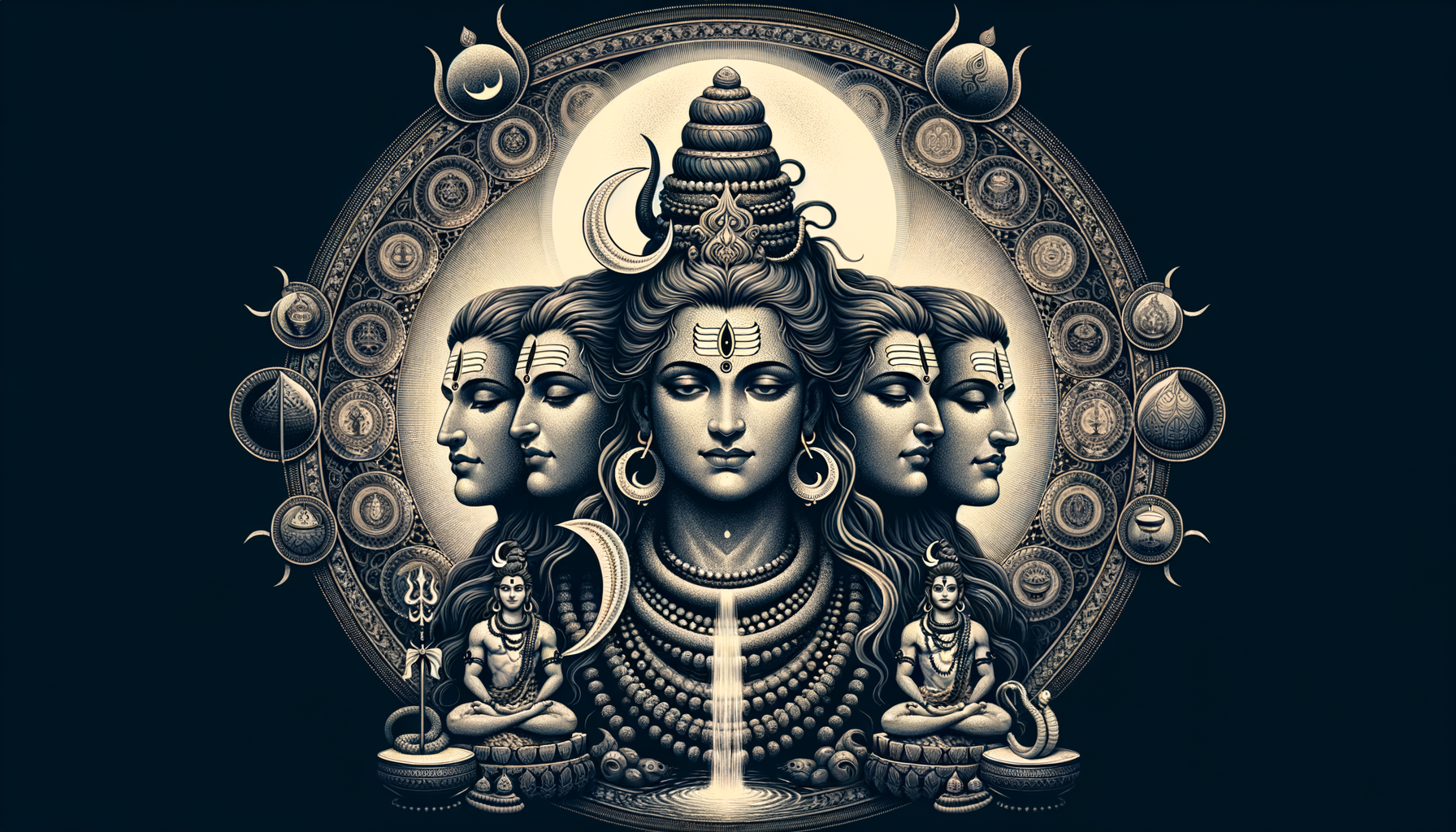
Panchamukha Shiva can be approached as more than a five-part iconographic scheme. Read devotionally, the form gathers a theology of change, a discipline of attention, and an ethical question: what kind of response does this moment require?
This article uses the supplied account to turn the image into a practical framework while preserving its central claim: the five faces express one Shiva, not five competing divine powers.
One Shiva within every movement of existence
The source locates Panchamukha Shiva, or Panchanana Shiva, within the Pancha Brahma doctrine. In this account, five aspects of Sadashiva encompass creation, preservation, dissolution, concealment, and grace. These functions can be distinguished without being separated: emergence and ending, visibility and mystery, effort and grace all belong to one divine reality.
The upward face makes this unity especially clear. The source reports that a mukhalinga may place four faces around its shaft and Ishana at the summit, with Pashupatinath identified as a prominent example. The horizontal faces provide an ordered view of change; the face above them points beyond the idea that existence can be completely classified or controlled.
Key takeaways: five directions for discernment
The supplied account assigns each face a direction and a contemplative emphasis:
- Tatpurusha, facing east: consciousness, alert awareness, and readiness for action.
- Aghora, facing south: dissolution and the transformation of what must pass away.
- Vamadeva, facing north: preservation, compassion, beauty, and harmonious continuity.
- Sadyojata, facing west: manifestation, creativity, and the emergence of form.
- Ishana, facing upward: revelation and grace beyond the four ordinary directions.
As a practical reading, these directions become prompts rather than rigid compartments. A worshipper facing a difficult situation might ask whether it calls for closer awareness, constructive initiative, patient support, necessary release, or receptivity to an outcome that cannot be forced. The value lies in considering all five possibilities before acting from habit.

The surrounding symbols place limits on power
In the source’s treatment, the faces are only one part of the teaching. Matted locks, the crescent moon, and Ganga portray sacred force held in order. The third eye signifies discernment; serpentine ornaments suggest awakened vitality; ash recalls impermanence; and the tiger skin represents mastery over primal impulses. These details prevent spiritual power from being confused with impulse or domination.
The trishula, damaru, akshamala, kamandalu, and kapala similarly bring power, rhythm, contemplation, restraint, and mortality together. Abhaya and varada mudras connect fearlessness with benevolence, while Nandi represents devotion joined to ethical steadiness. The icon therefore asks not only whether a person has strength, but also whether that strength is disciplined, compassionate, and mindful of life’s limits.
A five-breath practice joins mantra to conduct
The source pairs the icon with Om Namah Shivaya and its sequence Na-Ma-Shi-Va-Ya. For a brief household contemplation, it proposes five attentive breaths, one syllable accompanying each breath. The cycle may be used to notice emergence, continuity, release, receptive stillness, and grace without demanding an unusual experience.
The meaningful test comes afterward: clearer judgment, courage during change, compassion in relationships, steadiness in duty, and less attachment to controlling results. The source also mentions circumambulation, visualization, and recitation of the Pancha Brahma mantras as practices that coordinate space, image, sound, and attention.
Claims about emotional steadiness, resilience, and refined attention should remain in their stated devotional setting. The supplied material relies on practitioner testimony rather than clinical research, so the practice should not be presented as a guaranteed therapeutic intervention.

Let correspondences deepen attention without hardening into formulas
The source links the fivefold form with the pancha mahabhuta of earth, water, fire, air, and space, along with the five senses and the five sheaths, or pancha kosha. Such correspondences can guide attention from the visible icon toward embodiment, perception, thought, discernment, and awareness. Their usefulness does not require forcing every five-part system into an exact one-to-one chart.
The supplied material also reports surviving representations from the early medieval period onward in Chola, Chalukya, Hoysala, related artistic settings, and Nepalese Shaiva traditions. Variations in material, style, and ritual context show why a living sacred form should not be reduced to a single diagram.
Possible resonances with Buddhist fivefold contemplative patterns, Jain great vows, and the Sikh conjunction of simran and seva are likewise best treated with care. Shared attention to discipline, non-harm, truthful conduct, or service does not make the traditions interchangeable.
Panchamukha Shiva becomes practically significant when its symbolism informs the next considered action. The enduring discipline is to recognize change without losing sight of unity, act without mistaking control for mastery, and leave room for grace.
