
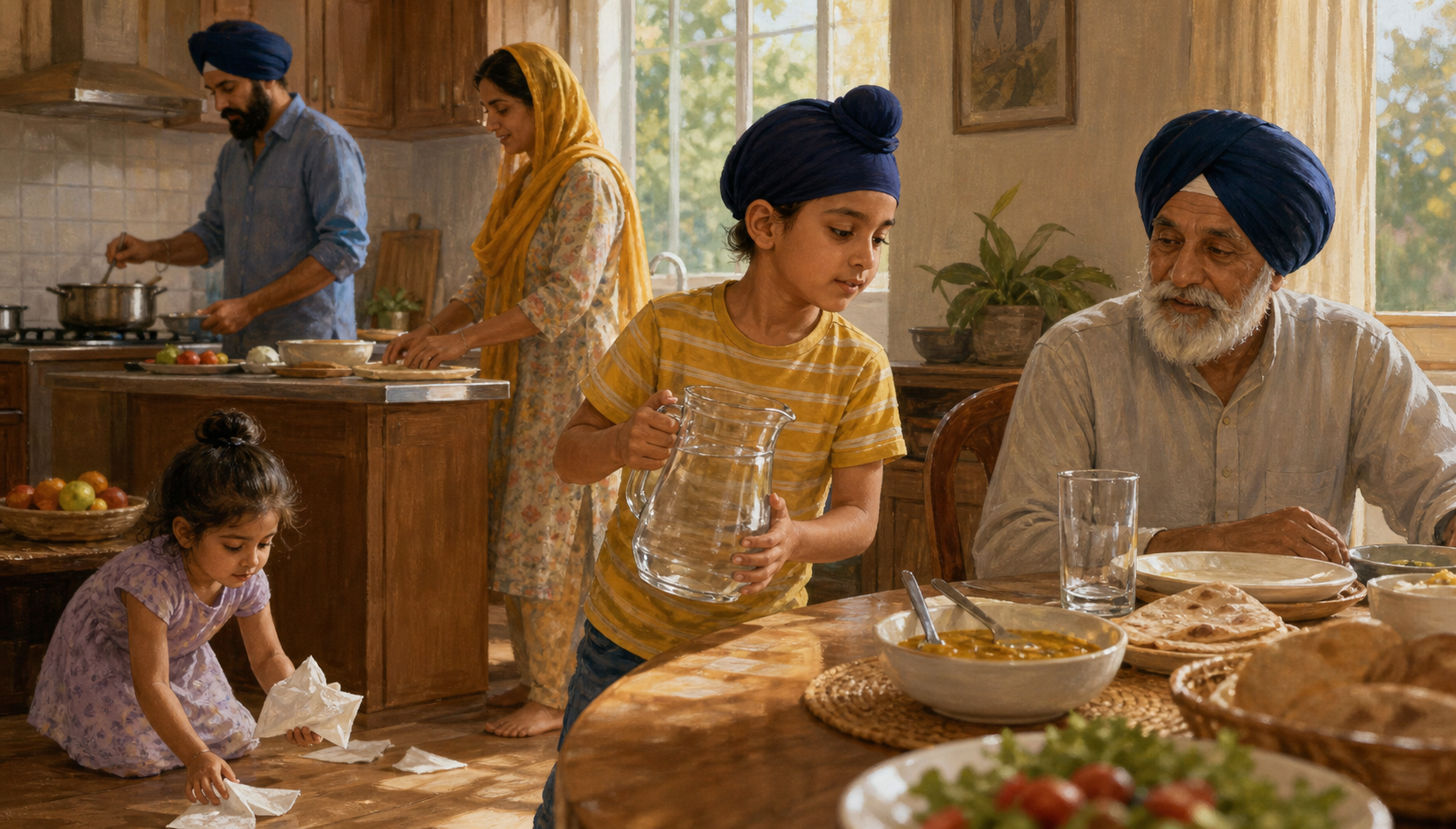
You may already ask your child to put toys away, help at the table or be kind to a sibling. The harder question is how to make those actions mean something. Compliance can finish a task; it does not necessarily teach a child to notice another person’s need or to serve without making themselves the centre of the moment.
Your aim is to build a repeatable inner sequence: notice what is needed, contribute with humility, and meet inconvenience with a steady, hopeful mind. Seva gives the child an action. Chardikala gives the child a way to carry it.
Teach two connected habits, not two vocabulary words
Seva is selfless service: work done for another person, a shared space or the wider community without treating praise or reward as the purpose. Chardikala is the Sikh ideal of an ever-rising spirit – a resilient optimism that remains oriented toward the good of all. A child does not need a formal definition before practising either one.
The distinction between responsibility and seva is still worth making. Cleaning up your own spill is responsibility. Helping restore the whole dining area so everyone can use it moves toward seva. Putting away your own toy is responsibility; helping a younger sibling put away a shared game can become service. Children need both. Calling every command seva, however, can empty the word of its moral meaning.
Seva and Chardikala also correct each other. Seva without an inner spirit can become resentful duty. Chardikala without service can shrink into a cheerful slogan. Together they teach a more demanding lesson: you can contribute when the work is ordinary, when nobody applauds and when the day has not gone as planned.
That does not mean telling a disappointed child to "be positive." Chardikala is not the denial of sadness, anger or fatigue. Let the child name the feeling, then help them find the next constructive action: "You are disappointed that the plan changed. We can be disappointed and still help each other." The goal is steadiness within difficulty, not a performance of happiness.
Selflessness should not be confused with having no boundaries, either. A child should never learn that service requires accepting mistreatment, hiding discomfort or obeying every demand. Seva is a freely cultivated orientation toward the welfare of others. It is not a religious label for powerlessness.
Build a daily doorway from words to action
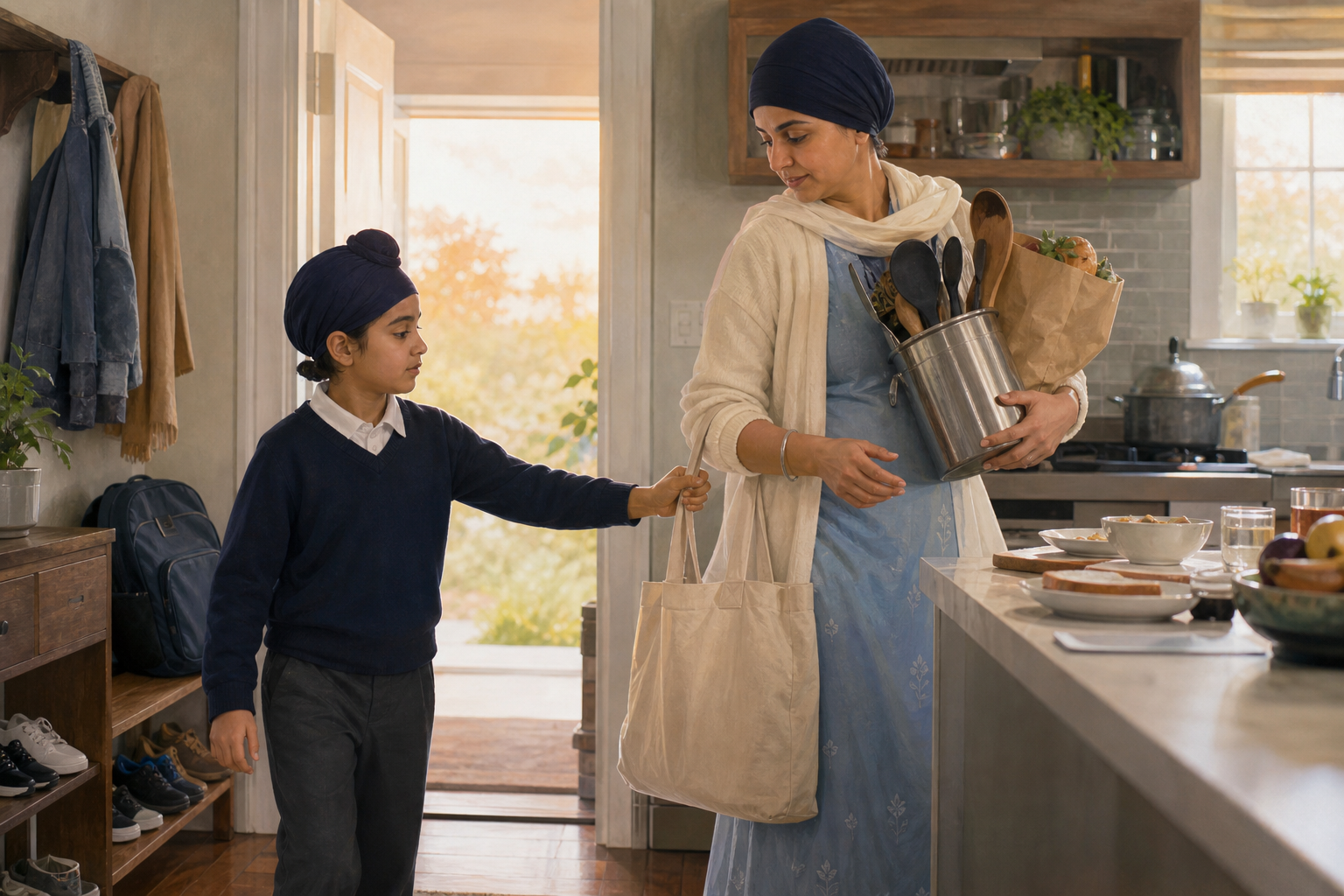
Children remember what the family repeats. Rhythm, predictable language and movement give a young child several ways to recall the same idea. The rhyme or call-and-response is therefore not the entire lesson. It is the doorway that tells the child what kind of action comes next.
- Attach Seva Time to a routine you already keep. Morning, a meal transition or bedtime works better than waiting for a morally impressive opportunity. Use the same cue consistently so the child does not have to negotiate whether service will happen that day.
- Settle before you serve. Begin with a calm breath. Depending on your family’s path, add a brief simran, mantra or moment of silent gratitude. This pause separates seva from a hurried order barked across the room.
- Use a short verbal cue. You might say, What time is it? and let the child answer, Seva Time. Then ask, How will we serve? and answer together, With Chardikala. Keep the rhyme or exchange under two minutes; the action should remain more important than the performance.
- Name one visible, finishable service. Say, We will place the cups so everyone can eat, rather than, Be helpful. A clear endpoint lets the child experience contribution instead of guessing what an adult wants.
- Work beside the child before expecting independence. Calm modelling is part of the teaching. Let the child see you take the less desirable part of the task, speak respectfully and continue without fishing for credit.
- Close with a brief reflection. Ask: What did we serve today? Who benefited? How did Chardikala help when something was difficult? A one-minute reflection is enough to connect the physical act with intention.
When the household is rushed, preserve the cue and reduce the task. A child can carry a napkin, return one shared object or offer one kind sentence. Consistency matters more than constructing a large project every day. Community service has depth when it grows from ordinary reliability at home.
Match the service to what your child can actually do
For a toddler, make the teaching physical and immediate. Hands to the heart can represent seva; uplifted palms can represent Chardikala. These simple gestures reinforce the words through movement. Let the child place a toy in a basket, carry an unbreakable item to the table, water a plant with you or practise a kind greeting. Do not demand an abstract explanation afterward. Participation and recognition are enough at this stage.
When a child can follow a short sequence, give them a complete role: set or clear part of the dining area, read to a grandparent, organise a shared shelf, help a younger sibling or sort items intended for donation. Say who benefits before beginning. That turns a domestic instruction into an exercise in seeing beyond oneself.
When a child is ready to serve outside the home, give them a real but bounded responsibility. Families can take part in langar preparation, the cleaning of a temple or vihara, support at a derasar, or a neighbourhood cleanup. Explain the customs of the place, work alongside the child and show that communal seva includes unglamorous tasks. A ceremonial photograph should never become the main event.
Handle refusal without turning dharma into a contest

The practice becomes real when the child would rather keep playing, dislikes the assigned task or quarrels with a sibling over who gets to lead. That moment is not an interruption of the lesson. It is where Chardikala becomes necessary.
- Name what is happening without shaming the child. Say, You wanted to keep playing, and stopping is frustrating.
- Restate the beneficiary. Say, We are clearing this space so the whole family can eat here. The need, not the child’s moral status, should remain central.
- Offer bounded participation. Ask whether the child will return the books or collect the blocks. Both choices should make a genuine contribution; neither should be a disguised escape from the shared task.
- Begin together. Say, We can feel frustrated and still start steadily. Then perform the opening action beside the child.
- Reflect after calm returns. Do not demand a spiritual explanation in the middle of a struggle. Later, ask what made the task difficult and what helped the family continue.
Avoid using Chardikala as a command to smile. Avoid comparing siblings, because the comparison redirects attention from service to rank. Avoid paying for every act described as seva, because the promised prize then becomes the obvious reason for acting. Children can still receive warmth and gratitude. Make that gratitude concrete: You carried the books, so Dada could sit comfortably is more instructive than You are the best helper.
If siblings compete to become the seva captain, redefine the role. The captain does not receive the easiest or most visible job. The captain notices what is needed, invites others respectfully and checks that nobody has been left with all the work. Rotating this role can let each child lead the familiar cue and reflection while learning that leadership itself is service.
Notice direction without scoring spiritual worth
Do not measure success by whether every task happens cheerfully. Use ordinary behaviour as your guide. Is the child beginning to join when invited? Can they complete a bounded role with fewer reminders? Can they identify who benefited? Do they sometimes notice a need before an adult names it? When plans change, can they recover and choose a helpful next step?
These are signs that the words are becoming samskaras rather than remaining ritual vocabulary. Progress will not be perfectly linear. A tired or upset child may need more help on a particular day. Keep the standard of contribution, but adjust the size of the task and return to modelling.
Honour Sikh roots while recognising Dharmic kinship
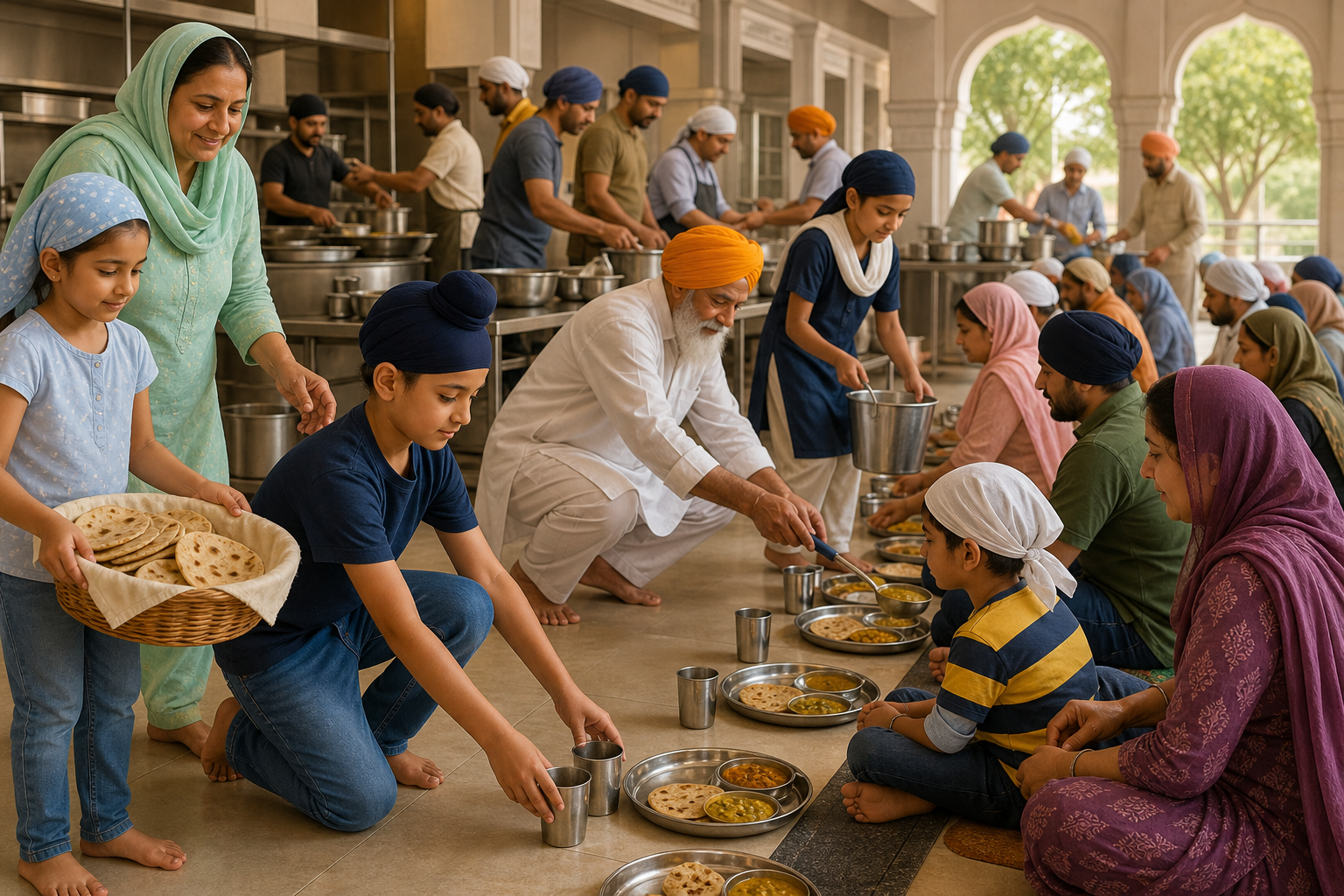
Chardikala should be taught as a specifically Sikh ideal, closely joined to concern for sarbat da bhala, the well-being of all. Seva also has a particularly visible communal expression in Sikh life through langar. Naming those roots is more respectful than turning every tradition’s language into a generic synonym for kindness.
At the same time, a Dharmic household can help children recognise ethical kinship without erasing difference. Hindu seva and dana, Buddhist dana and karuna, and Jain service grounded in ahimsa and anukampa all give families language for generosity, compassion and responsibility. Buddhist metta and equanimity, Jain samayik, Hindu bhakti-inflected cheerfulness, and Sikh Chardikala are not interchangeable doctrines. They can nevertheless help a child see that disciplined care for others runs across the Dharmic family.
You can make that relationship concrete with stories. After reading an episode from the Ramayana, a Jataka tale, a Jain narrative of compassion or a Sikh sakhi, ask three practical questions: Who noticed a need? What did they do? What inner quality helped them continue? Then choose a household act that expresses the same virtue. The story supplies moral imagination; the service gives it hands.
In a multi-faith classroom, keep the same clarity. A teacher can use a brief rhyme during circle time or a transition, then ask, What is one way to practise seva today? or How can Chardikala guide us when a plan changes? Children can connect the terms to action and emotional steadiness without being told that all traditions are identical.
Key takeaways for your family
- Teach seva and Chardikala as a sequence: notice a need, contribute, and meet difficulty with a steady spirit.
- Attach a short rhyme or call-and-response to a daily routine, then move immediately into one visible act of service.
- Choose a task that fits the child’s present capacity and has a clear beneficiary and endpoint.
- Let children name difficult feelings; Chardikala calls for resilient action, not forced cheerfulness.
- Use reflection to ask who benefited and what helped the child continue, not to assign a score for goodness.
- Name the Sikh roots of Chardikala while explaining related Hindu, Buddhist and Jain virtues with their distinctions intact.
Start with the next routine your household already keeps. Say the cue, complete one shared task and ask who benefited. Repeat it the next day. When a child regularly sees dharma move from the heart to the hands, seva stops being a special event and Chardikala becomes a way to meet ordinary life.
References
- DharmaRenaissance Blog – Complete Guide to SevaTime’s Chardikala Rhyme: Discover Joy, Seva, and Dharmic Unity
- DharmaRenaissance Blog – Essential Guide to Raising Children in Seva: Discover the Chardikala Rhyme for Daily Joy
