
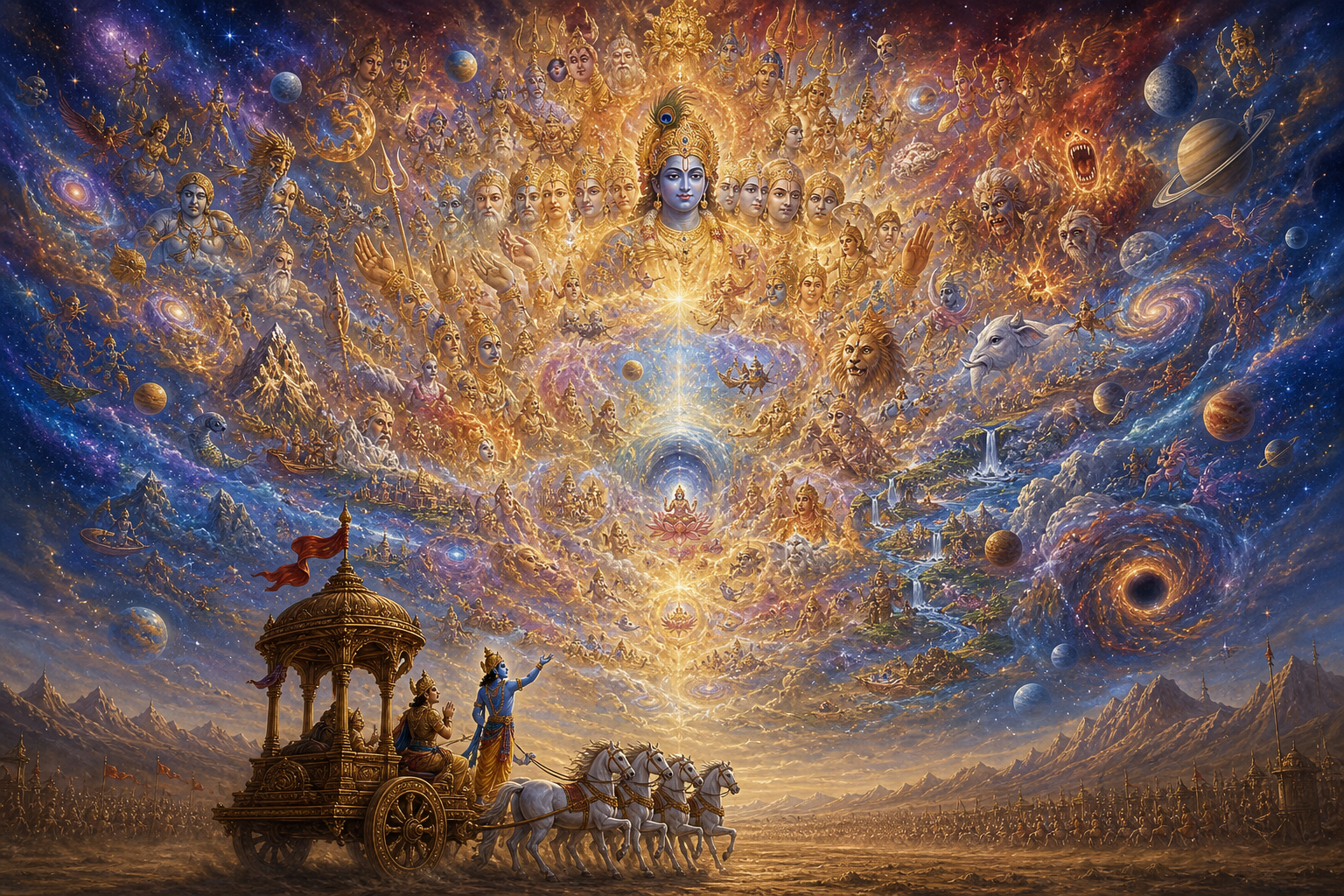
You look at Krishna’s Vishwaroopa and encounter a body filled with faces, heads, hands, beings, and worlds. The immediate question is understandable: are all those features meant literally, or is the image saying something through them?
Begin with the whole rather than counting the limbs. Vishwaroopa is not primarily a portrait of an unusually large person. It is a visual way of confronting a far greater claim: the universe itself can be perceived as the form of one divinity. Once you grasp that purpose, the apparent excess of the image becomes its most intelligible feature.
The first mistake is to treat Vishwaroopa as anatomy
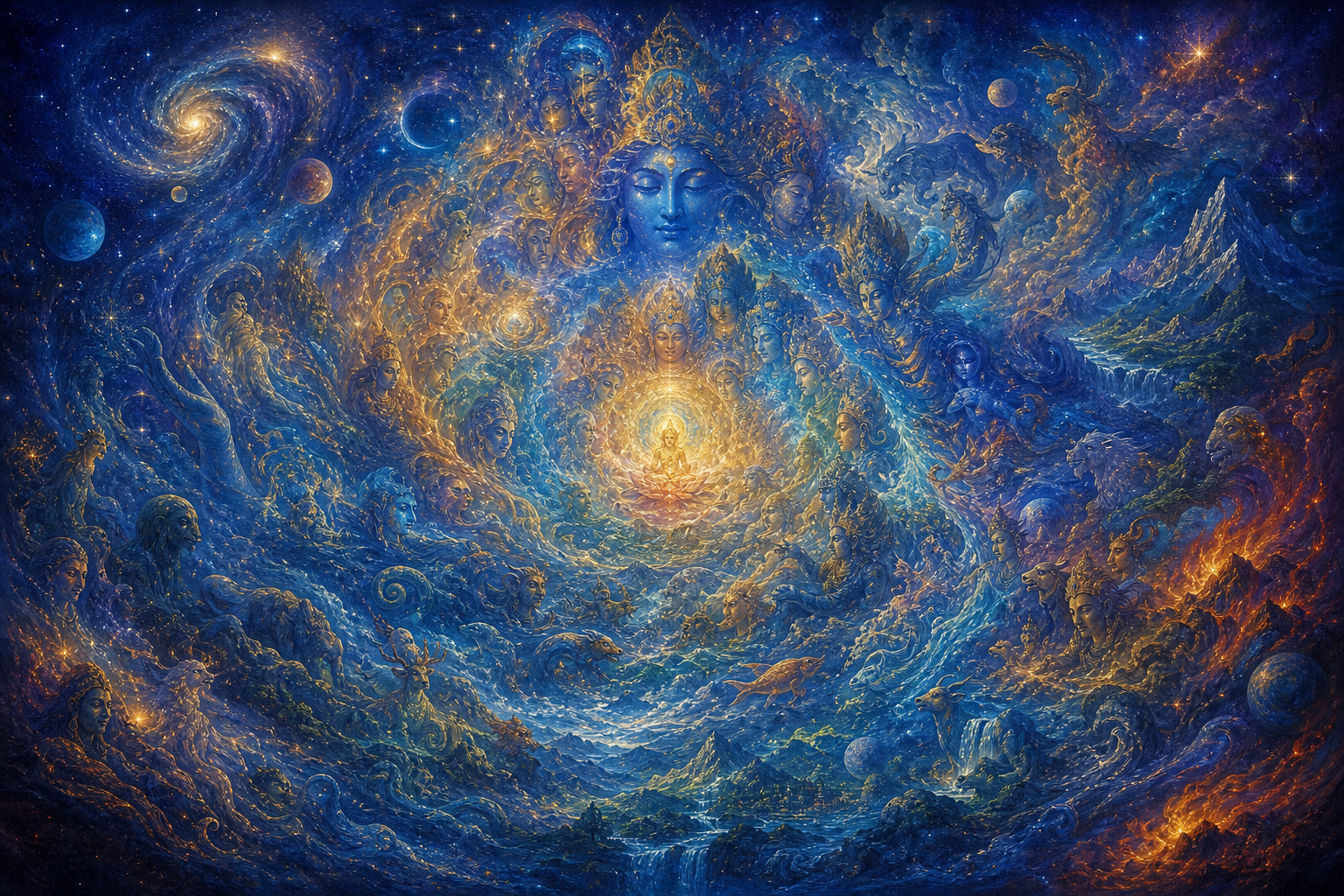
An ordinary portrait uses the body as a boundary. It shows one person occupying one place, distinct from everything around that person. Vishwaroopa reverses this expectation. The divine form does not merely stand inside the world; the world is gathered into the form.
The name supplies the essential key. Vishwa refers to the whole universe, while roopa here means the universal form. Its central meaning is to see God in everything and the whole universe as the form of one divinity. The useful question, therefore, is not, “How could one person possess so many heads and hands?” It is, “How can a finite image help you contemplate a reality that excludes nothing?”
A painter or sculptor has limited space. The universal has no such pictorial boundary. Repeated heads, hands, and figures bridge that gap. Multiplicity breaks the limits of the familiar human outline and tells your eye that this is not one being placed beside other beings. It is an attempt to show all existence within a single divine unity.
This distinction protects you from two shallow readings. Vishwaroopa is neither fantasy anatomy nor ornament added merely to make Krishna look powerful. Its unfamiliar body is a teaching device. The form has to strain ordinary visual language because the idea being expressed exceeds an ordinary portrait.
What the many heads and hands ask you to notice
Do not approach every feature as an entry in a fixed inventory. Unless a particular image identifies a figure or attribute, forcing a precise name onto every detail can distract you from the composition’s governing idea. Read the repeated forms first as a visual grammar of universality.
- Many faces can suggest that the universal cannot be confined to one face, identity, or point of view. Your eye is denied a single, comfortable centre.
- Many heads can suggest awareness that is not restricted to one embodied observer. The image loosens your habit of equating consciousness with one familiar human outline.
- Many hands can suggest action and capacity operating through innumerable forms. Instead of imagining one pair of hands doing one task, you are invited to contemplate divine agency throughout existence.
- Beings or smaller forms gathered within the larger form show the relationship between part and whole. Their differences remain visible, yet they do not stand outside the encompassing unity.
- A crowded or overwhelming composition prevents you from reducing the vision to a neat object. The difficulty of taking everything in is part of how the image redirects your attention beyond ordinary scale.
These are interpretive prompts, not a substitute for the specific tradition, temple, or artistic context of a particular depiction. The safest reading moves from the unmistakable central claim to the details: the whole universe is presented as divine form, and the multiplied features help the artist make that universality visible.
Vishwaroopa presents unity without erasing difference
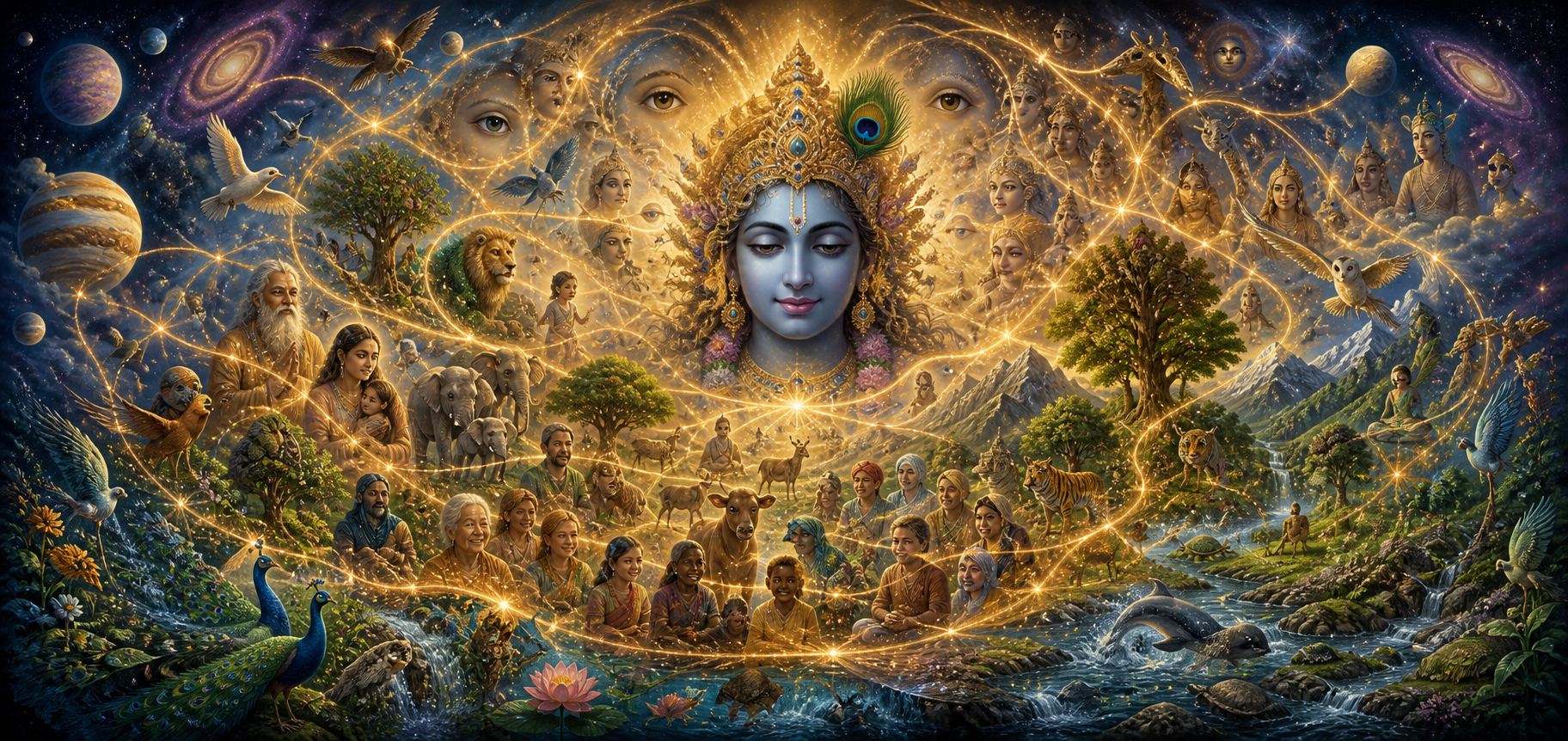
The image contains a productive tension. You see one form, but you also see many forms. If you notice only the many, the composition can look like a crowded assembly of unrelated beings. If you notice only the one, you miss why the artist retained so much variety. Vishwaroopa asks you to hold unity and multiplicity together.
That makes it a useful answer to a common misunderstanding of Hindu sacred imagery. The presence of many faces and forms does not necessarily imply a collection of competing divinities assembled at random. In Vishwaroopa, multiplicity is organised by an encompassing vision: all that appears belongs within one divine reality.
Unity, however, should not be confused with sameness. A hand is not a head, and one visible being is not interchangeable with another. The image preserves distinctions while placing them inside a greater whole. You can therefore recognise shared sacred belonging without pretending that every person, choice, or action is identical.
This matters in practice. Seeing divine presence in another person does not require approving every action that person takes. Reverence does not cancel discernment between dharma and adharma. It should change the spirit in which discernment is exercised: less contempt, less self-righteousness, and a clearer awareness that opposition need not become dehumanisation.
The same principle applies to the natural world. If the universe is contemplated as divine form, the material world cannot be dismissed as spiritually meaningless scenery. The image trains you to look again at what habit has made ordinary. Its challenge is not simply to admire cosmic grandeur but to reconsider how carelessly you treat the beings and places that appear small from your own limited viewpoint.
A practical way to contemplate the image
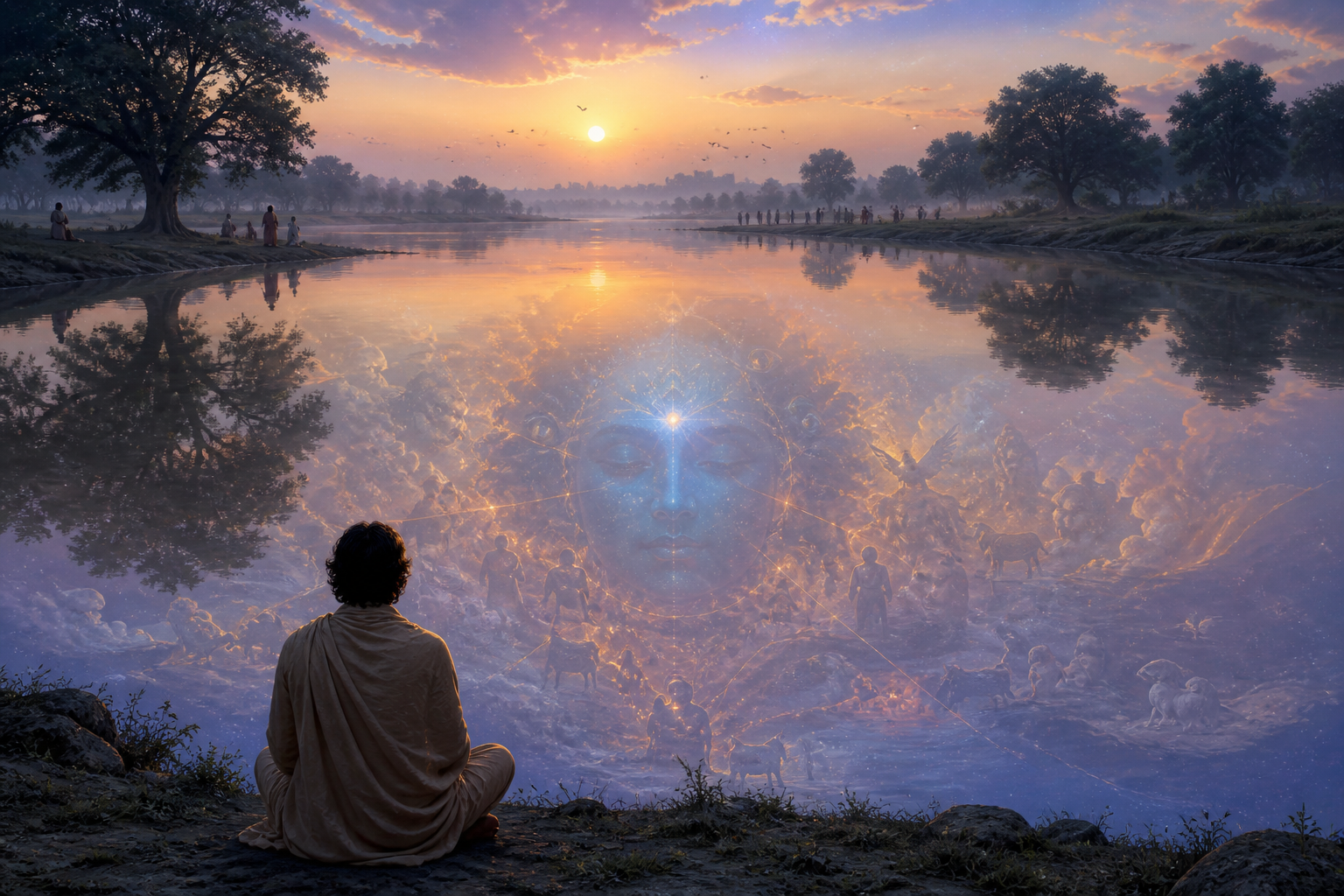
You do not need to decode every figure before Vishwaroopa becomes spiritually useful. Try approaching the image in a deliberate sequence.
- Look at the entire composition before examining individual features. Notice where your eye searches for a single face or centre, and how the image resists being reduced to one ordinary body.
- Choose one repeated feature, such as the faces or hands. Ask what human limitation that repetition breaks. Does it challenge a single viewpoint, a single location, or a narrow idea of who acts in the world?
- Observe how individual forms relate to the encompassing form. Do they disappear, remain distinct, or appear as parts of a larger unity? Let that relationship guide your reading more than the urge to count them.
- Turn your attention away from the image and toward your immediate surroundings. Consider which person, creature, place, or ordinary object you habitually treat as though it stood outside sacred concern.
- Translate the contemplation into one concrete act. Listen without contempt, handle food without waste, treat shared space with care, or perform your duty without imagining yourself to be the sole source of every result.
The final movement is essential. If contemplation ends with fascination at an extraordinary picture, you have remained at the surface. The universal form becomes a living teaching when it enlarges the field of what you regard as worthy of attention, responsibility, and reverence.
You can also use a simple test when discussing Vishwaroopa with a child or someone unfamiliar with Hindu imagery. Instead of beginning with a catalogue of names, ask: “If an artist wanted to show that the whole universe belongs within the divine, what would one ordinary pair of hands leave out?” That question allows the symbolism to emerge without asking the viewer to accept a bizarre anatomy first.
Key takeaways
- Vishwaroopa presents the whole universe as the form of one divinity; it is more than an enlarged human body.
- The many heads, faces, and hands are best read as artistic language for universality rather than as an anatomical diagram.
- The composition holds unity and multiplicity together: distinct forms remain visible within an encompassing divine reality.
- You should not force every unlabeled detail into a fixed symbolic inventory. Begin with the meaning of the whole and then interpret the parts.
- The image asks for a change in perception and conduct: widen reverence, retain discernment, and act with less contempt toward what you normally regard as separate or insignificant.
The next time you stand before Krishna’s Vishwaroopa, resist the impulse to count. Let your gaze move from the many forms to the unity that contains them, and then back into the world you are about to re-enter. The most consequential question is not how many hands Krishna has in the image. It is what you will treat differently once you have considered that nothing lies outside the universal form.
References
