
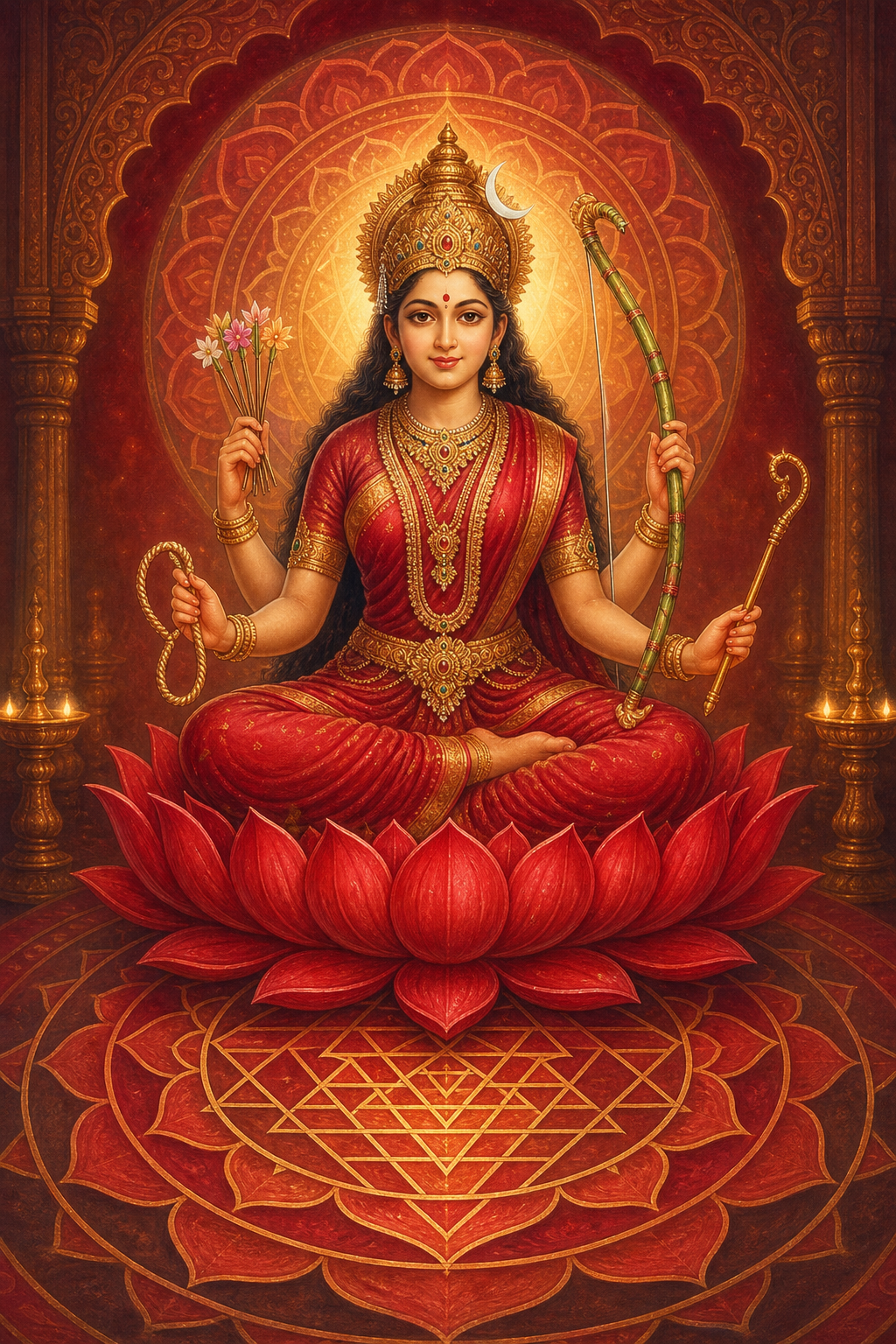
If you have encountered Kamakaleshwari while learning about Sri Vidya, you may be unsure whether she is a separate goddess, another name for Tripura Sundari, or a deity approached through a distinct practice. That uncertainty matters. A mistaken identity can turn a coherent tradition into a confusing catalogue of divine names.
The clearest starting point is this: Kamakaleshwari is a form of Tripura Sundari through whom desire is viewed in relation to sacred order and divine grace. Once you understand that relationship, her relevance becomes practical. She asks you neither to worship every impulse nor to become ashamed of wanting, but to bring desire into the light of discernment.
Begin with her identity, not a catalogue of goddesses
Kamakaleshwari is a manifestation of Tripura Sundari, one of the ten Mahavidyas and the presiding deity of the Sri Chakra. This relationship is the foundation for understanding her. You do not need to place Kamakaleshwari and Tripura Sundari in competition, as if choosing one meant rejecting the other.
A divine form can place a particular aspect of the larger reality before the devotee. Kamakaleshwari directs attention toward desire, its creative force, and the grace by which it can be purified. Tripura Sundari remains the encompassing identity; Kamakaleshwari is a focused way of meeting that identity.
This distinction prevents two common errors. The first is treating every name of the Divine Mother as an unrelated deity. The second is collapsing every form into an abstract sameness that makes its particular teaching disappear. Hold unity and distinction together: recognise Kamakaleshwari as Tripura Sundari, then ask what her emphasis on sacred desire requires you to notice.
Sacred desire is desire brought under dharma

The phrase sacred desire can be misunderstood as permission to spiritualise whatever you already want. It is not a blank cheque for appetite. A desire does not become holy merely because it feels intense, appears during prayer, or can be expressed in mystical language.
Nor does reverence for Kamakaleshwari require you to condemn desire itself. Desire can move a person toward knowledge, relationship, beauty, service, liberation, possession, recognition, or control. The decisive question is not whether wanting exists. It is what the desire serves, what it demands from others, and what kind of person you become by following it.
When a strong desire arises, test it before you either obey or suppress it:
- Truth: Can you name the desire plainly, without giving it a nobler label? A wish for control should not be disguised as concern; a wish for praise should not be disguised as service.
- Consequence: Would pursuing it require deception, exploitation, humiliation, betrayal, or avoidable harm? If so, devotional language cannot make the path dharmic.
- Freedom: Does the desire leave room for judgement, patience, and refusal, or does it insist that you must act immediately? Compulsion narrows awareness; sacred discernment widens it.
- Offering: Can you surrender the outcome while still taking the right action? If you can accept that the desire may need to be fulfilled, delayed, reshaped, or released, you have begun to loosen possession of it.
This is where grace becomes more than a pleasant religious word. Grace may not give you the object you requested. It may reveal that the request is too small, ethically compromised, or rooted in fear. It may also give you the steadiness to pursue a worthy aim without turning that aim into an idol.
Her Sri Chakra context changes how you read ordinary life

Tripura Sundari is associated with the Sri Chakra and embodies the totality of creation. In the context of Kamakaleshwari, this gives desire a larger horizon. Spiritual life is not confined to the moments when you feel detached, peaceful, or visibly religious. Your ambitions, attractions, disappointments, loyalties, fears, and creative longings also have to be examined.
The safe conclusion is not that every impulse is divine. It is that no part of life is outside spiritual scrutiny. Desire becomes a doorway when you look through it toward its deeper demand. The wish to be admired may conceal a need to know your worth. The wish to possess may conceal fear of loss. The wish to create may express a genuine movement toward beauty and contribution. Discernment neither romanticises the surface desire nor dismisses the energy within it.
A useful contemplative movement has three parts:
- Recognise: Admit what you want before editing it into a respectable answer.
- Refine: Separate the legitimate need or aspiration from the harmful method, inflated fantasy, or demand for control attached to it.
- Offer: Place both the desire and its outcome before the Divine Mother, then choose the next action that remains truthful and dharmic.
This is a practical framework for reflection, not a substitute for an initiated Sri Vidya liturgy. Its value lies in helping you notice what desire is doing inside ordinary decisions. If contemplation never changes how you speak, choose, wait, refuse, apologise, or act, it has remained an idea rather than becoming sadhana.
Approach her devotionally without imitating an initiation

Sri Vidya includes specialised mantra and ritual disciplines that are traditionally learned through qualified guidance. Curiosity about Kamakaleshwari does not require you to pretend that reading a mantra online is the same as receiving and understanding a practice. Respect for a tradition includes respecting the conditions under which its advanced disciplines are transmitted.
You can still begin devotionally. Plain prayer, ethical self-examination, reverence, and silence do not require you to invent an initiation. Use the following sequence as a simple personal contemplation rather than as a claim about formal ritual:
- Prepare a clean place. If you already keep an image of Tripura Sundari or a Sri Chakra for devotional use, sit before it. Otherwise, a clean and undistracted place is enough.
- Establish the relationship. Address Kamakaleshwari as a form of Tripura Sundari. This keeps the prayer anchored in her identity instead of treating her name as an isolated spiritual technique.
- Name one desire. Choose the desire actually shaping your decisions, not a vague aspiration that sounds pious. State what you want and why you think you want it.
- Apply the tests of truth, consequence, freedom, and offering. Do not rush past the answer that makes you uncomfortable. That point is often where the useful work begins.
- Ask for purification, not automatic fulfilment. Be willing for the desire to be clarified, redirected, delayed, or released.
- Sit quietly. You do not need to manufacture a vision, emotion, or sign. Let the desire remain present without rehearsing fantasies about its fulfilment.
- Choose one dharmic action. Make the apology, tell the truth, stop the manipulation, do the necessary work, or wait without forcing an outcome. Devotion should produce a more honest next step.
If you want words for the prayer, use plain language rather than presenting an invented formula as a traditional mantra: Kamakaleshwari, form of Tripura Sundari, let this desire be seen clearly. Purify what is selfish, strengthen what is truthful, and guide me toward the action that accords with dharma.
Judge the practice by its fruit. Greater honesty, less compulsion, more patience, and a clearer willingness to act rightly are meaningful signs of movement. Dramatic sensations are not required. If the practice instead makes you feel exempt from ordinary ethics, entitled to another person, or certain that every preference is a divine command, return to the tests of truth and consequence.
Key takeaways
- Kamakaleshwari is a form of Tripura Sundari, not a rival deity standing outside her.
- Her emphasis on sacred desire does not sanctify every impulse; it places desire under discernment and dharma.
- Her connection with Tripura Sundari and the Sri Chakra brings ordinary wants, fears, relationships, and ambitions within the field of spiritual examination.
- A useful practice recognises a desire, refines its motive and method, offers its outcome, and ends with a truthful action.
- Devotional prayer can be simple and direct. Specialised mantra and ritual practice should not be imitated from fragments without qualified guidance.
- The practical fruit is not guaranteed fulfilment but greater freedom from compulsion and greater clarity about what you should do.
For your next prayer, bring one real desire rather than a polished spiritual abstraction. Name it without shame, examine it without indulgence, and ask Kamakaleshwari for the grace to follow what is dharmic even if the answer changes what you thought you wanted.
References
