
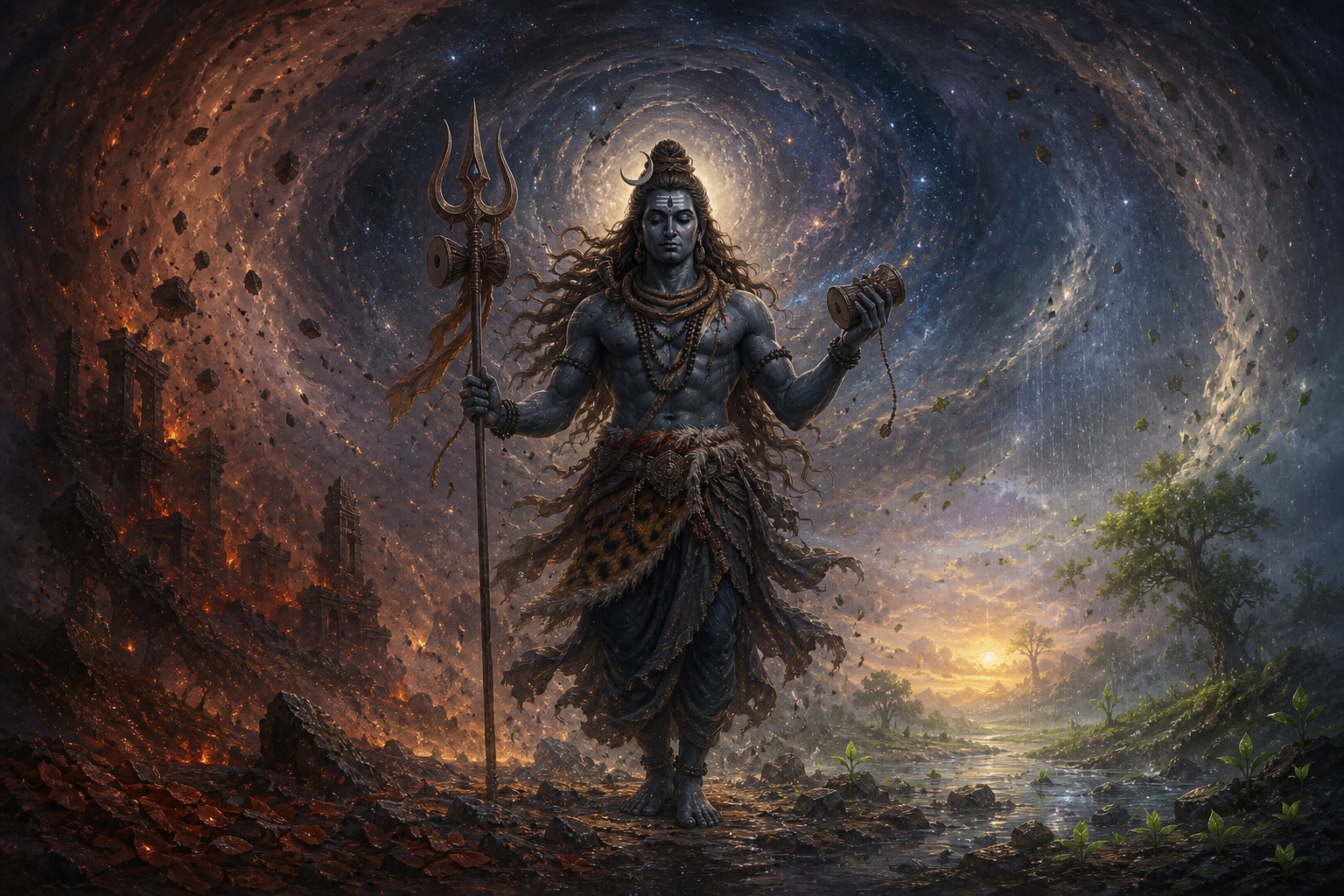
An ending has reached you, but its meaning is not yet clear. A role, relationship, habit, plan, or identity may no longer hold together. Should you keep preserving it, accept its dissolution, or begin again?
Kala Rudra offers a disciplined way to answer that question. This form of Shiva does not ask you to call every loss good. It asks you to see what time has exposed, release what has completed its work, protect the dharma that remains, and make renewal possible without pretending that dissolution is painless.
Destruction is not the enemy of creation

In the name Kala Rudra, Kala signifies time, change, and the inevitability of impermanence, while Rudra evokes a storm-like power of purification. Their conjunction is crucial. Kala Rudra is not destruction driven by resentment, appetite, or cruelty. It is dissolution within the larger movement of creation, preservation, and renewal.
Preservation is dharmic while it protects something living and worthy. It becomes attachment when you preserve a form merely because it is familiar. Time reveals the difference. A position may end while your responsibility to act honestly remains. A relationship may change while gratitude, restitution, or a clear boundary is still required. A practice may have served you once but now survive only as a defence against uncertainty.
This is why the fierce face of Shiva can also be understood as compassionate. Compassion here does not mean that every event is pleasant or that every loss was destined for your benefit. It means that falsehood, stagnation, and egoic certainty are not granted permanent protection. What cannot remain is eventually exposed. You then have a choice: cling to the failing form, or cooperate with truth while fulfilling the duties that have not ended.
Do not turn that principle into fatalism. If an injustice can be corrected, a promise can be kept, or a person can be protected, the teaching is not an excuse to stand aside. Accepting impermanence concerns your relationship to outcomes; it does not cancel intelligent action. Kala Rudra joins surrender to dharma rather than surrendering dharma itself.
Kala Rudra also should not be flattened into an interchangeable name for every time-related form of Shiva. Mahakala likewise expresses Shiva’s sovereignty over time, but related forms can carry distinct emphases in different traditions. For philosophical reflection, notice the resonance. For mantra, puja, or other lineage-specific practice, retain the name, method, and interpretation given by the tradition you actually follow.
Read the fierce imagery as a map of transformation
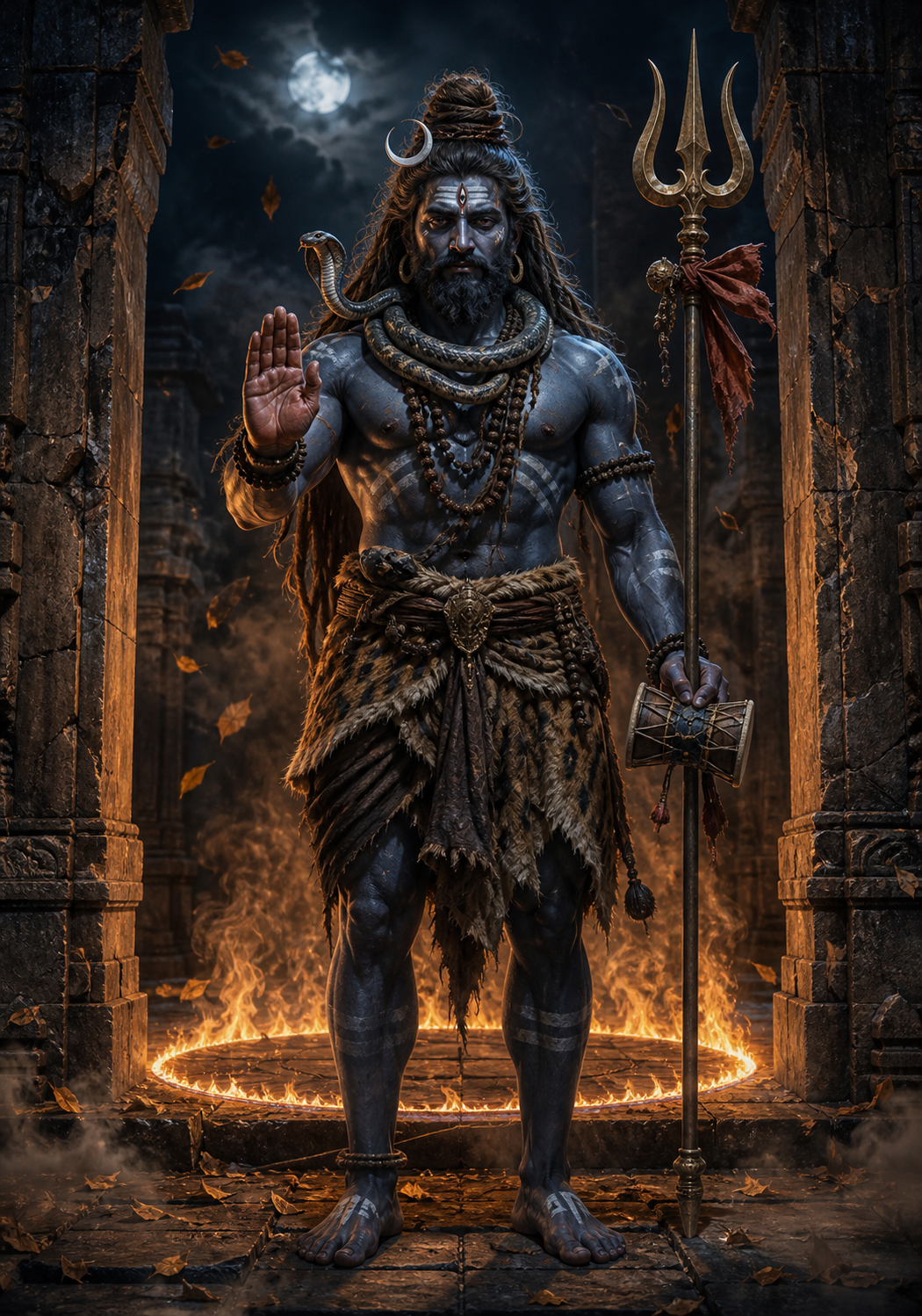
Kala Rudra does not have one universally fixed visual formula. Depictions vary in Purana lore and Shaiva Agama traditions. That variation matters: an image should be interpreted within its temple, text, lineage, or devotional setting rather than reduced to a single internet definition.
- The trishula: The trident can represent the piercing of threefold limitations. When you contemplate it, ask which limitation is actually binding you: the external situation, your interpretation of it, or the identity you believe must survive it.
- The damaru: The drum marks the pulse of becoming. Its presence beside fierce imagery prevents a one-sided reading. Dissolution is not the last movement; the possibility of a new rhythm is already present.
- The third eye: The third eye signifies awareness that sees beyond immediate appearances. Apply it by separating the painful fact from the story built around it. The fact may be that a role has ended. The story may be that you therefore have no worth.
- Ash, darkness, and skulls: An ash-smeared or dark form, sometimes accompanied by skull imagery, confronts the fate of embodied forms and constructed identities. The question is not whether a form will change, but whether you can recognize the consciousness, truth, or duty that is not exhausted by that change.
- Fire or a radiant halo: Fire can communicate both dissolution and illumination. What burns is not automatically worthless; it may have completed its season. Honour what was real without demanding that its former shape continue forever.
When you stand before such an image, resist the shallow question of whether the deity is angry. Ask three better questions: What is being dissolved? Which illusion made that dissolution seem impossible? What worthy possibility appears once the illusion no longer governs you?
The imagery is therefore diagnostic, not merely dramatic. The trident tests attachment. The drum prevents nihilism. The third eye asks for a wider field of awareness. Ash and fire make impermanence visible. Together, these symbols direct attention away from spectacle and toward the inner work demanded by change.
Use Kala Rudra when an ending becomes unavoidable

You do not need to romanticize your loss to contemplate Kala Rudra. Begin with accuracy. The following sequence is a practical reflection drawn from the symbolism; it is not presented as a replacement for a lineage’s prescribed worship.
- Name the form that is ending. Use a plain sentence: this position is over, this expectation is false, this habit is damaging, or this version of the relationship cannot continue. Do not enlarge the statement into everything is ruined. Kala concerns change in forms, not the careless denial of everything that remains.
- Separate the form from its function. Ask what the ending thing once provided: livelihood, belonging, discipline, status, companionship, or protection. You may need to release its old form while finding a more truthful way to meet a legitimate need.
- Identify the duty that survives. An ending does not erase every obligation. You may still need to keep a promise, return something entrusted to you, acknowledge harm, protect a dependent person, complete a handover, or state a boundary without ambiguity. Write down the remaining duty before deciding that you have let go.
- Locate the attachment beneath the grief. Grief and attachment are not identical. Grief honours significance. Attachment insists that reality must preserve a preferred arrangement. Ask which self-description you are defending: indispensable, successful, obeyed, blameless, secure, or always needed. That is often where ahankara resists time most strongly.
- Choose one act of closure and one seed of renewal. Closure might mean a truthful conversation, an apology, the return of an object, the ending of a recurring commitment, or a respectful memorial. The seed should be modest: one restored discipline, one honest boundary, or one duty resumed. Do not demand that the new life arrive fully formed.
Renewal often fails when it is used to escape closure. Replacing the job, relationship, label, or routine immediately can preserve the same attachment under a new name. Let the empty space show you what you were trying not to feel and which pattern you are tempted to repeat.
If grief remains after contemplation, the practice has not failed. Vairagya is wise detachment, not emotional numbness. You can mourn a form, value what it gave you, and still refuse to make its continuation a condition for living truthfully.
Within established Shaiva practice, Rudra may be invoked through hymns, homa, meditative recitation, and reflection during observances such as Mahashivaratri. If these forms belong to your tradition, let them contain the work rather than treating ritual as a mechanism for forcing a preferred outcome. If they are unfamiliar, seek guidance from the temple, acharya, or lineage responsible for the practice instead of inventing technical details.
Detachment must still answer to dharma
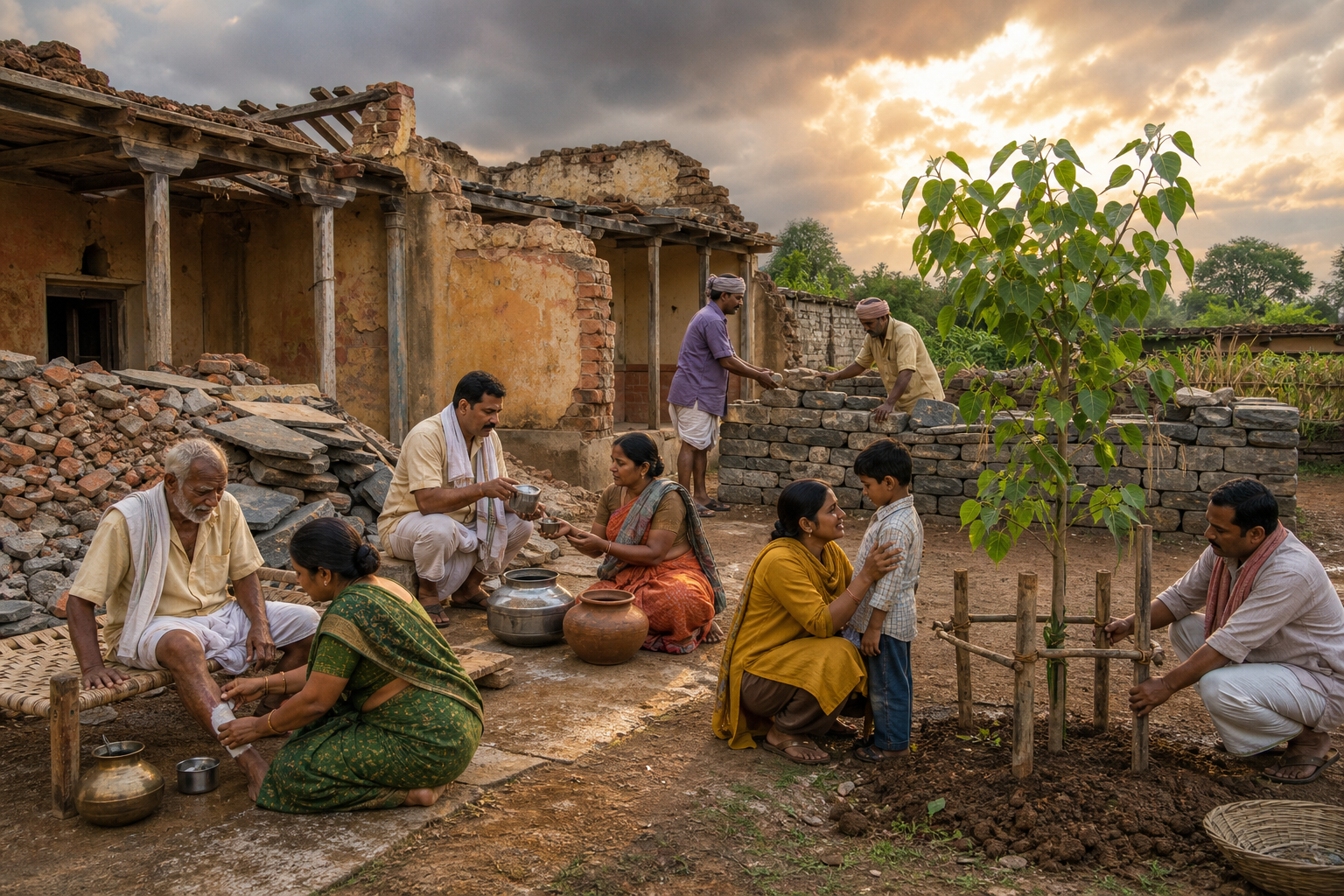
The language of destruction becomes dangerous when separated from ethical discipline. Kala Rudra does not sanctify impulsive rupture, violence, neglect, or the disposal of people once they become inconvenient. The object of inner dissolution is ignorance and possessiveness; the outer response must still be judged by truth, responsibility, and compassion.
| Common misreading | Dharmic correction |
|---|---|
| Everything ends, so nothing matters. | Because time is limited, your choices and duties matter more, not less. |
| Letting go means leaving without explanation. | Release attachment, but complete whatever truthful closure and responsibility the situation still requires. |
| Destruction is sacred, so destructive conduct is justified. | Kala Rudra represents purifying dissolution, not permission to glorify cruelty, recklessness, or revenge. |
| Detachment means that grief should disappear. | Vairagya removes possessive clinging; it does not require you to deny love, memory, or sorrow. |
| Renewal means replacing the old form immediately. | Allow the ending to reveal its lesson before rebuilding the same pattern under a different name. |
This disciplined response to impermanence has resonances across the Dharmic family. Buddhist anicca, Jain reflections on kala and continuous transformation, and Sikh teachings concerning Kaal each confront the instability of conditioned existence. The resemblance is meaningful, but it does not erase differences in theology, metaphysics, discipline, or the goal of practice.
When discussing these traditions together, use the language of resonance rather than claiming that they teach an identical doctrine. The practical meeting point is narrower and stronger: wisdom requires you to stop treating a changing form as though it were permanent. Each tradition then develops that insight through its own vocabulary and path.
Key takeaways for the threshold in front of you
- Kala Rudra presents time and dissolution as parts of transformation, not as proof that existence is meaningless.
- Acceptance is not passivity. Act against preventable harm, complete your duties, and release your demand to control every outcome.
- Use the fierce iconography to ask what is changing, which illusion is being exposed, and what remains worthy of protection.
- Distinguish grief from attachment: grief recognizes value, while attachment insists that a particular form must continue.
- Do not rush renewal. Complete one honest act of closure before choosing the next form.
- Recognize parallels among Dharmic traditions without collapsing their distinct teachings into a vague universalism.
Choose the ending that most needs your attention now. Name it without exaggeration, identify the duty that survives it, and complete one concrete act of closure. Then leave enough space for a new rhythm to emerge. That is a practical way to meet Kala Rudra: neither clinging to what time has taken nor abandoning what dharma still asks of you.
References
