

Perhaps your altar and mantra are Vaishnava, yet non-dual insight speaks to you and the Shakti symbolism of Puri will not fit the boxes you inherited. Your real question is probably not which label wins. It is how to let these truths deepen one sadhana without turning Bhagavan into an abstraction or Tantra into decoration.
Start with a disciplined synthesis: keep relationship at the level of devotion, non-separation at the level of ultimate reality, and Shakti at the level of divine activity. Puri holds Vaishnava worship, Shakta sanctity and Tantric symbolism within one ritual world, while the Srimad Bhagavata Purana allows devotion and knowledge to illuminate the same Supreme Reality. You can learn from both without pretending that every distinction has disappeared.
Hold relationship and non-separation at the same time
Bhakti begins with the grammar of address. You call a divine name, offer pranam, remember a lila, receive prasada and serve Bhagavan. Love requires a genuine relationship: worshipper and worshipped, servant and Lord, lover and beloved. If you erase that relationship too early, devotion becomes an intellectual statement about oneness rather than a living encounter.
Non-dual insight asks a different question: can anything possess an existence wholly independent of the Absolute? In the Brahmavada vision, the body, mind, ego and phenomenal universe do not stand outside Brahman as a second self-sufficient reality. They arise as varied expressions dependent upon the one ground. The wave has a recognisable form, but it has never acquired a substance separate from the ocean.
Tantra adds the language of power and manifestation. The Absolute is not treated as a sterile stillness. Shakti is the potency through which consciousness appears, moves, transforms and sustains. Purusha and Shakti can therefore be distinguished in contemplation without being torn into two unrelated absolutes.
- Bhakti tells you how to relate: approach Bhagavan with love, humility and service.
- Jnana tells you how to see: do not mistake temporary boundaries for independent existence.
- Tantra tells you what to notice: divine power is active in embodiment, ritual, transformation and the movement of life.
These are complementary angles, not interchangeable slogans. Advaita Vedanta is a particular philosophical tradition, and not every Vaishnava school accepts its account of the soul, world and Brahman. A responsible synthesis therefore does not announce that all Vaishnavas are secretly Advaitins. It observes that Brahman, Paramatman and Bhagavan can disclose different dimensions of the one Supreme Reality while leaving room for schools to explain their relationship differently.
Use a practical test. If non-duality makes you dismiss murti, mantra or loving service as inferior, you have allowed an idea to impoverish your bhakti. If devotion makes you imagine that Bhagavan is merely one finite being competing with others, you have lost sight of the Absolute. Hold intimacy without reducing infinity, and hold infinity without dissolving intimacy.
Let the Jagannath trinity make the synthesis visible
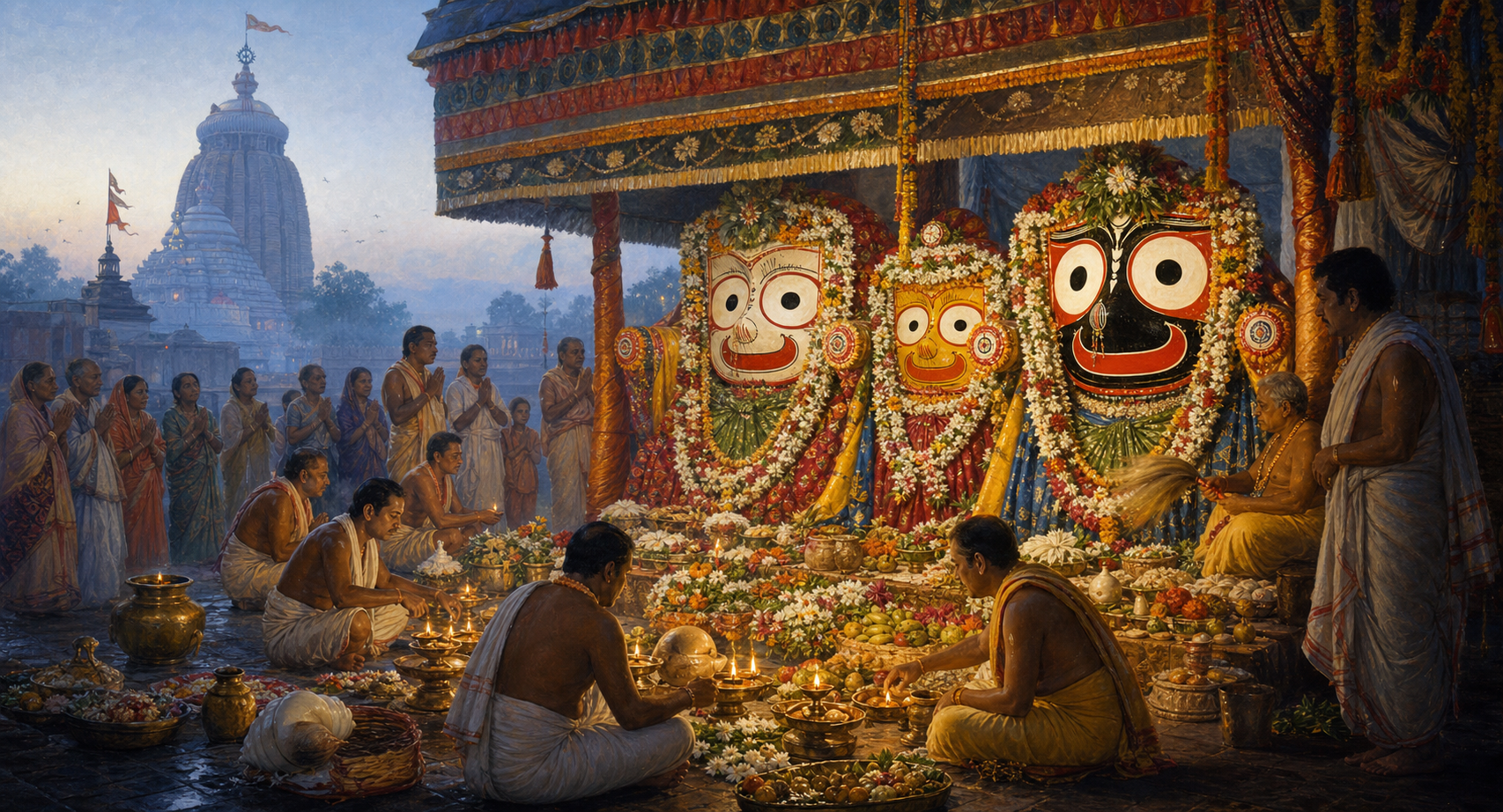
Jagannath, Subhadra and Balabhadra offer a concrete way to contemplate this balance. Their forms remain beloved deities within Vaishnava worship, but Tantric readings also see a living circulation of consciousness, transformative power and stabilising support. The second reading need not cancel the first.
| Deity | Contemplative lens | Question for your practice |
|---|---|---|
| Jagannath | Expansive consciousness, compassionate presence and Purusha | Can you remain spacious enough to see clearly before reacting? |
| Subhadra | Adi Shakti, Prakriti and catalytic transformation | Which energy in you needs direction rather than suppression? |
| Balabhadra | Stabilising strength, protective prana and sustaining support | What vow or dharmic responsibility must you hold steady? |
This table is a contemplative map, not a final code that exhausts the deities. Jagannath is not merely an impersonal awareness exercise. Subhadra is not merely psychological energy. Balabhadra is not merely personal willpower. The symbols help you notice aspects of divine reality; they do not reduce the divine forms to those aspects.
Other interpretations align the trinity with ida, pingala and sushumna, the subtle channels associated with pranic movement. A guna-based lens associates Subhadra with activating rajas, Balabhadra with clarifying sattva, and Jagannath’s depth with tamas absorbed and transformed. These mappings are best treated as parallel aids to contemplation. If you force all of them into a single rigid diagram, the symbol becomes harder to understand rather than clearer.
Puri’s ritual life prevents the synthesis from remaining an abstract theory. Bimala Devi has a shrine within the temple complex, and Mahaprasad receives its sacred completion through offering to Bimala Devi before distribution. Vaishnava devotion does not lose its identity by honouring Shakti here. Shakta sanctity participates in the fullness of the sacred meal.
That ritual fact gives you a useful principle: integration is strongest when each form is honoured, not when every form is renamed as something else. You do not have to make Devi a decorative appendage to Vishnu, nor make Jagannath a disguise for an unrelated doctrine. Let relationship reveal unity without making difference meaningless.
Read sacred symbols as doors, not replacement definitions
A symbolic reading becomes unreliable when it claims to be the only permissible meaning. The same triad can illuminate theology, subtle embodiment, the gunas and personal discipline because a sacred symbol exceeds any single explanatory scheme. Multiplicity of meaning is not licence for arbitrary invention, however. You still need boundaries.
- Begin with the deity, not your preferred concept. Receive Jagannath, Subhadra and Balabhadra as sacred forms before translating them into consciousness, energy or psychology.
- Identify the kind of claim you are making. Temple ritual, theological doctrine and contemplative analogy are not the same category. Say that a symbol can be contemplated in a certain way rather than declaring that it can only mean that one thing.
- Keep interpretation answerable to sadhana. A useful reading should deepen reverence, concentration, ethical steadiness or service. An interpretation that mainly displays cleverness has missed the devotional centre.
- Do not build esoteric certainty from suggestive correspondences. A nadi or guna association can guide reflection without authorising you to invent mantras, force the breath or assemble a private ritual system.
- Protect real differences between traditions. Shared insight does not require identical vocabulary, metaphysics or methods.
The last boundary matters when speaking about the wider dharmic family. Vaishnava compassion and seva can resonate with Buddhist karuna, Jain ahimsa and self-discipline, and Sikh seva and oneness. That resonance gives Hindu, Buddhist, Jain and Sikh practitioners genuine ground for mutual respect. It does not prove that all four traditions make the same claims about God, self, liberation or the world.
Use precise language. Say that two practices share an ethical orientation when that is what you mean. Say that a teaching offers a comparable contemplative insight when the metaphysical identity remains disputed. Religious pluralism becomes more credible when it respects difference instead of erasing it.
Turn the synthesis into a grounded Vaishnava practice
You do not need to settle every philosophical dispute before the synthesis becomes useful. You need a sequence that gives devotion, awareness, energy and responsibility their proper places.
- Begin with address. Offer pranam and practise your customary nama-japa or prayer. Approach Bhagavan as a real presence rather than using the divine name as a technique for obtaining an altered state.
- Rest in awareness. When the prayer becomes quiet, notice that sensations, thoughts and emotions arise within awareness. Do not fight them, and do not announce that your individual personality has vanished. Simply stop treating each passing movement as the whole of who you are.
- Recognise Shakti in the movement. Name the energy actually present: longing, irritation, courage, grief, creativity or the pressure of an unfinished duty. Ask how that force can be directed toward dharma instead of indulged or denied.
- Call upon stabilising strength. Choose one concrete responsibility that will hold the insight in place: keep a promise, complete neglected work, speak truthfully, restrain a harmful impulse or support someone through seva.
- Return the fruit to Bhagavan. Do the chosen action as an offering. This prevents non-dual reflection from becoming self-absorption and prevents talk of Shakti from becoming fascination with personal power.
If the Jagannath trinity is part of your devotional world, you can use a plain-language prayer: “Jagannath, let me see with spaciousness. Subhadra, turn this energy toward dharma. Balabhadra, give me strength to keep the vow.” This is a reflective prayer, not a lineage mantra. Keep inherited or initiated practices in the form given by the tradition and seek qualified guidance before undertaking esoteric ritual or forceful pranayama.
Ratha Yatra can extend the same contemplation into community life. The outward movement of the chariots can serve as an image of prana moving through embodied life, while collective darshan reminds you that awakening is not a private possession. Let the occasion move you toward service and shared reverence, not merely toward collecting an unusual interpretation.
Key takeaways
- Non-duality need not erase the loving relationship between devotee and Bhagavan.
- Tantra contributes attention to Shakti: the divine power that manifests, moves and transforms.
- Jagannath, Subhadra and Balabhadra can be contemplated as consciousness, transformative energy and stabilising support without reducing them to those functions.
- Puri’s honouring of Bimala Devi shows integration through ritual relationship, not through the erasure of Vaishnava and Shakta identities.
- Symbolic mappings are contemplative lenses, not permission to invent esoteric practices or declare one exclusive decoding.
- The fruit of synthesis should appear in clearer awareness, steadier vows, compassion and seva.
At your next sadhana, do not try to solve the whole metaphysics at once. Keep relationship in prayer, non-separation in silence, Shakti in responsible action and strength in the vow you actually keep. If one layer weakens reverence or duty, simplify the practice. If the layers deepen devotion and make your conduct more dharmic, the synthesis is doing useful work.



References
- DharmaRenaissance Blog — Jagannath’s Tantric Trinity: Unveiling Adi Shakti at Puri and the Harmony of Dharmic Paths
- DharmaRenaissance Blog — Brahmavada in the Srimad Bhagavata Purana: Unveiling Non-Dual Wisdom that Unites Dharmic Paths
