

If you stand before Kapāla Bhairava and see only skulls, weapons, blazing eyes and a dog, the image can look like a celebration of violence. That reading misses its governing logic. The fierce form confronts you with mortality and consequence so that fear can become vigilance rather than panic.
The key is to read the figure as a complete theological system. The skull, gestures, implements, ornaments, mount and location explain one another. Once you know how those elements work together, you can distinguish sacred ferocity from cruelty and approach the image with a more disciplined form of darśana.
Begin with the exchange between fear and protection
Śaiva Tantric tradition hears several related meanings in the name Bhairava: the power that frightens complacency, the guardian who removes fear, and the overwhelming presence that breaks ignorance open. These aren’t competing personalities. They describe a single spiritual movement in which what first appears terrifying becomes protective when its purpose is understood.
That movement should guide the way you look. Don’t begin by asking whether every weapon is benevolent or malevolent in isolation. Begin by asking what the whole figure is guarding, exposing or transforming.
- Take in the posture and gaze. A forceful stance, prominent eyes and rising or dishevelled hair are meant to arrest inattentive seeing.
- Look at the hands. Find the skull-bowl first, then identify the trident, drum, sword, noose, staff or protective gesture that accompanies it.
- Examine the body. Ash, snake ornaments, a skull garland, bone ornaments and a tiger-skin garment place ordinary social identity under the sign of impermanence.
- Notice the marks of Śiva. The third eye and crescent moon connect the fierce guardian to Śiva’s vision and cyclical time; Kapāla Bhairava isn’t a power independent of Śiva.
- Read the surroundings. The dog, cremation ground, gate or temple perimeter tells you that this is a deity of boundaries, transitions and vigilant protection.
This order prevents a common mistake: identifying a deity from a dramatic object while ignoring the rest of the image. Several Bhairava forms share weapons, ornaments and fierce expressions. Kapāla Bhairava becomes legible through the conjunction of skull-bearing, Bhairava’s protective vocabulary and a liminal setting.
The skull represents consequence accepted, not cruelty admired

Kapāla means skull, but the skull’s meaning depends on the myth carried with it. In the pan-Indic narrative behind the skull-bearer, Śiva severs Brahmā’s fifth head and then undertakes a kapālika vow, bearing the skull until the consequence is dissolved at Kapālamocana Tīrtha. The theological centre of the story is accountability under cosmic and moral law.
The skull therefore doesn’t function as a trophy. It is a burden consciously carried. Even an act performed by immense divine power remains within a moral universe in which consequence must be faced. Sovereignty is shown not as exemption from dharma but as the capacity to accept restraint, complete a vow and restore order.
This distinction changes the devotional question. Instead of asking, “Why is this deity holding something so frightening?”, ask what the deity refuses to conceal. The skull exposes the destination of embodied status, pride and self-importance. It also asks whether you can acknowledge the results of your own actions without denial or self-dramatisation.
Do not collapse every skull symbol into the same meaning
- The hand-held kapāla, or skull-bowl, emphasises consequence received and karmic residue brought into a field of transformation.
- The muṇḍamālā, or garland of skulls, announces mastery over the theatre of death rather than escape from death’s reality.
- The khaṭvāṅga, a staff that may carry a skull at its top, compresses the lesson of impermanence into an ascetic implement.
- Bone ornaments and the cremation-ground setting extend the same teaching to the body and its identities: what appears permanent is provisional.
These forms reinforce one another, but they aren’t interchangeable labels. When describing an image, say whether you see a bowl, a garland or a skull-topped staff. That small discipline makes the difference between observing the icon and merely repeating that it contains skulls.
Read every attribute as an action, not an accessory
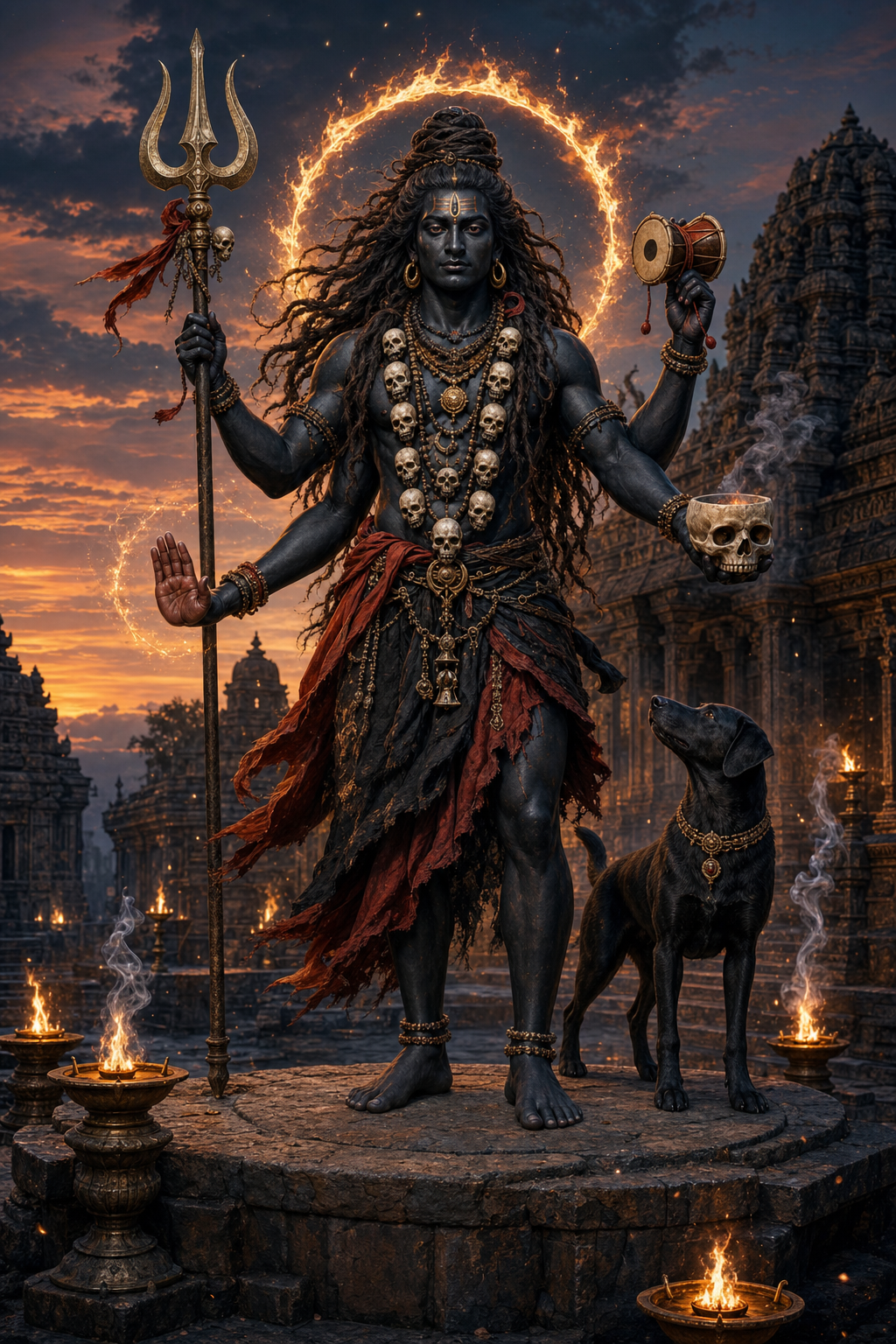
Kapāla Bhairava’s attributes form a grammar. Each one tells you what the fierce presence does, while the cluster tells you how protection, time, manifestation, death and awareness belong together. The recurring visual vocabulary remains stable even when arm counts and individual implements vary.
| Feature | Theological action | What you should notice |
|---|---|---|
| Kapāla | Receives and transforms the residue of action | The skull is held with command, but its moral weight is not denied. |
| Triśūla | Asserts clarity across past, present and future | The weapon belongs to an intelligence that sees consequence through time. |
| Ḍamaru | Sounds the pulse of manifestation | Dissolution isn’t the whole story; emergence and rhythm remain present. |
| Three eyes | Intensify vision beyond ordinary sight | The fierce gaze exposes what habitual perception avoids. |
| Crescent moon | Maintains continuity with Śiva and cyclical time | Kapāla Bhairava is a focused Śaiva manifestation, not an isolated spirit. |
| Dog | Keeps watch at a boundary | The mount links the deity to the edge between settlement and wilderness, life and death, and sacred precinct and exterior space. |
| Abhaya gesture | Dispels fear | A protective hand beside fierce attributes makes the apparent paradox explicit. |
Four-armed forms commonly carry the kapāla, triśūla and ḍamaru, with a sword, noose or another implement completing the group. Eight-armed forms can expand this vocabulary and may include the khaṭvāṅga. Regional sculptors and ritual lineages don’t always arrange these objects identically, so arm count alone is not a reliable name tag.
For practical identification, look for a cluster: a confidently held skull-bowl; the dog as vāhana; skull or bone ornaments; Śaiva implements such as the trident and drum; and a cremation-ground or boundary context. If a damaged sculpture preserves only a weapon or a fierce face, “a Bhairava form” may be a more responsible identification than “Kapāla Bhairava” unless the temple’s living tradition supplies the name.
The threshold explains both the theology and the ferocity

Bhairava images often occupy places where categories meet: a city gate, temple edge, corner of a sacred campus or cremation ground. These are not decorative placements. A threshold is where order is most exposed to intrusion and where a person passes from one condition into another. The guardian belongs there because boundaries require discernment as well as force.
The dog makes the same point in animal form. As a sentinel associated with the margin between settlement and wilderness, it embodies attention at the edge. In Kāśī, Bhairava is honoured as the city’s kotwāl, or chief guardian. Comparable civic and spiritual guardianship appears at Ujjain and Kathmandu. The Kāśī Khaṇḍa of the Skanda Purāṇa preserves Bhairava’s connection with Vārāṇasī, while temple Āgamas place Bhairava shrines at protective points around sacred precincts.
The cremation ground is the most radical threshold because it removes social camouflage. Rank, possession and bodily self-image can’t survive its lesson. Ash, skulls, bones and tiger skin turn that lesson into a visible discipline: look directly at impermanence, loosen attachment and remain awake enough to act with compassion.
Certain Tantric maṇḍalas honour Kapāla Bhairava as Lord of the Sixth Circle. Don’t treat that title as a universal address or assume that “circle” automatically means a bodily chakra. It belongs to particular concentric maṇḍala arrangements. In that setting, the station marks a zone where protection and moral order meet the passage between death and rebirth. Directional assignments and maṇḍala schemes differ among lineages, so a local ritual tradition should govern the local identification.
Kapāla Bhairava may also be placed among the Aṣṭa Bhairavas and within expanded arrays of sixty-four Bhairavas. The larger array distributes functions of protection, time, dissolution and transformation across ritual space. It doesn’t turn the deities into a competitive ranking. The useful question is which protective function a given form concentrates and how that function relates to its place in the maṇḍala.
Compare Dharmic parallels by function, not by erasing difference
Skull-cups and the khaṭvāṅga also appear in Vajrayāna settings with deities such as Vajrayoginī and Mahākāla, where they participate in disciplines of confronting impermanence and transforming inner poisons. Jain devotion incorporates protectors such as Nakoda Bhairav into the life of a community committed to ahiṁsā and discipline. Sikh tradition doesn’t centre this iconographic system, yet nirbhau, fearlessness, and nirvair, freedom from enmity, resonate with its ethical destination.
These are civilisational resonances, not permission to declare every protector identical. When you compare traditions, compare the work a symbol performs—guarding a boundary, exposing impermanence or transmuting fear—while preserving the name, doctrine and practice of each tradition.
Let the image produce discipline in ordinary life

Kapāla Bhairava’s theology isn’t completed by recognising objects correctly. The icon asks for a corresponding change in conduct. Its most accessible disciplines are ethical clarity, steady attention and responsibility toward beings who depend on human care.
- Settle your attention before naming the deity’s attributes. A measured breath gives you enough space to see rather than react.
- Bring a real fear or avoided consequence to mind. Keep it concrete: a truth you haven’t spoken, a duty you have postponed or an attachment whose impermanence you refuse to face.
- Move visually from the skull to the eyes, implements, protective gesture, dog and threshold. Let each feature test a different response: accountability, clarity, rhythm, vigilance and courage.
- If you make an offering, follow the temple or lineage in front of you. Contemporary practice in many Hindu communities uses sattvic and symbolic offerings aligned with ahiṁsā, including mustard-oil lamps, black sesame, fragrant ash and humble grains. A fierce image doesn’t by itself authorise a harmful offering.
- Complete the worship through conduct. Truthful action, restraint, care for dependants and humane care for dogs translate the guardian’s symbolism into dharma.
Kālāṣṭamī provides a sacred time for this discipline. It is observed on the kṛṣṇa-pakṣa aṣṭamī of Mārgaśīrṣa, although regional calendars vary, so use the calendar of the temple or community whose observance you are joining. Cleanliness, restraint and remembrance of mortality give the vrata its substance. Feeding or protecting dogs makes the vāhana’s symbolism tangible through care for a living being.
For recitation, the living tradition attributes the popular Kālabhairavāṣṭakam to Ādi Śaṅkara. Its devotional form offers an accessible meeting point between bhakti and contemplation. If your temple or guru provides a particular mantra or ritual order, that lineage-specific instruction should take precedence over a generic sequence.
Key takeaways
- The kapāla signifies mortality, accepted consequence and transformation; it is not an ornament glorifying cruelty.
- Bhairava’s terrifying and protective aspects belong to the same movement from complacency through confrontation to fearlessness.
- Identify Kapāla Bhairava from a cluster of features, especially the skull-bowl, dog, Śaiva implements, bone or skull ornaments and liminal setting.
- The Sixth Circle and directional placement are lineage-specific maṇḍala assignments, not universal rules for every Kapāla Bhairava image.
- The clearest devotional response is disciplined conduct: truthful living, non-harm, steady attention and concrete care for vulnerable beings.
The next time you encounter Kapāla Bhairava, don’t hurry past the fearsome surface. Locate what is carried, what is guarded and what is being stripped away. Then leave the shrine having accepted a concrete responsibility. That is where the skull-bearer’s iconography becomes theology lived under dharma.
References
