
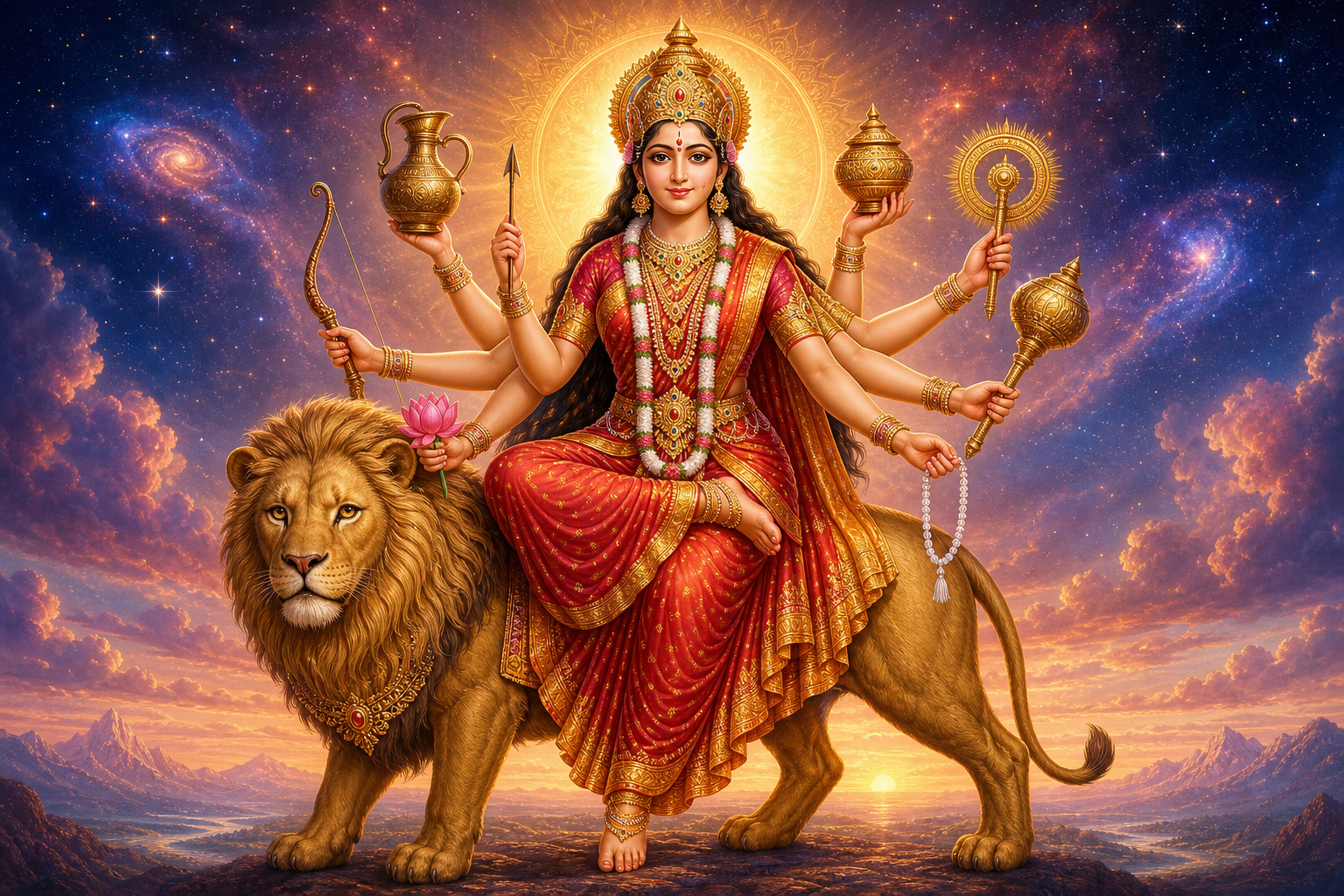
If you are looking at Goddess Kushmanda during Navaratri and can identify the lion but not everything in her eight hands, begin with the implements rather than the number. Each one answers a practical question: What should you create, sustain, discipline, defend, renew, or transform?
The image becomes much clearer when you read the hands as one coordinated teaching. Purity without strength is vulnerable. Strength without discipline becomes reckless. Action without remembrance loses its direction. Kushmanda holds these capacities together so that spiritual practice can become dharmic conduct.
Why Kushmanda has eight arms
The name Ashtabhuja tells you where to begin: ashta means eight and bhuja means arms. The title describes Kushmanda’s visible form, but the arms are not merely a display of multiplied power. They allow several cosmic and ethical functions to appear at once.
A traditional devotional etymology interprets Kushmanda as ku, the minute or subtle; ushma, heat or energy; and anda, the cosmic egg. Her name therefore evokes the subtle warmth through which unmanifest possibility becomes a living cosmos. Her solar radiance is associated with Surya and with the vitality, nourishment, and order that make life sustainable.
This cosmology changes how you should view the eight hands. They are not eight unrelated powers collected by a deity. They show creative energy becoming responsible order: bringing forth life, preserving what is worthy, confronting disorder, and transforming what can no longer remain as it is. In the familiar triad of srishti, sthiti, and samhara, creation, preservation, and transformative dissolution belong to one Shakti.
The lion completes the composition. It signals courage and dharmic sovereignty, reminding you that compassion is not passivity. The weapons in Kushmanda’s hands are protective, while the vessels, lotus, and mala ensure that protection remains joined to purity, nourishment, and spiritual discipline.
Read the eight hands as a map of dharmic action
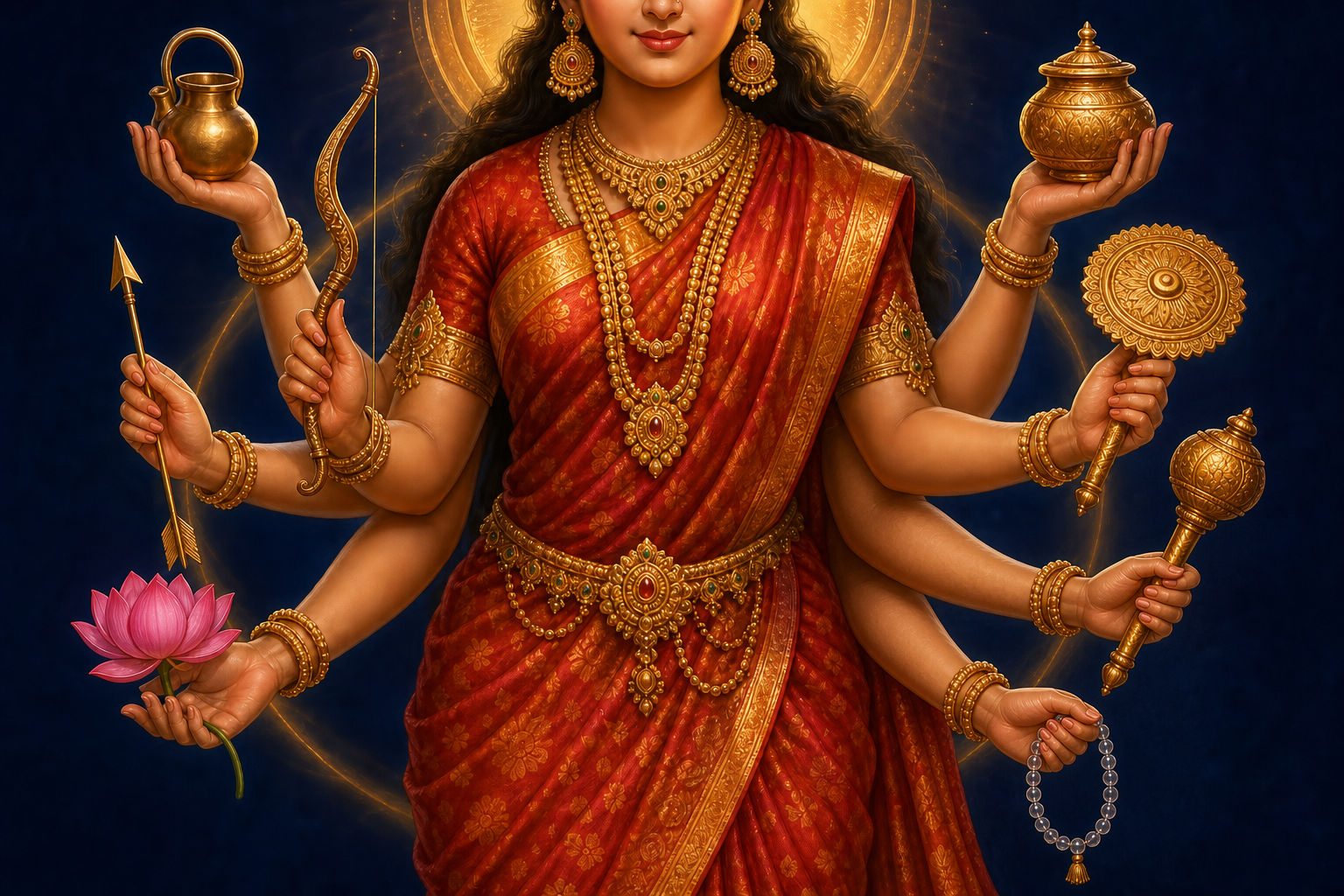
A common eight-hand inventory consists of the kamandalu, bow, arrow, lotus, amrit kalash, japa mala, chakra, and gada. Some depictions use a trishula in place of the gada. That variation is not a mistake, so identify the implement actually present in the murti or image before assigning its meaning.
| Emblem | Primary meaning | Question for your practice |
|---|---|---|
| Kamandalu | Purity and the originating waters of life | What must be cleansed before something worthy can begin? |
| Bow | Disciplined intention and readiness | Where do you need to gather your attention instead of scattering it? |
| Arrow | Directed action and protection | What precise action must now follow your intention? |
| Lotus | Purity unfolding amid change | How can you remain inwardly clear without withdrawing from the world? |
| Amrit kalash | Healing, nourishment, and renewal | What life-giving responsibility has been neglected? |
| Japa mala | Mantra, repetition, and the measured rhythm of practice | Which discipline must be repeated after enthusiasm fades? |
| Chakra | Cosmic order and the protection of dharma | What principle must remain firm when convenience pulls you away from it? |
| Gada or trishula | Fortitude and the removal of obstacles | Which obstruction requires courage rather than avoidance? |
The bow and arrow are especially important as a pair. The bow represents collected intention; the arrow is that intention released as exact action. If you repeatedly make resolves but do not act, contemplate the arrow. If you act impulsively without examining aim or consequence, return to the bow.
The gentler-looking objects are equally demanding. The lotus does not ask you to escape difficult conditions; it asks whether you can preserve clarity while moving through them. The kamandalu points to a clean beginning, while the amrit kalash asks whether your choices replenish life. The japa mala then introduces the element that dramatic moments often lack: sustained repetition.
Do not read the chakra, gada, trishula, bow, and arrow as endorsements of anger. Their symbolic work is the defense of dharma and the removal of obstruction. Kushmanda’s other hands place limits on force: action must answer to purity, nourishment, remembrance, and order. That balance is part of the teaching, not a decorative addition to it.
The whole form matters more than any isolated emblem
You can group the implements into three movements without locking any one symbol into a single meaning. The kamandalu, lotus, and amrit kalash evoke life, purity, and renewal. The japa mala and chakra sustain rhythm and order. The bow, arrow, and gada or trishula meet threats and obstacles. Creation needs protection; protection needs discipline; discipline must remain life-giving.
The eight arms also evoke the eight directions, or ashta dik. The useful implication is ethical consistency. Dharma cannot govern only the part of life visible during puja. It has to extend toward family, livelihood, speech, study, service, conflict, solitude, and public responsibility. The directional symbolism asks you to notice where your values stop traveling with you.
Another contemplative lens connects Ashtabhuja with the ashta-siddhis: anima, mahima, garima, laghima, prapti, prakamya, ishitva, and vashitva. These are traditionally presented as extraordinary attainments, but chasing unusual powers is a poor way to approach Kushmanda’s form. The more useful reading is inward and ethical: mastery over impulse, steadiness of awareness, and the ability to place power under the authority of dharma.
Notice, then, that no hand is sufficient alone. The arrow needs the bow’s restraint. The gada needs the lotus’s purity. The kalash needs the chakra’s order if nourishment is to be protected and distributed rightly. The mala keeps every resolve from becoming a temporary mood. Ashtabhuja is a theology of balanced capacities.
Use the image as a focused Navaratri practice
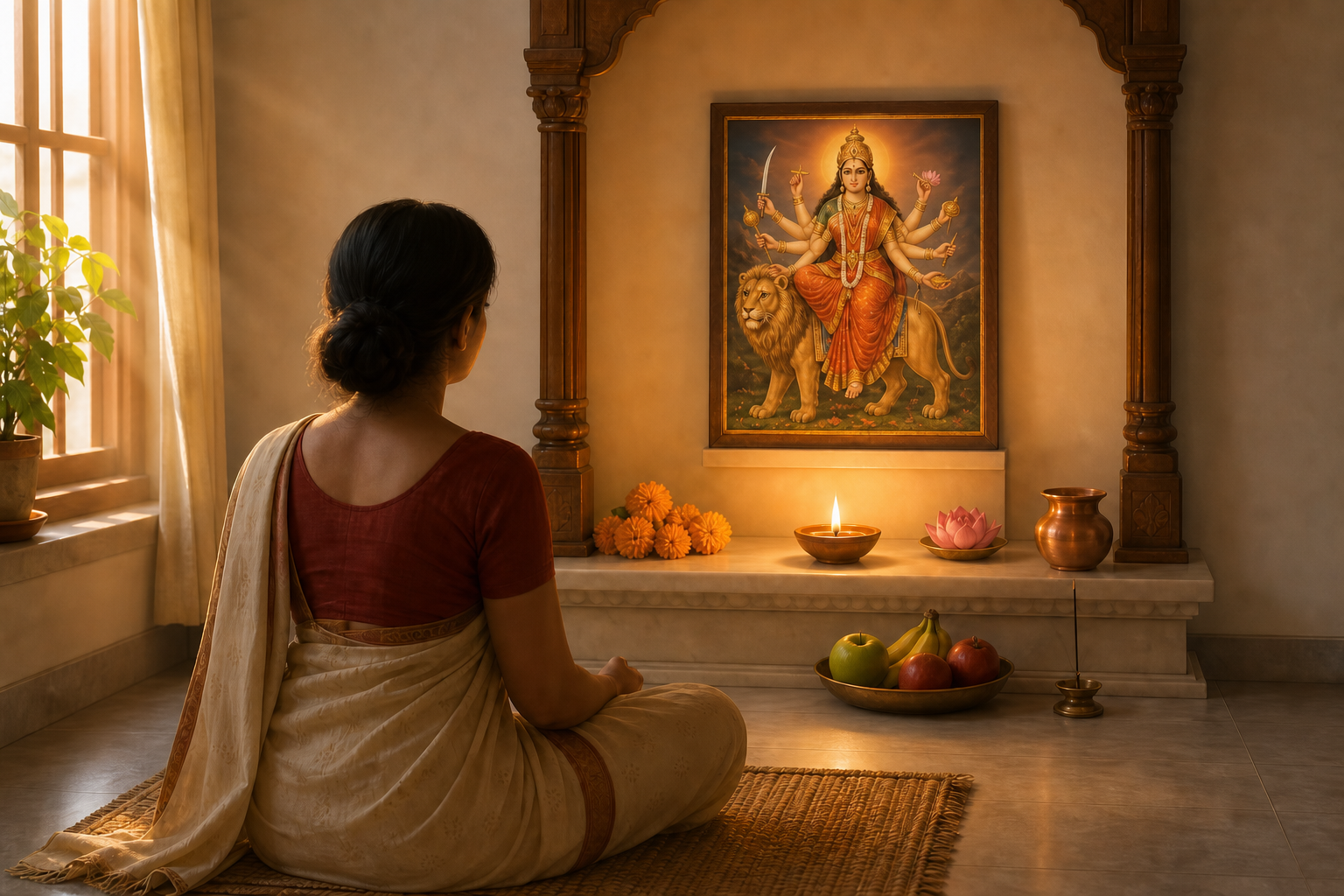
Kushmanda is worshipped on Navaratri’s fourth day, when devotees may contemplate her sun-like radiance and offer a deepa. If you already follow a family or sampradaya-specific puja, keep that practice primary. The following reflection can accompany it without pretending that every Hindu lineage uses an identical ritual method.
- Begin with the whole form. Look at Kushmanda, her lion, and all eight hands before selecting a favourite attribute. This prevents courage, prosperity, protection, or another desired quality from being separated from the rest of her teaching.
- Name the implements you can identify. If one object differs from a familiar chart, observe the actual image rather than forcing it into a standardized list. A gada-trishula variation changes the visual vocabulary without overturning the form’s larger meaning.
- Find the imbalance. Ask where intention has failed to become action, where action has lost compassion, where nourishment lacks order, or where practice has become irregular. Choose the question that points to a real duty rather than the one that sounds most elevated.
- Let one hand guide one observable act. Renew neglected japa, complete an avoided responsibility, offer practical care, correct disorder, or meet an obstacle without hostility. Keep the act small enough to perform and definite enough to recognize.
- Return to the complete image. Close by remembering that the selected emblem operates with the other seven. The aim is not to develop one impressive quality but to restore balance among clarity, discipline, compassion, resilience, devotion, wisdom, protection, and responsible action.
This method keeps contemplation from ending as image appreciation. The mala becomes a repeated practice. The arrow becomes a completed duty. The kalash becomes nourishment offered where it is needed. The chakra becomes an order you protect in your own conduct. Symbolism becomes sadhana when it changes what you do next.
Three questions that prevent common misreadings
Are the eight arms literal or symbolic?
They are literal features of Kushmanda’s sacred iconography and symbolic expressions of her functions. You do not have to reduce one to the other. The visible form gives devotion something concrete to encounter, while its emblems teach you how creative energy, protection, discipline, and nourishment belong together.
Do the arms guarantee the eight siddhis?
No such transactional conclusion follows from the symbolism. The siddhis provide one interpretive lens for contemplating mastery, but the sound practical emphasis is self-governance rather than the pursuit of occult ability. If fascination with powers makes conduct less humble, less disciplined, or less dharmic, it has displaced the central lesson.
Does the symbolism have meaning beyond Hindu worship?
Kushmanda is a Hindu form of Devi and should be understood within that devotional identity. At the same time, discipline, compassion, self-mastery, service, and luminous awareness resonate across the wider Dharmic family, including Buddhist, Jain, and Sikh traditions. Recognizing those affinities need not erase the distinct theology or practice of any path.
When you next stand before Kushmanda, do not strain to memorize a catalogue. Identify the hand that exposes a present imbalance, place its message beside your actual duty, and act before the insight becomes merely decorative. Then return to all eight hands, because her deepest instruction is not isolated power but power held in dharmic balance.
References
