

You may be asking Krishna for one concrete outcome: a relationship restored, an opportunity granted, a conflict resolved, or a burden removed. The desire itself may be understandable. The harder question is what to do when wanting that result begins to dominate your japa, determine your mood, or make you wonder whether Krishna is listening.
You don’t have to hide your desire behind religious language. You do need to stop treating your preferred outcome as the test of Krishna’s care. In the Vaishnava approach considered here, surrender is not the absence of desire. It is the discipline of placing desire before Krishna, doing the duty that remains yours, and allowing devotional practice to change the person who is asking.
Ask honestly without turning prayer into a bargain
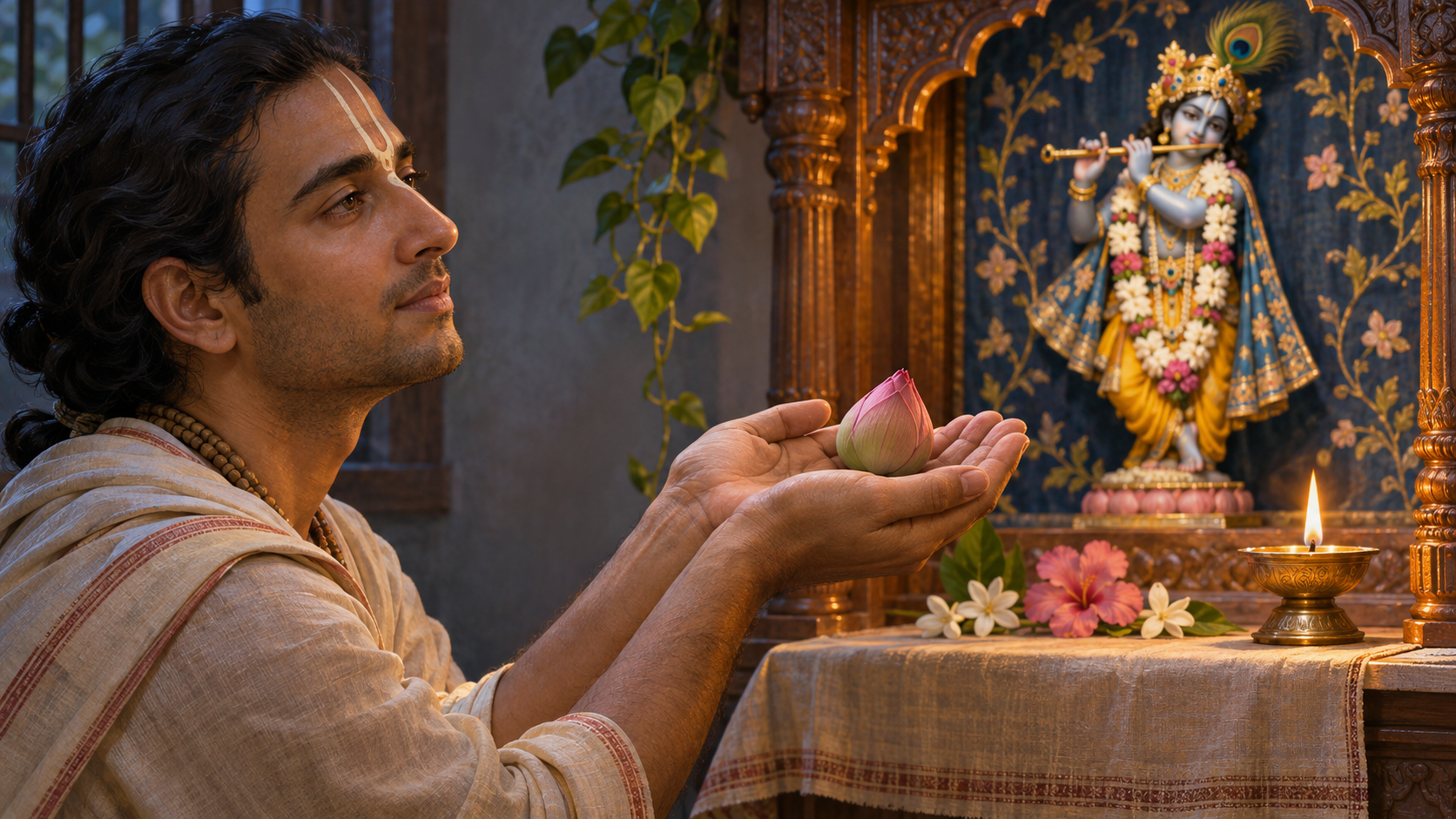
Desire, prayer, and demand are not the same thing. Desire says, This is what I want. Prayer says, I will place what I want before Krishna. Demand says, If Krishna loves me, He must give me this in the form and at the time I have chosen.
The movement from desire to surrender begins with that distinction. You can ask plainly. You can ask repeatedly. But you cannot make the requested result the price Krishna must pay for your devotion.
Dhruva’s encounter with Narada gives this problem a sharp form. Narada was capable of helping him, yet he did not simply bypass the spiritual process and hand Dhruva everything he sought. He directed Dhruva toward devotional discipline because the seeker needed more than the desired object; he needed a transformed relationship with Krishna. Immediate satisfaction would not have done the deeper work.
Before repeating a request, examine it with three questions:
- If I receive this, how will it affect my remembrance, conduct, and service?
- If I do not receive it, what duty will still remain mine?
- Am I asking Krishna for guidance, or asking Him to endorse a decision I have already made?
Do not manufacture the pious answer. If you want recognition, security, relief, companionship, victory, or control, name it accurately. A concealed desire still directs you; it simply becomes harder to offer.
Let prayer clarify your duty instead of replacing it

Surrender is often confused with passivity. The confusion is convenient: waiting for a divine intervention can spare you from a difficult conversation, a necessary apology, sustained preparation, or an unpopular decision. But devotional surrender does not mean asking Krishna to perform the part of the work assigned to you.
Krishna stood with Arjuna at Kurukshetra, yet He did not make Arjuna’s responsibility disappear. Arjuna was instructed to remember Krishna and act. The point for you is not to imitate the battlefield or turn anger into religion. It is to join remembrance to the legitimate duty directly in front of you.
After praying, state your next duty as a verb: call, listen, apologize, apply, prepare, study, decline, repair, serve, or wait. Then distinguish that action from the result you cannot command. You may be responsible for speaking truthfully, but not for controlling the other person’s response. You may be responsible for preparing well, but not for guaranteeing success. You may be responsible for correcting harm, but not for forcing immediate forgiveness.
The devotional disciplines are equally concrete. Attentive chanting, study of scripture, speaking about Krishna’s glories, and cooperation with Vaishnavas are practices that reshape consciousness. They are not payments placed into a spiritual vending machine. If you perform them only to secure a result, the bargain has merely acquired devotional clothing.
A useful test is simple: if the outcome remains unsettled, can you still chant attentively, study, serve, and cooperate? When your practice collapses every time your preference is frustrated, the result has become more central than the relationship.
Judge fulfilled and unfulfilled desires by the same standard
Most spiritual self-examination begins after disappointment. That is only half the work. An unfulfilled request can expose resentment, entitlement, or fear. A fulfilled request can strengthen possessiveness, pride, distraction, or the belief that divine approval has been granted to every preference surrounding it.
This is why getting what we pray for can carry its own spiritual danger. Fulfilment is not automatically proof that every motive was pure. Refusal or delay is not automatically proof that Krishna has rejected you. In either case, the devotional question is the same: what is this doing to your remembrance, humility, duty, and service?
| What happened | What to notice | What to do next |
|---|---|---|
| The request was fulfilled | Gratitude or entitlement; service or possessiveness; remembrance or forgetfulness | Give thanks, keep your disciplines, and decide how the result can support responsible service |
| The request was not fulfilled | Grief or bitterness; continued duty or withdrawal; faith or an attempt to punish Krishna | Name the disappointment, identify the attachment it exposes, and continue the next rightful action |
| The outcome remains unclear | Patience or compulsive interpretation; steadiness or a search for signs that confirm your preference | Avoid declaring every event a verdict; seek trustworthy guidance and remain faithful to present duty |
This standard prevents two opposite mistakes. The first is treating disappointment as evidence that prayer is useless. The second is treating success as evidence that your judgment is infallible. Both place the desired object at the centre and interpret Krishna from its position.
Use a prayer that leaves room for purification

When desire becomes mentally noisy, use a deliberate sequence rather than circling the same request. The sequence matters because it moves you from preference, through fear, toward duty and remembrance.
- Name the desire. Say what you want without exaggeration, self-accusation, or a long argument for why you deserve it.
- Name the fear beneath it. Ask what you believe will happen if the request is denied. The fear may reveal that you are seeking not only an outcome but also status, certainty, relief, or control.
- Offer the outcome. Tell Krishna that your knowledge is limited and that you do not want the request to weaken remembrance or distort your conduct.
- Name your duty. Identify what integrity requires from you while the result remains beyond your control.
- Choose a devotional anchor. Return to attentive chanting, scripture, Krishna-katha, or cooperative service with Vaishnavas. Choose the practice that prevents the desire from occupying your entire field of attention.
- Examine your response afterward. Whether the request is granted or denied, look for pride, bitterness, gratitude, steadiness, and willingness to serve.
You can put that sequence into plain language:
Krishna, this is what I desire, and this is what I fear. If the result will help me remember and serve You, please allow it. If it will not, please redirect me without letting me abandon my duty or devotional practice. Show me what is mine to do now, and help me receive the outcome without pride or bitterness.
This wording is not a mantra, a scriptural quotation, or a replacement for prayers received through your sampradaya. It is a practical discipline for exposing the terms you may have attached to your prayer. Adapt the words, but retain the movement: honest desire, acknowledged limitation, present duty, and willingness to be changed.
Devotional surrender does not require you to call every painful event pleasant. It asks you not to make pleasure the only condition under which you will remember Krishna. Nor does surrender forbid effort. It removes the claim that effort gives you ownership of the result.
Key takeaways
- You can tell Krishna what you want without making fulfilment the condition of your devotion.
- Prayer should reveal your next duty, not become a religious reason to avoid it.
- Chanting, scripture, Krishna-katha, and cooperation with Vaishnavas purify consciousness; they are not bargaining tokens.
- An answered prayer needs as much examination as an unanswered one because success can feed attachment as readily as disappointment can expose it.
- Surrender becomes visible in conduct: you remember Krishna, perform the rightful action, and release your claim to control the response.
The next time one desire takes over your prayer, write down the outcome you want and the duty that remains yours. Offer both to Krishna, return to a steady devotional practice, and complete the duty before reopening the argument in your mind. That small act will show whether you are asking Krishna to serve your plan or placing your plan in Krishna’s hands.
References
- Dandavats – The Danger of Getting What We Pray For | SB 11.10.22 | Class with HG Madana-gopala Dasa
- Dandavats – Path of surrender

Leave a Reply
You must be logged in to post a comment.